Lavinia: what’s in a name? Lots

Lavinia

Created and performed by Jon Lachlan Stewart

Uno Fest, Metro Studio, Victoria

May 25 to 26, 2016

The references to Shakespeare’s women in this compelling drama, created by quick-change artist Jon Lachlan Stewart, are simply the underpinning to the contemporary issues the show raises.  Lavinia is a victim of a brutal attack in which her hands were chopped off. She’s the outspoken one in a support group for women who’ve suffered physical and sexual abuse.

Shakespeare’s Lavinia appears in Titus Andronicus. She is the daughter of the Roman ruler, a virtuous woman who is raped. Stewart’s Lavinia is a punkish teen with long, straight, pink-tinted hair under a black wool toque. She introduces us to the other members of the support group (represented in framed silhouettes hung from above): Silvia, her best friend, named for Shakespeare’s character in Two Gentleman of Verona; Helena, blogger and Youtube celebrity, from Shakespeare’s unloved Helena in A Midsummer Night’s Dream; Lady Macbeth, who has a streak of violence; and the not-to-be mentioned, now absent Ophelia.

Stewart, a member of the Montreal troupe Surreal SoReal Theatre, is a fascinating performer. Tall and limber, he skips between two wigs mounted either side of the stage, transforming himself before our eyes. One wig is Lavinia’s; the other shiny hairpiece makes him handsome Proteus, best friend of Valentine (the other gentleman of Verona) and pursuer of Silvia, Valentine’s fiancée. As in Shakespeare, Proteus has a girlfriend too: Julia. While in character as Lavinia or Proteus, Stewart also impersonates others, notably deep-voiced Linda, leader of the therapy group, who’s given to dancing Elizabethan jigs and repeating words like conducive, as in “that behaviour is not conducive to recovery.”

Lavinia, an uncontrolled brat in group and a self-appointed voice for her friend Silvia, drives the script. “I don’t want to survive,” she says. “I want to live.” Proteus, on the other hand, is calm, poised and very capable of dissembling, especially when covering up a crime against his friend’s loved one, Silvia.

The show deftly raises issues familiar from the case against former CBC Radio host Jian Ghomeshi: what constitutes assault and how sexual assault is handled in the courts. A talk-back session is scheduled to follow the Thursday 8 pm performance of Lavinia. The play and the performance provide much  material for discussion.

Also recommended  ̶  before Uno Fest’s close: ana, from Victoria’s Impulse Theatre, on from Thursday through Saturday,  and  A Chitenge Story, a work-in-development  by Makambe K. Simamba of Calgary, at Intrepid Theatre Club on Saturday at 4:30.


Telling it like it is: inside the joint

Circus Incognito

Created and performed by Jamie Adkins

Intrepid Theatre’s Uno Fest, McPherson Playhouse, Victoria

May 21, 2016

Inside/Out

Written and performed by Patrick Keating

Uno Fest, Metro Studio, Victoria

May 24 and 25, 2016

Jamie Adkins was trained in the clown tradition, and so was Patrick Keating. But Adkins didn’t have to go to jail to find his calling. A native of San Diego, where he became a street performer at 13, Adkins added a lot of skills to his repertoire as he made his way from California to Montreal, where he joined Cirque Éloize.

On Saturday night, he delighted youngsters and adults alike with Circus Incognitus, a show of astounding variety. Adkins  is one funny guy, with a talent for surprising us. From an opening scene with a flashlight in the dark, to the “grande finale” involving a tightrope and a pair of ladders used like stilts, Adkins never skipped a beat, rolling from one routine to another with a light heart and true engagement with his audience.  It takes a great performer to look like a klutz doing things worthy of a trapeze artist.

A deft mover, Adkins  made a dance partner out of a wooden chair, over-balancing and tipping it on its edge. He juggled with ping pong balls that he later pushed into his mouth to make grotesque faces. He caught oranges thrown at him — on a fork held in his mouth. He dressed up and dressed down in his Buster Keaton suit and borrowed a few expressions from Charlie Chaplin in a mostly wordless act. One word Adkins did announce, with a child’s expression of wonder: “magic.” And magic this show was, from beginning to end.

When he was 13, Patrick Keating was a speed freak, on his way to heroin addiction. His first time behind bars was in juvenile detention, a hell hole for children. Keating was in and out of prisons in Quebec and British Columbia for nearly 10 years. Gallows humour informs his amazing monologue, as revealing a depiction of prison life as any memoir, but much more entertaining. His timing is impeccable.

Keating enters bearing a banker’s box of belongings, like a man just released from the joint. “It was my choice,” he says. Incarceration, that is. A judge offered him the choice of rehab or prison and he chose sentencing. “Life on the instalment plan,” is how he terms his lengthy stint.

A shy kid from an Irish Catholic background who grew up in east-end Montreal, Keating first earned respect after a school yard fight. Not yet a teenager, he became the drug dealers’ guard with a 12-guage shotgun aimed at the door. Soon this rather slight man was getting big sentences for armed robbery that meant penitentiary time. There he needed all his smarts just to survive. Keating’s tales bring to life characters such as the transgendered Madot, who sews her boyfriend a three-piece suit out of prison greens; Noel, the fearless Rastafarian; or Buddy, the car fanatic who had his pedal  foot nearly blown off by a cop.

There’s much wisdom in Keating’s show, about how loyalty and generosity are developed in prison and how the arts, theatre in this case, can be a way to true rehabilitation. Keating performs Inside/Out again at 8:30 Wednesday in the Metro Studio.

Uno Fest takes off

The Unfortunate Ruth

Written and performed by Tara Travis at Uno Fest

Metro Studio, Victoria, BC

May 18 – 20, 2016


Shylock

By Mark Leiren-Young

Performed by John Huston at Uno Fest

Metro Studio

May 19 ­­­­­­­– 20, 2016


Victoria’s 19th Uno Fest, an annual event produced by Intrepid Theatre, is off to a terrific start to 10 days of performance of 14 solo shows.

The running gag in Tara Travis’s The Unfortunate Ruth, is “I have a hunch,” a line delivered by the Ruth, a buck-toothed hunchback receptionist in a white coat. Ruthie, her Doppelganger, is also a receptionist – in a clinic that performs ultrasounds on pregnant women.

I have to admit that I didn’t quite get this show, which grew out of Travis’s fascination with “identical twins, parallel universes, the work of Mind of a Snail and a particularly rare medical condition called fetus in fetu.”

Buck-toothed Ruth has a fetus in her hump that makes its presence known by gripping Ruth’s heart with its legs. Ruth calls the fetus Cordelia, Cordy for short. The other Ruth, known as Ruthie (a quick on-stage costume change takes place), has a fetus growing in her abdominal cavity. She could see it herself with her ultrasound wand, if she cared to. Then, just to complicate things, there are talking cartoon fetuses projected on a screen behind each Ruth. In one video scene, one fetus eats the other. There’s a confusion of names: who knows where the fetus Gertrude fits in? what about this unicorn and the ashes in the urns? And which of the Ruths is the one who survives surgical removal?

Travis, a Vancouver performer who brought this show to the Vancouver Fringe in 2014, gets off some good lines and disports herself with aplomb, puzzling as her show remains to this viewer.

                Victoria playwright Mark Leiren-Young’s Shylock is the stuff of great solo performances and John Huston is the actor to do it justice. Essentially a lecture, this Shylock soliloquy is a literal undressing as an actor bares his heart before his post-show audience.  Huston is John Davies, an actor trained in the classical tradition (think the Stratford Festival as run by an Englishman), and currently embodying a villainous, obnoxious Shylock in a festival’s controversial production of Merchant of Venice. He enters — swarthy, dirty, costumed with a hawk-like nose, grey page-boy wig and full Elizabethan accoutrement  — and delivers his most memorable soliloquy. “I am a Jew. Hath not a Jew eyes? hath not a Jew hands, organs, dimensions, senses, affections, passions? . . If a Christian wrong a Jew, what should his sufferance be by Christian example? Why, revenge. The villany you teach me, I will execute . . .”

                This Shylock is either a victim of anti-Semitism, or a reason for inciting it. In his one-sided “talk-back” address to the audience,  Davies, Jewish himself, answers his critics (“you must be a Jew-hating Jew,”) and makes a plea for returning to theatre that is about art and not about pandering to patrons or protecting the public from things they’d rather not acknowledge. Davies believes Shakespeare was an anti-Semite; Shylock is his villain, not someone with whom we need to sympathize.

As he’s raising issue after issue, eloquently displaying the power of “dangerous words,” the actor is wiping off his make-up, removing his wig, working down to his leggings and stocking-feet.  Huston holds our attention every minute. (He performs  an adaptation of  The Screwtape Letters at Christ Church Cathedral, Saturday, May 21 at 7:30 pm.)


Erasing borders with jazz

Song of Lahore

Directed by Sharmeen Obaid-Chinoy and Andy Schocken


Song of Lahore

Directed by Sharmeen Obaid-Chinoy and Andy Schocken

Cinecenta, University of Victoria

May 17 to 19, 2016

This documentary opens on a very sad note, as the camera follows some Pakistani  musicians – artists who all learned at the knee of a father or uncle –  through the ruins of the once vibrant Lahore music scene. After independence in 1947 tabla, flute and sitar players, violinists and guitarists enjoyed fame and thrived, making music for the Bollywood film industry. In the cold war years, an American program of jazz ambassadors, including Duke Ellington, Charlie Parker and other greats, introduced the subcontinent to a form of music that was similar to their own centuries’ old instrumentation. Improvisation came naturally to them and the rhythms were not hard to match.

Then in 1977 came General  Zia, Sharia law and suppression of music and all the other arts. The Taliban only made things worse. At the time this film was made, musicians were still playing in semi-secret in Pakistan’s second largest city. And they feared a complete loss of a proud and complex musical tradition. It would be like losing your language.

As we hear from Saleem Khan, son of Namdar Khan, considered the country’s finest violinist, things had come to such a pass that instruments were broken beyond repair and in scarce supply. No musician could make a living with his art form. But in 2004 Izaat Majeed pulled together seasoned players and started the Sachal Studios for recording music. Returning to the jazz they’d heard as young men, the players recorded Dave Brubeck’s “Take Five” on tabla drums, Indian keyboard. flute and sitar. It went viral.

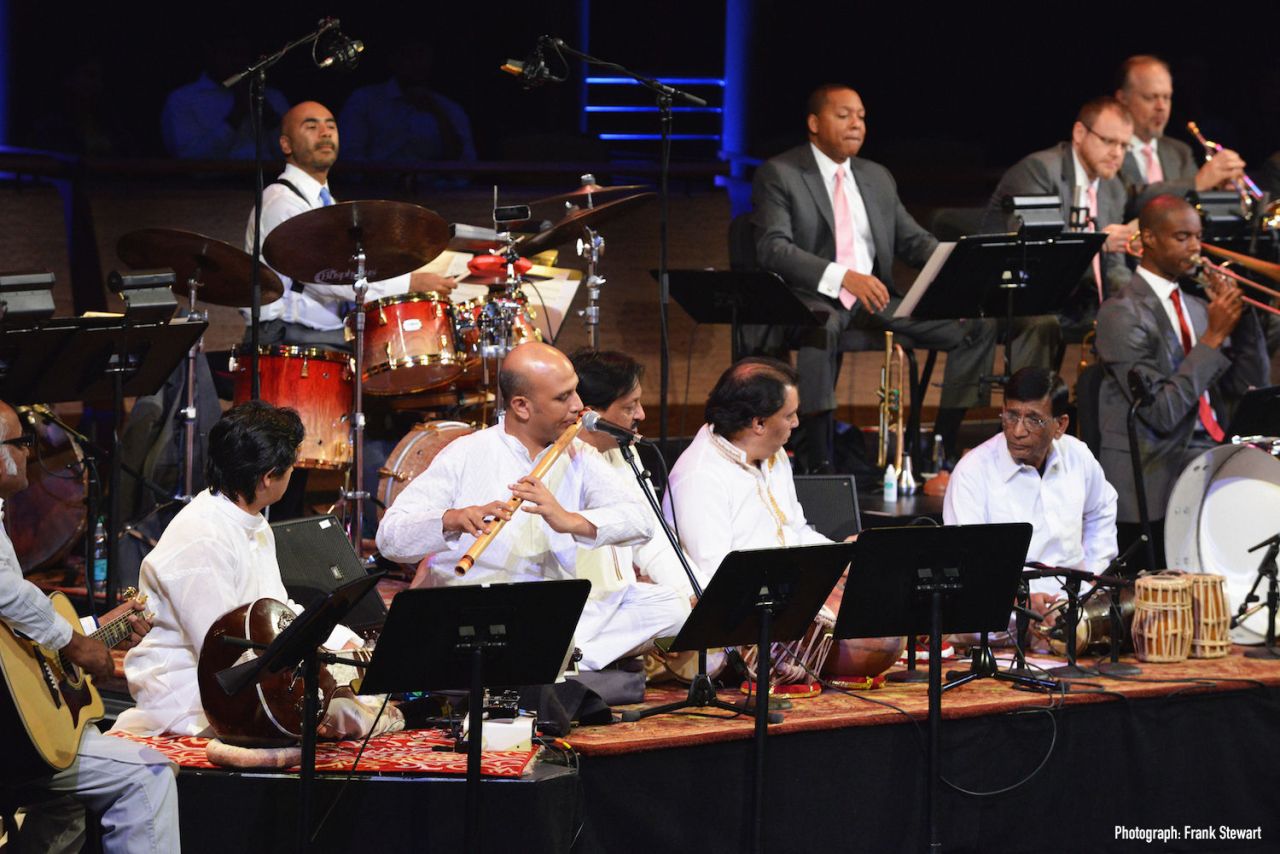
Next came an invitation from Wynton Marsalis to perform with his band for a special concert in the Lincoln Center program “Jazz at Lincoln.” In one scene we’re in the grimy lanes of Lahore and in the next six brown guys are strolling through Times Square, jamming with the Naked Cowboy.

Conductor Nijat Ali, who loses his father and mentor during the course of the film, has to struggle to bring off this unusual merger of East and West, but as Marsalis says, musicians will always come together. What started as a lament becomes an uplifting story of how art overcomes difference and conflict in a vivid documentary that recalls Wim Wenders’ Buena Vista Social Club. The closing credits roll over images of the musicians finally getting to give a concert before a huge audience in Lahore.

Photo credit: Frank Stewart


Gallery

Hogging it: Rosenblatt and Callaghan

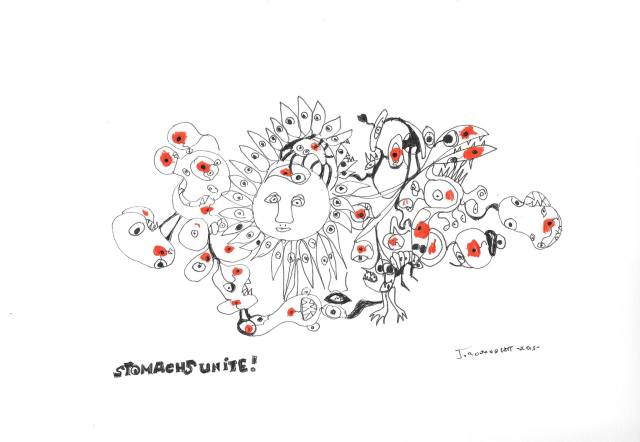
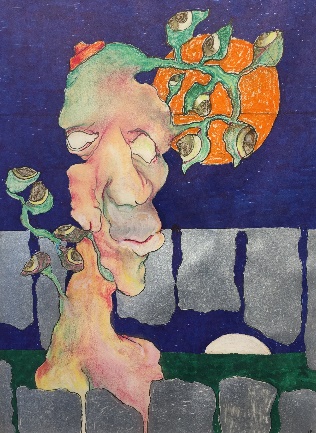
Stomachs UniteDrawing #11Chow DownDrawing #18

It’s anything but hogwash: an intellectual and artistic engagement between two CanLit titans entitled Hoggwash, because Joe Rosenblatt’s letters are addressed to James Hogg, Barry Callaghan’s alter ego and poetic protagonist. The release of the book, published by Exile Editions and subtitled The Callaghan and Rosenblatt Epistolary Convergence, is accompanied by an exhibition of Callaghan’s and Rosenblatt’s drawings and paintings on at the GN Studio in Oakville until May 11.

The works displayed on two walls at GN Studio are all new. (Those pieces reproduced in the book are no longer in the artists’ possession.)These pictures seem to converse across the room. Callaghan’s surrealistic, Dali-esque beings, all feet and lips and teeth, address Rosenblatt’s birds, cats, fish, dogs and other half-human creatures with much on their minds, and not all of it philosophic.

Hoggwash began with a proposal from Rosenblatt.  “Ten years ago I suggested to Barry that I would like to write to the leading protagonist in his epic poem, James Hogg and ask him a series of philosophical questions, pointed questions, as to the birth, or reincarnation of Hogg who emerges on an ice floe in Toronto Harbour and is set upon by thugs and crucified. Barry as Hogg would answer my questions, referring to our mutual friend Barry Callaghan.”

The epistles would also serve as a forum for the two authors’ thoughts on religion, philosophy, poetry and literature in general. The result (full disclosure; I acted as copy editor) is a unique Canadian literary document and a lively entertainment.

Callaghan sets the pace for Hoggwash in an opening Q&A with Rosenblatt, quoting liberally from Rosenblatt’s poetry. “You seem to me to be a blue angel, always in a delirium of poems and in this delirium you are, over and over again, born like death, with burning branches growing . . . .”

Rosenblatt describes himself as a “disillusioned romantic” and admits to a strange kind of voyeurism, the study of bees and their pollinating ways. Hogg is captured in a poem as a man living through “an endless winter of endless / nights, . . . sitting / squat hour after hour by a seal hole in the ice, / waiting for the snout of the seal . . . .” Hogg is in some ways the straight man to Rosenblatt’s remarks on Hogg’s musings about Martin Heidegger, God, the Virgin Mary and his Toronto subway Stations of the Cross. As for Callaghan, Hogg remarks, he “can be a bit of a gadabout and a rounder.”

This is not the first time either poet has emerged as a visual artist to be reckoned with. Writing about Callaghan’s Hogg works for an Ottawa exhibition, artist Vera Frenkel identified him as “a naturally skilled draughtsman.” Drawing and painting were something he did from an early age, prompting a poet visiting the Morley Callaghan household to ask what his son was to be, “poet or painter?”  But like Rosenblatt, Callaghan needs a theme and Hogg (the actual James Hogg immigrated to Upper Canada in 1824 from Glasgow) has provided him with lots of inspiration.

Among the Callaghan watercolours on display at GN, a large picture of limbs and lips locking, called “Hogg Remembers the All of their Love,” is a tender depiction of two lovers. Other paintings are more in-your-face, even sinister, such as “Hogg in Purgatory” or “Hogg Pursued by Devils in Hell.” These Hogg paintings are expressive in their jumble of body extremities and Janus-like visages of the earthly/heavenly polarities in Hogg’s thinking.

Drawing and painting is more of a constant pursuit for Rosenblatt, who has a solo show concurrently running at Yumart Gallery in Toronto. Making his artist’s statement, the poet says, “In my drawings personalities grow exactly like limbs . . . . Those creatures in my landscape carry my genetic material. . . . The drawing paper demands its form. It wants to be fed and craves for limbs. And perhaps a spiritual envelope called the soul.” At GN you can see in Rosenblatt’s black-and-white drawings accentuated with bright splotches of paint that the hand that draws the lines is the same one whence Rosenblatt’s thoughts proceed on paper. “Stomachs Unite” is a good illustration of the Stoma principle under discussion in Hoggwash. Other works, such as “Chow Down” and “Eat or Be Eaten” could be visual equivalents of his ripostes to Hogg.

There’s plenty of food for thought in Hoggwash, both the book and the art works; readers and viewers might well demand a sequel.

“Hoggwash: The Exhibition,” April 16 to May  11, gnstudio / contemporary art, 123 Lakeshore Road West, Oakville, ON

“Angels, Demons and Spirits,” works by Joe Rosenblatt, May 7 to 28 at Yumart Gallery,  401 Richmond St. West, Suite B20, Toronto, ON

Hoggwash: The Callaghan and Rosenblatt Epistolary Convergence, Exile Editions, 118 pages, $17.95 pbk.

Art work courtesy of the artists, from top: “Stomachs Unite”; “Compared to What,” Drawing #11; “Chow Down”; “Compared to What” Drawing #18


Zingers drive The Summoned

The Summoned

By Fabrizio Filippo

Tarragon Theatre, Toronto

April 27 to May 29, 2016

The dialogue in The Summoned – and this play is nothing but dialogue – moves at the speed of electrons; appropriate considering the subject is digital technology. Fabrizio Filippo, the forever-young actor and playwright, wrote the heady 90-minute play and stars as Aldous, the son of Annie Mann (Maggie Huculak) who partly presides over this whirlwind production.

A collection of eccentric characters has been summoned for the reading of the last will and testament of Khan (“not Mr. Khan; Khan, like Cher”) a billionaire technology proprietor. Think Steve Jobs, Steve Bezos or any tech giant. It’s the striving of all the egos in this Silicon Valley simulacrum that propels The Summoned and makes the piece, ably directed by Richard Rose, a wearying watch.

“How far from our nature will technology take us?” is the leading question in this comedic sci-fi entertainment that spins on the theme, will humans overcome mortality? Emblazoned on the blue screen before the show begins is the statement, If It Can Be Done It Will Be Done.

Filippo, in hoody, jeans and sneakers, sets the pace with a machine-gun delivery to introduce the scene: a budget hotel near the Toronto airport where participants await the announcement from the grave (or cyberspace) of Khan’s legacy. High security is required. Tony Nappo is a goofy security type called Quentin who carries a large shoulder bag from which he pulls out numerous flip-phones, crushing them to bits as he grows frustrated with the proceedings. He sprays the room with odoriferous air freshener, later revealed to be nanno-robots with some ill intent. Annie Mann comes on, mike in hand, as if giving a TED talk; she is owner of the hotel, a possible Khan liaison, which makes Aldous his possible son.

John Bourgeois plays an explosive Gary Alameda, president of Khan’s tech empire. Kelli Fox is Laura Kessler, a sassy, sexy lawyer who has been handmaid to Khan’s ambitions and has a tendency to break into uncontrollable giggles. Rachel Cairns is Isla, a sparky airline stewardess who had some pivotal mid-air encounter with Khan.

Security is the big concern here, because apparently Khan (voiced by Alon Nashman, listed in the program as Walkie Talkie) built his empire on the creation of cyber security, with mechanisms such as “Log Secure System Refresh”. Sounds vaguely like a toilet bowl cleaner, says one wag.

Pronouncements are the order of the day, spoken rapid-fire and aimed to kill, as the characters spar over the big stakes, a fortune worth billions. Khan authored a quote that went down as real Shakespeare quote: “It is not in the stars, our destiny, but in ourselves.”  Annie laments, “nature lost its grip on us.” And there are lots of zingers, along the lines of “the Internet is the best thing that ever happened to the exclamation mark.”

Kurt Firla’s video design and Jason Hand’s lighting and set design place the whole event in a wacky world of infinite possibility, i.e. cyberspace. Much of the dialogue is cleverly synched to text-style utterances running across the blue screen.

Not very much of lasting import is under scrutiny in The Summoned, but Filippo’s show makes a showcase for some terrific performers, including the playwright himself.

Top: Rachel Cairns and Fabrizio Filippo. Photo by Cylla von Tiedemann