


Among the several reasons to visit Fort Walsh National Historic Site in southwest Saskatchewan, is the route that takes you there. Heading west out of Eastend, you’ll drive through the Cypress Hills, location of some of the most spectacular and unpredictable landscape to be found in Canada: white clay mounds rising out of hills riven with lush, treed coulees; wide open prairie where ferruginous hawks can swoop over the grasslands; and a winding upland highway that opens onto an alpine meadow.
Just beyond the meadow lies Fort Walsh, designated a national historic site because of the massacre of more than 20 Nakoda men, women and children on June 1, 1873. Behind the Assiniboine peoples’ deaths lies a complicated history. The Nakoda were the collateral damage in a fight for resources among various colonial and American parties over the land they lived on.
The wolf hunters, whiskey and fur traders who committed the massacre were mostly American, but there also Métis and Upper Canadian fur traders attracted to the territory by the dwindling herds of buffalo.
The massacre, news of which soon reached Ottawa, spurred the deployment of the Northwest Mounted Police, precursors of the Royal Canadian Mounted Police. Created by an act of Parliament in 1873, the force was already established at Fort Garry. But news of the massacre prompted a long march of Northwest Mounted Police, 300-strong, aimed at bringing law and order to the western territories and securing Canada’s sovereignty over the land in the face of American incursions from south of the border.
In their scarlet tunics and navy-blue trousers, the men set out from Dufferin, Manitoba on July 8, 1874 to make the 1,300-km march across the prairies on horseback, towing supplies in red river carts. The force split at La Roche Percée in what is now southwest Saskatchewan, one group going northwest to establish Fort Edmonton and the other heading for the territory where the American whiskey traders were still making trouble for the local indigenous people. And so it was that James Morrow Walsh, a NWMP superintendent, established a military base at Fort Walsh in 1875. Soon Canadian control of the territory was fixed, the whiskey traders routed and relations with the indigenous locals established.
The present fort is a reconstruction of the original, furnished and appointed as it was in the heyday of the NWMP as the force protected the territory for the English and French traders and settlers, including a substantial community of Métis, who became adept traders with the local first nations inhabitants. For better or worse, the presence of the NWMP also ensured the signing of treaties with the indigenous peoples.
Today, uniformed guides at Fort Walsh take visitors on an informative tour of officers’ quarters, stables and smithy, giving a clear picture of life in the fort nearly 150 years ago. Bernard (Cheng Hao), an excellent guide in full uniform, points out details in the reconstructed interiors of various buildings, including the commanding officer’s living quarters, non-commissioned officer’s quarters and a piece of artillery whose function he can demonstrate.
Outside the palisades, stroll down to two cabins, where guide Stephen Girard, dressed as a Métis trader, outlines the relationship between the local Métis, the NWMP, the settler population and the Indigenous communities. Hudson’s Bay blankets, dry goods, beaver and other pelts stock the shelves and counters. Girard explains how many bison hides (five or more) might be traded for one HBC blanket, marked with lines that show the height of pelts required in trade.
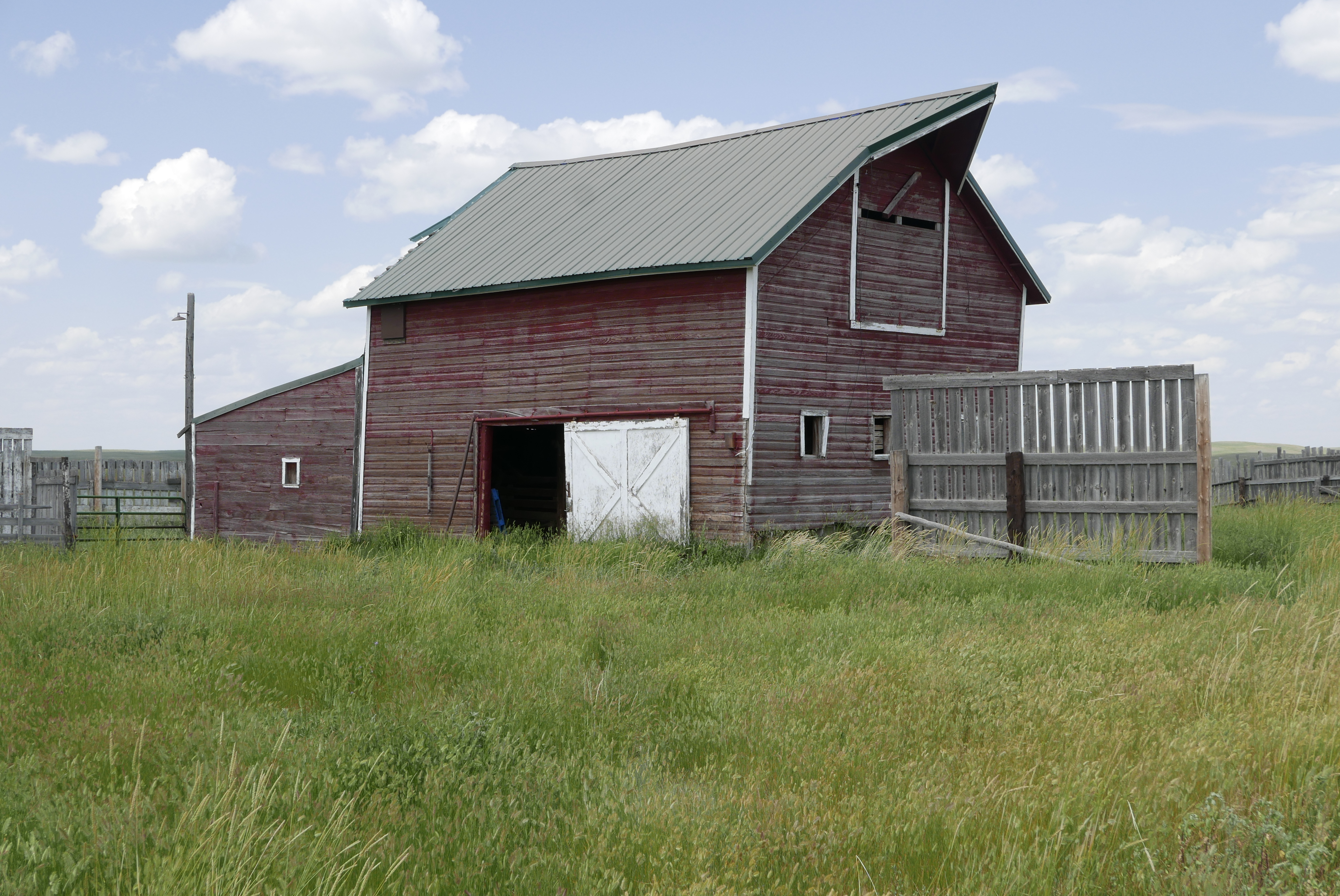
In search of living bison, a visitor might drive toward the border with Montana to a former ranch on the Old Man on His Back plateau, now designated a Prairie and Heritage Conservation Area. If you haven’t booked a tour, you can wander over the hills and plateau and if lucky, might see a bison or two grazing with cattle. It’s pretty exciting.
Photos, clockwise: Stephen Girard as a Métis trader, Old Man on his Back nature conservancy, Bernard in the Fort Walsh NCO quarters, cattle grazing in the Cypress Hills.
 susan walker's artsblog