Susan Musgrave’s Haida Gwaii

A Taste of Haida Gwaii

Food Gathering and Feasting

at the Edge of the World

By Susan Musgrave

Whitecap

ISBN 978-1-77050-216-1

340 pages, $34.95 softcover


There are cookbooks to use, cookbooks to peruse, or cookbooks to dip into, but rare is the cookbook you would read from front to back. A Taste of Haida Gwaii is that volume.

A lifetime of wry observation, poetry, memories and images has gone into Susan Musgrave’s first cookbook, set mostly on the northern Graham Island of Haida Gawaii, in Masset, where Musgrave lives and operates the Copper Beech Guest House.

A leisurely, literary text combines travelogue, history, personal anecdotes, Haida culture, unique menus and all manner of flora and fauna in a cleverly designed book containing 90 recipes and numerous illustrations including glorious photographs and cartoonish drawings by Dejahlee Busch.

“I can’t say I was cut out to be an innkeeper. I feel uncomfortable most of the time, charging anyone for a place to lay their head,” writes Musgrave, an inventive chef and brilliant hostess. Her statement is buttressed with a quote from Hebrews 13.2 about “entertaining strangers.”

A reminiscence of Matt Cohen introduces kelp, its uses and the preparation of seaweed. “He had never seen kelp before (Matt hailed from Ontario) and was fascinated by something I had always taken for granted . . . Kelp and seaweed had always floated through the lines of my poetry—so much so that one English academic described me as having emerged from “the kelp school of poetry.”

Musgrave’s father features in a reminiscence about fishing. “Dad used to climb into the dinghy and row up Sansum Narrows between Salt Spring Island, where my great-grandfather had settled at Musgrave Landing . . . catch a couple of grilse for breakfast and fry them to a shade just past well done, filling the cabin with an oily fishy smoke, which made it hard for me to choke down my Coco Puffs. (For a definition of grilse see one of Musgrave’s entertaining footnotes.)

A section on Haida Gawaii berries makes reference to During My Time: Florence Edenshaw Davidson, A Haida Woman in which Davidson recollects how her mother picked berries and kept them fresh in a bentwood box. Musgrave follows up with instructions for making salmonberry jelly.

“Coitus Interruptus” is the heading over a section on Dungeness crabs, best gathered, says Musgrave on North Beach, in the summer months, at a “minus tide,” although a low tide will do.  The title refers to the technique used to net the crabs. “You nudge them in flagrante delicto out of the sand and scoop them up in your net. The male will cling to the smaller, luckier female, so now you have to separate them and toss the male into your tote, where he will soon be joined by other angry male whoppers who are just as unhappy at having been parted, involuntarily, from their squeeze of the day.”

Reading stories such as “Never Overcook an Octopus,” asides on unlikely topics (edible gold leaf), a compendium of edible wild mushrooms of Haida Gawaii and recipes such as “Thimbleberry Elderflower Liqueur Coulis,” one begins to suspect that Musgrave is drawing us to her island home through the ancient lure of good food and good company.

Above: Crabbing on Haida Gawaii. Photos by Michelle Furbacher, Lynda Osborne and Peter Sloan

 

the tea experience


The Tea Farm, Cowichan

Tea Farm, 8350 Richards Trail, Duncan, BC V9L 6B4


One of my favourite road trips on Vancouver Island is to the Cowichan Valley, home of the slow food movement. Cowichan Bay, an official cittaslow, is a place to visit for cheeses from a local farm, bread baked from grains milled on site, freshly caught fish and seafood. Farther north, off the Island highway, is the Tea Farm. Go for the views of the valley, the company of owners Victor Vesely and Margit Nellemann, the ceramic art of Margit and others, and the tea experience. Stay for the tea service and shop to your heart’s delight.

“We are curators of organic loose tea, designers of artful tea blends, and growers of Camellia sinensis,” they say. “Artful” is the operative word. I’ve become a fan of their matcha tea, the health-giving brew made of the fine powder made from tea leaves. Tea Farm also serves baked goods, some laced with matcha from their own plants.

Belfry goes a-Caroling

Scrooge 3 captioned

Kyle Atlas Stahl, Tom McBeath in A Christmas Carol. Photo by Don Craig

A Christmas Carol
By Charles Dickens
Adapted by Michael Shamata
Belfry Theatre, Victoria
Dec. 1 – 20, 2015

Michael Shamata’s A Christmas Carol is 25 years old now, getting on to be as enduring a classic as the Charles Dickens novella that inspired it. Toronto audiences first saw it on a wide proscenium stage, but Shamata has ingeniously adapted the show to the much smaller thrust stage of the Belfry Theatre in Victoria, still accommodating a cast of 14.
Christmas brings out the worst and the best in all of us, as Dickens so clearly saw when he wrote A Christmas Carol in 1843. Bringing the melodrama to the stage, Shamata has given new life to Dickens’ “Ghostly little book,” shaping dialogue and scenes for economy and speed.
And in this season of mass shootings, suffering migrants, homelessness and youth unemployment, the social ills of Dickens’s 19th-century London seem not far removed from ours in the 21st.
We watch this Christmas Carol the way we read it on the page; both writer and director, Shamata has conceived the show to engage our imaginations. Gerry Mackay frames the story for us as the narrator who asks us to follow the ghost light into another time/space. “Jacob Marley was dead . . . dead as a coffin nail.”
No separation can exist in live theatre between the dream characters of the past, present and future and the physically present Ebenezer Scrooge, played with aplomb by Tom McBeath. Scenes are conceived as if the whole theatre were our cranium. Blocking, choreography and some very deft stage directions manage the illusion. The first ghost arises out of a trapdoor in the stage in a column of misty light so he looks like a hologram. Scrooge stands high above London with the ghost of Christmas present observing the streets below: three performers encased in black puppeteers garb move around with painted streetscapes held aloft to give the impression of the city in the 1840s.
Nancy Bryant’s authentic costuming plays against John Ferguson’s minimalist set – a solid tall entranceway with a clock on top – to put all our focus on the characters and the action. Alan Brodie’s lighting design transforms the set from a snowy sidewalk to the cozy confines of the Crachit home on Christmas.
The superb Victoria cast keeps it moving from laughter to tears and a few opening-night improvs. Seven-year-old redhead Kyle Atlas Stahl is a memorable Tiny Tim; Anton Lipovetsky a pale-faced Bob Cratchit; Gerry MacKay as Marley and others is highly versatile; Brian Linds brings Mr. Fezziwig and several other characters to life as does Jan Wood as Mrs. Fezziwig; Amanda Lisman is just the kind of Belle that Scrooge could never forget; and white-faced spirits John Han and Jessica Hickman control the spooky atmosphere.
The universal appeal of A Christmas Carol is enhanced in this production. A theatre-goer could go multiple times and never see the same show twice: that is the charm of live performance.

Aside

Ronnie rocks Victoria

21668678181_caa050182c_n

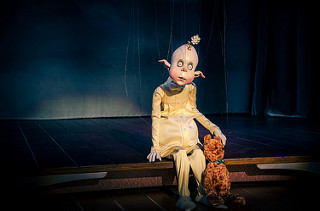
Schnitzel, the fairy child, stepping over the line

The Daisy Theatre

Ronnie Burkett Theatre of Marionettes

The Metro Theatre, Victoria, BC

November 19 to 22, 2015

It had been almost two decades since Ronnie Burkett last took the stage in Victoria. But the city must have left a big impression on him, or else he’s a quick study, because the puppet master of puppet masters sure knew how to touch a nerve or more likely prick a funny bone at the Saturday performance of his madcap improv show, The Daisy Theatre.

“Look,” he said to one of his high-strung, loosely jointed marionettes. “It’s our dream demographic: menopausal women and gay men!”

“No script,” promised Burkett in a cheeky intro expressing surprise at the lively Saturday night audience. No safety net, no doom and gloom, no social message, just a rollicking, raunchy, seat-of-the-pants-falling-below-the-asscrack show from the irreverent and multi-talented Burkett, who has been doing this sort of thing since the 70s. He is puppeteer, puppet maker, performer, writer and who knows what else. The Alberta-born artist did his first show in clubs, wearing a “bag stage.” The entire Daisy Theatre set looks as if it might fit comfortably in a large minivan and it has been on the road since the June 2013 premiere at Luminato.

Daisy Theatre provides Burkett with the opportunity to come out from behind and interact with the audience as well as his marionettes. Not that he was ever a keen observer of the fourth wall.

Slagging the city and the theatregoers of the Garden City, Burkett even took aim at his venue, calling the show “16 inches of fun in a dark church basement.” Never mind. It proved exactly the right intimate setting for Burkett’s in-your-face improv act. There were moments reminiscent of Robin Williams’ verbal and physical hypomania, but it was vintage Burkett.

A fairly serious conversation sets the context for the show. Burkett’s toddler-like little striver Schnitzel gets into an existential dialogue with his/her master, then makes the desperate climb up the curtains to get a good look at the man the audience can see pulling the strings and voicing his puppet’s lines. Schnitzel is the inner actor in all of us, scared to death of being exposed, and yet wanting to cross the line (in front of the stage) where there’s no protection from masks and make-believe.

On the heels of a really tough act to follow, the marionette stripper Dolly Wiggler, Burkett twice gave the audience a chance to pick from three characters he had waiting in the wings. The first choice (by applause) was a bosomy ageing chanteuse with a real Victoria vibe, who resembled a demented Dame Edna and was accompanied on piano by a puppet manipulated in Burkett’s other hand. She sings an obscenely funny “Hey-nonny” tune with lyrics that wouldn’t get past the Internet censors. The second choice brought a meandering, shaggy-dog segment, in which the sweaty-thighed, pie-making widow, Edna Rural of Turnip Corners, Alberta reveals the secret of her “dill-dough.” (Too bad we never got to see Miss Lillian Lunkhead, “Canada’s oldest and worst actress.”)

You get the gist. And before the two solid hours of manic music, monologue and dance has ended we were entertained as well by Tony, the drunken, sleazy lounge singer and Jesus Christ, the Jewish Messiah who comes on like a Borscht Belt stand-up comic. There were also the sleeping or dead ventriloquist and his dummy Woody, who carries on while his manipulator slumps in the chair.

It’s debatable what constituted the highlight. Perhaps Edna or the fairy child Schnitzel or brave audience member Mark, dragged from his seat and induced to operate the pianist marionette, then remove his shirt (to more applause).

Schnitzel makes the final appearance of the show, which might have been only an hour, Burkett said, if we were too unresponsive. But on it went to the sweaty max, two hours of laughs, a few gasps, a lot of admiring sighs and a few call-outs to come back soon.

Uno Fest – It’s a wrap

Magic Unicorn Island

Jayson McDonald

Metro Studio, Victoria

May 22, 2015

The Incompleat Folksinger

Written by Pete Seeger

Adapted by Ross Desprez and Mark Hellman

Performed by Mark Hellman

Metro Studio

May 23, 2015

Nothing says boomer nostalgia like the word hootenanny. Add the Pete Seeger song list, a full-throated performer such as Mark Hellman and you’ve got yourself a 60-year reunion of old lefties, unionists and what’s left of the 60s protest movement. This show, the finale to a well curated line-up of solo artists, closed Uno Fest on Sunday with a rousing singalong.

Seeger, who died last year at 94, has hardly been forgotten, but this show, with Hellman impersonating the lifelong activist as well as narrating his story, reminded us of what an influential artist the New York singer was. Son of a musicologist, he used to go along with his father on folk tune-gathering expeditions to the deep South. In his late teens, a Harvard dropout, Seeger heard his calling in singing for political causes. In 1945, he was a founder, with Woodie Guthrie and others, of the People’s Songs organization; from that moment on there wasn’t a protest that could get very far without Pete Seeger.

Hellman is less assured as a narrator than a singer. But he certainly underscored the Seeger dictum, “a good song can only do good.” From Seeger’s days in union halls with Woodie Guthrie (“Solidarity Forever”/ “I’m sticking to the Union”) to his civil rights activism and support for Paul Robeson (“We Shall Overcome”) to  participation in Vietnam War protests (“Where Have all the Flowers Gone”) and prosecution by the House Unamerican Activities Committee (he beat the rap), The Incompleat Folksinger is a piece of musical/political history that entertains as much as it edifies.

The same might be said for Magic Unicorn Island, created and performed by Jayson McDonald of London, Ontario.

The show had a strange opening, a post-apocalyptic scene of a caveman type cooking over a fire made of discarded furniture: all in mime. That didn’t bode well, but once McDonald launched into his script, playing multiple roles in an uproarious dystopic scenario set in the aftermath of planetary collapse, the fun began. A Bush-like persona with an imperious mien is president of the United Empire, the one big global state. Another glib character is a TV presenter, delivering the news as if it were a game show (Big news is an appearance by “ageing pop star Rihanna.”). A legislator delivers one of the latest dicta: “You have the constitutional right to bear arms, also you will be shot on sight. Endless war is discussed. And then the kicker: in pursuit of the one world state, the government of the United Empire declares war on its own children. They’ve abandoned the parents, left them to greed and conflict and established their own country on Magic Unicorn Island. A summit between the 14-year-old head of MUI and the Scotch-sipping prez of United Empire fails to avert the crisis. You can guess the outcome.

A clever mix of Swiftian satire, comedy, speculative fiction and shock tactics – in one tireless performer — Magic Unicorn Island summed up what Uno Fest does best: makes us laugh and makes us uncomfortable, in about equal parts.


Angela Hewitt: More joy in Christ Church Cathedral

Angela Hewitt solo piano recital

Christ Church Cathedral, Victoria BC

16 May 2015


Canadian pianist Angela Hewitt has made a study, it appears, of the generosity of virtuoso performers, among them Franz Liszt and Domenico Scarlatti. Virtuosity is not a measure of technical proficiency; it is about giving with all that is in you, losing yourself to the music, responding to the notes on the page as if you were singing them.

And sing them Hewitt did, at a master class on the day before her performance at Christ Church Cathedral, giving listeners a clue to her own virtuosity. In her notes to a gifted student who performed a toccata Hewitt hadn’t played for many years, she gave hints at how she became such an outstanding performer. She sang; she conducted; she described a passage as “the language of sighs.” And she pointed out the bars in the score, where “you bring in all these voices (notes) and take down the other voices.”

Small wonder then that when Hewitt played in the cathedral last Saturday, the passion with which she interpreted the music of Bach, Beethoven, Scarlatti and Liszt was palpable. The big black Fazioli grand piano dominated the church platform, but the real living, breathing instrument in the room was Hewitt.

Raised in a musical family, the Ottawa-born pianist has been playing since the age of 3. She gained national prominence in 1985 when, at 27, she won the Toronto International Bach Piano Competition. Ever since, she has been branded as a premier interpreter of Johann Sebastian Bach, but the truth is that Hewitt is a wide-ranging musician whose discography of more than 40 recordings includes composers from Schubert to Scarlatti to Beethoven, Chopin, Mozart and Messiaen.

The evening’s five segments all made some reference to Italy, where Hewitt lives part-time and runs the Trasimeno Music Festival. She led off the recital – her first solo performance in Victoria — with a performance of Bach’s Italian Concerto in F major, the performance of which won her the Toronto prize 30 years ago. Such crispness and forceful fingering in the opening movement brought to mind another word often associated with this musician: joy.

Hewitt introduced Beethoven’s “Les Adieux” Sonata with a story about how it was inspired by a sad farewell he had to his friend and supporter Archduke Rudolph in 1809 when the French bombarded Vienna. Hence the lament at the opening of the sonata, which Hewitt played with her whole person, as if she might have been a dancer, her fingers making footwork on the keyboard. Her ability to shift moods from light to dark, soft footfalls to ominous thunder suggestive of cannon fire is what gives her performances so much drama.

Following a few Bach arrangements (from a 2001 CD), Hewitt played Scarlatti keyboard sonatas, recorded for a forthcoming CD and chosen from the 555 short harpsichord pieces Scarlatti composed. She played four, including the K.87 in B minor, a contrapuntal piece played by many famous musicians.  With her strong round arms flying, Hewitt makes 18th-century music such as Scarlatti’s alive and breathing in the 21st century.

Franz Liszt’s incredible evocative Années de pèlerinage (Years of Pilgrimage) and his “Dante Sonata” with its powerful soundscape of hell brought the recital to a close. Returning for an encore, Hewitt switched gears with an achingly haunting yet transcendent playing of Debussy’s Clair de Lune. And then, with her one arm flying up off the treble end of the keyboard, and the other down off the bass end, the music seemed to release her.

A footnote: in the audience for the recital was a couple married in 1973 in Christ Church Cathedral in Ottawa, where Godfrey Hewitt was organist. Angela Hewitt, then 15, played at their wedding and clearly bestowed her joy on them, for they remain happily married 42 years later.

Three cheers for Uno Fest

Uno Fest

Metro Studio +

Intrepid Theatre Club

May 8-24, 2015

Only an issue as urgent as the extinction of marine life through ocean acidification – the subject of Alanna Mitchell’s 2009 book Sea Sick – could have compelled a newspaper journalist to take to the stage. As she said herself, on the last night of Sea Sick (May 14) at Victoria’s Uno Fest, “this is breaking all the rules.” Journalists are the messengers, not the message, but this was an important story that Mitchell lectured on with her book’s publication. Toronto artistic director Franco Boni saw the potential for a one-woman show and with Ravi Jain helped the writer create a script to ignite audiences across Canada.

Mitchell’s storytelling skills and self-deprecating humour easily adapt to the theatre. Casually, she relates her own story: growing up on Prairies, nurtured by her artist mother and zoologist father. Hence a natural curiosity, drive to investigate and gift for painting narratives in words.

Three years ago, Mitchell, a mother of two, set out to document the accelerating crisis in the world’s oceans: 99 percent of the planet’s living space. Her findings are alarming, to say the least. Way, way down under the sea in a submersible, she got a first-hand glimpse of extinction underway. Literally drawing her conclusions on a chalkboard, Mitchell spells out the doomsday scenario: with warming comes acidification, killing essential marine life. Without plankton, no oxygen; with no life in the oceans, no life on land. Despite the chilling stats she rhymes off, this journalist-turned-actor brings a message of hope that humanity is finding ways to save the planet.

Sea Sick is the sort of innovative, edgy performance that Victoria’s 18-year-old Uno Fest of solo performances showcases. Each May, the three-week festival presents an engaging line-up of shows from Canada, and occasionally abroad, to unsettle and entertain us, including works in development with Intrepid Theatre Club. The final four days of Uno Fest features seven different one- to two-hour shows and the short, short (15 minutes) UnoWorks-in-progress. Not to be missed: Mark Hellman’s adaptation of Pete Seeger’s The Incompleat Folksinger; Zoë Erwin Longstaff’s Half Girl/Half Face; The Rendez-vous, a cabaret show from Krin Haglund; Jayson McDonald’s Magic Unicorn Island; Slick, by Karen Lee Pickett; and Shirley Gnome’s sultry musical, Real Mature.

Adapting Much Ado About Nothing

Much Ado About Nothing

Tarragon Theatre

Until May 17, 2015

Desi Shakespeare never had it so good. Under the direction of Richard Rose, the Brampton Much Ado, complete with Bhangra, Bharatanatyam and Bollywood references, Hindi surtitles and a fine cast of South Asian actors, wrings the classic comedy for every conceivable form of humour.

Some may object to the sometimes over-the-top farcical, even slapstick moments. But just try to stifle a laugh at Alon Nashman’s Benedict as a ruthless, self-possessed CFO, grey suit covering a vulnerable heart, in a comic turn that transforms him into passionate suitor for the hand of Beatrice.

Rose and consulting director Ravi Jain’s adaptation of the comedy is straightforward. Messina is Brampton; in place of a war between Italian city states, we have the hedge fund wars. In place of Don Pedro, prince of Arragon, we have Lord Tata, billionaire businessman and his duplicitous, vengeful half-brother Jovanni Tata. Presiding over the entire affair, as in Leonato, governor of Messina, is, Ranjit, Mayor of Brampton. He’s the Shakespearean fixer, the one who drives the plot, decides who marries whom and acts the benevolent godfather to niece Thara (Shakespeare’s Beatrice). Darius aka Claudio, a young lord of Florence, is Benedict’s protégé. Darius is smitten by Ranjit’s daughter Sita (Hero in Shakespeare), but he’s too shy to approach her. His friend Lord Tata offers to do the honours and impersonates Darius at a costume ball, winning Sita for his friend.

The seduction is successful and the wedding is on, but there’s always a wrinkle. Tata’s jealous half-brother Jovani must sow discord and destroy the peace of Brampton. He does it through a ruse to make Sita look unfaithful. In this he is assisted by Dalal, hiding in Ranjit’s garden in the disguise of a stone warrior statue, making for an amusing bit of stage business.

Music and dance are what knit together the cultural elements of the play, advancing the plot and anchoring the desi adaptations, without which it would be hard to tell the players without a scorecard. Nova Bhattacharya choreographs an opening Bharatanatyam dance class, at which we perceive that Thara, while sharp of tongue, is lacking in graces.  Battacharya can act too: as Menaka, the lady’s maid, she joins in the scheme to discredit Sita. The Michael Jackson “Thriller” sequence elevates the comedy to pure satire, but the comic highpoint is definitely Nashman creeping around behind artificial bushes and even on to the laps of audience members as he tries to eavesdrop on Lord Tata and friends setting a trap to make him think Thara is infatuated with him.

Much more style than substance, this Much Ado might have failed were it not for some classically trained actors such as Ellora Patnaik, as Auntie, wiser sister of Ranjit, Anusree Roy as Thara and David Adams as Mayor Ranjit. Ed Hanley’s sound design supports many jovial moments and Michelle Tracey’s costumes cleverly express the Shakespearean themes of class conflict, false love based on the acquisition of wealth and power and true love that restores harmony.

In the end all discord is removed, all money stays in the right hands and families remain intact. You might say that in this Brampton Much Ado, all’s well that ends well.

Above: Ali Momen, Kawa Ada, Alon Nashman and David Adams in the Brampton Much Ado About Nothing

Photo by Cylla von Tiedemann

Sashar Zarif soars in dance

Moving Memories

Sashar Zarif Dance Theatre

Small World Music Centre

180 Shaw St. Studio 101

May 8 & 9, 8 p.m.


As complex and in a way alien to western dance as Sashar Zarif’s work is, there is no excuse for going away baffled from his show Moving Memories. The title refers to Zarif’s journey of rediscovery:  the roots of his dance in his grandmother’s practice and in the songs and folk dances of his home country of Azerbaijan. Elchin Musaoglu’s film, screening behind the performance space, documents the dancer’s trips back to Baku since 2004. Zarif discovered the reason for his quest in family memories he unearthed, both emotionally moving and literally causing him to move, to dance, to tell his story. There’s a touching moment when he is lying on a carpet his grandmother took with her everywhere: “What made me look for a home? It was her need to belong.”

Zarif has a home now, and it is in Toronto, Canada. Moving Memories is a culmination of all that he has learned in his research of his heritage, his dance aesthetic and himself. Rather brilliantly produced on a small budget, Moving Memories is a journey in dance. From his opening monologue to a closing, improvised dervish-y spin with drum and singing, Zarif takes us on a life dance, showing us the relationship between his culture, the need to be in the song (the Azerbaijani mugham) and for the song to be in him. Louis Laberge-Côté, in long flared white skirt, brings a contemporary interpretation to the Sama – the whirling dance done by shamans and Sufis. Mezmerizingly, he spins and dips, carving out the space with his arms, inhabiting the music with grace and power. At the centre of the show is Zarif’s solo, set to the poetry of Rumi: “The wound is the place where the light entres you.” The choreographer seems possessed as he utters deep growling, animal noises indicative of the essential self he has reached in for. It is a transformative dance showing the way to enlightenment. The whole thing is akin to an act of love.

As collaborator and dramaturge Elizabeth Langley informs us, when Zarif performs, he is so in the moment that there is no difference between living it and dancing it. Introducing him for the finale, she says, “Sashar will now experience the last work.” So he does and so do we.

A George F Walker double bill

Parents Night/The Bigger Issue

A Crazy Lady production

Theatre Passe Muraille, Toronto

Until May 17, 2015

George F. Walker says he’s only channelling the voices he hears when he wades into a contentious issue to witness injustice, dysfunction and people under the pressure cooker, trying to do good work in impossible situations — a general description of what’s going down in our schools. Walker’s wife is a teacher; they’ve had three children in the public system; how could he not be attuned to the voices of protest, burn-out, financial strain and frustration coming from both parents and teachers?

                As for Walker’s contention that “I’m just transcribing what they say,” we beg to differ. A lot of craft has gone into making those voices count and turning 65 minutes of hard-hitting tragicomedy into a cathartic event.

                Parents Night, first mounted last year in Hamilton, and The Bigger Issue, a world premiere, are the first two playlets in a theatre cycle focusing on education.

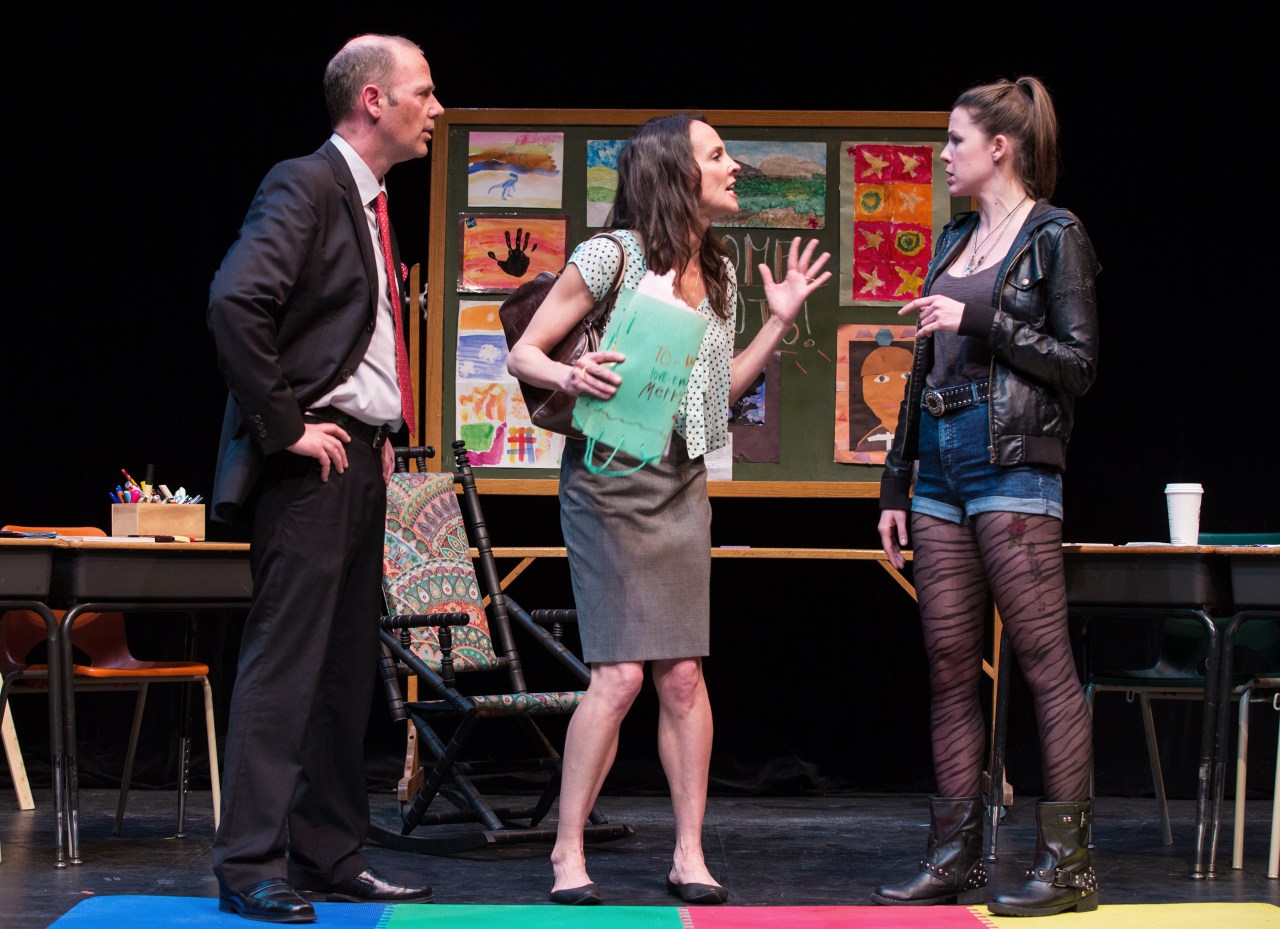
                First up is Parents Night, a tightly scripted, breath-takingly confrontational pas de trois between two parents of struggling seven-year-olds and the children’s beleaguered teacher.  Into the empty classroom, in which little desks flank a display board, strides business-suited John (Matthew Olver) loaded for bear before the teacher Nicole (Sarah Murphy-Dyson) has even appeared. He picks up an artwork, tosses it aside with contempt, then makes for the finger-painting by his son Patrick as if it was a homing device. Judging a little girl’s work as Asian, he spews forth a critique of “social engineering”, teamwork that shores up “slackers” and an accusation that his son’s seven-year-old deskmate might be a subversive North Korean. John is divorced, a cuckold and a parody. He’s soon withered by the breakdown of teacher Nicole. Already at the point of meltdown, she is in a puddle after learning of her father’s death.

                Enter Rosie (Dana Puddicombe), an even bigger shock to Toronto middle-class smugness. She’s dressed like a hooker and indeed is a lapdancer: cut-off jeans over zebra-striped hose, stuffed into black leather jacket and boots.  She’s parent to Sonia, a child who’s already declared she’s gay. Sonia’s father is a drug dealer; Rosie, to put it mildly, is a parent with a brief. Where does Nicole (“I’m already at the peak of my niceness”) get off judging her and her child for their homeless condition? Nothing is ever resolved in this play, a triangle of fictional proportions in which the teacher is totally defeated: “It’s people like you who ruin this job for me,” she says.

                Walker ratchets up the tension inherent in the conflicts by forcing a tragic storyline into a comedy format. In The Bigger Issue, concerning the parental complaints of Jack (Olver) and Maggie (Puddicombe), whose 12-year-olds are in teacher Irene’s (Murphy Dyson) class. Irene is accused of assault on a boy who’s “on the spectrum (of autism)” and who carries a butcher knife to class. Again a steady rant rises to an absurdist climax as the knife is pulled out. Through the din we hear a home truth from Irene: “I don’t want to be in this school. I might as well just join the police force.”

                Director Wes Berger makes the perfect interpreter, fine-tuning all the symmetry of Walker’s script. The cast, especially the wide-ranging Sarah Murphy-Dyson, is pretty much flawless in its timing. Only one quibble: with the intensity of the writing and the rapid-fire delivery, is it really necessary to have everyone shouting at full volume? We know we’re meant to be worn down. We don’t actually have to be pummelled into the back of our seats.

Above: Matthew Olver, Sarah Murphy-Dyson and Dana Puddicombe in Parents Night

Photo by Cylla von Tiedemann