Vera Frenkel brings us a sparkling, thought-provoking video installation

It would be a mistake to try to sum up As If by Chance, Vera Frenkel’s newly completed two-channel video and print installation. But an entry point to this multivalent, moving – in both senses – picture could be in the notion that there are many ways of telling a story.

In most traditions a story is linear. We speak of a story arc, a climax, a resolution, a beginning, a middle and an end. Indeed video – remember tape? – is a linear medium. But poetry, music, painting and dance tell us that a story can be multilayered, circular, non-chronological and open-ended.

The title As If by Chance, says a note about the work, alludes to “an inter-generational card game, evidence of which was found by the police after a Toronto art centre was closed by the City.”  The complex video work began with a film shoot Frenkel organized in which seven elders, all older than 70 and seven children, all 10 or younger, were paired, seated at a glass table and given paints, brushes and markers.  Colourful cards were displayed, which the participants turned over to reveal words – boat, or sky, house or flower — that were prompts for the creation of art works. Naturally, conversations between young and old ensued.

As in previous works of hers, Vera acts as narrator, lending her even-toned statements to a voiceover that is convincingly objective. But she also provokes with statements such as, “I’m telling the story from the end again. That’s what happens when there are so many beginnings.”

The narrative has at least three strands. One story line is mostly descriptive, the voiceover explaining how the children “painted their dreams” and the elders were “mapping their memories.” There’s also the underlying saga of the art centre promised by the City as a place for working artists to call their own. Through political jockeying and outright lying, the artists are cheated out of the space, the property instead turned over to a laundromat.

And then there’s the story of Natasha, the narrator’s landlady. Natasha has evicted the narrator who lived in an upstairs apartment, possibly to make way for the art centre, which is Natasha’s project. Except for her love of Russian poetry and a possible connection Russian interference in our elections – art centres serving as covers for espionage – we know nothing about Natasha.

She has gone missing; we get no clues as to how and why. The narrator refers to the disappearance from time to time, but the implication is that some mysteries are never solved. For the viewer, the mention of Natasha’s absence heightens the immediacy of the exchanges between the elders and the youngsters.

Adding yet another dimension to the composition is William Blake’s Songs of Innocence and Experience. The title is superimposed on the scene of the card game early on in the video. At random intervals, Blake’s illustrated, hand-printed poem “The Tyger” floats into view. A five-year-old girl, who surely can’t be familiar with Blake, is drawing a tiger, meticulously painting in the stripes and sharing the task with her twin sister. Their innocence is expressed in this spontaneous artmaking. Blake’s metaphysics included a “higher innocence,” a recovered innocence, now informed by experience.  The artists among the elders could be an example of this higher or “organized” innocence that allows for self-expression without self-consciousness.

As If by Chance proceeds through a flow of moving and still images, written and spoken words. Sometimes the images, black and white in one stream, richly coloured in another, overlap each other. Digital prints of stills extracted from the videos, hang on the walls of the Charles Street Video premises, where Frenkel and her co-editor Konrad Skręta have been toiling for many months to make As If by Chance.  

The viewer is a necessary participant, not just passively watching, but interpreting the flow of juxtaposed words and images to complete the artistic process. We observe an elder drawing a spiral and associate it with the hand of a child drawing a circle. A simple statement, such as “the present, as usual, is invisible,” offers another insight. Of course: we see the past and the future in pictures, not so the present.    

After 30 minutes, the video comes to an end, but then comes Part 2, a rearranging of the video elements as if the author were telling the story from another perspective.

As If by Chance is surprising, absorbing, spiked with subtle wit, and a little bit challenging. As the credits roll after another 30 minutes, this viewer’s immediate reaction was, “I’ve got to see this again.”

As If by Chance

By Vera Frenkel

Screening November 26, 12 pm to 4 pm; November 27, 6 pm to 8 pm; November 29, 12 pm to 4 pm.

Charles Street Video, 76 Geary Avenue, Toronto

25 years . . . and counting

Older and Reckless? At its inception, the name of the show for dancers and choreographers (initially over 40) had a whimsical air, implying “nothing left to lose.” Over time, the showcase for senior dance artists, established in 2000 by Claudia Moore when she led Moonhorse Dance Theatre, has become an occasion for artists more than 45 years of age to advance their craft, take new risks and mentor younger dancers and choreographers.

At first, says Allison Cummings, Moonhorse artistic director since 2022, Older and Reckless “was a more casual, small series where they had three shows a year at the Dancemakers studio. In 2016, Claudia felt our seasoned artists need a bigger stage and so it was pared down to one show a year at Harbourfront Centre.”

So the Older and Reckless show celebrating 25 years of the event, with three performances November 21 to 22 at the Fleck Harbourfront Centre stage, is kind of a big deal. Since the very first show, in which Robert Desrosiers performed a solo, Older and Reckless has been a platform for a long line of dancers and choreographers, from Karen and Allen Kaeja, to José Navas, to Peter Chin, Denise Fujiwara, Learie McNicolls … the list goes on. For the 25th anniversary, Moonhorse is assembling an eight-minute video drawing on archival footage to show the range of work presented. (Among my personal favourites is a performance by Elizabeth Langley in which she presented herself as the child of Gertrude Stein and Alice B. Toklas.)

“I’ve changed the word ‘senior,’ to ‘lifelong.’ I think it’s more appropriate,” says Cummings, who curates each Older and Reckless through a combination of performers reaching out to her and calling on artists to present existing or new work. She makes every effort to ensure that all the people involved in putting on the show, which typically features three 20-minute works, are also in the 45-plus category.

The 2025 show includes an intriguing pairing – Montreal dancers Marc Boivin and Louise Bédard – in a duet, Handmade, exploring what it means to be older and (possibly more) reckless. Carol Anderson first presented Elsinore/night hours, a solo for Julia Sasso, in 1999. Sasso will reprise the work for this show.

Dancer/choreographer William Yong, who began his career in ballet, has joined up with Sonia Rodriguez, former principal dancer with the National Ballet of Canada, to present the solo de corazón (from the heart). Collaboration with Rodriguez, who retired from the National Ballet in 2022, began with a conversation.

“I discovered such richness in her life story,” says Yong. “I felt that, at this moment in her career, a solo for someone like Sonia — a true ballet legend — needed to come from something deeply personal, something from her heart. We spoke about everything: her journey to Canada, her extraordinary career, her family, and motherhood.” What he gleaned from became the basis for a dance that Yong says is “simple, direct and full of feeling.” 

Year-round, Moonhorse sponsors workshops and dance classes for people over 45 and interdisciplinary exchange programs by and for older dance artists.

More than a decade ago, Moonhorse began a community performance project that was, says Cummings, “a way to get people from our audiences who were not dancers into a creative process and on stage.” This year Jenn Goodwin has created a six-minute piece for 26 dance enthusiasts.

“We have people who come back every single year. It’s an opportunity for them to really experience from the inside what they love so much to watch,” adds Cummings.

Like the trained professionals, these untrained dancers are driven by a lifelong passion: “I want to dance.” 

Older & Reckless
November 21 at 8pm
November 22 at 2pm and 8pm, 2025
Fleck Harbourfront Centre Theatre, Toronto

The National Ballet’s perfect mix

In all the years of enjoying the National Ballet of Canada’s mixed program I have never seen a program so well attended and so loudly appreciated. You might, without too much exaggeration, call this artistic director Hope Muir’s perfect mix.

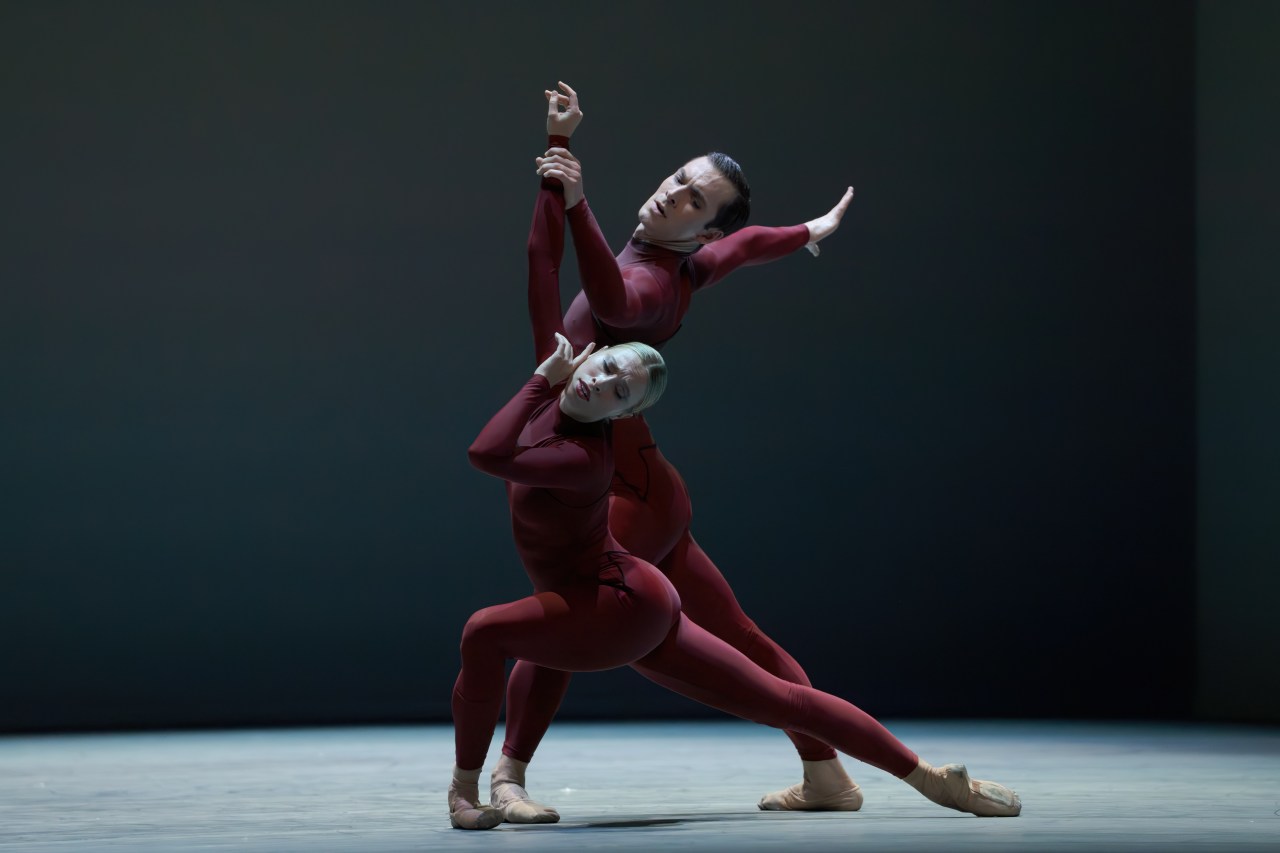
This two-hour program, with one last performance today, Sunday, March 2, opens with something old, Antony Tudor’s The Leaves are Fading, marking 50 years since its world premiere at the American Ballet Theatre in July 1975. The something new is an NBoC commission, Marco Goecke’s thrilling duet Morpheus’ Dream, set to Keith Jarrett’s Budapest Concert, Parts VII and VIII, and Lady Gaga’s rousing love/hate anthem, “Bad Romance.”

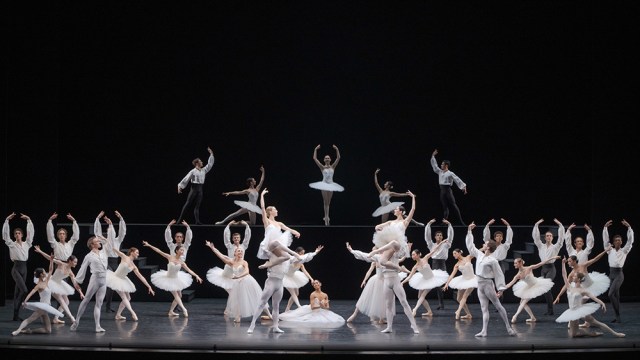
And for the finale, something reinvented: David Dawson’s brilliant re-conception  of Antonio Vivaldi’s Four Seasons, to a score by Matt Richter that reshapes the original four violin concertos in a dramatic way.

The evening pays equal homage to a youthful, skilled edition 2024-2025 of the National Ballet and the talented players of the National Ballet Orchestra under the sensitive directin of principal conductor David Briskin.

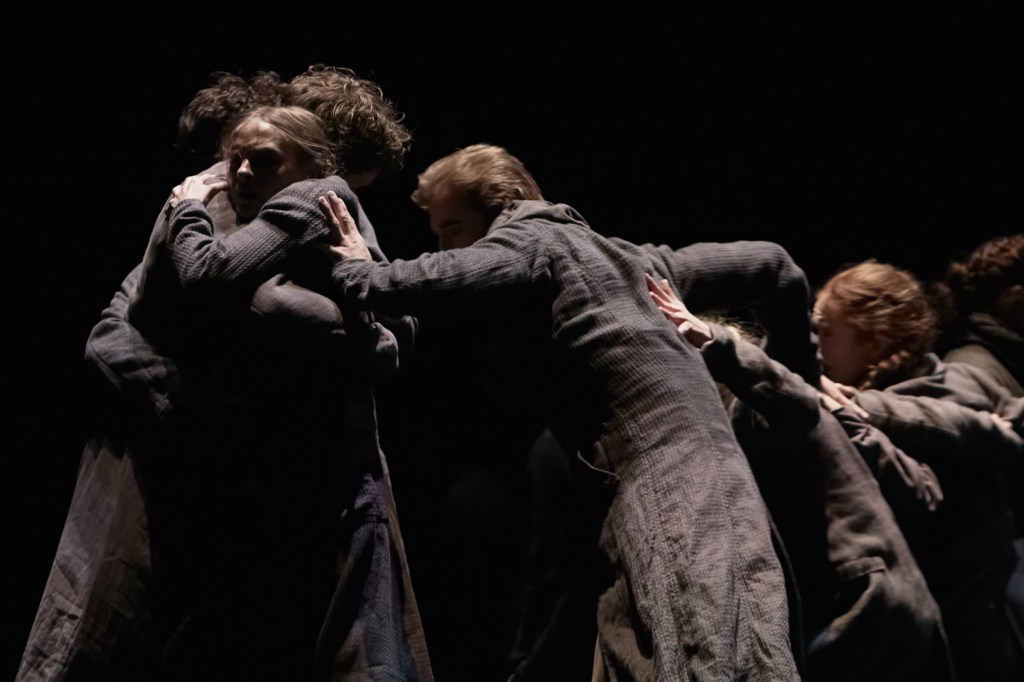
The Leaves are Fading is a late work of Tudor’s (1908 to 1987) and the most unfussy, in its purity of form and abstract conception. Tudor set it to chamber music for strings by Antonín Dvořák, another perfect mix, as it turned out. For this dance is about a woman looking back on her life from a long distance, as the autumn leaves are falling, contemplating the years with a fusion of nostalgia and regret.

Alexandra MacDonald, in the role of the woman looking back, performs by turns wondering, nostalgic, solemn and celebratory. Leaves gives parts to nearly 20 dancers, all of them as light on their landings as the faded falling leaves. Tirion Law and Naoya Ebe performed a particulary poetic pas de deux near the end.

Tudor’s neo-classical signature is etched with precision on this work, the dance inseparable from Dvořák score, with the orchestra’s fulsome violin section performing as one, like the lyrical voice of the woman reflecting on life’s seasons.

After the autumnal Tudor, Spencer Hack bursts onto the stage like a bolt of lightning in Morpheus’ Dream, named for the god of dreams. To call the 10-minute piece edgy is anunderstatement. German-born Goecke, once associate choreographer of Nederland Dans Theater, is a favourite of European ballet companies, lauded with good reason for works such as Nijinsky and The Big Crying.

In this commission, supported by the Gail Hutchison Fund, the choreographer seemed to find the bad-boy, bad-girl element in Tene Ward and Spencer Hack. Their muscular partnering makes for an exciting push-pull of love on the hoof and a not-so-playful lover’s quarrel, bringing the audience to its feet with a roar, completely invested in this dream of the dynamics of an affair to remember. Lady Gaga says it all in what many a woman might want as her theme song, the Jarrett determinist keyboard playing counterpoint to her ballad “Bad Romance:” I want your love and I want your revenge.”

British dancer/choreographer brings his striking, abstract, full-immersion Four Seasons to the NBoC stage for its North American premiere. Dawson was finely inspired in this stark, yet fully absorbing dance with the recording Recomposed by Max Richter: Vivaldi, The Four Seasons. Nothing is lost but much is gained in Richter’s streamlining of the main themes of the Vivaldi seasons to give it a bigger sound and more range for the dancers.

This reinterpretation of The Four Seasons does not supplant James’ Kudelka’s more literary reading of the Vivaldi classic; rather Dawson’s piece with its dramatic lighting and moving geometric shapes on stage to represent the rise and fall of the light, of the associations with the seasonal changes that have governed our lives for millenia.

Violin soloist Aaron Schwebel shows the way, as swarms of the Ballet’s nimble best criss-cross the stage in colour-coded leotards meant to represent the intermingling of the seasons’ themes.

The Four Seasons / Morpheus’ Dream / The Leaves are Fading

Performed by the National Ballet of Canada at the Four Seasons Centre for the Performing Arts, Toronto February 26 to March 2, 2025

Photo: Calley Skalnick and Spencer Hack in The Four Seasons. Credit: Karolina Kuras

Josiah escapes to freedom in Ontario

Contemporary interpretations of slave narratives have kept the focus on the relentless cruelty of slave owners. Whipping and more whipping, repeated, horrific rape, humans reduced to beasts of burden and tools of their slave masters: it amounts to torture porn.

Male creators crafted Twelve Years a Slave, The Book of Negroes and Django Unchained – slave women’s stories are depicted in a way so violent as to make the viewer feel complicit in the abuse. Nothing can be learned from this.

Josiah, based on the life of Josiah Henson (born 1789, died in Dresden, Ontario in 1883)is no such tale. Charles Robertson, a Kingston scribe and author of the supernatural horror story Dark Church, has crafted a script told in dance and movement, a saga of literacy, redemption, hope and a kind of freedom.

Tap-dancing phenom Cassel Miles, a triple threat who has been appearing in dance and musical shows since 1984, is Josiah. We meet the young slave as a boy, sold down the river with his mother by a Maryland slave owner. He’s considered too wilful, too prideful “for his own good.” He is, after all, a piece of property and must learn to accept that.

Josiah and his mother are sold to the highest bidder, Master Adam Robb, because he’s a “vigorous, healthy boy.” Robb is a brutal man “especially addicted to the vice of licentiousness.” He is “a beast who wants to be a man.”

Slavedriver and overseer Master Isaac Riley in the fields is even worse. His ultimate threat is to sell Josiah down the river if he doesn’t behave. This action is accompanied by an overhead sound of lashings – we are not exposed to any raw, open suppurating wounds on the back and shoulders here, thank goodness.

Long story short, Josiah learns to read, finds God, meets a preacher and becomes one himself, raises the $400 to buy his freedom and finally enters Canada crossing the border via the Underground Railway in 1830. There the play ends.

Charles Robertson is no Shakespeare; the text of this play is serviceable, but nary a word of poetry creeps in. And it is way too long. A one-man show is normally an uninterrupted work of 85 to 90 minutes. Neither performer nor audience member can concentrate on a work such as this for longer than 90 minutes. So Robertson chooses to break the play after an interminable first act for an intermission. Then, for another hour or so we learn of Josiah’s journey on the Underground Railroad. Thus, two plays, both of which have been done before, more movingly and profoundly in works such as Middle Passage (1990) by Charles R. Johnson and the fascinating, poetic Underground Railroad (2016) by Colson Whitehead.

The one-man show that my companion and I were keen to see is Josiah entering Canada in 1830. What happened to him after that?

As for Cassel Miles, he is a lovely mover, can sing and mime and keeps the cadence of the piece. But the speaking voice is not his tool. He does a reasonable job of impersonating all the characters, male and female, but the voice of Josiah is not distinct. Josiah should have something akin to a preacher’s or an orator’s voice, and it should change over the course of a long life seen from boyhood into middle age. It doesn’t.

Still, I’m glad I saw Josiah.

Josiah

Written by Charles Robertson, directed by Jim Garrard and performed by Cassel Miles

Produced by Thousand Miles of Bricks Productions

At the Alumnae Theatre, Toronto, until February 7

Photo, courtesy of the producers:  Cassel Miles

Opera Atelier’s Acis and Galatea acquires French panache

Just suppose that the Sun King, Louis XIV, reappeared in his dancing guise to attend Opera Atelier’s remounting of Actis and Galatea opening tonight at the Elgin Theatre. He might well experience a tinge of pride to see how a contemporary opera company performs George Frideric Handel’s pastoral “serenata”  in the baroque style that the Sun King established.

The Bourbon king (1638 – 1715), himself a more than decent dancer, laid the groundwork for classical ballet mounting 26 ballets de cours in the royal theatre at Versailles. In such ballets, dance, instrumentation, song, spoken dialogue and acting were all given equal weight. As Opera Atelier co-artistic director Marshall Pynkoski, says, “Every aspect of theatre was treated with equal importance. I like to say [baroque ballet] is like a Broadway musical. You will not have a successful show if you have great singing and a great book, but the dancing is horrible…Everything must be firing at the same level to ensure success and that’s precisely what theatre was meant to be in the 17th and 18th centuries, and, I would argue, for the most discriminating audience in the history of the western world.”

Small wonder that Pynkoski and co-artistic director Jeannette Lajeunesse Zingg are happy to have enticed two young, acclaimed French tenors to make their debuts with the company in the remount of Opera Atelier’s Acis and Galetea. Antonin Rondepierre, singing the role of Acis, began his training in the 17th-century French baroque repertoire a mere eight years ago, when he began studies at the Centre de Musique Baroque de Versailles. Praised for his musical intelligence and poetic sensibility, Rondepierre has performed in Opera Atelier’s productions at Versailles. For the final show of Opera Atelier’s 2024-25 season, the nimble young tenor will reprise his role of the violent villain Joabel in the company’s production of Marc Antoine Charpentier’s David and Jonathan, scheduled to run from April 9 to 13 in 2025.

Another rising star of French opera ballet, Blaise Rantoanina, singing for the first time in Canada, performs the role of the shepherd Damon, Acis’ close friend. Born in Madagascar, Rantoanina began his vocal studies in his native country and then enrolled in France’s Conservatoire National Supérieur de Musique et de Danse de Paris (CNSMDP), where he earned a master’s degree. He’s known for roles such as Belmonte in Die Entführung aus dem Serail with the Clermont-Ferrand Opera and, last season was cast as Joe in George Gershwin’s Blue Monday, with the Picardy Orchestra in France. Rantoanina is lined up for a role in a in a yet-to-be-announced Opera Atelier production in 2026.

“These two young men bring tremendous finesse musically to this production,” says Pynkoski. He and Zingg have worked with both of them in Versailles.

Rounding out the cast of four in Acis and Galatea is longtime Opera Atelier performer and soprano Meghan Lindsay, who has appeared in more than twelve OA productions, including Donna Anna in Don Giovanni, Ilia in Idomeneo, Alcina in Alcina, and Agathe in Der Freischütz. Bass-baritone Douglas Williams, a featured performer wit Opera Atelier since 2017– cast as Figaro in The Marriage of Figaro and as the Don in Don Giovanni — performs as Polyphemus, the monster rival who wants Galatea for himself.

The Opera Atelier artists Eric Cesar de Mello da Silva, Juri Hiraoka, Elizabeth Kalashnikova, Kevin Law, Courtney Lyman, Kealan Mclaughlin, Julia Sedwick, Cynthia Akemi Smithers, Edward Tracz, Dominic Who, Laura Willis, Xi Yi, Jeannette Lajeunesse-Zingg and supernumerary Peter Akiki provide the dancing, while Tafelmusik and the Nathaniel Dett Chorale lend a big sound to complement set and costume designer Gerard Gauci’s immersive and dreamlike set.

Acis and Galatea has a history as Handel’s most popular opera, often considered a starter work for those new to opera. The pastoral masque, as it is sometimes called, is based on a tale from Ovid’s Metamorphoses  about Acis the shepherd and Galatea the nymph who fall in love. Their affair is upset by the jealous monster Polyphemus who wants Galatea for himself. Polyphemus threatens dire consequences for Acis, until Damon comes in with a stone to crush the monster.

“It’s a wonderful story for audiences of all ages. It’s a classic fairy tale,” says Pynkoski, comparable to the experience of an adult reading a fairy story to a child. “I mean Acis is probably the most sensual, the most sexual opera that Handel ever wrote. But there’s nothing there that parents might feel they should shield their children from. For children, it’s a fantasy with crazy people on stage doing crazy, improbable things to beautiful music.”

The excitement in Pynkoski’s voice as he talks about Opera Atelier’s evolution and its productions has not dimmed over the years since Opera Atelier began in 1985. Born of a dream of two classically trained ballet artists, Pynkoski and Zingg, who took to Versailles and Paris to research Louis XIV’s court ballets – they took jobs at Moulin Rouge in Montmartre, “sharing the stage with dolphins and horses” to support their studies – Opera Atelier today is struggling to make up for the vanishing audiences that COVID lockdowns brought. But there’s no shortage between them of imagination, inventiveness or enthusiasm for revitalizing a 17th- and 18th-century theatrical form that brings dazzle to the contemporary stage.

Acis and Galatea

By George Frideric Handel

Presented by Opera Atelier at the Elgin Theatre in Toronto

October 24 to 27, 2024

Photo by Bruce Zinger: Opera Atelier artists with soprano Mireille Asselin in a previous presentation of Acis and Galatea.

Gallery

East merges with West in Mukashi Mukashi, to hilarious effect

Once upon a time, David Danzon, the peripatetic artistic director of Corpus Dance Projects, decided to embrace Japanese theatrical traditions to come up with a cross-cultural contemporary fairy tale.

After touring shows through Japan, Corpus partnered up with Osaka’s 53-year-old Kio theatre company to co-produce  Mukashi Mukashi, a contemporary interpretation of two characters central to European and Japanese folklore: the wolf and the crane, respectively.

The kid-friendly show, launched at a festival in Japan last October is playing now, for its first North American run, at the Theatre Centre in Toronto, until Sunday, September 29.

Mukashi Mukashi is a madcap mash-up of physical theatre from two distinctly different cultures. Corpus and Kio found their theatrical modus operandi quite compatible. Danzon worked with the Kio company to incorporate Kabuki, Noh, Bunraku (body puppetry) and Kyogen (the comic interludes between acts in a Noh play) into the Corpus brand of physical theatre. He layers these expressive movements, scene by scene, to create a melding of human and animal, as any good fairy tale would. The skills on display here revolve rapidly through mime, to dance, puppetry, mask, clown, live origami-making, Asian shadow puppetry, to a manic, sequin-jacketed TV game-show host — all accompanied by Anika Johnson’s evocative  soundscape.

By turns hilarious and thought-provoking, Mukashi Mukashi proceeds  through a series of nine short scenes, the performers speaking mainly Japanese, with a few lines of English thrown in. There is not a lot of dialogue, but English and French surtitles, white on black panels, spark memories of the talk panels in the silent films of Buster Keaton or Charlie Chaplin, early influences on Danzon’s comedic practice. The dream-like sequence follows an arc from mortal danger through comical transformations, to peace and fulfilment, tapping deep into the collective unconscious.

In The Uses of Enchantment (1976) child psychologist Bruno Bettelheim famously argued that the violence and fantastical nature of traditional fairy tales were not to be shunned in favour of anodyne realist children’s literature, because stories such as Little Red Riding Hood cathartically deal with primal fears and lead to healthy childhood psychological development. Mukashi Mukashi is enchantment at its best.

Guffaws greet the opening scene, as performers Sakura Korin, Kio artistic director Kohey Nakadachi, Takako Segawa and Kaitlin Torrance arrive on stage, costumed by designer Atsuko Kiyokawa, in black tights with big bushy  wolf tails. They are soon howling at the moon overhead and with the next scene we’re plunged into the fantastic, as Nakadachi in a wolf headpiece morphs from the big bad wolf to little red riding hood being tantalized by Mr. Wolf, to later hilarious scenes when he’s begging for sympathy from little red riding-hood. Mr. Wolf’s funeral ushers in scenes involving the performers making origami paper cranes – in one case screwing up, prompting a live demonstration of how to make a paper crane.

The crane is a powerful symbol in Japanese culture. Considered mystical creatures who may have lived for eons, they are thought to bring luck and prosperity, peace and hope. A paper crane may be gifted as an emblem of honour. The wings of the crane took mortals to paradise, hence the scenes with Kaitlin Torrance as an ethereal crane, arms gracefully spread, her signature origami crane or orizuru atop her head. The final scenes bring a soothing feeling of something transcendent after the set-tos of big bad wolf, grandma and little red riding hood.

A note to parents: make sure your child is familiar with the story of the Little Red Riding Hood and maybe take them around the exhibition created by Carolin Lindner displaying Japanese masks and explaining the four traditions of Japanese theatre and the making of orizurus.

Photos: The Big Bad Wolf and Little Red Riding Hood, the  wolf takes on an outsized little red riding hood and Kohey Nakadachi as Mr. Wolf.

Stephen Bigsby 1946 – 2024

My friend Stephen Bigsby was a remarkable person. It’s not often you find kindness, supreme intelligence, generosity, political astuteness and laugh-out-loud quick-wittedness in one man. I knew Stephen for most of my life, because his sister Gail was my best friend from grade 1 at Monterey elementary school in Oak Bay, BC.

Meeting the Bigsbys and spending much of my early years at their grand home on the corner of Beach Drive and St. Patrick Street, exploring tide pools on the rocks or dunking in the chilly waters of McNeil Bay, was for me a formative experience. Harry Bigsby, a superintendent of music for the Victoria School Board, oversaw a school program that ensured several generations of Victoria students got a sound musical education. Tall and handsome, and sometimes a little formidable, Harry, unlike most other dads in the 1950s actively engaged with his children and their friends. His American wife Dorothy, whom he met in the music faculty at the University of Washington, was a beautiful singer. She was the cool mum–full of fun, an avid golfer, outgoing and happy to chat with her children’s friends. She was the rare ‘50s mum who had a job, notably in the Hudson’s Bay Company’s record department during the Elvis era. Dorothy was the mother some of us wished our mothers might emulate.

Jim was the eldest. Five years older than Gail and I, he was a high school Somebody when we were still in bobby socks and saddle shoes. After graduating from the University of Victoria and Simon Fraser, Jim developed a business designing and implementing innovative educational materials. An enthusiast of the best kind, Jim was a musical force in Victoria. For decades he directed the Goward House Singers, a choir I joined in 2009, much to my benefit, for Jim was a gifted conductor, educator and orchestral arranger. Tragically, we lost Jim on January 20, only 13 days before his brother Stephen’s death from cancer on February 2, his exuberance stolen by vascular dementia. But that illness never robbed Jim of his expansive spirit, his brilliant smile and magnetic good looks. He leaves his wife Suzanne, steadfast and loving throughout Jim’s final years, son David, daughter Caitlin and their families.

Stephen, only 20 months older than Gail, was from his early teens a force to be reckoned with. He could be highly entertaining: joking, clowning and firing off zingers. Or he could be laser-focused on scholastic achievement, with a drive that saw him and his Oak Bay High School teammates win the BC Grand Champions title on Reach for the Top in 1964. The Bigsby household was not like mine. Here people laughed, joked and debated, expressed their feelings and followed their passions. Stephen was especially adept at debate. From high school, he was marked out for leadership — in politics, diplomacy and executive management.

Gail, lest we forget, was the little sister who more than held her own with her brothers, a talented artist and musician, and a champion golfer. She and I were friends, teammates and rivals on the honours list. We also got up to plenty of no good, starting from puberty. Gail was always the first to try anything forbidden or exciting: she made me do it.

As a first-year student at UVic, I re-encountered Stephen, in his capacity as the 1966-67 student president. He took on the role like the governor of a minor state. He encouraged me to apply for a Canadian Union of Students exchange scholarship that took me to Toronto for a mind-expanding year at York University. I was proud to join Stephen and his friends, including a previous UVic student president, Paul Williamson, at a weekly discussion group held in a downtown Victoria sauna bathhouse. The group was called the Socrates Society, if memory serves. Serious socio-political discussions took place as we sat in our bathing suits and damp towels. Although, it must be admitted, Paul and I also had less erudite pursuits in mind.

Stephen was a most educated man. In addition to a BA from UVic, he held an MA in political science from Carlton University and did a post-graduate year in economics in Stockholm, where he learned Swedish. On top of that, he earned an MBA at Université Laval, becoming a fluent French speaker. These studies were a methodical preparation for Stephen’s application to join the Canadian Trade Commissioner Service, where he worked in Ottawa and then secured an appointment to the Canadian consulate in Milan, Italy.

The fates served up the perfect match for Stephen, in the person of Elisabetta Recchi, a sharp-witted, well educated and cultured Italian, whom he hired to work in the trade commission office. Before long Stephen and Elisabetta were married. When they moved to Montreal in 1981, Stephen became Senior Industrial Commissioner (Europe) for Metropolitan Montreal’s Economic Development Agency. Elisabetta joined the RBC Financial Group, a move that eventually elevated her to the RBC executive committee. By 1997, Stephen and Elisabetta had moved to Toronto, where Stephen held the positions of vice-president at the Canadian Commercial Corporation and executive director at the Association of Canadian Pension Management.

After retirement, the couple travelled extensively, hopping between homes in Toronto, a condo in Victoria’s Swallows Landing and Elisabetta’s haunts in northern Italy. I got to know Stephen afresh and witnessed a marriage of true minds. They were amazing companions, sometimes during one conversation switching from English to French to Italian. Stephen was a loyal friend to those he’d grown up with and always stayed connected with them. He was also a benefactor from an early age, dating back to the summer he spent working for CUSO. A quiet but thoughtful philanthropist, he supported the arts and education.

On walks with him, Elisabetta and Gail, I noted that minor irritants such as a deceptive trail marking on a map of John Dean Park could set Stephen fuming. At the same time, he could, when faced with BC’s real estate speculation and money-laundering tax on their months-empty condo, compose a letter to the NDP government telling them precisely how to better reframe the tax, then post copies in the mail to every BC MLA.

Stephen wore his intelligence lightly; he never pontificated but could casually cast an analysis of Alexander Hamilton’s Federalist Papers, 50 years after he’d studied it. What’s more, he was a true gentleman, kind and considerate and always listening to what others had to say about the world.

I, along with all his friends and family, will miss Stephen fiercely, but we will never forget him. He was a man about whom you could say, he always showed up.

Photo: Stephen and Elisabetta on New York City’s Highline, December 2009, by Jack MacDonald

Gallery

Beautiful, historic southwest Saskatchewan

Among the several reasons to visit Fort Walsh National Historic Site in southwest Saskatchewan, is the route that takes you there. Heading west out of Eastend, you’ll drive through the Cypress Hills, location of some of the most spectacular and unpredictable landscape to be found in Canada: white clay mounds rising out of hills riven with lush, treed coulees; wide open prairie where ferruginous hawks can swoop over the grasslands; and a winding upland highway that opens onto an alpine meadow.

Just beyond the meadow lies Fort Walsh, designated a national historic site because of the massacre of more than 20 Nakoda men, women and children on June 1, 1873. Behind the Assiniboine peoples’ deaths lies a complicated history. The Nakoda were the collateral damage in a fight for resources among various colonial and American parties over the land they lived on.

The wolf hunters, whiskey and fur traders who committed the massacre were mostly American, but there also Métis and Upper Canadian fur traders attracted to the territory by the dwindling herds of buffalo.

The massacre, news of which soon reached Ottawa, spurred the deployment of the Northwest Mounted Police, precursors of the Royal Canadian Mounted Police. Created by an act of Parliament in 1873, the force was already established at Fort Garry. But news of the massacre prompted a long march of Northwest Mounted Police, 300-strong, aimed at bringing law and order to the western territories and securing Canada’s sovereignty over the land in the face of American incursions from south of the border.

In their scarlet tunics and navy-blue trousers, the men set out from Dufferin, Manitoba on July 8, 1874 to make the 1,300-km march across the prairies on horseback, towing supplies in red river carts. The force split at La Roche Percée in what is now southwest Saskatchewan, one group going northwest to establish Fort Edmonton and the other heading for the territory where the American whiskey traders were still making trouble for the local indigenous people. And so it was that James Morrow Walsh, a NWMP superintendent, established a military base at Fort Walsh in 1875. Soon Canadian control of the territory was fixed, the whiskey traders routed and relations with the indigenous locals established.

The present fort is a reconstruction of the original, furnished and appointed as it was in the heyday of the NWMP as the force protected the territory for the English and French traders and settlers, including a substantial community of Métis, who became adept traders with the local first nations inhabitants. For better or worse, the presence of the NWMP also ensured the signing of treaties with the indigenous peoples.

Today, uniformed guides at Fort Walsh take visitors on an informative tour of officers’ quarters, stables and smithy, giving a clear picture of life in the fort nearly 150 years ago. Bernard (Cheng Hao), an excellent guide in full uniform, points out details in the reconstructed interiors of various buildings, including the commanding officer’s living quarters, non-commissioned officer’s quarters and a piece of artillery whose function he can demonstrate.

Outside the palisades, stroll down to two cabins, where guide Stephen Girard, dressed as a Métis trader, outlines the relationship between the local Métis, the NWMP, the settler population and the Indigenous communities. Hudson’s Bay blankets, dry goods, beaver and other pelts stock the shelves and counters. Girard explains how many bison hides (five or more) might be traded for one HBC blanket, marked with lines that show the height of pelts required in trade.

In search of living bison, a visitor might drive toward the border with Montana to a former ranch on the Old Man on His Back plateau, now designated a Prairie and Heritage Conservation Area. If you haven’t booked a tour, you can wander over the hills and plateau and if lucky, might see a bison or two grazing with cattle. It’s pretty exciting.

Photos, clockwise: Stephen Girard as a Métis trader, Old Man on his Back nature conservancy, Bernard in the Fort Walsh NCO quarters, cattle grazing in the Cypress Hills.

Gallery

CORPUS, moving, moves us

Singing in five-part harmony, making the music of the spheres, the five singing goddesses proceeding along Toronto’s Esplanade were a welcome sight for bystanders on May 25. This was the premiere of Divine Interventions, the latest production from CORPUS.

“There comes a time in every story when it feels like hope is lost,” states the introduction on the company website. “Everything is going wrong, all options have been exhausted, and the only thing left to do is pray for divine interventions.” That’s a sentiment most of us who’ve lived through the COVID-19 pandemic can relate to.

“We’ve been working on this piece for two years,” says artistic director and CORPUS co-founder David Danzon. That means in lockdown and rehearsing in masks. Danzon commissioned composer Anika Johnson to create new songs that form the score sung by Barbara Fulton, TrudyLee Gayle, Barbara Johnston, Tracy Michailidis and Michelle Yu. Choreographer Bonnie Kim and company member Matthew O’Connor collaborated with Danzon to achieve a trademark CORPUS spectacle — surrealism, delivered with wit and whimsy.

“They are five really talented, amazing singers, who also happen to be great movers,” says Danzon. They sang a capella, on and off their tricycle, winding up in the courtyard at Berkeley Castle at the end of the Esplanade. The four nights of the Toronto processional show found audiences eager for joyful and meaningful human interaction.

This spring and summer CORPUS is back on the road after a two-year hiatus, with engagements in San Diego, Norway, Sweden, Germany and France before returning to Canada for an August gig in Quebec. Among the shows they’re touring is the enduring Les Moutons, first seen in a Toronto park in 2003. You can get a taste of it in this video: Les moutons – Corpus Dance Projects

One might say Danzon, who was born in France, has come full circle since co-founding CORPUS with Dusk Dances artistic director Sylvie Bouchard in 1997. They arrived on the scene in 1996, creating A Flock of Flyers, for Dusk Dances. The premise was playful: “Due to severe budget cutbacks, the 217th Canadian Flying Squadron has been left without any planes . . .” Danzon, in the part of squadron leader, led the performers, costumed in leather helmets like World War I flying aces, in a show of a kind never seen before in Toronto. You can watch it here: http://corpus.ca/creations/flock-of-flyers

Danzon moved to Toronto with his parents and brother when he was 15. After the family returned to France, he remained and after high school enrolled in York University’s theatre program. But he was not destined for the indoor stage. “It’s a curious thing, he says of his career path. “I grew up on street theatre, because I had an aunt who was part of a well known Paris theatre company in the 70s and 80s. They were doing a lot of street performances in France. In the 60s there was a big thing about taking theatre outside the traditional four walls; a lot of festivals developed and it became a kind of form unto itself.”

Danzon has been leading CORPUS tours abroad since the early 2000s. This year company will go back to Japan, a country among the 34 they’ve performed in where they are particularly popular. There are hundreds, if not thousands, of street festivals in Europe in the summer, says Danzon. Plenty to keep inspiring this street artist extraordinaire.

Photos, courtesy CORPUS, from left: A Flock of Flyers, Divine Interventions, La Bulle

Gallery

Serge Bennathan: Paintings for the Soul

A broad, enticing smile is Serge Bennathan’s default expression. I beam back when we meet at a Broadway intersection in Vancouver. Bennathan, best known as a choreographer, has more than dance on his mind these days.

For the last several years, this jack of all arts has been turning out beautiful, intriguing and alluring watercolour paintings and showing them on his website.

It all began, says Bennathan, at the time when he was artistic director of Dancemakers. He got into the habit of writing, in a poetic way, and sketching when creating new dance works. He took his talent public for the first time in 1999, with a little book featuring an amusing cartoon character, The Other Moon of Mr. Figlio.

Becoming a full-time visual artist, Bennathan says in his delicious French accent, was an organic process. Nothing in a long career in the performing arts – he is still active in his choreographic work for the world’s major opera companies – was pre-planned.

Born in the village of L’Aigle in Normandy in 1957, Bennathan first saw an occupation for himself when his parents took him to see an operetta. Encouraged to learn dancing, he took his first ballet lesson in 1966, the only boy in his class. Bennathan’s father was in the military and the family moved frequently, but talented teachers were available in locations as disparate as Perpignan and Paris. Young Serge was curious enough to seize an opportunity whenever he saw one.

One day in 1975 in Paris, after being publicly admonished by his ballet teacher for arriving late prior to the end-of-year recital, Bennathan happened to notice a sign saying Roland Petit was auditioning new dancers for the Ballet National de Marseille. Only three dancers would be chosen from a field of 200 applicants. Serge was confident he’d make the cut. He didn’t. Shocked, he waited behind after all the other dancers had left the rehearsal hall. “Roland looked at me and said, ‘come, I’ll take you.’ ” To this day, Bennathan doesn’t know why. “I had a bad technique but I could jump really high. Roland would come close to me and say ‘Saute, saute’ and I would jump, with my hair flying.”

Bennathan’s first visit to Canada was on a tour with Ballet Marseille. Karen Kain was one of the guest artists they employed in the cities they visited. Petit encouraged Bennathan to be a choreographer, but when a dance he created did not get budgeted to include his preferred, Bennathan decided to leave. Invited by Rosella Hightower to take up a creative residence in Cannes, he settled there and later started his own company. After money troubles closed the company, Bennathan chose to immigrate to Canada. He arrived in Montreal in 1985 with a suitcase and a thousand dollars.

Luck and sharpened instincts took him like the wind from Montreal to Ottawa, where he had a very fruitful time with La Groupe de la Place Royale, to Vancouver and to Toronto to head up Dancemakers, where he served as artistic director from 1990 to 2006. When it was time to leave, he returned to Vancouver, creating dances as an independent choreographer under the name Les Productions Figlio.

Serge’s Vancouver bedroom serves as his painting studio.  He has a drawing board near the window and his pictures are stacked on shelves in the corner. He can paint anywhere, which is important for a peripatetic man like him. “When I was 13 years old I wanted to be a monk, to have this space of silence. Now I’m there,” he says.

Bennathan explains the origins of the pictures he is pulling out. “I am attracted to this right now,” he says of a painting with mountains and a night sky. The constellations and the stars are only visible to people who live outside cities, as he does when he returns to a little house he owns in Normandy.

Then there’s the Courageous Villages series of paintings, beautiful renditions of fortified towns that have lasted for centuries. He shows an unsold one of St. Paul de Vence, the place in the south of France that has always attracted artists, most famously Picasso, Chagall and Alexander Calder. These pictures, rich in a thickly laid watercolour paint, are dazzling in their colours, particularly red. (Full disclosure: I bought one of Bennathan’s paintings, Dance is My Freedom.)

A pandemic series called Giants feature huge figures on bare landscapes. A newish picture, “Zone Libre,” has an element of the giants, in the form of a huge seated figure draped in the Ukrainian flag.

Bennathan calls his art Paintings for the Soul, because he thinks maybe the pictures might help viewers in a gently healing way. He finds he needs to be of service somehow. “Painting is what I can give to people.” It’s obvious, in any case, that the inspiration for these watercolour pictures comes from some place deep within him. 

http://www.sergebennathan.com

Instagram: serge.bennathan

Facebook: Serge Bennathan

From top left, clockwise: Zone Libre, Quand Calder et Chagall Illuminaent St. Paul de Vence, Serge Bennathan, Creating the Music of Our Lives