Susan Musgrave’s Haida Gwaii

A Taste of Haida Gwaii

Food Gathering and Feasting

at the Edge of the World

By Susan Musgrave

Whitecap

ISBN 978-1-77050-216-1

340 pages, $34.95 softcover


There are cookbooks to use, cookbooks to peruse, or cookbooks to dip into, but rare is the cookbook you would read from front to back. A Taste of Haida Gwaii is that volume.

A lifetime of wry observation, poetry, memories and images has gone into Susan Musgrave’s first cookbook, set mostly on the northern Graham Island of Haida Gawaii, in Masset, where Musgrave lives and operates the Copper Beech Guest House.

A leisurely, literary text combines travelogue, history, personal anecdotes, Haida culture, unique menus and all manner of flora and fauna in a cleverly designed book containing 90 recipes and numerous illustrations including glorious photographs and cartoonish drawings by Dejahlee Busch.

“I can’t say I was cut out to be an innkeeper. I feel uncomfortable most of the time, charging anyone for a place to lay their head,” writes Musgrave, an inventive chef and brilliant hostess. Her statement is buttressed with a quote from Hebrews 13.2 about “entertaining strangers.”

A reminiscence of Matt Cohen introduces kelp, its uses and the preparation of seaweed. “He had never seen kelp before (Matt hailed from Ontario) and was fascinated by something I had always taken for granted . . . Kelp and seaweed had always floated through the lines of my poetry—so much so that one English academic described me as having emerged from “the kelp school of poetry.”

Musgrave’s father features in a reminiscence about fishing. “Dad used to climb into the dinghy and row up Sansum Narrows between Salt Spring Island, where my great-grandfather had settled at Musgrave Landing . . . catch a couple of grilse for breakfast and fry them to a shade just past well done, filling the cabin with an oily fishy smoke, which made it hard for me to choke down my Coco Puffs. (For a definition of grilse see one of Musgrave’s entertaining footnotes.)

A section on Haida Gawaii berries makes reference to During My Time: Florence Edenshaw Davidson, A Haida Woman in which Davidson recollects how her mother picked berries and kept them fresh in a bentwood box. Musgrave follows up with instructions for making salmonberry jelly.

“Coitus Interruptus” is the heading over a section on Dungeness crabs, best gathered, says Musgrave on North Beach, in the summer months, at a “minus tide,” although a low tide will do.  The title refers to the technique used to net the crabs. “You nudge them in flagrante delicto out of the sand and scoop them up in your net. The male will cling to the smaller, luckier female, so now you have to separate them and toss the male into your tote, where he will soon be joined by other angry male whoppers who are just as unhappy at having been parted, involuntarily, from their squeeze of the day.”

Reading stories such as “Never Overcook an Octopus,” asides on unlikely topics (edible gold leaf), a compendium of edible wild mushrooms of Haida Gawaii and recipes such as “Thimbleberry Elderflower Liqueur Coulis,” one begins to suspect that Musgrave is drawing us to her island home through the ancient lure of good food and good company.

Above: Crabbing on Haida Gawaii. Photos by Michelle Furbacher, Lynda Osborne and Peter Sloan


the tea experience


The Tea Farm, Cowichan

Tea Farm, 8350 Richards Trail, Duncan, BC V9L 6B4


One of my favourite road trips on Vancouver Island is to the Cowichan Valley, home of the slow food movement. Cowichan Bay, an official cittaslow, is a place to visit for cheeses from a local farm, bread baked from grains milled on site, freshly caught fish and seafood. Farther north, off the Island highway, is the Tea Farm. Go for the views of the valley, the company of owners Victor Vesely and Margit Nellemann, the ceramic art of Margit and others, and the tea experience. Stay for the tea service and shop to your heart’s delight.

“We are curators of organic loose tea, designers of artful tea blends, and growers of Camellia sinensis,” they say. “Artful” is the operative word. I’ve become a fan of their matcha tea, the health-giving brew made of the fine powder made from tea leaves. Tea Farm also serves baked goods, some laced with matcha from their own plants.

Aside

Ronnie rocks Victoria

21668678181_caa050182c_n

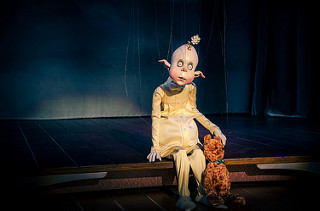
Schnitzel, the fairy child, stepping over the line

The Daisy Theatre

Ronnie Burkett Theatre of Marionettes

The Metro Theatre, Victoria, BC

November 19 to 22, 2015

It had been almost two decades since Ronnie Burkett last took the stage in Victoria. But the city must have left a big impression on him, or else he’s a quick study, because the puppet master of puppet masters sure knew how to touch a nerve or more likely prick a funny bone at the Saturday performance of his madcap improv show, The Daisy Theatre.

“Look,” he said to one of his high-strung, loosely jointed marionettes. “It’s our dream demographic: menopausal women and gay men!”

“No script,” promised Burkett in a cheeky intro expressing surprise at the lively Saturday night audience. No safety net, no doom and gloom, no social message, just a rollicking, raunchy, seat-of-the-pants-falling-below-the-asscrack show from the irreverent and multi-talented Burkett, who has been doing this sort of thing since the 70s. He is puppeteer, puppet maker, performer, writer and who knows what else. The Alberta-born artist did his first show in clubs, wearing a “bag stage.” The entire Daisy Theatre set looks as if it might fit comfortably in a large minivan and it has been on the road since the June 2013 premiere at Luminato.

Daisy Theatre provides Burkett with the opportunity to come out from behind and interact with the audience as well as his marionettes. Not that he was ever a keen observer of the fourth wall.

Slagging the city and the theatregoers of the Garden City, Burkett even took aim at his venue, calling the show “16 inches of fun in a dark church basement.” Never mind. It proved exactly the right intimate setting for Burkett’s in-your-face improv act. There were moments reminiscent of Robin Williams’ verbal and physical hypomania, but it was vintage Burkett.

A fairly serious conversation sets the context for the show. Burkett’s toddler-like little striver Schnitzel gets into an existential dialogue with his/her master, then makes the desperate climb up the curtains to get a good look at the man the audience can see pulling the strings and voicing his puppet’s lines. Schnitzel is the inner actor in all of us, scared to death of being exposed, and yet wanting to cross the line (in front of the stage) where there’s no protection from masks and make-believe.

On the heels of a really tough act to follow, the marionette stripper Dolly Wiggler, Burkett twice gave the audience a chance to pick from three characters he had waiting in the wings. The first choice (by applause) was a bosomy ageing chanteuse with a real Victoria vibe, who resembled a demented Dame Edna and was accompanied on piano by a puppet manipulated in Burkett’s other hand. She sings an obscenely funny “Hey-nonny” tune with lyrics that wouldn’t get past the Internet censors. The second choice brought a meandering, shaggy-dog segment, in which the sweaty-thighed, pie-making widow, Edna Rural of Turnip Corners, Alberta reveals the secret of her “dill-dough.” (Too bad we never got to see Miss Lillian Lunkhead, “Canada’s oldest and worst actress.”)

You get the gist. And before the two solid hours of manic music, monologue and dance has ended we were entertained as well by Tony, the drunken, sleazy lounge singer and Jesus Christ, the Jewish Messiah who comes on like a Borscht Belt stand-up comic. There were also the sleeping or dead ventriloquist and his dummy Woody, who carries on while his manipulator slumps in the chair.

It’s debatable what constituted the highlight. Perhaps Edna or the fairy child Schnitzel or brave audience member Mark, dragged from his seat and induced to operate the pianist marionette, then remove his shirt (to more applause).

Schnitzel makes the final appearance of the show, which might have been only an hour, Burkett said, if we were too unresponsive. But on it went to the sweaty max, two hours of laughs, a few gasps, a lot of admiring sighs and a few call-outs to come back soon.

Angela Hewitt: More joy in Christ Church Cathedral

Angela Hewitt solo piano recital

Christ Church Cathedral, Victoria BC

16 May 2015


Canadian pianist Angela Hewitt has made a study, it appears, of the generosity of virtuoso performers, among them Franz Liszt and Domenico Scarlatti. Virtuosity is not a measure of technical proficiency; it is about giving with all that is in you, losing yourself to the music, responding to the notes on the page as if you were singing them.

And sing them Hewitt did, at a master class on the day before her performance at Christ Church Cathedral, giving listeners a clue to her own virtuosity. In her notes to a gifted student who performed a toccata Hewitt hadn’t played for many years, she gave hints at how she became such an outstanding performer. She sang; she conducted; she described a passage as “the language of sighs.” And she pointed out the bars in the score, where “you bring in all these voices (notes) and take down the other voices.”

Small wonder then that when Hewitt played in the cathedral last Saturday, the passion with which she interpreted the music of Bach, Beethoven, Scarlatti and Liszt was palpable. The big black Fazioli grand piano dominated the church platform, but the real living, breathing instrument in the room was Hewitt.

Raised in a musical family, the Ottawa-born pianist has been playing since the age of 3. She gained national prominence in 1985 when, at 27, she won the Toronto International Bach Piano Competition. Ever since, she has been branded as a premier interpreter of Johann Sebastian Bach, but the truth is that Hewitt is a wide-ranging musician whose discography of more than 40 recordings includes composers from Schubert to Scarlatti to Beethoven, Chopin, Mozart and Messiaen.

The evening’s five segments all made some reference to Italy, where Hewitt lives part-time and runs the Trasimeno Music Festival. She led off the recital – her first solo performance in Victoria — with a performance of Bach’s Italian Concerto in F major, the performance of which won her the Toronto prize 30 years ago. Such crispness and forceful fingering in the opening movement brought to mind another word often associated with this musician: joy.

Hewitt introduced Beethoven’s “Les Adieux” Sonata with a story about how it was inspired by a sad farewell he had to his friend and supporter Archduke Rudolph in 1809 when the French bombarded Vienna. Hence the lament at the opening of the sonata, which Hewitt played with her whole person, as if she might have been a dancer, her fingers making footwork on the keyboard. Her ability to shift moods from light to dark, soft footfalls to ominous thunder suggestive of cannon fire is what gives her performances so much drama.

Following a few Bach arrangements (from a 2001 CD), Hewitt played Scarlatti keyboard sonatas, recorded for a forthcoming CD and chosen from the 555 short harpsichord pieces Scarlatti composed. She played four, including the K.87 in B minor, a contrapuntal piece played by many famous musicians.  With her strong round arms flying, Hewitt makes 18th-century music such as Scarlatti’s alive and breathing in the 21st century.

Franz Liszt’s incredible evocative Années de pèlerinage (Years of Pilgrimage) and his “Dante Sonata” with its powerful soundscape of hell brought the recital to a close. Returning for an encore, Hewitt switched gears with an achingly haunting yet transcendent playing of Debussy’s Clair de Lune. And then, with her one arm flying up off the treble end of the keyboard, and the other down off the bass end, the music seemed to release her.

A footnote: in the audience for the recital was a couple married in 1973 in Christ Church Cathedral in Ottawa, where Godfrey Hewitt was organist. Angela Hewitt, then 15, played at their wedding and clearly bestowed her joy on them, for they remain happily married 42 years later.

Adapting Much Ado About Nothing

Much Ado About Nothing

Tarragon Theatre

Until May 17, 2015

Desi Shakespeare never had it so good. Under the direction of Richard Rose, the Brampton Much Ado, complete with Bhangra, Bharatanatyam and Bollywood references, Hindi surtitles and a fine cast of South Asian actors, wrings the classic comedy for every conceivable form of humour.

Some may object to the sometimes over-the-top farcical, even slapstick moments. But just try to stifle a laugh at Alon Nashman’s Benedict as a ruthless, self-possessed CFO, grey suit covering a vulnerable heart, in a comic turn that transforms him into passionate suitor for the hand of Beatrice.

Rose and consulting director Ravi Jain’s adaptation of the comedy is straightforward. Messina is Brampton; in place of a war between Italian city states, we have the hedge fund wars. In place of Don Pedro, prince of Arragon, we have Lord Tata, billionaire businessman and his duplicitous, vengeful half-brother Jovanni Tata. Presiding over the entire affair, as in Leonato, governor of Messina, is, Ranjit, Mayor of Brampton. He’s the Shakespearean fixer, the one who drives the plot, decides who marries whom and acts the benevolent godfather to niece Thara (Shakespeare’s Beatrice). Darius aka Claudio, a young lord of Florence, is Benedict’s protégé. Darius is smitten by Ranjit’s daughter Sita (Hero in Shakespeare), but he’s too shy to approach her. His friend Lord Tata offers to do the honours and impersonates Darius at a costume ball, winning Sita for his friend.

The seduction is successful and the wedding is on, but there’s always a wrinkle. Tata’s jealous half-brother Jovani must sow discord and destroy the peace of Brampton. He does it through a ruse to make Sita look unfaithful. In this he is assisted by Dalal, hiding in Ranjit’s garden in the disguise of a stone warrior statue, making for an amusing bit of stage business.

Music and dance are what knit together the cultural elements of the play, advancing the plot and anchoring the desi adaptations, without which it would be hard to tell the players without a scorecard. Nova Bhattacharya choreographs an opening Bharatanatyam dance class, at which we perceive that Thara, while sharp of tongue, is lacking in graces.  Battacharya can act too: as Menaka, the lady’s maid, she joins in the scheme to discredit Sita. The Michael Jackson “Thriller” sequence elevates the comedy to pure satire, but the comic highpoint is definitely Nashman creeping around behind artificial bushes and even on to the laps of audience members as he tries to eavesdrop on Lord Tata and friends setting a trap to make him think Thara is infatuated with him.

Much more style than substance, this Much Ado might have failed were it not for some classically trained actors such as Ellora Patnaik, as Auntie, wiser sister of Ranjit, Anusree Roy as Thara and David Adams as Mayor Ranjit. Ed Hanley’s sound design supports many jovial moments and Michelle Tracey’s costumes cleverly express the Shakespearean themes of class conflict, false love based on the acquisition of wealth and power and true love that restores harmony.

In the end all discord is removed, all money stays in the right hands and families remain intact. You might say that in this Brampton Much Ado, all’s well that ends well.

Above: Ali Momen, Kawa Ada, Alon Nashman and David Adams in the Brampton Much Ado About Nothing

Photo by Cylla von Tiedemann

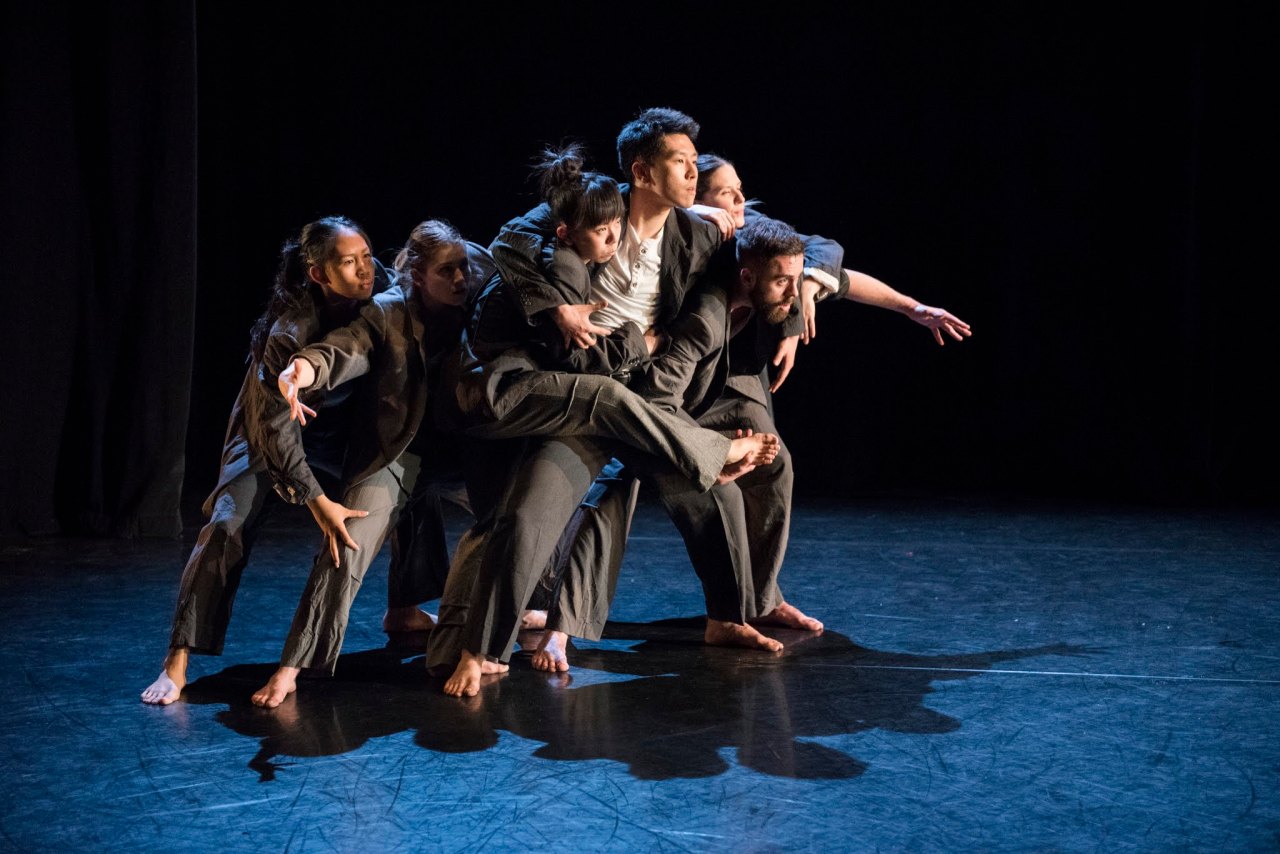
Burpee/Chin: Two New Works, Toronto Dance Theatre April 9-12, 15-18

It isn’t entirely clear how the neologism in Peter Chin’s Returning Empathis (empathy/emphasis) plays out in the work at hand. But never mind. We get the references to deep listening and empathy. Five dancers cluster around a throne-like chair to listen and watch as soloist Naishi Wang performs a tremendously articulate dance, all hands, limbs, sharp emphatic gestures – as if speaking to them.
When we watch dance we are practising a form of empathy, dancing in the dancers’ shoes, as it were. And we go into the dance and out of it, as do the watching dancers here, entering the empty space — the space of awareness — breaking into duets, quartets and solos, almost signing with finger gestures in their harmonic arrangements. Each entry onto the stage is a reinvention of oneself, akin to a reincarnation. Cheryl Lalonde’s costumes in the colours of Tibetan monks enhance the understanding of Eastern forms of thought. Chin’s marvellous soundscape, a haunting surround of chants from Tibet, music of Burkina-Faso and Madagascar and the ascendant choir of voices singing Thomas Tallis’ O Salutaris hostia provides the other chamber for this dance of ever-cycling life and death. Along with Naishi Wang, performers Alana Elmer, Yuichiro Inoue, Pulga Muchochoma and Jarrett Siddle make wonderful music together.
The Asian elements to the piece are a reminder that dance began in temples, in sacred spaces. It is a shame Chin’s piece couldn’t have been performed in a wide open white space, sun streaming in at a side angle. As it is, the bare, scarred walls of the Winchester stage, with its armature of industrial lighting equipment make a distraction requiring a very willing suspension of disbelief.
Speaking of which, Susie Burpee’s Making Belief (OR Seven Stages for Transformation, as played by a Willing Character) is a charmingly manic discourse on what it means to put on a character, go in and out of character, reveal the trickery behind the curtains and generally romp about in a swirl of artifice. Naishi Wang puts on a sad-face mask and white wig, while Pulga Muchochoma, his comic opposite, strides in like a loopy, vaudevillian Mr. Bojangles, grinning and manipulating Wang’s geriatric, tentative sadsack to perform — damn it. The metaphors get a little mixed as the rest of the company joins them, alternately role-playing as audience and back-up ensemble. A muscular Jarrett Siddall does deep breathing and holds his breath as if it was an athletic feat: maybe a sly jab at the tendency of some performers to overachieve on stage.
In any case, it’s a whole lot of fun, and to see Toronto Dance Theatre in all its current diversity – culturally, physically and stylistically – is to imagine we could have watched them dance all night.

Making Belief. From left: Danah Rosales, Christianne Ullmark, Megumi Kokuba, Naishi Wang, Alana Elmer, Nathan Todd

Photography by Ömer K. Yükseker.