Stephen Bigsby 1946 – 2024

My friend Stephen Bigsby was a remarkable person. It’s not often you find kindness, supreme intelligence, generosity, political astuteness and laugh-out-loud quick-wittedness in one man. I knew Stephen for most of my life, because his sister Gail was my best friend from grade 1 at Monterey elementary school in Oak Bay, BC.

Meeting the Bigsbys and spending much of my early years at their grand home on the corner of Beach Drive and St. Patrick Street, exploring tide pools on the rocks or dunking in the chilly waters of McNeil Bay, was for me a formative experience. Harry Bigsby, a superintendent of music for the Victoria School Board, oversaw a school program that ensured several generations of Victoria students got a sound musical education. Tall and handsome, and sometimes a little formidable, Harry, unlike most other dads in the 1950s actively engaged with his children and their friends. His American wife Dorothy, whom he met in the music faculty at the University of Washington, was a beautiful singer. She was the cool mum–full of fun, an avid golfer, outgoing and happy to chat with her children’s friends. She was the rare ‘50s mum who had a job, notably in the Hudson’s Bay Company’s record department during the Elvis era. Dorothy was the mother some of us wished our mothers might emulate.

Jim was the eldest. Five years older than Gail and I, he was a high school Somebody when we were still in bobby socks and saddle shoes. After graduating from the University of Victoria and Simon Fraser, Jim developed a business designing and implementing innovative educational materials. An enthusiast of the best kind, Jim was a musical force in Victoria. For decades he directed the Goward House Singers, a choir I joined in 2009, much to my benefit, for Jim was a gifted conductor, educator and orchestral arranger. Tragically, we lost Jim on January 20, only 13 days before his brother Stephen’s death from cancer on February 2, his exuberance stolen by vascular dementia. But that illness never robbed Jim of his expansive spirit, his brilliant smile and magnetic good looks. He leaves his wife Suzanne, steadfast and loving throughout Jim’s final years, son David, daughter Caitlin and their families.

Stephen, only 20 months older than Gail, was from his early teens a force to be reckoned with. He could be highly entertaining: joking, clowning and firing off zingers. Or he could be laser-focused on scholastic achievement, with a drive that saw him and his Oak Bay High School teammates win the BC Grand Champions title on Reach for the Top in 1964. The Bigsby household was not like mine. Here people laughed, joked and debated, expressed their feelings and followed their passions. Stephen was especially adept at debate. From high school, he was marked out for leadership — in politics, diplomacy and executive management.

Gail, lest we forget, was the little sister who more than held her own with her brothers, a talented artist and musician, and a champion golfer. She and I were friends, teammates and rivals on the honours list. We also got up to plenty of no good, starting from puberty. Gail was always the first to try anything forbidden or exciting: she made me do it.

As a first-year student at UVic, I re-encountered Stephen, in his capacity as the 1966-67 student president. He took on the role like the governor of a minor state. He encouraged me to apply for a Canadian Union of Students exchange scholarship that took me to Toronto for a mind-expanding year at York University. I was proud to join Stephen and his friends, including a previous UVic student president, Paul Williamson, at a weekly discussion group held in a downtown Victoria sauna bathhouse. The group was called the Socrates Society, if memory serves. Serious socio-political discussions took place as we sat in our bathing suits and damp towels. Although, it must be admitted, Paul and I also had less erudite pursuits in mind.

Stephen was a most educated man. In addition to a BA from UVic, he held an MA in political science from Carlton University and did a post-graduate year in economics in Stockholm, where he learned Swedish. On top of that, he earned an MBA at Université Laval, becoming a fluent French speaker. These studies were a methodical preparation for Stephen’s application to join the Canadian Trade Commissioner Service, where he worked in Ottawa and then secured an appointment to the Canadian consulate in Milan, Italy.

The fates served up the perfect match for Stephen, in the person of Elisabetta Recchi, a sharp-witted, well educated and cultured Italian, whom he hired to work in the trade commission office. Before long Stephen and Elisabetta were married. When they moved to Montreal in 1981, Stephen became Senior Industrial Commissioner (Europe) for Metropolitan Montreal’s Economic Development Agency. Elisabetta joined the RBC Financial Group, a move that eventually elevated her to the RBC executive committee. By 1997, Stephen and Elisabetta had moved to Toronto, where Stephen held the positions of vice-president at the Canadian Commercial Corporation and executive director at the Association of Canadian Pension Management.

After retirement, the couple travelled extensively, hopping between homes in Toronto, a condo in Victoria’s Swallows Landing and Elisabetta’s haunts in northern Italy. I got to know Stephen afresh and witnessed a marriage of true minds. They were amazing companions, sometimes during one conversation switching from English to French to Italian. Stephen was a loyal friend to those he’d grown up with and always stayed connected with them. He was also a benefactor from an early age, dating back to the summer he spent working for CUSO. A quiet but thoughtful philanthropist, he supported the arts and education.

On walks with him, Elisabetta and Gail, I noted that minor irritants such as a deceptive trail marking on a map of John Dean Park could set Stephen fuming. At the same time, he could, when faced with BC’s real estate speculation and money-laundering tax on their months-empty condo, compose a letter to the NDP government telling them precisely how to better reframe the tax, then post copies in the mail to every BC MLA.

Stephen wore his intelligence lightly; he never pontificated but could casually cast an analysis of Alexander Hamilton’s Federalist Papers, 50 years after he’d studied it. What’s more, he was a true gentleman, kind and considerate and always listening to what others had to say about the world.

I, along with all his friends and family, will miss Stephen fiercely, but we will never forget him. He was a man about whom you could say, he always showed up.

Photo: Stephen and Elisabetta on New York City’s Highline, December 2009, by Jack MacDonald

The secret order unveiled

Phil Comeau is an experienced francophone filmmaker with a long list of documentaries and features to his name. But even he looks a bit stunned by what he’s finding out about his father as he researches l’Ordre de Jacques Cartier in the NFB film The Secret Order.

The secret society established in 1926 was truly underground, its members recruited mainly through the church and its aims and rituals kept secret for life among most members.

A sinister air surrounds the francophone society as Comeau recreates an initiation ceremony in a very effective dramatization. The young men, having assembled at some point, don eye-masks for a blindfolded journey to an underground chamber. They must put a hand on the shoulder of the man in front and are led then by a member of the order to submit to five “ordeals” that will determine if they have what it takes to belong to Jacques Cartier brotherhood.  These tests involve holding a hand over a candle, walking a plank and having their heads held under water. In the film, one initiate decides the order is not for him. The ritual, led by a grand chief in a blue satin sash, was to show how solidarity was as important as secrecy in the operations of the order.

The Secret Order follows Comeau, a New Brunswick-born francophone, in his search through multiple archives to uncover the purpose of the secret society. The Jacques Cartier order was born of necessity: to assert the rights of French Canadians. Long before the 1963 Royal Commission on Bilingualism and Biculturalism, it was only through the Ordre de Jacques Cartier that francophones could establish the right to use their own language in their own country.

English oppression was so bad that as one Acadian former member of the order recalls, he was reprimanded by his boss at the post office for speaking French to a French-speaking customer.

For Phil Comeau, investigation into the order that his father was a member of was freighted with personal revelations. In one of the archives, he finds his father’s membership card. In another cache of materials, the actual eye coverings used in the initiation ritual. And his searches lead him to living family members as well as former members of the order, most of whom have never spoken of the secret society for a public audience.

Secrecy was paramount so each chapter or cell of L’Ordre de Jacques Cartier—as many as 850 across the country comprising 72,000 members—kept to itself. The goal was representation in government, in banks and on school boards, but recruitment focused on the rural population, which was where most Canadian francophones lived in the early 20th century.

By 1965, after Quebeckers began to agitate for their rights, the order was disbanded. However, The Secret Order is a testament to the many men (only one woman was ever made a member of the order) who helped secure the French language and francophone culture in Canada on a permanent basis. Among the prominent names were onetime mayor of Montreal Jean Drapeau and the first francophone premier of New Brunswick, Louis Robichaud.

No longer secret, L’Ordre de Jacques Cartier made an important contribution to Canadian democracy.

The Secret Order https://www.nfb.ca/film/the-secret-order/.

Photo: Young initiates taking the oath to the Ordre de Jacques-Cartier. Courtesy of the National Film Board of Canada

Louise Lecavalier, simply the best

Under a spotlight on a darkened stage, a breathtaking sight: her platinum blonde mane flashing, an embodied force of nature, the dancer in the black bustier explodes into barrel rolls, airborne, gathering speed. This was Louise Lecavalier dancing with La La La Human Steps in the 1990s.

And she’s still rolling: Lecavalier will perform her own solo, Stations, at the Fleck Dance Theatre in Toronto from November 23 to 25.

Muse to Edouard Lock, artistic director of La La La Human Steps, Lecavalier has continued as a solo performer and choreographer since she struck out on her own in the early 2000s.

She’s been a legend in her own time, a dancer one never forgets. “When you’re holding a bomb in your hands, what do you do with it?” says a male dancer in Raymond St-Jean’s 2018 documentary Louise Lecavalier: In Motion.

Born in Montreal in 1958, Lecavalier was dancing professionally by the time she was 18. She joined La La La in 1981 and helped define that company’s unique style of dancing. Interviewed by the CBC in 1989 alongside Lecavalier, Lock noted that dance had historically been about shapes, beautiful bodies arranged in artful positions. “I think it’s more interesting to see a flux of energy. Someone moving has no shape and that’s really interesting; it’s almost an abstraction.” Lock and Lecavalier’s collaborations ended in 1999.

Her hair shorter now, Lecavalier has continued as a notable presence on the international stage, commencing with establishment of her own company, Fou Glorieux, in 2006. Its mandate: “to bring together dancers and collaborators of all ages and horizons around a fully mature performer to carry out creation projects in a flexible, open framework.”

In 2006, Lecavalier collaborated with Crystal Pite, who choreographed a solo for her, Lone Epic, which was boldly set to Bernard Herrmann’s music for Citizen Kane. In the 2009 piece Children, choreographed by Nigel Charnock, Lecavalier danced with Patrick Lamothe to the music of Leonard Cohen, Brownie McGhee, Billie Holliday and others. Described as a narrative of a long relationship breaking down, Children is highly physical, the performers taking on the appearance of overgrown kids.

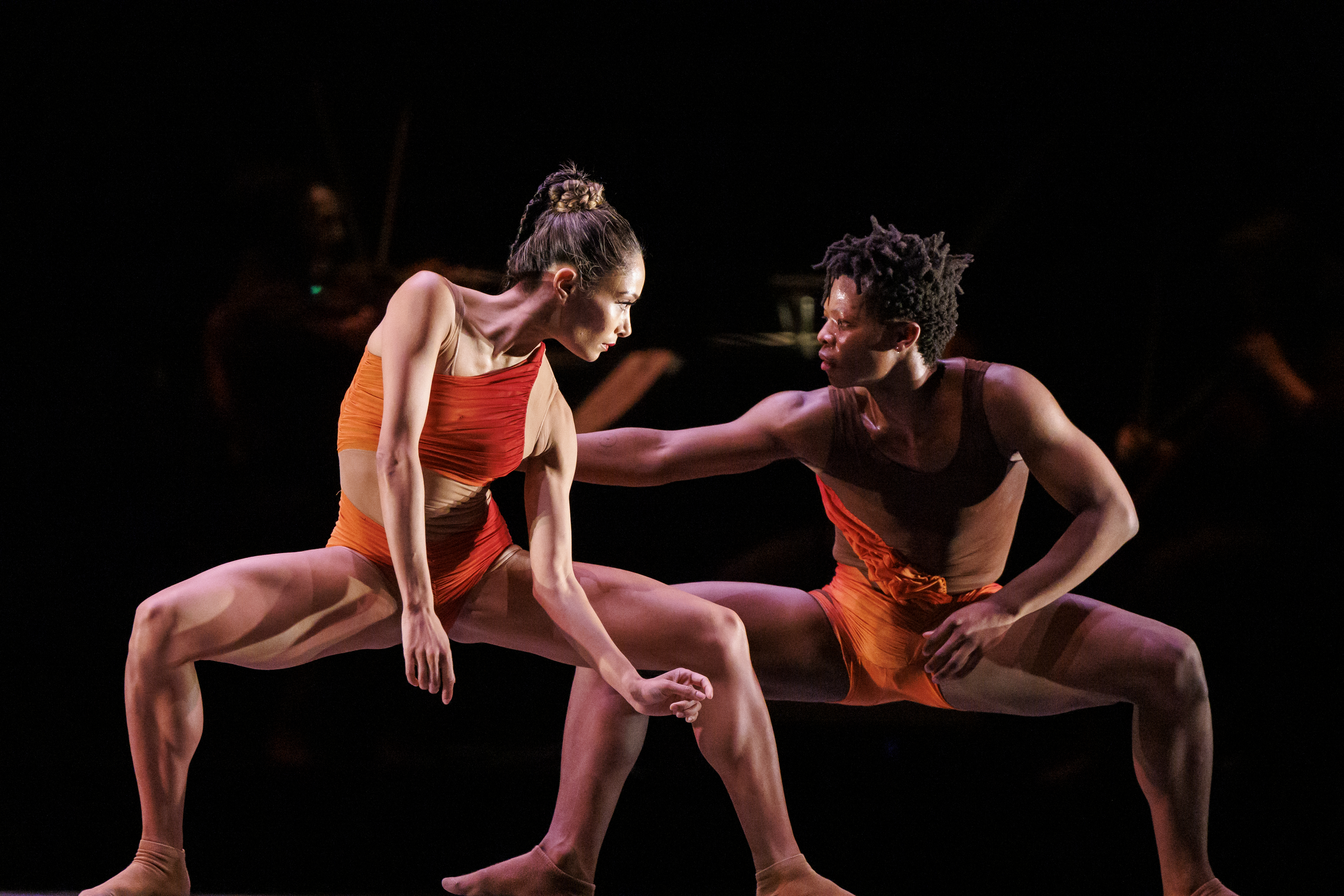
Battleground, the piece Lecavalier choreographed for herself partnering Robert Abubo, is based on the characters in Italo Calvino’s novella, The Non-Existent Knight. These duets seem to deepen Lecavalier’s intensity, as she pits herself against a dancer of equal energy, the results definitely greater than the sum of the parts.

“Increasingly, over time, I have become the subject of my research,” says Lecavalier. “I take the risk that my various existential battles as a dancer may resemble those of others, trusting that the new difficulties I come up against or inflict upon myself in the movements will always provide an answer and perhaps a true space of freedom. I go back into the studio to discover the previously unrevealed movements that will allow me to renew and clarify what my body needs and what inspires me now. I seize upon new steps as if it were a matter of sheer survival.”

Hence, Stations, which premiered in Dusseldorf in 2020. The wild white-blond hair is part of this performance, which finds Lecavalier, no worse for punishing years on stage, whirling and contorting in a fascinating blur to the original, jazzy music of Antoine Berthiaume. Clearly Louise Lecavalier is the Mick Jagger of contemporary dance: electrifying, inimitable.

Stations

Created and performed by Louise Lecavalier

November 23 to 25, 2023

Fleck Dance Theatre, Harbourfront Centre, Toronto
Photo of Louise Lecavalier by André Cornellier

Gallery

Beautiful, historic southwest Saskatchewan

Among the several reasons to visit Fort Walsh National Historic Site in southwest Saskatchewan, is the route that takes you there. Heading west out of Eastend, you’ll drive through the Cypress Hills, location of some of the most spectacular and unpredictable landscape to be found in Canada: white clay mounds rising out of hills riven with lush, treed coulees; wide open prairie where ferruginous hawks can swoop over the grasslands; and a winding upland highway that opens onto an alpine meadow.

Just beyond the meadow lies Fort Walsh, designated a national historic site because of the massacre of more than 20 Nakoda men, women and children on June 1, 1873. Behind the Assiniboine peoples’ deaths lies a complicated history. The Nakoda were the collateral damage in a fight for resources among various colonial and American parties over the land they lived on.

The wolf hunters, whiskey and fur traders who committed the massacre were mostly American, but there also Métis and Upper Canadian fur traders attracted to the territory by the dwindling herds of buffalo.

The massacre, news of which soon reached Ottawa, spurred the deployment of the Northwest Mounted Police, precursors of the Royal Canadian Mounted Police. Created by an act of Parliament in 1873, the force was already established at Fort Garry. But news of the massacre prompted a long march of Northwest Mounted Police, 300-strong, aimed at bringing law and order to the western territories and securing Canada’s sovereignty over the land in the face of American incursions from south of the border.

In their scarlet tunics and navy-blue trousers, the men set out from Dufferin, Manitoba on July 8, 1874 to make the 1,300-km march across the prairies on horseback, towing supplies in red river carts. The force split at La Roche Percée in what is now southwest Saskatchewan, one group going northwest to establish Fort Edmonton and the other heading for the territory where the American whiskey traders were still making trouble for the local indigenous people. And so it was that James Morrow Walsh, a NWMP superintendent, established a military base at Fort Walsh in 1875. Soon Canadian control of the territory was fixed, the whiskey traders routed and relations with the indigenous locals established.

The present fort is a reconstruction of the original, furnished and appointed as it was in the heyday of the NWMP as the force protected the territory for the English and French traders and settlers, including a substantial community of Métis, who became adept traders with the local first nations inhabitants. For better or worse, the presence of the NWMP also ensured the signing of treaties with the indigenous peoples.

Today, uniformed guides at Fort Walsh take visitors on an informative tour of officers’ quarters, stables and smithy, giving a clear picture of life in the fort nearly 150 years ago. Bernard (Cheng Hao), an excellent guide in full uniform, points out details in the reconstructed interiors of various buildings, including the commanding officer’s living quarters, non-commissioned officer’s quarters and a piece of artillery whose function he can demonstrate.

Outside the palisades, stroll down to two cabins, where guide Stephen Girard, dressed as a Métis trader, outlines the relationship between the local Métis, the NWMP, the settler population and the Indigenous communities. Hudson’s Bay blankets, dry goods, beaver and other pelts stock the shelves and counters. Girard explains how many bison hides (five or more) might be traded for one HBC blanket, marked with lines that show the height of pelts required in trade.

In search of living bison, a visitor might drive toward the border with Montana to a former ranch on the Old Man on His Back plateau, now designated a Prairie and Heritage Conservation Area. If you haven’t booked a tour, you can wander over the hills and plateau and if lucky, might see a bison or two grazing with cattle. It’s pretty exciting.

Photos, clockwise: Stephen Girard as a Métis trader, Old Man on his Back nature conservancy, Bernard in the Fort Walsh NCO quarters, cattle grazing in the Cypress Hills.

Raising the roof with red-hot ballet

As thunder snow and lightning engulfed Toronto on opening night, the energy of dozens of dancers on the stage of the Four Seasons Centre felt sufficient to lift the roof off – and indeed lifted the National Ballet of Canada’s opening-night audience multiple times out of their seats.

The mixed program, which resumes March 22 and 23, is all about the new and the renewed. In her first season as NBoC artistic director, Hope Muir has shown dedication to new work, new choreographers and development of a dynamic and thrilling cadre of performers.

This mixed program — something old (George Balanchine’s Symphony in C), something new (Rena Butler’s Alleged Dances) and something new to the National Ballet (David Dawson’s Anima Animus) – engages one’s imagination like no other dance show in recent memory.

George Balanchine’s Symphony in C, created for the Paris Opéra Ballet in 1947 and first performed by the NBoC in November 1984, is dazzlingly renewed with this staging, the last for dancer and Balanchine répétiteur Joysanne Sidimus, who is retiring from her work as a Balanchine interpreter for the National Ballet for the last 38 years. In its lightness of mood and step, its speed and its clean lines and stripped-down classicism, Symphony in C embodies the spirit of modernism that Balanchine brought to ballet. The four movements of the ballet, challenging in the precision needed for difficult pas de deux and pas de trois, are here outstandingly executed by pairs Koto Ishihara and Harrison James, Genevieve Penn Nabity and Ben Rudisin, Jenna Savella and Naoya Ebe and Tina Pereira with Keaton Leier.

Rena Butler, a Chicagoan who shares with Muir a history at Hubbard Street Dance Chicago and is the 2019 recipient of the Princess Grace Award for Choreography, more than meets expectations with her first piece for the National Ballet, Alleged Dances. Butler engendered a piece in which the ballet’s dancers share the stage with a live string quartet (Aaron Schwebel, Jamie Kruspe, Joshua Greenlaw and Olga Laktionova) that shifts on its platform across the stage as they play American composer John Adams’ John’s Book of Alleged Dances (1994), creating a spectacle of red-hot, sexy and sassy dance, at once playful and awe-inspiring.  Siphesihle November performs the part of a playground leader, as Teagan Richman-Taylor, Noah Parets, Tina Pereira, Alexander Skinner, Josh Hall, Emma Oullet, Tene Ward and Arielle Miralles, play a game of tag involving pigtail-pulling, or hide-and-seek, or truth or dare. Alleged Dances is a high-octane, ever transforming romp that borrows from social dance and at some points looked like a country hoedown. Hogan McLaughlin’s blazing red, minimal costumes brilliantly highlight the singular movement of each performer.

The ten dancers who made David Dawson’s Anima Animus their own upped the bar even higher, supercharged as they were with the emotion-filled music of the late Italian composer Ezio Bosso. The British choreographer, associate artist at Het Nationale Ballet and associate choreographer for Semperoper Ballett, is a prolific contemporary dancemaker with whom Muir has frequently collaborated. Having been moved by the San Francisco Ballet’s 2018 premiere performance of Anima Animus by the San Francisco Ballet, Muir was eager to bring Dawson’s work to the National Ballet as an opportunity for the dancers to deepen their individual capabilities.

As hinted in its title, Anima Animus mixes up traditional ballet gendering, with the women, particularly Calley Skalnik, doing as much of the heavy lifting as the men in what was a beautifully, organically constructed performance, seemingly evolving before our eyes and ears. All the enduring elements of ballet – especially the pure joy of movement and partnering – were present, the dancers’ movements emphasized in Yumiko Takeshima’s unisex costuming that outlined each undulating spine. For all the abstraction of set and costume, the piece appeared to grow as if in nature, establishing a fragile order and following the geometry of desire toward a culminating exultation.

Anima Animus & Alleged Dances & Symphony in C

Choreography by David Dawson, Rena Butler and George Balanchine

Performed by the National Ballet of Canada at the Four Seasons Centre for the Performing Arts, Toronto

March 22 and 23, 2023

Photo of Tina Pereira and Siphesihle November in Alleged Dances by Bruce Zinger, courtesy of the National Ballet of Canada

Remounting a play about regeneration

Talk about dramatic catharsis. The Belfry Theatre’s remount of Yvette Nolan’s enduring play The Unplugging takes us through the pain of exclusion and the suffering of shunned women, through to survival, remembering and reconnection to community. Filled with music and laughter and ending with a kitchen party musical jam, this unplugging opens up the heart and brings a lump to the throat. But those were tears of joy.

“It is, I guess, a reconciliation play. That’s not what I was thinking when I wrote it. But I’m a half-breed, right?” Yvette Nolan, chatting on Zoom from Stratford, where she’s teaching the young artists of the Birmingham Conservatory, comes across as a thoughtful, generous writer with a buoyant spirit and a sense of wonder about life and other’s lives.

“The source material is an Athabaskan story called “Two Old Women” told by an Alaskan Gwich’in woman,” says Nolan in an interview recorded for the Canadian Theatre Museum.

“It’s an old story — pre-contact, generations ago. Two old women, in a time of need are banished from their community because they are old and grumpy and useless. Instead of dying they must go inside themselves and remember their traditional knowledge and in order to survive.”  Learning that the banished elders are thriving and not dead, their band sends an emissary to bring them back home.

As Nolan was adapting the tale for a 21st century context, a series of warnings, from the Toronto blackout of 2003, to the Japanese earthquake and tsunami to the extreme weather events contributed to an apocalyptic vision: a complete collapse of the world’s electrical grid. In the aftermath, two older women, Elena and Bernadette — 60-ish and 50-something respectively — are cast out of a cult-like, post-digital community ruled by the Laird. Director Reneltta Arluk has chosen to cast Bernadette as non-Indigenous, cementing the theme of reconciliation.

The Unplugging plots Elena and Bern’s journey in lunar fashion from Sugar Moon to Bear Moon to Pink Moon, from despair to survival to hope and joy. Elena, who has been forcibly detached from her daughter and grandson, regains her indigeneity, her traditional knowledge. She ponders what was lost when the grid went down: “Think of all the information that disappeared, in a blink. All the things we stopped writing down and putting into books, all the things we stopped teaching our children, all the things we need to know now, like, what is the shelf life of tea.” Elena’s recovery of her indigenous skills and knowledge is done in concert with Bern’s recovery of her female vitality. She acts as a goad to Elena in her lowest moments and finds her inner strength. Along with it, she regains the joy of touch sexual congress with Seamus, the young man who suddenly shows up in the women’s forest sanctuary, an abandoned summer cabin.

Nolan, born in 1961 in Prince Albert, Saskatchewan, where her Irish-born father was teaching in the penitentiary there, moved with her family to Winnipeg when she was six. As a young ballet student in the school of the Royal Winnipeg Ballet, she found her calling after seeing the ballet’s adaptation of George Ryga’s 1970 play, The Ecstasy of Rita Joe.

“It was the first time I recognized that our stories – Indigenous people’s stories – could be told on those big stages. It didn’t matter to me that Rita Joe and Jamie Paul were danced by a Spanish dancer and an Italian. What I learned in that moment was the power of theatre to raise people’s stories, to make my stories visible.”

The playwright, dramaturg, director and educator – a stellar artistic director of Toronto’s Native Earth Performing Arts company from 2003 to 2011 – admits there’s something of her mum in Elena. Nolan’s Algonquin mother, Helen Thundercloud née Chabot, was born and raised in Kitigan Zibi, a reserve at Maniwaki, north of Ottawa.

“She had no formal education. She was sent to residential school in Spanish, Ontario and then Kenora in the 50’s.” Despite the lack of necessary schooling, Helen could speak three languages: Algonquin  French and English.  As Yvette, born when her mother was only 17 or 18, sees it, her mother grew up in one patriarchy, married into another and then had to endure the ultimate colonial experience: the harsh racism of pure laine Quebeckers whose references to her as “une sauvage” she all too painfully understood.

Helen Chabot met Yvette’s immigrant father, son of a Sinn Fein fighter, after he’d fled to Canada from a seaside town outside Dublin, refusing to be conscripted into the English army.  “He was my mother’s math teacher, ten years older than his student.” They grew together out of a shared sense of colonial oppression. “When she graduated from the residential school, the nuns gave them a little wedding.”  But the struggle continued for Kevin Nolan.  As he was always trying to find a better job, they moved often and Yvette, elder sister to two younger brothers, witnessed the scorching anti-Indigenous racism of the prairie provinces. But today, Nolan has happily settled in Saskatoon. “I’ve got some really special feelings about Saskatchewan, these days.”

The Belfry’s production of The Unplugging is also a kind of homecoming: the show had its premiere in October 2012 at Vancouver’s Arts Club Theatre. Director Arluk, an Inuvialuk/Dene/Cree raised by her grandparents on a trap line in the Northwest Territories, once put up a production of The Unplugging  for her own Akpik Theatre in Whitehorse. This time for the Belfry she went for maximum celebration, bringing in Krystle Pederson, a Cree/Metis actor, singer and songwriter as sound designer. On opening night, Pederson warmed up the audience with a full-throated rendition of “Red River Valley” then took her place on set among the trees, playing musical interludes she composed.  Daniela Masellis’s emblematic forest set and lighting enclose the action for what is a very intimate play.  All three actors — Lois Anderson as Bern, aaron wells as Seamus and Marsha Knight as Elena – are outstanding in their roles, making the play very physical and dancey. Winnipeg’s Marsha Knight as Elena really anchors this show, embodying a proud, motherly spirit of reconnection and hope for reviving the broken dreams of unity among Indigenous and non-Indigenous communities.  

The Unplugging

Written by Yvette Nolan

Directed by Reneltta Arluk

At the Belfry Theatre, Victoria BC until March 3, 2023

Photos, clockwise, from left: Marsha Knight as Elena, Lois Anderson as Bern, čačumḥi – aaron wells as Seamus; playwright Yvette Nolan. Photo credit: Don Craig

Newton throws a bang-up birthday party

Ask Newton Moraes — celebrating 25 years of the company that bears his name — how he got into dance in Brazil and the first word that comes out of his mouth is “Bob”. By that he means the late Bob Shirley, an anthropologist from the University of Toronto whose studies were concentrated in Brazil.

“I met Bob in 1985. I was studying physical education at Unisinos University in Porto Alegre.” They became friends and later, partners. Moraes, who had done some samba dancing, admired a company called Ballet Phoenix. “He said, ‘Why don’t you start taking class with them? So I did and I took some jazz and some ballet classes.”

He recalls with fondness the 86-year-old dancer, Tony Petzholds, who taught the ballet classes. “She was a fabulous dancer. She was doing a penché and I couldn’t believe this woman had her leg up here (he demonstrates). ‘This is how it is supposed to be done,’ she said. Even the dancers in the company would look at her and say, ‘holy fuck’.”

While still living in Porto Alegre Moraes also took lessons from a jazz dancer, Annette Lubisco. Three years after meeting Newton, Bob had to return to his job at U of T. But the two kept in touch. By 1991, Moraes was dancing in Porto Alegre and even teaching. On a visit, Bob said, “Newton, you are very talented. I should take you to Canada. Believe me, you are going to love it.”

So in 1991, with minimal dance experience, no English and few prospects for work, Newton — thanks to a letter Bob wrote to immigration authorities – was granted a visa and moved in with the anthropology professor in Toronto. Right away he enrolled in English classes during the day and dance classes at Toronto Dance Theatre at night. He auditioned for the School of Toronto Dance Theatre and in 1992 was accepted. Then, like a hot wind in winter, Newton Moraes burst upon the dance scene.

“Six months later, I was on stage.” Toronto Dance Theatre was performing Court of Miracles at the Premiere Dance Theatre (now the Fleck) and they brought in students, including the first-year men, to fill out the cast. “There I was performing with Patricia Beatty, David Earle and Peter Randazzo.”

Students at the TDT School were encouraged to create. “I started to make my little choreographies for the student shows at the Coffee House. And Trish Beatty said, ‘You have something to share: carry on.’ ”

By 1994, with Bob Shirley’s assistance, Newton and the students mounted a show at the George Ignatieff Theatre on the UofT campus. It was all free and the theatre was packed. Soon, he was dancing at the Fringe Festival of Independent Dance Artists and even got a gig at the Music Gallery. The first time I saw Newton dance, it was a solo based on his batuque religion. Scantily clad, moving slowly and deliberately on the FfIDA stage, he was spellbinding, doing something I had never seen before.

More lessons, in jazz, invitations to perform at German festivals, a stint at York University and more networking led to the formation of Newton Moraes Dance Theatre presenting its first show May 22 and 23, 1997. The company continued into the new millennium, funded through a combination of Bob’s generosity, government grants, teaching classes in Afro-Brazilian dance and Newton’s willingness to take on day jobs, usually as a cleaner.

Over the years, Newton Moraes Dance Theatre has employed dozens of dancers and given work to outstanding dance professionals, including Sharon DiGenova, lighting designer for the anniversary show Life Under My Skin. His Brazilian influences and dance foundation have always been detectable in his choreography, especially in works such as Brazil: The Land of Tears and Soul, from 2013. Nevertheless, Moraes credits major mentors such as Denise Fujiwara, Danny Grossman and choreographer/dancer Jean Sasportes, the long-time Pina Bausch associate, for his growth as a choreographer.

Life Under My Skin has been in development for months. Collaborating with composer Edgardo Moreno and the troupe of eight dancers, Newton built a dance that asks the universal questions about why artists are forced to create and how they survive when money is scarce. Questions Newton himself knows the answers to. Funding from the Toronto Arts council, Ontario Arts Council and Canada Council for the Arts has also enabled the creation of a documentary film about the company. It’s going to be a bang-up birthday for Newton Moraes Dance Theatre.

Life Under My Skin

By Newton Moraes Dance Theatre

Fleck Dance Theatre, Harbourfront Centre, Toronto, 8 pm, November 24-26, 2022

Photo of dancers Maggie Armstrong, Daniela Carmona, Emilio Colalillo, Rumi Jeraj, Aryana Malekzadeh, Jianna Neufeld, Andrea Rojas, Brendan De Santis by David Hou.

“I’m worried about your health…it seems to be improving.”

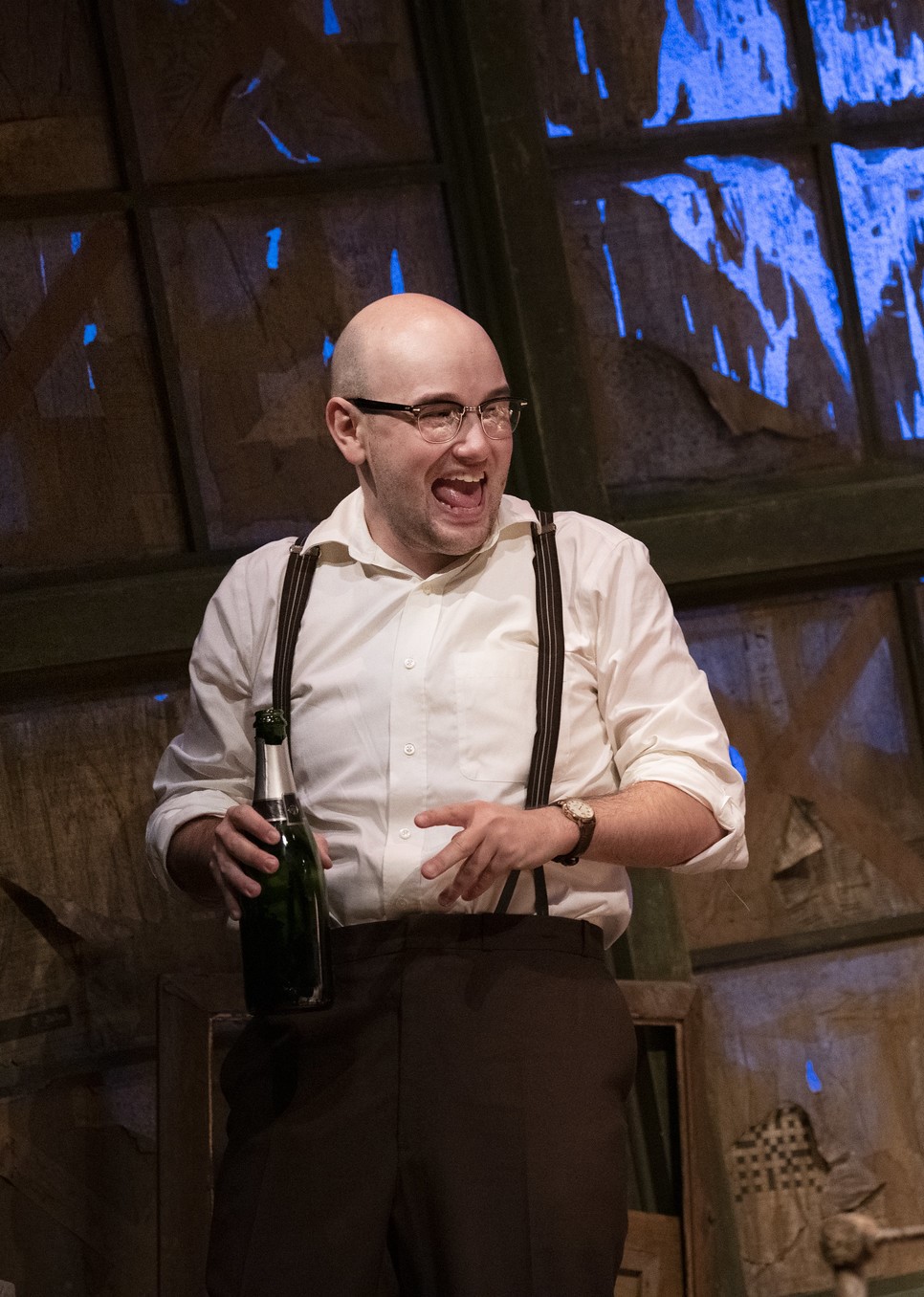
In its opening moments, Morris Panych’s Vigil is a straightforward black comedy about a man visiting his aunt on her deathbed. It’s a good text for a stand-up comic. Then as we get into the second act it’s pure theatre of the absurd. Looking back after the curtain comes down, you realize that Panych wasn’t just riffing on death and dying. He nailed another universal theme: the need to feel loved and accepted.

Panych himself directed the first production of Vigil, which took place at the Belfry Theatre in 1995. Glynis Leyshon was the Belfry’s artistic director then. Twenty-seven years later she has returned to the Belfry to direct this production. She shows a sure hand indeed. In the intervening years, Vigil took over lots of theatres in Canada and abroad. Of the many Panych plays – he’s written upwards of thirty of them – this one sticks in the mind like no other.

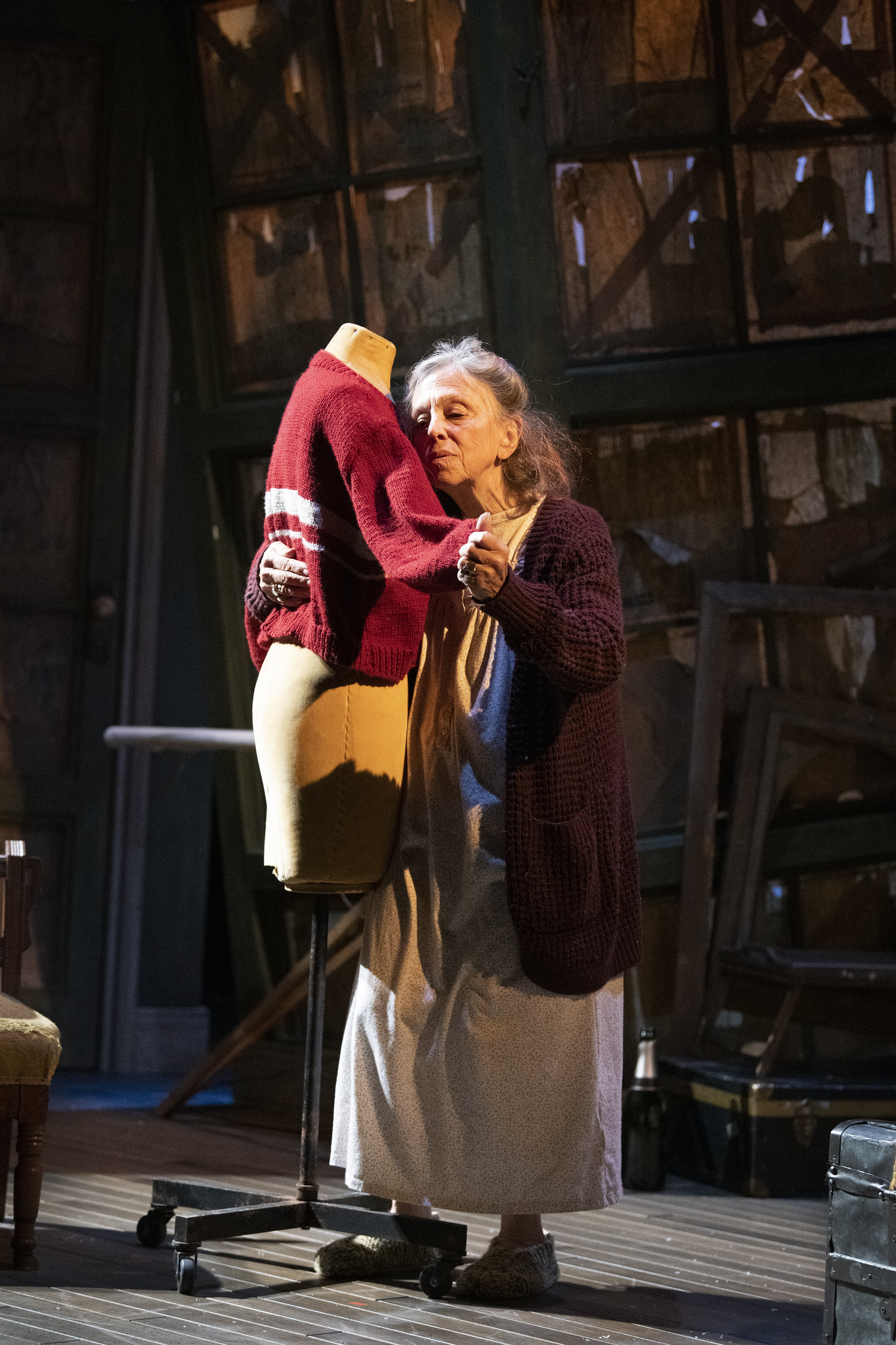
“Why are you looking at me like that. I’m your nephew. Okay – so I didn’t visit you for thirty years.” This is Kemp, played by Anton Lipovetsky, addressing Grace, who sits silent in her bed propped up by pillows. As Grace, Nicola Lipman must act without words, which she does very well.

It soon becomes clear that Kemp is more interested in his aunt’s death, and how it might benefit him than in tending to her in her final days. Bearing a clipboard, he proffers a will for her signature: “You are leaving it all to me.” The vigil lasts days, then weeks, then passes the year mark.

Kemp puts on a sham show of concern. “What am I supposed to wear to your service?” he asks. “Let’s not talk about anything depressing. Do you want to be cremated?” Grace, her meals served to her bed, alternately smiles, nods, rolls her eyes and occasionally hurls something her nephew.

Vigil is a well honed play. Nearly all the spoken words are Kemp’s. He rambles from self-interest to self-pity to genuine concern, in the process confessing to crimes committed against him by an alcoholic mother. Unfortunately, Lipovetsky doesn’t express the nuances, delivering all his lines at much the same pitch and tone. Maybe he’ll grow into the part with the help of enthusiastic audiences. He can certainly move well.

Lipman makes an excellent bed-ridden aunt, except when her nephew is absent from the room. Then she’s delightfully spry, at one point circumambulating around her bed doing lunges and lifting (invisible) weights.

Ken MacDonald’s set is key to the action, with its aged walls, windows and doors skewed at crazy angles. The Belfry production underscores the durability of Panych’s plays. Long may he reign, in Gilbert Reid’s words, as “a driving force in the Vancouver and Toronto theatre communities.”

Vigil

By Morris Panych

Directed by Glynis Leyshon

The Belfry, Victoria BC

Live performances through December 11

Live-streamed November 29 to December 4 http://www.belfry.bc.ca

Photos of Anton Lipovetsky and Nicola Lipman by Emily Cooper

Kaeja d’Dance going strong and stronger at 31

“Kaeja d’Dance is driven by a commitment to innovation in the performing arts through the expression of dance and gesture. We explore identity, personal stories and the complexity of the human experience . . . [through] mediums of live performance, dance film and community engagement.”

The mission statement is no mere window-dressing. On the 31st anniversary of the company they formed, in the 37th year of their relationship, Allen and Karen Kaeja are innovating as much as ever. For this dance company, curiosity and imagination have allowed the participants – dancers, composers, filmmakers and directors always their co-creators – to evolve according to the opportunities presented to them.

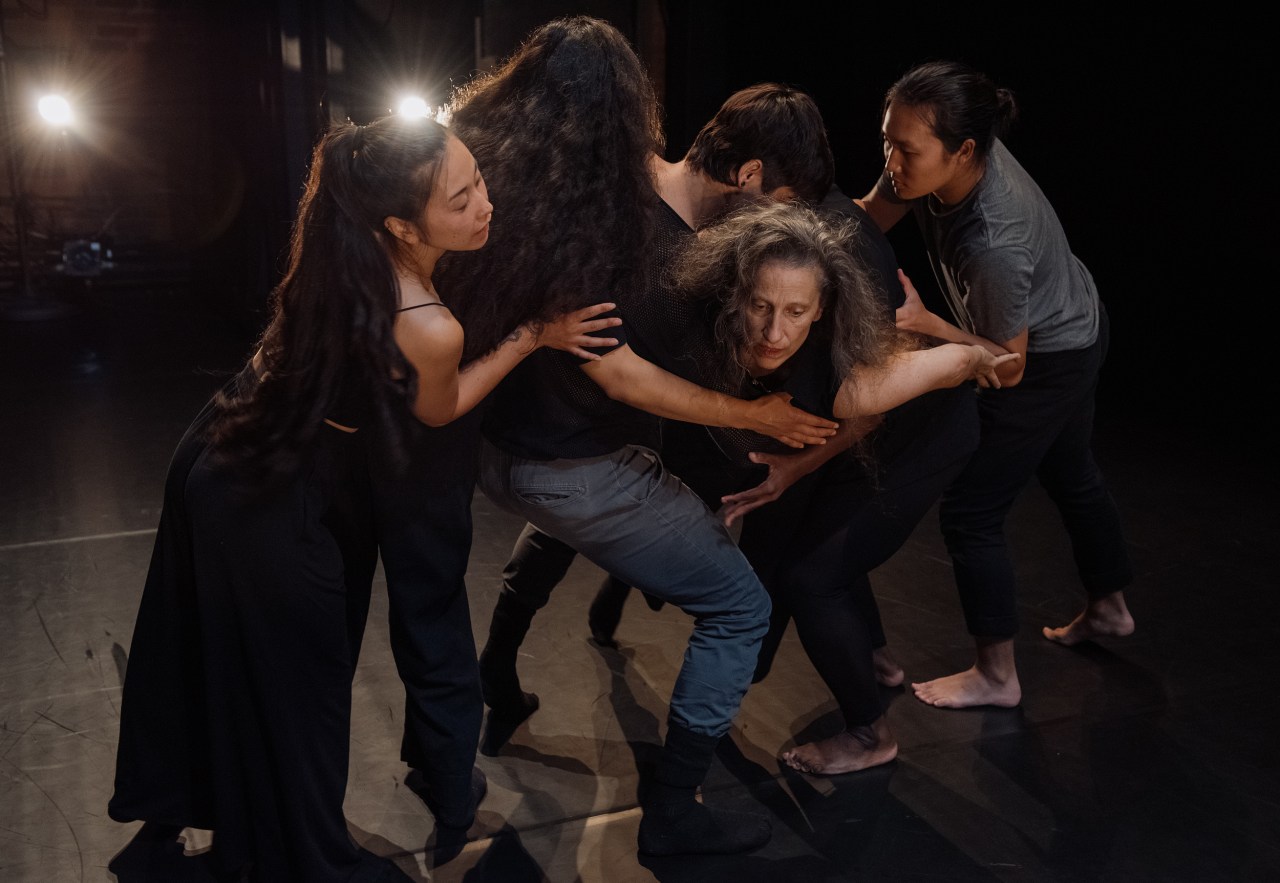
From November 11 to 13 at Harbourfront Centre Theatre, Kaeja d’Dance presents 31, a double bill that in several ways sums up the themes and direction the company has taken since its founding. In both pieces – Allen’s I am the Child of… and Karen’s TouchX – it is possible to see the fruits of a commitment to innovation and community involvement.

On Zoom from their home in Toronto, the married couple, parents to 29-year-old Aniya and 24-year-old Mika, give a clear account of how they got to this production.

Speaking about innovation, Allen, who came to dance through the martial arts, says of 31, “we are the first dance company in Canada to fully integrate immersive AR in a dance stage production. And Karen’s work is totally cutting edge in the integration of community and professional dancers.”

If there’s a rough division of labour here, Allen’s focus has been on making dance film and technological innovation, Karen’s on collaborating with community. Both have been heavily involved in dance training, which is an ongoing practice for the company, offering workshops to schools, professional dancers and individuals with no prior dance training. As co-artistic creators, they’ve racked up more than forty awards, created more than 200 original works and 35 dance films. They’ve also published EXPRESS DANCE: Educators’ Resource to Teaching Dance.

“We have worked with hundreds and hundreds of dancers over the 31 years. People who brought their beautiful talents to our work,” says Karen. The annual summer series Porch View Dances, inaugurated in 2012, is an example of the meaningful community engagement the Kaejas strive for.

After turning the porches and front yards of Toronto’s Seaton Village into outdoor stages, Porch View has also expanded to other cities. The project, says Karen, is about “honouring people who live in the community we’re working with, revealing the stories that live in the houses and bringing those stories alive on the front porches and front yards, working with professional choreographers.“ The format involves a tour guide who leads the audience around the neighbourhood telling stories from the area, “some true, some less true.”

The development, over seven years, of TouchX is allied to Karen’s work with communities. “It is based on an exploration of touch in all its fabulous and not so fabulous aspects. The fragility of touch, the agency of touch, the wanted touch, the unwanted touch and all the different kinds of responses that touch can evoke.” A late arrival to dance, Karen was drawn to its sensorial aspects at age 18. She alludes to childhood trauma when she talks about how enrolment in York University’s dance program led to a fascination with improvisation and contact dance.

For TouchX, Karen invited different generations of community participant dancers to join the professional dancers on stage. Needless to say, the pandemic, with its enforced social distancing shed a new light on the importance of touch in all our lives. “It’s great,” says Karen of COVID strictures, “because it’s pushed the work. It’s been wonderfully challenging.”

I am the Child of … had its genesis in a Facebook post Allen put up in 2015, reacting to the Harper government’s determination to stop middle eastern refugees from coming to Canada. “I am the child of a refugee,” it was titled. Allen told the story of his father, Morton Norris, a holocaust survivor whose entire family was murdered by the Nazis. He sought to enter Canada and a cousin warned him, “They don’t want our kind here.” But when the government of that day fell, Allen’s father was admitted to Canada. His story exemplifies the value that refugees bring to whatever country they land in. “What do refugees do? My father built a world; he built a community; he made a new family. He was made an honorary police officer because of his work in the community.”

Bruce Barton, a performance director, dramaturg and creator based in Calgary, has worked with Allen Kaeja on five productions. With I am the Child of… they have been co-creators from the outset of workshops and residencies that built the show, which engages 13 dancers, eight live and on stage, five who exist in augmented reality. Audience members for Child are encouraged to bring their devices, for an enhanced experience of the show.

The Kaejas had experimented with AR for a site-specific commission from ArtworxTO that had to go virtual after a new wave of COVID imposed lockdowns. But for this show, says Barton, he and Allen were entering uncharted territory: creating the appearance of live and AR dancers interacting on stage.

“We had to be sure that the AR aspects were thoroughly integrated thematically into the piece, and not just a novelty,” says Barton, who with his partner Pil Hansen (one of Karen’s dramaturgs for TouchX) is an artistic director of Vertical City Performance. To achieve this goal, they engaged Toasterlab, a Toronto-based outfit with experience in using “extended reality” in performance. Edgardo Moreno, who has been composing sound and music for Kaeja d’Dance for thirty years, has created a soundscape for Child that employs the performers voices in speech and song, with no instrumentation.

Allen’s genius, Barton says, is in creating a framework for the dancers to explore different themes in the piece, one of which is “how we connect, or fail to connect, with one another through the stories we tell about ourselves.” (See links below to trailers.)

So, much to celebrate. And when asked what they are looking forward to as Kaeja d’Dance heads into the future, both artistic directors are pretty sure they won’t run out of ideas. What’s more, says Karen, it is vital to engage with younger generations, as the company tends to do.

“Thank goodness for them,” she notes, “because we more mature artists have a lot to learn from their new thinking.”

Kaeja d’Dance: 31 (TouchX + I am the Child of …)

November 11 and 12 at 7:30 pm, Nov. 13 at 2 pm

Harbourfront Centre Theatre, Toronto

Links to trailers: https://drive.google.com/file/d/1VFFhvUpHiVqSM4kWVvXS1iSgZiGvCz7S/view

https://www.kaeja.org/k31

Photo of I am the Child of…: Aria Evans, Karen Kaeja, Ethan Kim, Geanderson Mello, Mio Sakamoto

Photographer: Kevin Jones