Gallery

East merges with West in Mukashi Mukashi, to hilarious effect

Once upon a time, David Danzon, the peripatetic artistic director of Corpus Dance Projects, decided to embrace Japanese theatrical traditions to come up with a cross-cultural contemporary fairy tale.

After touring shows through Japan, Corpus partnered up with Osaka’s 53-year-old Kio theatre company to co-produce  Mukashi Mukashi, a contemporary interpretation of two characters central to European and Japanese folklore: the wolf and the crane, respectively.

The kid-friendly show, launched at a festival in Japan last October is playing now, for its first North American run, at the Theatre Centre in Toronto, until Sunday, September 29.

Mukashi Mukashi is a madcap mash-up of physical theatre from two distinctly different cultures. Corpus and Kio found their theatrical modus operandi quite compatible. Danzon worked with the Kio company to incorporate Kabuki, Noh, Bunraku (body puppetry) and Kyogen (the comic interludes between acts in a Noh play) into the Corpus brand of physical theatre. He layers these expressive movements, scene by scene, to create a melding of human and animal, as any good fairy tale would. The skills on display here revolve rapidly through mime, to dance, puppetry, mask, clown, live origami-making, Asian shadow puppetry, to a manic, sequin-jacketed TV game-show host — all accompanied by Anika Johnson’s evocative  soundscape.

By turns hilarious and thought-provoking, Mukashi Mukashi proceeds  through a series of nine short scenes, the performers speaking mainly Japanese, with a few lines of English thrown in. There is not a lot of dialogue, but English and French surtitles, white on black panels, spark memories of the talk panels in the silent films of Buster Keaton or Charlie Chaplin, early influences on Danzon’s comedic practice. The dream-like sequence follows an arc from mortal danger through comical transformations, to peace and fulfilment, tapping deep into the collective unconscious.

In The Uses of Enchantment (1976) child psychologist Bruno Bettelheim famously argued that the violence and fantastical nature of traditional fairy tales were not to be shunned in favour of anodyne realist children’s literature, because stories such as Little Red Riding Hood cathartically deal with primal fears and lead to healthy childhood psychological development. Mukashi Mukashi is enchantment at its best.

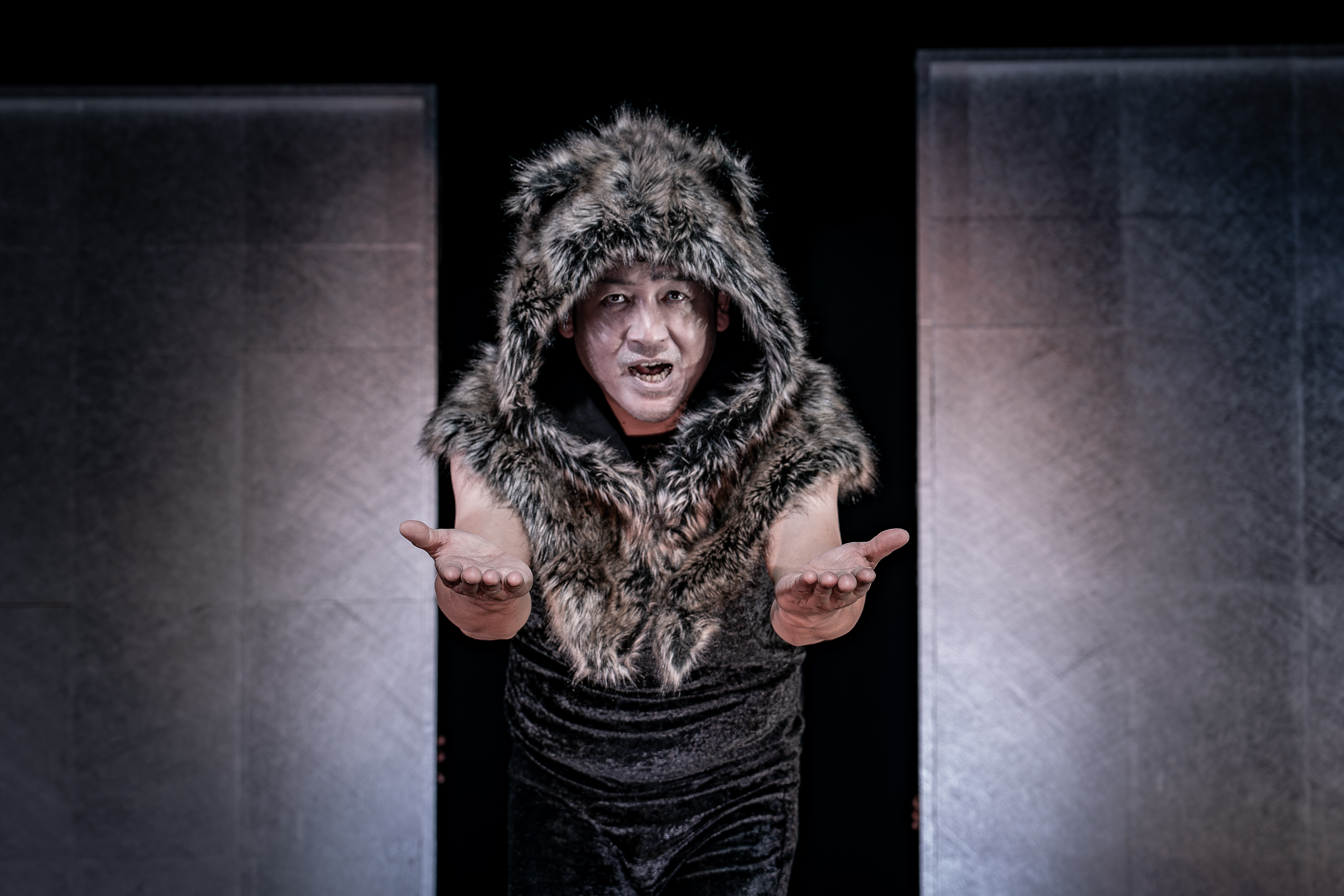
Guffaws greet the opening scene, as performers Sakura Korin, Kio artistic director Kohey Nakadachi, Takako Segawa and Kaitlin Torrance arrive on stage, costumed by designer Atsuko Kiyokawa, in black tights with big bushy  wolf tails. They are soon howling at the moon overhead and with the next scene we’re plunged into the fantastic, as Nakadachi in a wolf headpiece morphs from the big bad wolf to little red riding hood being tantalized by Mr. Wolf, to later hilarious scenes when he’s begging for sympathy from little red riding-hood. Mr. Wolf’s funeral ushers in scenes involving the performers making origami paper cranes – in one case screwing up, prompting a live demonstration of how to make a paper crane.

The crane is a powerful symbol in Japanese culture. Considered mystical creatures who may have lived for eons, they are thought to bring luck and prosperity, peace and hope. A paper crane may be gifted as an emblem of honour. The wings of the crane took mortals to paradise, hence the scenes with Kaitlin Torrance as an ethereal crane, arms gracefully spread, her signature origami crane or orizuru atop her head. The final scenes bring a soothing feeling of something transcendent after the set-tos of big bad wolf, grandma and little red riding hood.

A note to parents: make sure your child is familiar with the story of the Little Red Riding Hood and maybe take them around the exhibition created by Carolin Lindner displaying Japanese masks and explaining the four traditions of Japanese theatre and the making of orizurus.

Photos: The Big Bad Wolf and Little Red Riding Hood, the  wolf takes on an outsized little red riding hood and Kohey Nakadachi as Mr. Wolf.

Gallery

National Ballet’s Winter Triple Bill heats up the hearts of balletomanes

No matter what one’s taste in ballet, one can be assured of an evening of wall-to-wall, bravura dancing at the National Ballet of Canada’s Winter Triple Bill, running at the Four Seasons Centre for the Performing Arts until March 24.

For those with a craving for the cutting edge in dance, there’s William Yong’s UtopiVerse, a dreamy, multimedia spectacle performed by 25 or more National Ballet dancers. Yong, a Hong-Kong-born dancer, choreographer, dance filmmaker, designer and artistic director of Zata Omm Dance Projects and W Zento Production, arrived in Toronto – via studies and performing in London, England – in 1999. A commission from artistic director Hope Muir to make a piece for the National Ballet, has been a huge opportunity for this multi-faceted artist to think big and make ample use of the finest single group of dancers in the country.

And think big he has, for UtopiVerse is a high-concept feast for the senses, involving huge moving and mesmerizing projections, a resounding, evocative score consisting of excerpts from violin works by Benjamin Britten (with additional music from composer Constantine Caravassilis), and an enormous, glowing glass circle that rises and lowers over the dancers, sometimes enclosing them, sometimes quite ominously.

Mystery and ambiguity abound in UtopiVerse, intended, Yong has said, to be “a visually stimulating playground, where the quest for an ideal and alternative universe takes centre stage.” Bits of Yong’s symbolism send mixed signals, such as the black, wide-brimmed hat worn by The Daemon, (a commanding Christopher Gerty), which to viewers of a certain age, conjures up that TV hero of the 1950s, Zorro.

Koto Ishihara as Lotus and Ben Rudisin as Leo lead a dynamic cast on a wandering narrative set out in sinuous contemporary ballet moves. The dancers – questing strangers in a strange land dressed in flesh-coloured leotards, with shoulder armor and outlined spinal columns to make them look other-worldly – are at times overwhelmed by giant projections of themselves and by the constantly swirling, expanding and transforming white forms etched on the scrim behind them.

But is that not the point? Humans, depicted here as energetic, curious seekers, partnering and re-partnering, are but specks on the surface of a planet that is itself a microdot in our ever-expanding notions of the cosmos we inhabit.

In setting out to create any new dance, Ottawa-born, internationally renowned choreographer Emma Portner asks herself, “What have I not seen in the world?”  Such was the conception for islands, a fascinatingly complex duet for two women made for and premiered by the Norwegian Opera & Ballet in March 2020.

In the National Ballet’s North American premiere of islands, Heather Ogden and Emma Ouellet made an extraordinary duo in a sculptural, ever-evolving partnership, in which they define their own performance space as well as a new physics of women partnering each other. Portner has reimagined the ballerina role without the tutu, a costume that keeps women at a four-foot distance apart from one another. In islands, she puts her dancers in the same pair of pants, so that for the first half of the 20-minute performance, Ogden and Ouellet appeared not so much a pair of conjoined twins, but as one unified creature, limbs intertwining and unwinding in a technique called threading.

Out of the pants, the women can lift one another or leap into the air just as well as any male dancer, shaping the space around them with the imaginative soundscape: excerpts from haunting music by Brambles, Guillaume Ferran, Forest Swords, Lily Konigsberg and Bing & Ruth. Yet islands is not so much a statement of queer identity as it is a demonstration of giving ballerinas their own agency in the context of a dance form traditionally directed by men.

As a closer to the triple bill, nothing could please a classical ballet purist better than the National Ballet’s Canadian premiere of Serge Lifar’s Suite en Blanc from 1943, staged by Charles Jude and Stéphanie Roublot Jude.

From the opening tableau with the all-white costumed dancers ranged on black elevations like sculptures about to be set in motion, Suite en Blanc is an homage the étude, a classical ballet tradition akin to a competition. With unmatched precision and a joyful savoir faire, the dancers perform to Édouard Lalo’s 1882 Suite from Namouna to thrilled applause. On opening night, Isabella Kinch in the Sérénade section, Koto Ishihara in Presto, Spencer Hack in Mazurka and Svetlana Lunkina, with and without partner Harrison James, were especially impressive.

UtopiVerse

Choreography by William Yong

Music of Benjamin Britten with compositions of Constantine Caravassilis

Set and costumes by William Yong

Lighting design Noah Feaver

Projection design Thomas Payette / Mirari

Islands

Choreography by Emma Portner

Music by Brambles, Guillaume Ferran, Forest Swords, Lily Konigsberg, Bing & Ruth

Costumes by Martin Dauchez

Lighting by Paul Vidar Sævarang

Suite en Blanc

Choreography and music arrangement by Serge Lifar

Music by Édouard Lalo

Costumes adapted by the NBoC wardrobe department under supervision of Stacy Dimitropoulos

Lighting adapted by Jeff Logue

A production of the National Ballet of Canada at the Four Seasons Centre for the Performing Arts until March 24, 2024

Photos by Karolina Kuras, clockwise: Koto Ishihara, Ben Rudisin and artists of the National Ballet in UtopiVerse; Emma Ouellet and Heather Ogden in islands; Monika Haczkiewicz, Tene Ward and Chelsy Meiss in Suite en Blanc

Gallery

Alice’s Adventures in Wonderland a phantasmagoria to behold

Lewis Carroll’s Alice’s Adventures in Wonderland is a story of the precisely rational overturned by the absurd. It’s a delightful fantasy fit to charm the young yet satirically entertaining enough for parents seeking to decode its characters and plot.

And so goes Christopher Wheeldon’s adaptation of the 1865 novel. A full-length three-act show that breaks the mold of the romantic story ballet, it was co-commissioned by the Royal Ballet and the National Ballet of Canada and premiered on both stages in 2011.

Running throughout March Break, the National Ballet’s latest staging of Alice plays to the max to both sides of our brains, the cerebral and the emotional, with a tremendous cast of dancers supported by David Briskin’s rousing direction of the ballet’s orchestra playing Joby Talbot’s brilliantly innovative score.

Wheeldon had not made a full-length story ballet when he tackled Alice’s Adventures, an audiotape of which he’d listened to repeatedly as a child. Knowing it would be impossible to condense the whole plot into a traditional ballet format, he seized on the vivid characters, the humour and the imagery of Carroll’s book to fashion stunning, often zany dance tableaux. Talbot’s score carries the narrative arc.

Wheeldon chose Talbot as a co-creator, because coming from a background of scoring films, he had transitioned to dance with majestic soundscapes for works by Wheeldon and the Royal Ballet’s Wayne McGregor. “He created these unusual, shimmering orchestral colours that to me felt absolutely like the right direction for Alice’s Adventures in Wonderland,” says Wheeldon.

Talbot’s score illuminates the two worlds that Alice occupies and foregrounds the many transformations that occur in the ballet.

The opening of scene takes us into the upper-class 19th-century, ordered environment of Henry Liddell, Dean of Christ Church, father to daughters Lorina, Alice and Edith. Lewis Carroll, a mathematics professor and friend of the family reads to the girls and performs magic tricks, as tea is served on the lawn amid a game of croquet. Enter Jack, the gardener’s boy, a friend of Alice’s, who offers her a rose clipped from Mrs. Liddell’s sacred rosebushes. Alice in return gives him a jam tart. An enraged Mrs. Liddell pounces on Jack, accusing him of theft and dismissing him from the party.

Talbot describes the musical motif he found for Wonderland as “a strange, shifting bitonal music – a restless ticking clock.” This emphatic tick-tocking percussion also signals the plunge from Alice’s above-ground, secure family life into a dark netherland, where one pill makes you larger and one pill makes you small.

Bob Crowley’s ingenious graphic projections on the changing scrim take Alice down the black hole, following Caroll, now transformed into the White Rabbit, through a glowing jelly mould on the tea table into Wonderland. As the projections of doors on the scrim grow bigger or smaller, so does Alice with each substance she consumes, appear diminutive or gargantuan, against her graphic background.

The score makes Alice an active protagonist and not just an observer of events. She’s chasing the white rabbit, following the smoky messages of a hookah-smoking caterpillar, keeping up with a manic tap-dancing Mad Hatter (the dramatic Ben Rudisin) and encountering a wild-eyed, puppeteered Chesire cat made up of parts that come together and fall asunder.

Tirion Law, with her quick-silver steps and seamless transitions from sheltered girl to able adventurer, strikes just the right balance between portrayal of a child and a sophisticated guide to her wonderland. She and Naoya Ebe as Jack/the Knave of Hearts make a beautiful pairing, especially in the climactic pas de deux.

Talbot gave several of the main characters a musical signature. Donald Thom, a formidable shapeshifter who doubles as Lewis Carroll and the White Rabbit, comes on to the strains of the celesta. Peng-Fei Jiang, in a sinuous solo as the Caterpiller, dances to a middle-eastern-sounding oboe d’amore piece.

Svetlana Lunkina gives an hilarious character portrayal as Alice’s mother, reappearing as The Queen of Hearts. She’s a neurotic, controlling hostess and mistress of ceremonies spoofed by her King, Rex Harrington in one of the campiest, funniest performances of his late career. Talbot gives the queen a tango to perform and themes her with a semi-tone sharpened solo violin to indicate her high-strung nature.

Wheeldon and Talbot pay such attention to the telling detail – the backwards-running hands of a huge pocket watch dangling over Alice’s adventures in a surreal landscape representing many a childhood fear, hangs overhead accompanied by cacophonous, dissonant musical crescendos – that the audience willingly suspends disbelief to enjoy outstanding dancing mixed with a little delirium.

Alice’s Adventures in Wonderland

Choreography  Christopher Wheeldon

Music  Joby Talbot

Scenario  Nicholas Wright

Set and costumes  Bob Crowley

Performed by the artists of the National Ballet of Canada

At the Four Seasons Centre for the Performing Arts, Toronto

March 6 to 17, 2024

Trailer: Alice’s Adventures in Wonderland | The National Ballet of Canada (youtube.com)

Photos by Kira Kuras, from left: Tirion Law and Naoya Ebe as Alice and the Knave of Hearts; the Dormouse, Alice, The Mad Hatter and the March Hare; Donald Thom as the White Rabbit, with Tirion Law. Courtesy of the National Ballet of Canada

Gallery

Beautiful, historic southwest Saskatchewan

Among the several reasons to visit Fort Walsh National Historic Site in southwest Saskatchewan, is the route that takes you there. Heading west out of Eastend, you’ll drive through the Cypress Hills, location of some of the most spectacular and unpredictable landscape to be found in Canada: white clay mounds rising out of hills riven with lush, treed coulees; wide open prairie where ferruginous hawks can swoop over the grasslands; and a winding upland highway that opens onto an alpine meadow.

Just beyond the meadow lies Fort Walsh, designated a national historic site because of the massacre of more than 20 Nakoda men, women and children on June 1, 1873. Behind the Assiniboine peoples’ deaths lies a complicated history. The Nakoda were the collateral damage in a fight for resources among various colonial and American parties over the land they lived on.

The wolf hunters, whiskey and fur traders who committed the massacre were mostly American, but there also Métis and Upper Canadian fur traders attracted to the territory by the dwindling herds of buffalo.

The massacre, news of which soon reached Ottawa, spurred the deployment of the Northwest Mounted Police, precursors of the Royal Canadian Mounted Police. Created by an act of Parliament in 1873, the force was already established at Fort Garry. But news of the massacre prompted a long march of Northwest Mounted Police, 300-strong, aimed at bringing law and order to the western territories and securing Canada’s sovereignty over the land in the face of American incursions from south of the border.

In their scarlet tunics and navy-blue trousers, the men set out from Dufferin, Manitoba on July 8, 1874 to make the 1,300-km march across the prairies on horseback, towing supplies in red river carts. The force split at La Roche Percée in what is now southwest Saskatchewan, one group going northwest to establish Fort Edmonton and the other heading for the territory where the American whiskey traders were still making trouble for the local indigenous people. And so it was that James Morrow Walsh, a NWMP superintendent, established a military base at Fort Walsh in 1875. Soon Canadian control of the territory was fixed, the whiskey traders routed and relations with the indigenous locals established.

The present fort is a reconstruction of the original, furnished and appointed as it was in the heyday of the NWMP as the force protected the territory for the English and French traders and settlers, including a substantial community of Métis, who became adept traders with the local first nations inhabitants. For better or worse, the presence of the NWMP also ensured the signing of treaties with the indigenous peoples.

Today, uniformed guides at Fort Walsh take visitors on an informative tour of officers’ quarters, stables and smithy, giving a clear picture of life in the fort nearly 150 years ago. Bernard (Cheng Hao), an excellent guide in full uniform, points out details in the reconstructed interiors of various buildings, including the commanding officer’s living quarters, non-commissioned officer’s quarters and a piece of artillery whose function he can demonstrate.

Outside the palisades, stroll down to two cabins, where guide Stephen Girard, dressed as a Métis trader, outlines the relationship between the local Métis, the NWMP, the settler population and the Indigenous communities. Hudson’s Bay blankets, dry goods, beaver and other pelts stock the shelves and counters. Girard explains how many bison hides (five or more) might be traded for one HBC blanket, marked with lines that show the height of pelts required in trade.

In search of living bison, a visitor might drive toward the border with Montana to a former ranch on the Old Man on His Back plateau, now designated a Prairie and Heritage Conservation Area. If you haven’t booked a tour, you can wander over the hills and plateau and if lucky, might see a bison or two grazing with cattle. It’s pretty exciting.

Photos, clockwise: Stephen Girard as a Métis trader, Old Man on his Back nature conservancy, Bernard in the Fort Walsh NCO quarters, cattle grazing in the Cypress Hills.

Gallery

CORPUS, moving, moves us

Singing in five-part harmony, making the music of the spheres, the five singing goddesses proceeding along Toronto’s Esplanade were a welcome sight for bystanders on May 25. This was the premiere of Divine Interventions, the latest production from CORPUS.

“There comes a time in every story when it feels like hope is lost,” states the introduction on the company website. “Everything is going wrong, all options have been exhausted, and the only thing left to do is pray for divine interventions.” That’s a sentiment most of us who’ve lived through the COVID-19 pandemic can relate to.

“We’ve been working on this piece for two years,” says artistic director and CORPUS co-founder David Danzon. That means in lockdown and rehearsing in masks. Danzon commissioned composer Anika Johnson to create new songs that form the score sung by Barbara Fulton, TrudyLee Gayle, Barbara Johnston, Tracy Michailidis and Michelle Yu. Choreographer Bonnie Kim and company member Matthew O’Connor collaborated with Danzon to achieve a trademark CORPUS spectacle — surrealism, delivered with wit and whimsy.

“They are five really talented, amazing singers, who also happen to be great movers,” says Danzon. They sang a capella, on and off their tricycle, winding up in the courtyard at Berkeley Castle at the end of the Esplanade. The four nights of the Toronto processional show found audiences eager for joyful and meaningful human interaction.

This spring and summer CORPUS is back on the road after a two-year hiatus, with engagements in San Diego, Norway, Sweden, Germany and France before returning to Canada for an August gig in Quebec. Among the shows they’re touring is the enduring Les Moutons, first seen in a Toronto park in 2003. You can get a taste of it in this video: Les moutons – Corpus Dance Projects

One might say Danzon, who was born in France, has come full circle since co-founding CORPUS with Dusk Dances artistic director Sylvie Bouchard in 1997. They arrived on the scene in 1996, creating A Flock of Flyers, for Dusk Dances. The premise was playful: “Due to severe budget cutbacks, the 217th Canadian Flying Squadron has been left without any planes . . .” Danzon, in the part of squadron leader, led the performers, costumed in leather helmets like World War I flying aces, in a show of a kind never seen before in Toronto. You can watch it here: http://corpus.ca/creations/flock-of-flyers

Danzon moved to Toronto with his parents and brother when he was 15. After the family returned to France, he remained and after high school enrolled in York University’s theatre program. But he was not destined for the indoor stage. “It’s a curious thing, he says of his career path. “I grew up on street theatre, because I had an aunt who was part of a well known Paris theatre company in the 70s and 80s. They were doing a lot of street performances in France. In the 60s there was a big thing about taking theatre outside the traditional four walls; a lot of festivals developed and it became a kind of form unto itself.”

Danzon has been leading CORPUS tours abroad since the early 2000s. This year company will go back to Japan, a country among the 34 they’ve performed in where they are particularly popular. There are hundreds, if not thousands, of street festivals in Europe in the summer, says Danzon. Plenty to keep inspiring this street artist extraordinaire.

Photos, courtesy CORPUS, from left: A Flock of Flyers, Divine Interventions, La Bulle

Gallery

Serge Bennathan: Paintings for the Soul

A broad, enticing smile is Serge Bennathan’s default expression. I beam back when we meet at a Broadway intersection in Vancouver. Bennathan, best known as a choreographer, has more than dance on his mind these days.

For the last several years, this jack of all arts has been turning out beautiful, intriguing and alluring watercolour paintings and showing them on his website.

It all began, says Bennathan, at the time when he was artistic director of Dancemakers. He got into the habit of writing, in a poetic way, and sketching when creating new dance works. He took his talent public for the first time in 1999, with a little book featuring an amusing cartoon character, The Other Moon of Mr. Figlio.

Becoming a full-time visual artist, Bennathan says in his delicious French accent, was an organic process. Nothing in a long career in the performing arts – he is still active in his choreographic work for the world’s major opera companies – was pre-planned.

Born in the village of L’Aigle in Normandy in 1957, Bennathan first saw an occupation for himself when his parents took him to see an operetta. Encouraged to learn dancing, he took his first ballet lesson in 1966, the only boy in his class. Bennathan’s father was in the military and the family moved frequently, but talented teachers were available in locations as disparate as Perpignan and Paris. Young Serge was curious enough to seize an opportunity whenever he saw one.

One day in 1975 in Paris, after being publicly admonished by his ballet teacher for arriving late prior to the end-of-year recital, Bennathan happened to notice a sign saying Roland Petit was auditioning new dancers for the Ballet National de Marseille. Only three dancers would be chosen from a field of 200 applicants. Serge was confident he’d make the cut. He didn’t. Shocked, he waited behind after all the other dancers had left the rehearsal hall. “Roland looked at me and said, ‘come, I’ll take you.’ ” To this day, Bennathan doesn’t know why. “I had a bad technique but I could jump really high. Roland would come close to me and say ‘Saute, saute’ and I would jump, with my hair flying.”

Bennathan’s first visit to Canada was on a tour with Ballet Marseille. Karen Kain was one of the guest artists they employed in the cities they visited. Petit encouraged Bennathan to be a choreographer, but when a dance he created did not get budgeted to include his preferred, Bennathan decided to leave. Invited by Rosella Hightower to take up a creative residence in Cannes, he settled there and later started his own company. After money troubles closed the company, Bennathan chose to immigrate to Canada. He arrived in Montreal in 1985 with a suitcase and a thousand dollars.

Luck and sharpened instincts took him like the wind from Montreal to Ottawa, where he had a very fruitful time with La Groupe de la Place Royale, to Vancouver and to Toronto to head up Dancemakers, where he served as artistic director from 1990 to 2006. When it was time to leave, he returned to Vancouver, creating dances as an independent choreographer under the name Les Productions Figlio.

Serge’s Vancouver bedroom serves as his painting studio.  He has a drawing board near the window and his pictures are stacked on shelves in the corner. He can paint anywhere, which is important for a peripatetic man like him. “When I was 13 years old I wanted to be a monk, to have this space of silence. Now I’m there,” he says.

Bennathan explains the origins of the pictures he is pulling out. “I am attracted to this right now,” he says of a painting with mountains and a night sky. The constellations and the stars are only visible to people who live outside cities, as he does when he returns to a little house he owns in Normandy.

Then there’s the Courageous Villages series of paintings, beautiful renditions of fortified towns that have lasted for centuries. He shows an unsold one of St. Paul de Vence, the place in the south of France that has always attracted artists, most famously Picasso, Chagall and Alexander Calder. These pictures, rich in a thickly laid watercolour paint, are dazzling in their colours, particularly red. (Full disclosure: I bought one of Bennathan’s paintings, Dance is My Freedom.)

A pandemic series called Giants feature huge figures on bare landscapes. A newish picture, “Zone Libre,” has an element of the giants, in the form of a huge seated figure draped in the Ukrainian flag.

Bennathan calls his art Paintings for the Soul, because he thinks maybe the pictures might help viewers in a gently healing way. He finds he needs to be of service somehow. “Painting is what I can give to people.” It’s obvious, in any case, that the inspiration for these watercolour pictures comes from some place deep within him. 

http://www.sergebennathan.com

Instagram: serge.bennathan

Facebook: Serge Bennathan

From top left, clockwise: Zone Libre, Quand Calder et Chagall Illuminaent St. Paul de Vence, Serge Bennathan, Creating the Music of Our Lives

Gallery

Modernist Vancouver a hub for artists and designers

Even to a British Columbian born and bred, the Vancouver Art Gallery exhibition Modern in the Making: Post-war Craft and Design comes as a big revelation, for the depth and breadth of modernist design from the late 1940s to the early 1960s on show here.

Curated by VAG interim director Daina Augaitis, guest curator Allan Collier
and associate curator Stephanie Rebick, this exhibition is a well integrated assemblage of 300 items including furniture, ceramics, fashion, textiles and jewelry by a long list of makers from Barbara Baanders to Chuck Yip, including West Coast indigenous artists such as Haida carver Robert Davidson and Nuu-chah-nulth weaver Nellie Jacobson.

Like most VAG shows, this one is very viewer-friendly. The curators have built a context for the works on display, citing international timelines and defining trends such as pop art or abstraction that link these BC artists and designers and show how much of their time they were.

Near the beginning of the exhibition is an elegantly tailored day suit in deep green wool gabardine made by Madame Julia Visgak in Vancouver in 1949. Nearby is a 1946 armchair made of moulded plywood, by Mouldcraft Plywoods in North Vancouver. Both pieces exemplify a force that was driving new design and manufacture at the time: post-war reconstruction.

The show’s many examples of pottery, furniture, clothing and decor from the 1950s and 1960s remind us of far-reaching influences such as Walter Gropius’ Bauhaus Manifesto of 1919. “Architects, painters, sculptors, we must all return to crafts,” he stated. A stylish clock radio sits on a block surrounded by ceramics of the time. The objects all seems to fit together like the pieces of a puzzle — the Cowichan Indian sweater, the Kwagulth masks and a glass-topped, steel-framed coffee table appear at home together, as they are all expressions of modernist art and design.

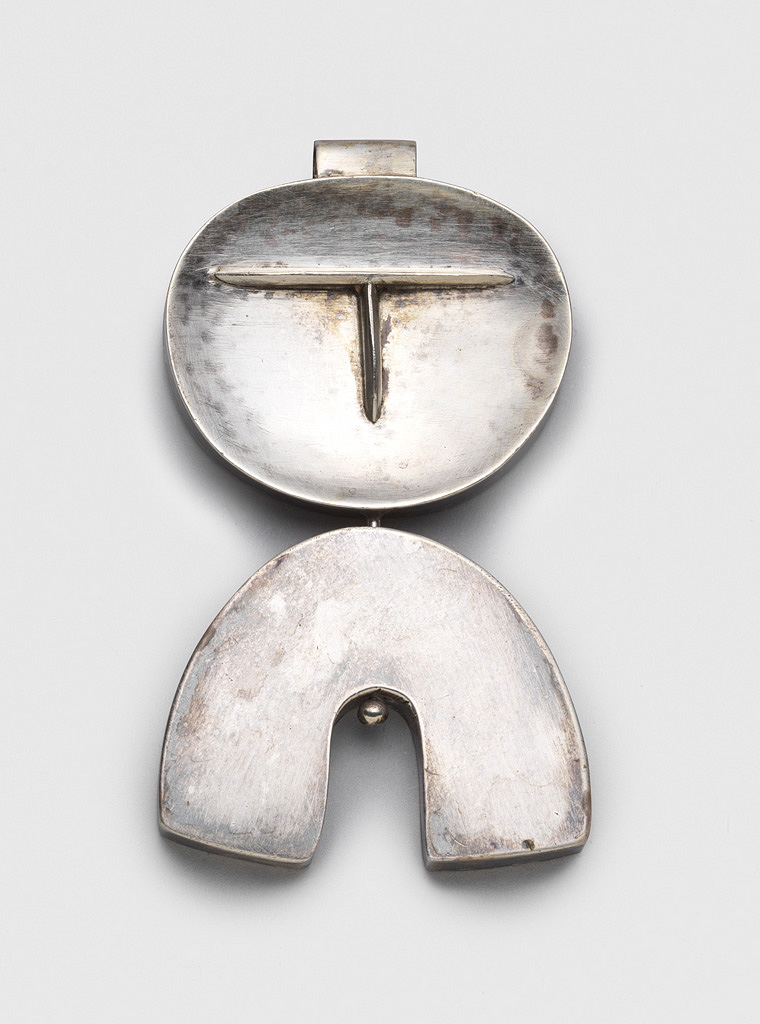
Doris Shadbolt, a curator and art critic, is celebrated here as an artist. Her 1950s silver jewelry, inspired by the same African imagery that prompted European movements such as Cubism, are exemplified in two brooches and a pendant, labelled “Human-form”.

Wayne Ngan, the Hornby Island artist who died earlier this year, earns his place in a group display of 1960s and 1970s ceramic by Jan Grove, Gathie Falk, Stanley Clark, Robert Weghtsteen and Jean Marie Weakland, with a raku pot using an old salt glaze.

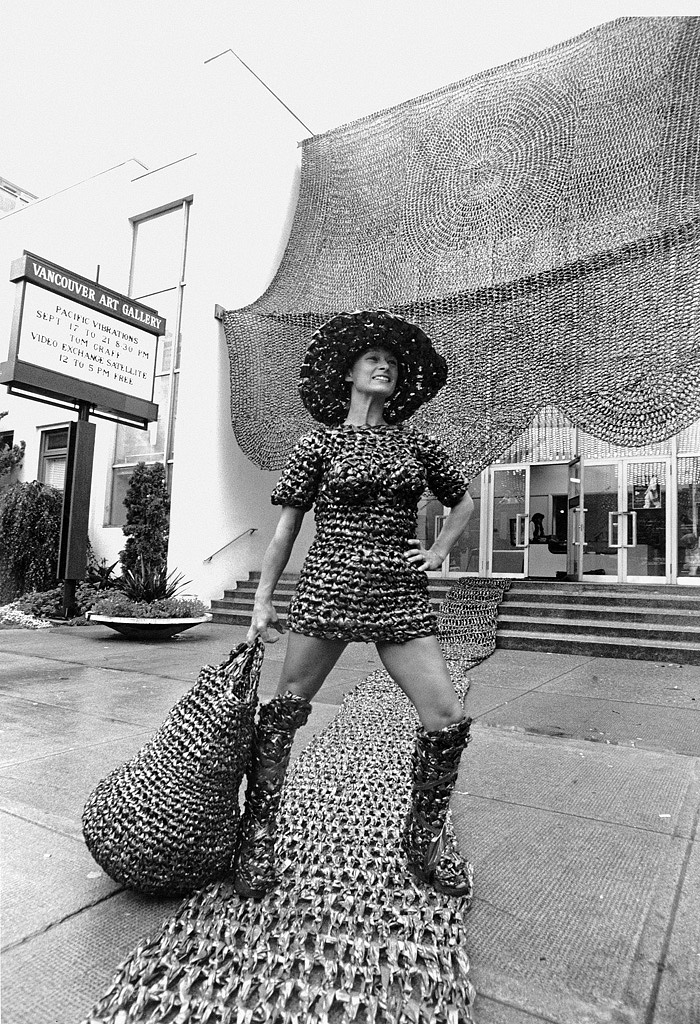
Modern in the Making is a show that rewards leisurely viewing. Where else are you likely to see how Dzunuk’wa dishes from a Kwakwaka’wakw potlatch and Evelyn Roth’s crocheted Video Armour could have been created in the same region in the same time period?


From top left: Evelyn Roth in Video Armour, 1972; Doris Shadbolt, silver Human-form Pendant, 1955; unknown Nuu-chah-nulth weaver, Ucluelet basket, 1944; Helmut Krutz, fold-down couch, c. 1955

Modern in the Making runs at the Vancouver Art Gallery until January 3, 2021

Gallery

Eastend, Saskatchewan


“The river is important in my memory for it conditioned and contained the town. What I remember are low bars overgrown with wild roses, cutbank bends, secret paths through the willows, fords across the shallows, swallows in the clay banks, days of indolence and adventure where space was as flexible as the mind’s cunning and where time did not exist.” –Wallace Stegner, Wolf Willow


Eastend, Saskatchewan is one of my favourite places anywhere, anytime. In the valley of the Frenchman (formerly Whitemud) River, surrounded by some of the most beautiful of the Cypress Hills, the town of 500 permanent residents remains pretty much just as Wallace Stegner (1909-1993) described it in the 1950s, when he returned to his childhood haunts.

Today, Wallace Stegner House, the one the Iowa-born writer occupied as a boy, operates as an artists’ retreat. Writers, visual and performing artists can apply to spend one to three months there. Poet, fiction writer and editor Seán Virgo (Dibidalen; The Eye in the Thicket) once stayed in the Stegner house and Eastend has been his home for more than two decades. I first visited him in late March about 12 years ago, when the farms were covered in snow and the lands where cattle graze displayed white patches.

June or July is a different story. With rain, which came this year, the hills and trees are draped in many shades of glorious green. But in drought years, the summer hills are a dusty shade. Precipitation, or the lack of it, is the crucial factor in this farming community. Whether they’re raising Angus cattle or growing canola, mustard, wheat or alfalfa, Saskatchewan farmers can never be certain what summer will bring.

What draws travellers to Eastend is the landscape; Scotty, the Tyrannosaurus rex skeleton discovered there in 1991; and the local culture. In the footsteps of a guide like Virgo, you can take in the surrounding country from a bluff in Cypress Hills Interprovincial Park, noting a Hutterite community in the distance. The trees are mostly pines, the hills steep enough to raise the heart rate on a walk to the top. Nearer to Eastend, the Cypress Hills are rolling, showing bands of white clay where the groundcover has been washed off in the spring melt.

Ninety minutes south and east of Eastend is Grasslands National Park, where at the right time of day you can see bison gathering in the coulees and at any time you might spot an antelope, a coyote or hundreds of prairie dogs poking out of their burrows to chirp a warning to their fellows. On the ground, the prickly pear cacti, surrounded by blue gramma and needle-and-thread grass, show pale orange flowers.

Northwest of Eastend, about 24 km on Grid 614, you can see a point on the Continental Divide. North of an imaginary line, the creeks and rivers flow northeast to Hudson Bay, 1,808 km away. South of the line, creeks and rivers, including the Frenchman, flow south, 2,768 km to the Gulf of Mexico.

Coming from the Medicine Hat airport, as I was, you drive south from the TransCanada Highway, and enter Eastend across an old iron bridge. Just before the bridge, you’ll see signs pointing up the hill to the T. rex Discovery Centre. A beautiful structure embedded in the grassy slope, it houses the world’s most massive T. rex skeleton. The discovery of the skeleton, 65-million years old, occurred on August 16, 1991. An Eastend chemistry teacher named Robert Gebhardt, invited to a dig site by lead paleontologist Tim Tokaryk, came upon the fossils of the base of a tooth and a vertebra, sticking out of the bedrock. It was three years before paleontologists could start removing Scotty, named after the bottle of Scotch used in a toast by the digging crew. The skeleton, found 65 percent intact, was reconstructed and is 13 metres long and as high as a two-storey house. Scotty’s oblong skull is nearly two metres long. Visit the centre, open every day from 10 a.m. to 6 p.m. to view a film about Scotty, some amazing exhibits and the workspace where paleontological research and reconstruction continues.

Just before you cross the iron bridge to enter Eastend, you’ll see a farmhouse brightly renovated in with red vertical slats. It belongs to Stephen Langton Goulet, a BC-born artist and jack of all trades. On his acreage on the banks of the Frenchman River, Stephen is practising regenerative agriculture, attempting to replenish the topsoil. Some of his “rockatry” sculptures – impossibly balanced stones that look like inukshuks – stand on the property, also sculptures made of found metals such as barbed wire. Look but don’t trespass.

Upon entering the main street of Eastend, you’ll see a big sign for White Mud Clay, the studio and home of Stephen Girard, an Eastender by birth. He shapes and creates glazes for wonderful pottery made of local clays. Another Eastend potter is Nick Saville, son of a local rancher, who makes mugs, bowls and such, glazed in bright, almost neon colours. Not the only other artist in town, but a notable one is Grieta Krisjansons, sculptor of a horse in the market square, made of found metal elements, such as bicycle chains and tractor parts.

Writers, whether visitors or part-time residents, continue to flock to Eastend. Maureen Elder, a poet and foodie, lives part-time on farmland outside Eastend with her husband, musician and composer Shaun Elder. Maureen’s privately printed Honey Cumin Saskatoons; Cooking in a Special Place, is a compendium of delicious vegetarian recipes and poems, such as “Geologic”: “I recall this sea of grass / once sea of water: seen so, / my own few years seem / little matter.”

Barbara Klar, a Saskatoon writer who once planted trees in the Cypress Hills, is now a fulltime resident of Eastend. Her 2019 title, Cypress, is a gem. Here’s the opening of “South Benson Trail, The Stone Road:”

To walk uphill keep your eyes on the ground.

Stones distract from the work of climbing, show you

Their pace, the lung wish, the getting there

Not winded.

References:

Dibidalen, short stories by Seán Virgo, Thistledown Press; Eye in the Thicket, an anthology of nature essays, Seán Virgo, ed., Thistledown Press

Cypress, by Barbara Klar, Brick Books

T.rex Discovery Centre https://www.royalsaskmuseum.ca/trex

Eastend Historical Museum, https://saskmuseum.org

Grasslands National Park https://www.pc.gc.ca/en/pn-np/sk/grasslands

Whitemud Clay https://www.facebook.com/whitemudclaypottery

Stephen Goulet https://www.facebook.com/rockatier

Nick Saville Pottery https://www.nixavl.ca

Photos, clockwise from top left: Grieta Krisjansons’ horse, Stephen Girard pottery studio, the iron bridge over the Frenchman River, Scotty, Stephen Goulet’s rock sculptures

Gallery

Up and down the Mekong Delta


For anyone captivated by the idea a tropical river cruise, a trip on Vietnam’s Mekong Delta doesn’t disappoint. On board the vintage, wooden-sided Bassac II, I was channelling Katherine Hepburn in The African Queen.

The Mekong Delta, end point of the 4,500-kilometre-long river that has its source in the mountains of Tibet, is known as Vietnam’s rice bowl. The Mekong here is called Song Cuu Long, the River of Nine Dragons, for its many branches on the vast delta. The two main tributaries, watery highways for serious freight transportation, are the Hau Giang (Lower River) or Bassac River, and the Tien Giang or Upper River. My daughter Jenny and I elected to take the day cruise up to Can Tho and back down on the Bassac, boarding at Cai Be, a bustling port that’s a four-hour drive from Ho Chi Minh City.

The delta is a populous part of the country, both on and off the water. We grew used to the sounds of karaoke voices pumping out from villages behind a wall of thick jungle greenery as we steamed upstream over lush outgrowths of water lilies. In the towns on the delta, people inhabit stilted houses on the river banks, or they ply their wares at floating markets, as tourist cameras flash. Thirsty? You can order up a fresh coconut cut and served by the lady who poles her launch between larger craft offering onions, potatoes, greens, fish, meat, whatever. The floating merchants live on their boats too.

Our guide Anh took us ashore to walk a short path into a village where homes were surrounded with pens for pigs, ducks and chickens. Fruits cultivated here include bananas, jack fruit, mangoes, papaya and much more. Along the way we learned how Vietnamese growers in the south can get three harvests of rice out of the huge paddies that cover the delta. It’s women’s work, we heard, as Anh pulled no punches about life in the state of the Socialist Republic of Vietnam. Women here in the south also raise the children and keep house.

Throughout Vietnam these days, it’s Mammon over Marx. Despite a roaring economy, with annual GDP growth of more than 6 percent, the average citizen must work very hard to make ends meet. There are no government pensions, no medicare and those who wish proper health care and education for their children must pay for it, sometimes in bribes to insure proper care in hospital. The hoarded-up (prior to Tet celebrations) huge statue of Ho Chi Minh in the centre of Ho Chi Minh City became a symbol of how far this communist state has strayed from the ideals established by its first leader. Ho Chi Minh, who served as president of North Vietnam from 1945 to 1969, died before his country achieved victory in the American War and reunification of the north and south parts of the country, which didn’t happen until July 2, 1976.

Amid the buzz of construction and commerce – universal in Vietnam – there is room for peace and prayer in some spectacular temples on the delta. Most unusual for this part of the world is in the Cao Dai temple in Cai Be. Decorated in an Eastern rococo style, the Cao Dai temple is dedicated to a religion unique to Vietnam. A fusion of Taoism, Buddhism and Confucianism, Cao Dai also displays elements of Christianity and Islam. Its monks and nuns all wear white and the most prominent symbol is a single eye, signifying an all-seeing divine power or God.

In Can Tho, a city with a population of 1.52 million, three outstanding temples are evidence of  the return of religion to the centre of life in a country where the communist government once banned all religious observance. The biggest and most typical of Vietnam is Pitu Kohsa Rangsay Pagoda, a massive edifice featuring huge statues of the Buddha and four levels of worship. On the top floor, the carved wooden monks, gathered as if attending the last supper, add a human touch.

A helpful young monk took us on a brief tour of the Khmer pagoda called Pitu Kohsa Rangsay, radiant in its gold leaf covering. The abbot invited us to rest, drink tea and invited questions on the practice of Theravada Buddhism, practised mainly in Cambodia. He delineated the major differences between different strands of Buddhism practised in southeast Asia. Their objectives don’t differ and when followers from different countries meet as a group, he said, “we converse in Pali, the language of the Buddha.”

Our last stop in Can Thu before reboarding Bassac II was the Chinese Ong Temple, facing the Mekong and easily identified by the Chinese characters and iconography decorating its front. Inside, disciples keep incense burning around the clock and tend to altars to different deities and local heroes. The temple was built in the 19th century for worship of Kuan Kung, a deity associated with intelligence, honesty, confidence, virtue and faithfulness. Many offerings were piled up in front of the Goddess of Fortune and the Kul-Am Buddha.

Getting There: to book a Bassac tour, go to http://www.travelvietnam.com

Photos from top left, clockwise: a Bassac touring boat, Cao Dai temple, incense in the Ong temple, a monk and law student at Pitu Kohsa Rangsay temple, a merchant hawks her wares near Can Tho

Gallery

Three days in Hanoi

_1030053_1030105_1030125

In a city of contrasts, a tourist visiting Hanoi can in the space of a few hours experience the sacred and the crassly commercial, the high anxiety of negotiating anarchic traffic and the splendid tranquility of a walk around an inner-city lake.

On this second visit to the capital of the Socialist Republic of Vietnam, having already taken in the mandatory sights of the Ho Chi Minh mausoleum and museum, the Imperial Citadel and historic sites such as the Hoa Lo Prison, dubbed the “Hanoi Hilton” by American prisoners of war, I got dropped off at the tiny, perfect Den Ngoc Son temple across a picturesque bridge in Hoan Kiem Lake, just south of Hanoi’s Old Quarter. Amid the bustling preparations for the lunar new year, Tet, to come, visitors and worshippers flock to this legendary location. In the 15th century, Lê Lói, who became emperor and founder of the Lê dynasty, was on this lake when he received the magic sword, Heaven’s Will, from the Golden Turtle god, Kim Qui. Thus did Vietnam gain independence from China. Later Lê Lói returned the sword to the turtle god, giving Hoan Kiem its name, which means “Lake of the Returned Sword.”

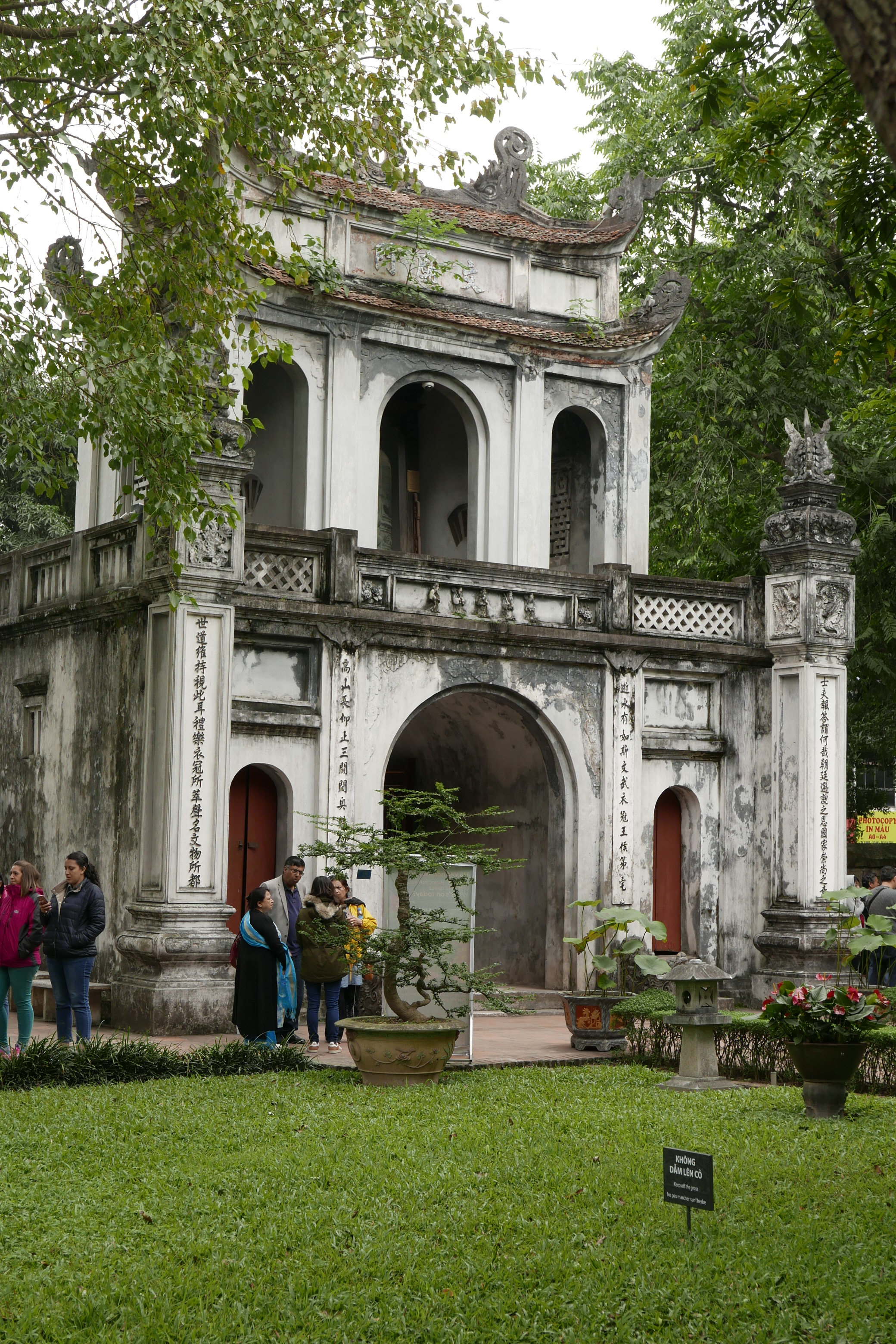
Next stop is the Temple of Literature, not exactly what an English major might expect, but a complex of courtyards, monuments and temples dedicated to Confucian teachings and scholars. Explanatory panels in the central courtyard present archival documents and photographs of the French occupation of the city, which started in 1873. Within 12 years, the Concession was complete and the ancient capital, first established by the invading Chinese army in the seventh century as the Red River fort, was a mirror image of a 19th-century French capital. Vietnam, forever conquered and then repelling invaders including the Chinese, the French and the Americans, or ruled over by authoritarian royal families, presents a perfect case study in the nature of power.

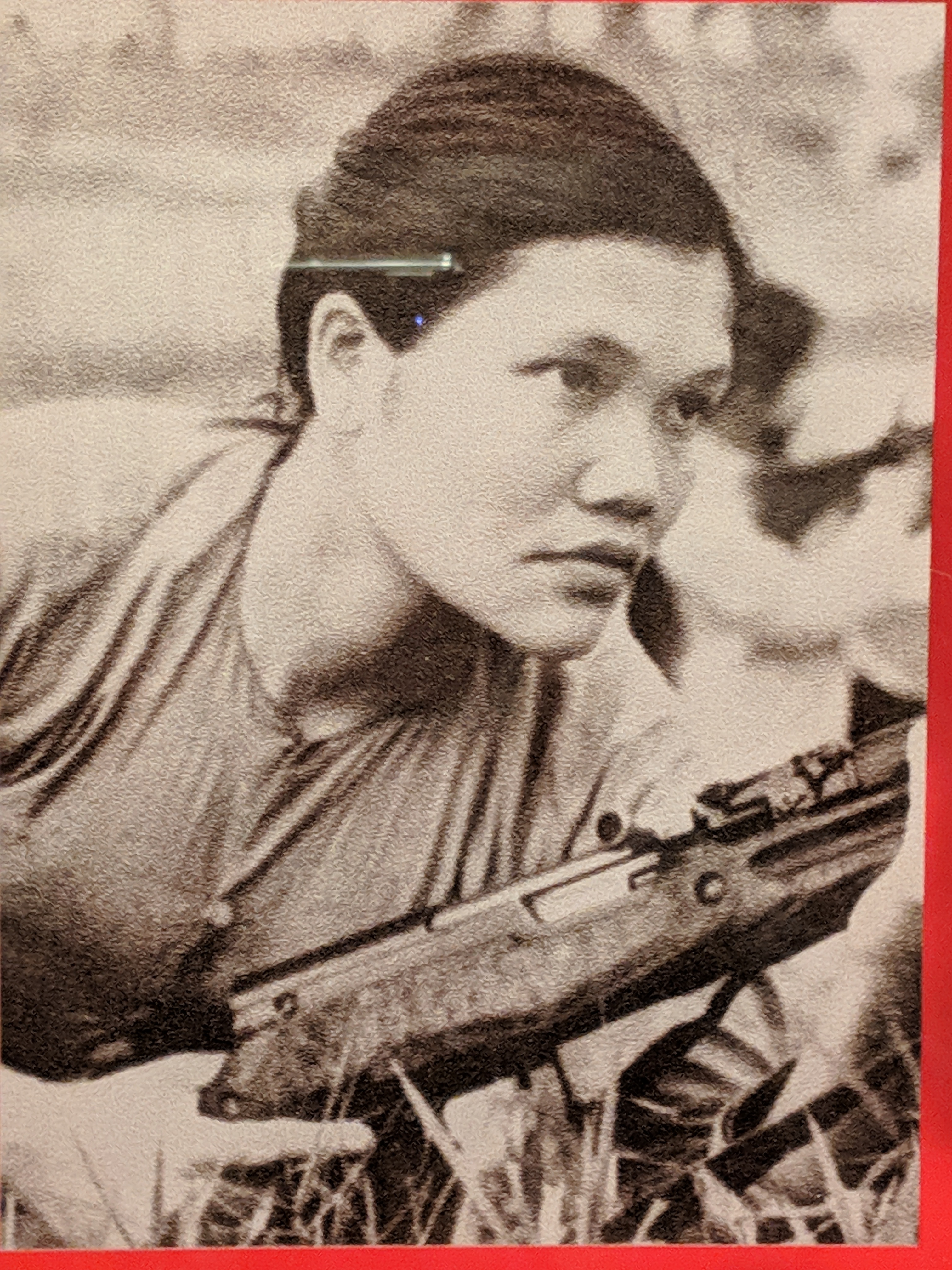
The Women’s Museum, on a main street in the Hoan Kiem district, earns its reputation as the best museum in the city. Outstandingly curated displays on four floors, take us through centuries of female influence from marriage and family, to women’s participation in war and revolution, to the development of women’s fashions. Most inspiring is the history of Vietnamese women’s involvement in combat from 1945 to 1975. A typical heroine is Kan Lich, who directed a female guerilla force against American troops at 18 and was honoured in 1968 as a Hero of the Nation for participating in 49 battles and bringing down an American Dakota plane.

Beyond the centre of Hanoi and well worth the short taxi ride is the Vietnam Museum of Ethnology, where detailed reconstructions of minority habitats and customs give the visitor a very clear picture of the Vietnamese population. Fifty-three ethnic minorities, divided into five main groups, make up the contemporary population of Vietnam. The majority, Viet or Kinh peoples, account for 87 percent of the 95.5 million population (as of 2017). The arts and crafts and traditional lifestyles of minorities such as the Red Dao or the Black Hmong are all on display here, but are best appreciated with a visit to their homelands, mostly in mountainous regions of the country.

Strolling through the old quarter of Hanoi in January you’ll quickly get a taste of what a huge occasion Tet is. The coming Year of the Pig, will be very lucky for those born in such a year, and as you wind your way through busy, narrow streets some of them specializing in the sale of silver, silk, stationery or flowers, you can feel part of the celebrations. And after a day of dodging scooters and cars on the streets of Hanoi, no better place for a final stop than at Body and Soul spa, where I experienced the best massage ever.

From top: Den Ngoc Son temple; Temple of Literature; Yao family relic, Museum of Ethnology; Kan Lich, Women’s Museum

img_20190117_152311