Another fabulous Baker girl

phasespace

Peggy Baker Dance Projects

Betty Oliphant Theatre, Toronto

January 22-24 and 27-31, 2016

The heroine of Friday night’s performance of phasespace was Sahara Morimoto, who not only beautifully performed in a trio and a solo, but stepped in on very short notice to take the place of an injured Sean Ling in a duet with Andrea Nann.

Much was made, in the before-show chat from Baker and Fides Krucker, of the vocal scores that Krucker composed from the dancers’ own pre-verbal and non-verbal sounds. The voice, Baker maintained, provides a direct link to the performer’s body and to the audience. But it was Morimoto’s silent solo that was the highlight of the night.

In the noisiest piece, the trio performed by Ric Brown, Sarah Fregeau and Morimoto, there was little sign of the narrative that Krucker had seen forming while working with the dancers. Three sets of standard straight-backed chairs, one human-sized the other a miniature, made an aimless allusion to Alice in Wonderland. The dancers came and went and moved themselves and the chairs through space. John Kameel Farah, perched above and behind the dancers played and improvised acoustically and electronically on the piano and computer keyboards, but did not seem a part of the piece as he did in last year’s Baker show locus plot. Marc Parent’s well designed lighting defined performance spaces. All of these elements should have added up to a unified piece, but it was hard work to find coherence in this piece.

Morimoto was a character shaking with the giggles, a high tittering sound. Brown was a howling dog. Fregeau careened about and each of them phased in and out of a whispered chatter that had no obvious connection to their movement. Such distractions took away from the well-rehearsed dance steps.

In Baker’s introduction to the show, she referred to a starting point: recognizing her own choreography in the body memories of her dancers. When it came to the Morimoto solo, first mounted in 2013, we could see Baker’s vocabulary, alive and present in a dynamic way. The Tokyo-born dancer, who has worked with Baker since 2008, displayed the long, wind-milling arms, the precise hand gestures and the fluid, almost flying movement that have long been Baker’s hallmarks. Inside a diamond shape etched in blue light, Morimoto created a world of her own. It was a simple, abstract solo, a purity of movement expressed through facial and body gestures as only dance can do.

Andrea Nann added a new element to the gallery of dances. Not only is she a fine interpreter of Baker’s dance; she is an established performer of her own choreography. In the duet that Baker made on her and Ling in 2014, Nann’s prolonged, sinuous movements made a kind of dance alchemy.

Kate Holden, who has been a fine interpreter of just about every contemporary choreographer of note, performs the new Baker solo, also vocally scored by Krucker. Her performance stretched the boundaries of the space and she broke out of her invisible box with long, slow strides and a final winding-out, a Ginsbergian howl that seemed to come from some place deep within her.

CREDIT: Sahara Morimoto in a solo, one of four dances in phasespace. Photo by Jeremy Mimnagh


Fun with philosophers

6. Germinal - Photo by Be a Borgers

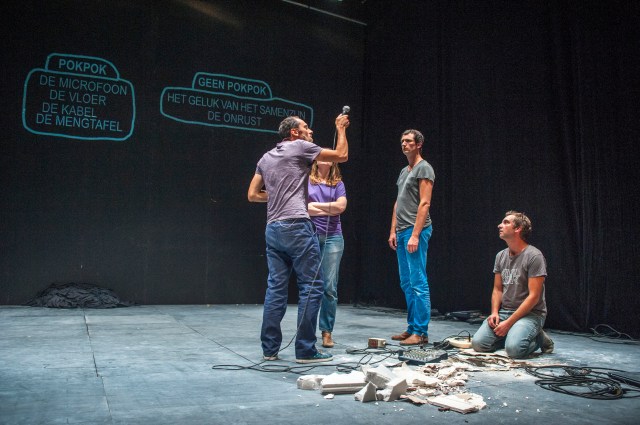
Halory Goerger, Ondine Cloez, Denis Robert and Arnaud Boulogne in Germinal.                 Photo by Be a Borgers


Germinal

By Halory Goerger and Antoine Defoort

L’Amicale de production at World Stage

Fleck Dance Theatre, 231 Queens Quay W., Toronto

January 20 to 23, 2016


In the beginning there was darkness – black – but for a pool of dim light in the middle of the stage. Germinal is a creation story for the theatre. Slowly, lights come up on some dim shapes on stage: performers Halory Goerger, Arnaud Boulogne, Ondine Cloez and Denis Robert. Each is concentrating on a handheld computer, connected with a long wire to the wall of the black box they inhabit.

As tall, thin Halory strolls around the stage, stroking a key on his keyboard, his thoughts take shape in white letters beamed from a surtitle panel high on the back wall. In a Eureka moment, he draws Ondine to his discovery: thoughts transferred with the click of a key. Ondine’s thoughts are manifest on a second surtitle panel. They beckon to the other two – a sulky Arnaud and insular Denis —  to join them. Soon words, whole sentences are flashing on and off at the speed of dialogue, as the characters begin erecting the structure of a play, starting with a system of communication.

If Jacques Derrida ever gave a lecture in the form of a song and dance show, it might have looked something like Germinal.

After all this intellectual to-ing and fro-ing, Ondine literally chews up the scenery. Approaching a section of the stage with a pick-axe, she begins to tear it up, creating a hole and a pile of rubble. Arnaud pulls a microphone out of the hole and becomes the mouthpiece for more exchanges, each character now speaking French, but with their words displayed in English. The microphone sound “poc poc” becomes a system for categorization: items and concepts are listed under “poc poc” and “non poc poc”. A laptop from the hole gives the world according to Windows: a menu allows a projection of a hill, a mountain, a swamp on the back wall. The scenery is described as an overlay on top of the wall.

Voices are raised – the letters grow bigger – and then comes choral singing.  Voila! Opera. Germinal manages to be at once highly cerebral and physically, noisily concrete, thought-provoking and laugh-out-loud funny. The production, thanks to a combination of advanced electronic effects and an old-school piece of stage trickery, is dazzling. But nothing happens.

Nothing except for a long, joint effort to describe a series of events occurring in space over time – the objects, the action and duration reduced to a chronological graph that marches across the back wall as words writing themselves on a blackboard.

Timing in theatre is everything: this show has bits we’ve never seen before. Without a trace of artificiality, four performers and almost as many lighting technicians mount a play that is a philosophical argument to totally captivate an unsuspecting audience.


Swirling in the glass


Within The Glass, Tarragon Theatre

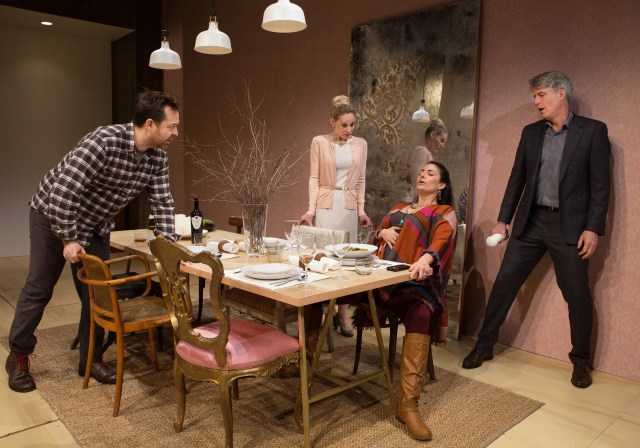
Paul Braunstein, Philippa Domville, Nicola Correia-Damude and Rick Roberts in Within the Glass. Photo by Cylla von Tiedemann

Within the Glass
By Anna Chatterton
Tarragon Theatre, Toronto
To February 14, 2016

Dashed expectations might be two words to sum up the well-made play that Anna Chatterton has written about two couples struggling – in four different directions – over an in vitro fertilization gone terribly wrong.
Upwardly mobile, in fact very much arrived, Michael and Darah are on tenterhooks in their perfectly appointed living/dining room, anticipating the arrival of a couple they’ve never met before. Scott and Linda, poet and artist, have it seems been given the wrong petri dish and now Linda’s bearing a foetus that is legally not her own. Scott and Linda’s embryo didn’t prove viable in Darah’s uterus – nor did the previous five fertilized eggs of her own. What is to be done?
The scenario sounds like the set up for a debate on reproductive rights, but Within the Glass is a lot more dynamic than that. It’s a black comedy of manners with many tragic elements. Ravenous eating is the central metaphor in a performance in which all are hungering for something they’ll never get.
In structure reminiscent of Who’s Afraid of Virginia Woolf, this parlour drama directed by Andrea Donaldson defies audience expectations at every one of its many turns of mood, as if both men and women were running wild on hormones. Julia Fox’s detailed set and costumes reinforce the theme of how our animal natures lie just below the surface of civilized behaviour and confound our drive for order, fairness and decency.
A bearded Paul Braunstein plays Scott, a gruff guy with the unlikely occupation of renowned poet. He makes it clear as he enters with his pancho-ed wife Linda (Nicola Correia-Damude), the glow of pregnancy full upon her, that he hasn’t come for a social occasion. A suave, Rick Roberts in bespoke suit is Michael, the investment banker who assures his careerist wife Darah (Philippa Domville) that he can make a deal and they will get the baby they’ve been longing for.
Over the 90-minute course of highly physical theatre all four characters exit and enter, switch and shed their stereotypes, revealing themselves to be driven by nothing but self-interest. The show is staged like a mad minuet.
Linda sets the action in motion by announcing she wants to keep Darah and Michael’s baby; she is after all, carrying it. This is unwelcome news to Scott who thought they’d decided to abort. Dinner, arranged so fastidiously, from the scotch and tzatziki (“all the way from Greece; we like to support the local shops”) to the capon (“Linda’s a vegetarian”) never does get properly served as husbands and wives turn on each other and reveal hidden facets of themselves, such as Michael’s way with a foot massage for another man’s wife.
The words “foetus” and “baby” become loaded missiles hurled across the floor, as men become mothering and women go on the attack. This is a play about identity turned into a game of musical chairs, but the stakes are high and it is never clear whether anyone comes out a winner.