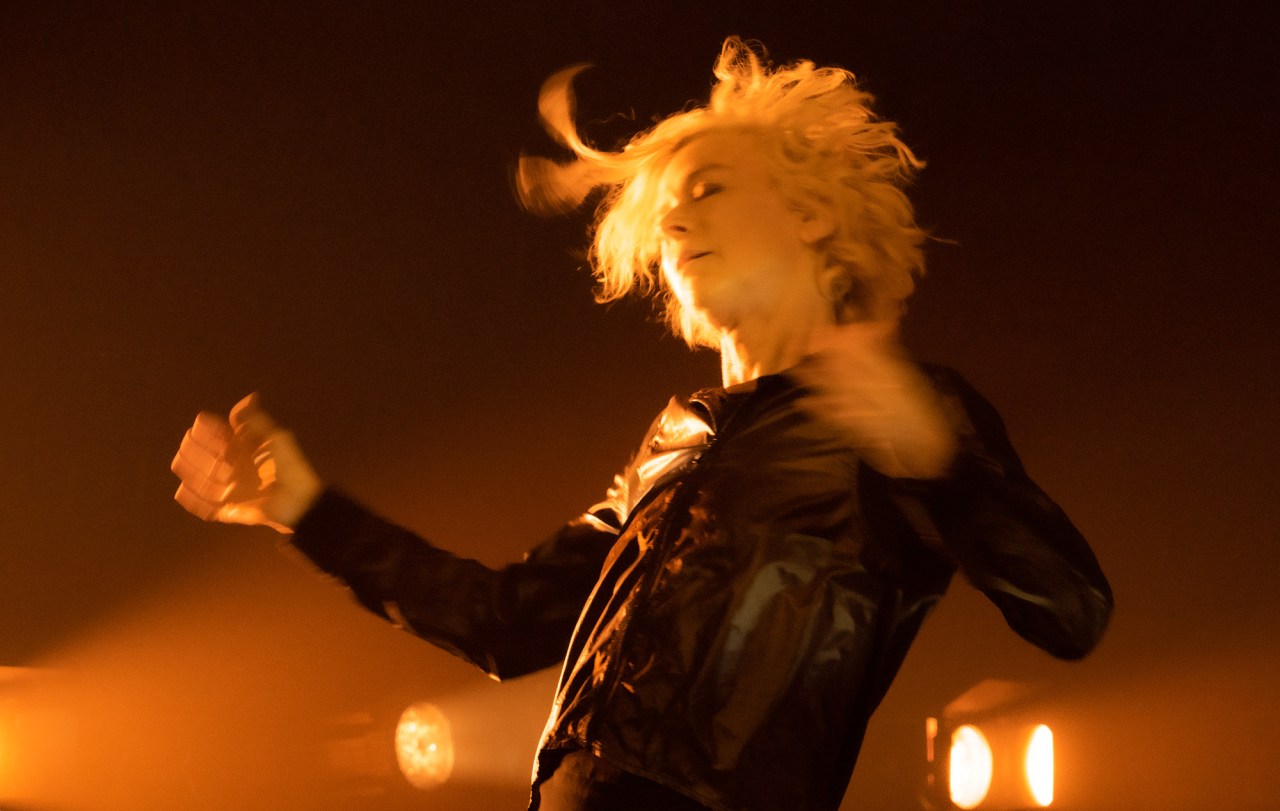
Under a spotlight on a darkened stage, a breathtaking sight: her platinum blonde mane flashing, an embodied force of nature, the dancer in the black bustier explodes into barrel rolls, airborne, gathering speed. This was Louise Lecavalier dancing with La La La Human Steps in the 1990s.
And she’s still rolling: Lecavalier will perform her own solo, Stations, at the Fleck Dance Theatre in Toronto from November 23 to 25.
Muse to Edouard Lock, artistic director of La La La Human Steps, Lecavalier has continued as a solo performer and choreographer since she struck out on her own in the early 2000s.
She’s been a legend in her own time, a dancer one never forgets. “When you’re holding a bomb in your hands, what do you do with it?” says a male dancer in Raymond St-Jean’s 2018 documentary Louise Lecavalier: In Motion.
Born in Montreal in 1958, Lecavalier was dancing professionally by the time she was 18. She joined La La La in 1981 and helped define that company’s unique style of dancing. Interviewed by the CBC in 1989 alongside Lecavalier, Lock noted that dance had historically been about shapes, beautiful bodies arranged in artful positions. “I think it’s more interesting to see a flux of energy. Someone moving has no shape and that’s really interesting; it’s almost an abstraction.” Lock and Lecavalier’s collaborations ended in 1999.
Her hair shorter now, Lecavalier has continued as a notable presence on the international stage, commencing with establishment of her own company, Fou Glorieux, in 2006. Its mandate: “to bring together dancers and collaborators of all ages and horizons around a fully mature performer to carry out creation projects in a flexible, open framework.”
In 2006, Lecavalier collaborated with Crystal Pite, who choreographed a solo for her, Lone Epic, which was boldly set to Bernard Herrmann’s music for Citizen Kane. In the 2009 piece Children, choreographed by Nigel Charnock, Lecavalier danced with Patrick Lamothe to the music of Leonard Cohen, Brownie McGhee, Billie Holliday and others. Described as a narrative of a long relationship breaking down, Children is highly physical, the performers taking on the appearance of overgrown kids.
Battleground, the piece Lecavalier choreographed for herself partnering Robert Abubo, is based on the characters in Italo Calvino’s novella, The Non-Existent Knight. These duets seem to deepen Lecavalier’s intensity, as she pits herself against a dancer of equal energy, the results definitely greater than the sum of the parts.
“Increasingly, over time, I have become the subject of my research,” says Lecavalier. “I take the risk that my various existential battles as a dancer may resemble those of others, trusting that the new difficulties I come up against or inflict upon myself in the movements will always provide an answer and perhaps a true space of freedom. I go back into the studio to discover the previously unrevealed movements that will allow me to renew and clarify what my body needs and what inspires me now. I seize upon new steps as if it were a matter of sheer survival.”
Hence, Stations, which premiered in Dusseldorf in 2020. The wild white-blond hair is part of this performance, which finds Lecavalier, no worse for punishing years on stage, whirling and contorting in a fascinating blur to the original, jazzy music of Antoine Berthiaume. Clearly Louise Lecavalier is the Mick Jagger of contemporary dance: electrifying, inimitable.
Stations
Created and performed by Louise Lecavalier
November 23 to 25, 2023
Fleck Dance Theatre, Harbourfront Centre, Toronto
Photo of Louise Lecavalier by André Cornellier
 susan walker's artsblog
Hope you are prevailing. Good night!
LikeLike