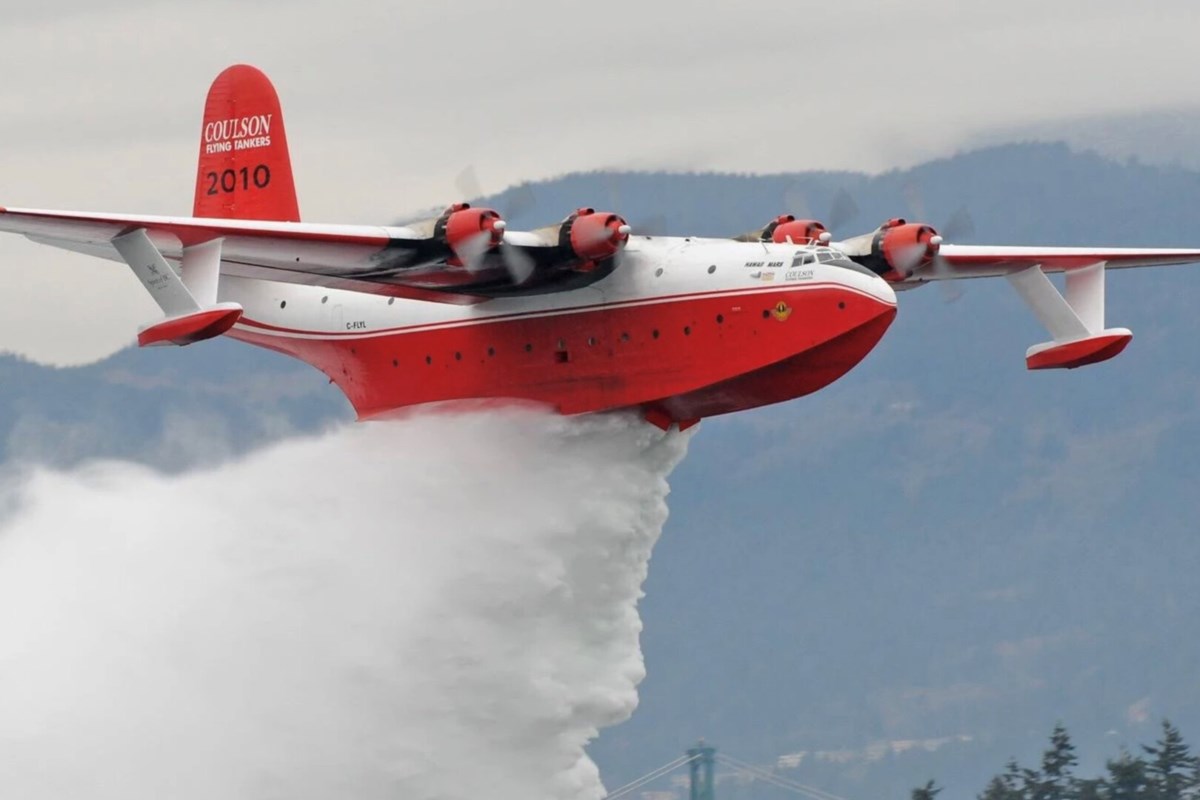
Anyone who was living in Canada from the 1960s to the 1980s, especially those of us on Vancouver Island, will have seen a Mars water bomber. A lucky few will have witnessed one of these flying behemoths skimming over a lake or the sea, scooping up thousands of gallons of water to disgorge over a forest fire.
“Before the Mars, nobody had seen four acres of water at one time come out of an airplane to extinguish a fire. Seven thousand, two hundred gallons in one drop. Nothing else can do that,” says Wayne Coulson, CEO of Coulson Aviation.
Coulson Aviation, a leading aerial firefighting operation based in Port Alberni, B.C. owned two of the last Mars Martin bombers in existence. The Hawaii Mars and the Philippine Mars are now preserved on the sites of two aviation museums. How they got there is a dramatic tale told in the documentary Fire Guardians: Final Flight, soon to be airing as a three-episode series on Crave TV.
After the Coulsons agreed to send the Hawaii water bomber to the British Columbia Aviation Museum outside Victoria and the Philippine Mars to the Pima Air & Space Museum in Tucson, Arizona, the question became how to get these 80-year-old, propeller-driven flying tankers to their final resting places. Overland was not an option; no highway could accommodate the bombers’ 200-foot wingspan. They would have to fly.
Enter filmmaker Gary Lang. As writer and director he teamed up with producer Ian Kerr to make Fire Guardians. It was a logistically complex production, taking two years and encompassing 100 shooting days, and involving teams of cinematographers and editors. The result of their labour is a film that is beautifully shot, packed with action and amazing characters, making an unforgettable piece of aviation history.
So how to get the aerial tankers airborne? Only a few flight engineers and pilots have the know-how to get these planes flying again and most were retired. The Coulsons knew where to find them.
The first to fly was the big red Hawaii Mars, which had been dormant for eight years. “You have to know that this is 1930s technology,” says one of the flight engineers, as we watch Mike Johnson, Dave Millman and Mario Di Rocco at work. Aviation maintenance engineer Al Jack notes that the components in these four-propeller engines are 80 years old. You can’t just order new parts. Besides the engines, the engineers and mechanics would have to deal with the fuselage, held together with millions of rivets, which – no surprise — can give rise to disastrous leaks.
After much tinkering and with a little help from apprentice mechanic Tazman Higgins who crawled into small spaces and climbed the heights of the plane, Hawaii Mars is declared flight-worthy. The next step was to get her into Sproat Lake beside the Coulson base. Manoeuvring the plane, about the height of a four-storey building, makes for good footage. We see the Mars bellyflop into the lake. Then we hear the four engines, sounding like hundreds of cars revving up, propel the beast across the water.
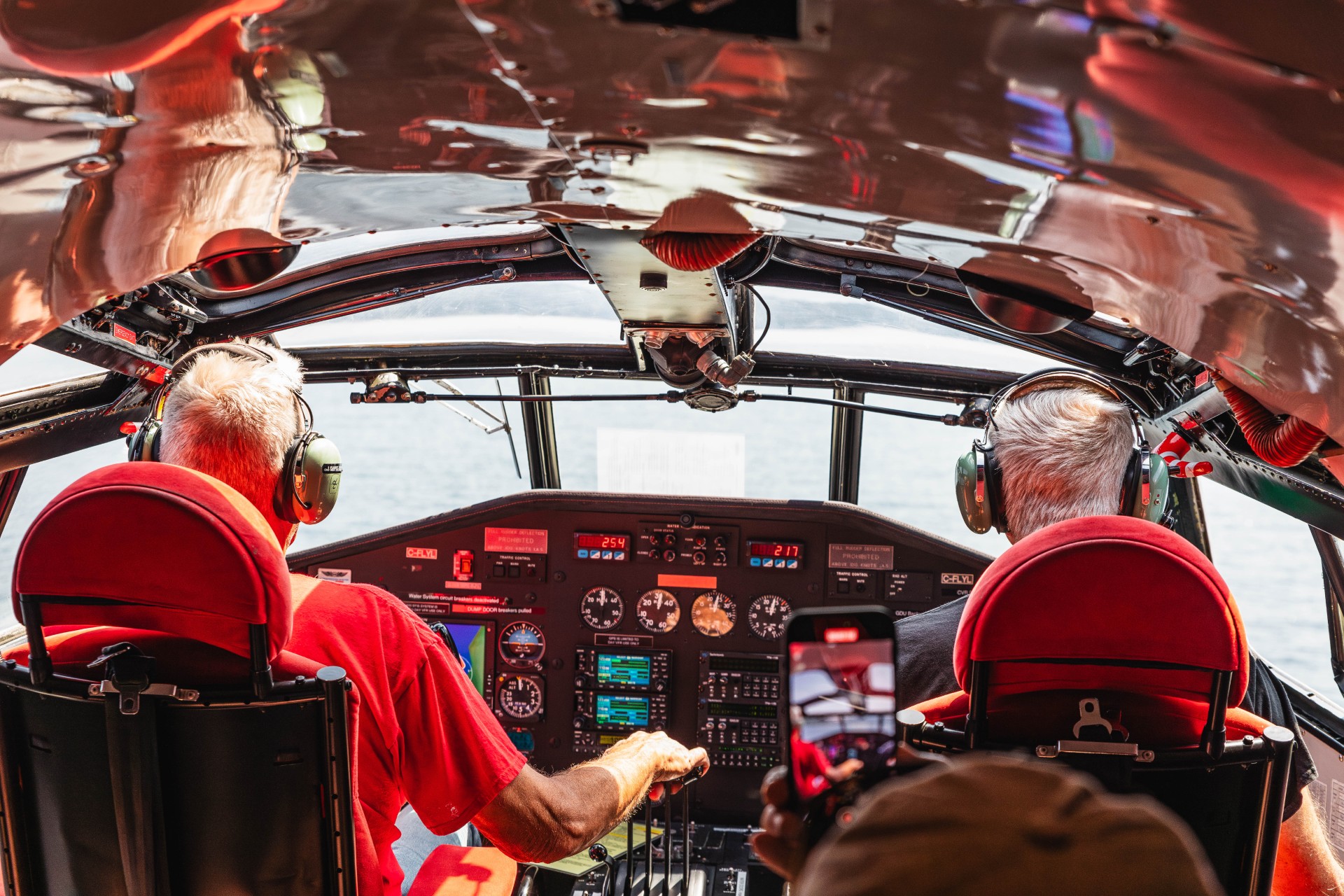
Retired pilot Peter Killin and first officer Rick Mathews settled into the Hawaii cockpit as if it was only yesterday they’d flown a Mars into a fire. The trip to the BC Aviation Museum near Victoria’s airport would be only a couple of hours, but a lot could go wrong. And indeed, before long one of the four engines is ailing. The cameras capture a discussion in the cockpit among pilots and engineers about whether they try to fly on three engines or tow her back to land for more repairs. They go back.
Finally on August 4, 2024, escorted by a group of the RCAF’s Snowbirds, Hawaii Mars made the flight over forested mountains to dock near the museum. It was a real occasion easily observable from Victoria as the big old Mars landed in Patricia Bay to welcoming cheers from bystanders on the dock.
The second delivery, that of the Philippines Mars, was a bigger challenge. The flying distance to Tucson is 1,425 miles and the big black Philippines Mars needed much work. What’s more, winter was approaching and the weather was an additional peril. The pilots and engineers had to wear multiple layers of clothing because there’s no heating on a Mars bomber. (Is there even a toilet, one wondered.)
Snow was on the ground at the Coulson site, as the crews readied the Philippine Mars for the flight. The first attempted flight was aborted when a leak was found and an engine failed. In near-zero temperatures, the maintenance crew manage to switch the failing engine with one of the Hawaii’s and replace the failing rivets in the fuselage. There is obvious tension but nothing is said on screen about the possibility of a crash, which makes the calm demeanour of the pilots and the flight engineers even more remarkable.
On February 10, 2025, six months later than planned, Philippines Mars takes to the air. Thanks to some excellent drone camera work we get to see her gliding over the Golden Gate bridge for the stop in San Francisco. (A Mars requires 5,000 gallons of fuel and burns about 1200 gallons an hour.) By now the men, mostly in their 60s and 70s, who have leant their expertise to this venture are screen heroes. And because of them, the Philippines Mars achieves immortality at the Pima Air and Space Museum.
Trailer: https://vimeo.com/1125853542/d2a402edb4?share=copy
Photos: Courtesy Coulson Aviation

