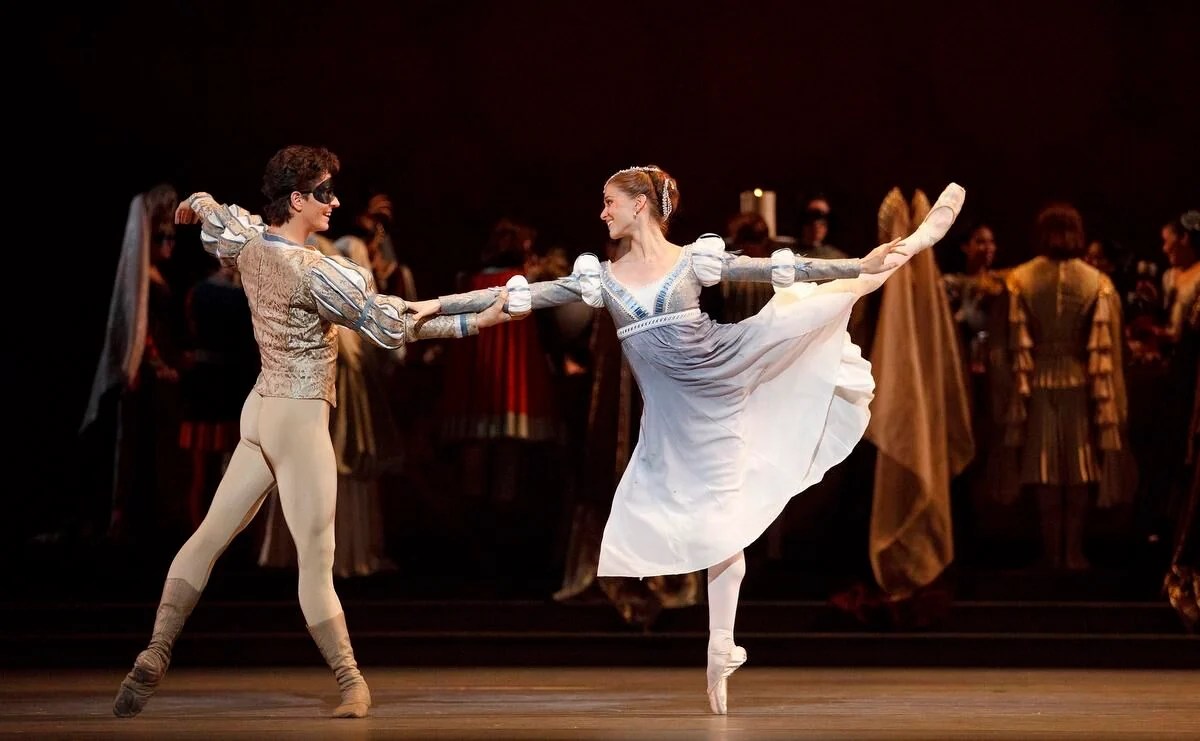
It was a coming-of-age moment when in 1964, the National Ballet of Canada acquired the rights to John Cranko’s Romeo and Juliet. Artistic director Celia Franca had had a hand in founding the company only 13 years earlier. She must have been immensely proud when the curtain came up on this magnificent production on April 21 at the O’Keefe Centre.
Romeo and Juliet was the company’s first performance on the O’Keefe stage. (It was also the show the company last performed on that stage.) And the National Ballet of Canada is the only company in North America that had Cranko himself come to produce the show.
John Cranko, born in 1927 in Rustenburg, South Africa, was a talented choreographer who took classical ballet in a new direction once he had a company to work with. After a stint from 1946 with Sadler’s Wells in London, he came to Stuttgart in 1961and established the Stuttgart Ballet as a contemporary company with himself at the helm. Romeo and Juliet, set to the splendidly provocative 1935 score by Sergei Prokofiev, was the first of Cranko’s major story ballets.
The performance of Romeo and Juliet, beginning this Saturday at the Four Seasons Centre for the Performing Arts, marks the opening of National Ballet’s 75th season and makes a good occasion to reflect on the company’s progress.
“If I was born to anything it was to found a ballet company and boss people around,” says Celia Franca (1921 to 2007) in archival footage. With the acquisition of her friend John Cranko’s Romeo and Juliet she set the company on a course for international fame.
The fledgling company was in debt in 1964, so Romeo and Juliet changed everything. In 1995, Walter Carsen donated more than a million dollars for new sets and costumes designed by Susan Benson that gave Romeo and Juliet a second life. This 75th season’s performances will be the first since 2009.
Asked if he remembers the first time he danced Romeo, Rex Harrington, rehearsal director and principal coach for the company, laughs. “It was the time I got the worst review of my career.” Called in at the last moment to replace an injured Frank Augustyn, Harrington was Romeo to Karen Kain’s Juliet. “I think it was Gary Smith who said, ‘all I saw was a nervous young man struggling to keep up with a mature ballerina.’ ” Kain was the first in a long line in a long line of Juliets Harrington partnered, from Chan Hon Goh to Evelyn Hart to international stars, topped off by a performance with Carla Fracci (the original Juliet in Cranko’s ballet) at La Scala when she was 62 years old.
Now Harrington is coaching a new generation of Romeos and Juliets. “I tell the men all my tricks about the partnering, but what Cranko’s work demands is a dance actor. It requires them to think as real people telling a story.” For a dancer new to the role without a lot of life experience, acting can be difficult. Working with a young cast – one of the Romeos is only 22 – Harrington says, “I tell them to have a conversation with themselves in their head,” so the audience can believe in the character.
Quite a few of the past Romeos have similar thoughts. For Guillaume Côté, being Romeo means “every moment has to be crafted in a certain way.” Peter Ottman, in a video produced by the National Ballet, says, “getting to play Romeo was a gift beyond gifts for me.”
Veronica Tennant made her debut with the National Ballet in 1965 as Juliet to Earl Kraul’s Romeo. She performed it many times over her 25 years in the company, dancing with 10 different Romeos. She’s immortalized in the role in Norman Campbell’s film of Romeo and Juliet made in 1965 for CBC Television.
Ballerinas echo the Romeos’ feelings when it comes to playing Juliet in Cranko’s ballet. Heather Ogden, who debuts on Saturday as Lady Capulet in her farewell season with NBoC, remembers how nervous she felt before her first performance as Juliet. “But it turned out to be such an incredible experience to be lost in a role. It gave me a taste of what I wanted in my career.” Sonia Rodriguez would concur. “It is one of the few roles where you leave the stage on top of the world. It gives back so much.”
Given the potent history of John Cranko’s Romeo and Juliet at the National Ballet of Canada, audiences have much to look forward to as a new generation of dancers take on the roles.
Trailer: https://www.youtube.com/watch?v=yKLjjpl0zIs&t=30s
Romeo and Juliet
Created by John Cranko to the music of Sergei Prokofiev
Performed by the National Ballet of Canada at the Four Seasons Centre for the Performing Arts, Toronto
October 31 to November 8, 2026
Photo of Guillaume Côté and Elena Lobsanova by Bruce Zinger

