Gallery

Indigenous achievement on screen


“How many have to die before you say, Enough? ENOUGH!” So says one of the Maori women in Waru, a film made in New Zealand by eight Maori female directors, each of whom contributed a 10-minute segment to a feature telling how a community comes together over the killing of a boy by his caregiver.

Tomorrow, Waru will open the 18th imagineNATIVE Film + Media Arts Festival, running from October 18 to 22 in different downtown Toronto locations. imagineNATIVE, now the largest festival of indigenous screen content in the world, is this year presenting 130 works, including 116 films and videos, five audio pieces and nine digital media works. Almost three-quarters of the works (72%) were made by women.

Powerful imagery about powerful women, Waru is composed of eight shorts, each made in one continuous shot that, strung together, tell the story from many points of view of a boy named Waru, revealing the pain of child abuse and looking to ways of healing.

The festival closer, screening Sunday at TIFF Bell Lightbox, is The Road Forward, a Canadian-made musical documentary created by Marie Clements, a Métis/Dene playwright and filmmaker from Vancouver. The National Film Board production is based on a stage show employing first nations singing and dancing to tell the story of protest and activism by indigenous peoples in Canada from the 1930s to the present.

Sweet Country, another searing feature from Down Under, is a western directed by Australian filmmaker Warwick Thornton. Set in 1929 in the Northern Territory, the movie is based on an actual event: the murder of a white rancher by an Aboriginal bushman acting in self-defence.

This year’s festival is an occasion to mark the 50th film made by Alanis Obamsawin, Our People Will be Healed. The Quebec filmmaker, whose works go back to 1971, when she made her first film with the NFB, Christmas in Moose Factory, has this time turned her lens on the Helen Betty Osborne Ininiw Education Resource Centre, a Cree school near Norway House, 800 kilometres north of Winnipeg. As the 85-year-old Obamsawin told reporters in September at the time of the Toronto International Film Festival, “if you want to start talking about (native) problems, start talking about them in a positive way.”

Indictment: The Crimes of Shelley Chartier, is a documentary from CBC Docs POV. “I was stupid, I was bored, I was lonely – that’s the truth,” Chartier tells the camera of her catfishing exploits. She relates how simple it was to impersonate celebrities and their fans online from her home in a remote reserve in Manitoba, Easterville. When an NBA superstar falls for Chartier’s online pose as a model who sends him nude photos of herself, the player is entrapped with the revelation the pictures were of a 17-year-old. Chartier’s extortion efforts took RCMP on a trail that led to the Playboy Mansion and other celebrity locales, before Chartier was indicted and sent to prison for 18 months.

Among the 102 short films screening at the festival are many directed by emerging indigenous filmmakers. Razelle Benally (Diné) is an alumna of the Sundance Film Institute Native Filmmakers Lab. Her 10-minute drama, Raven, screens in the shorts program Mother + Child. Beautifully shot, Raven is the wordless, heart-breaking story of a teenage suicide that derails at the last minute.

Terry Jones, a Seneca artist from the United States, has made untitled & unlabeled, a three-minute experimental documentary that uses a video-game format to tell the story of how as a small boy he learned just how “different” he was.

Inuit filmmakers Carol Kunnuk and Zacharias Kunuk are represented at the festival with the world premiere screening of “Bowhead Whale Hunting with My Ancestors,” the first episode of a seven-part television series, Hunting With My Ancestors.

The festival’s new headquarters at 401 Richmond Street West will be the site for much of the industry component of the festival, including the imagineNATIVE live pitch sessions, workshops and panel discussions on such topics as, “Breaking the Mould: Developing Indigenous Narrative Models.”

Friday night, starting at 5 pm at the Onsite Gallery, is the festival’s Art Crawl, a bus tour taking in shows and talks on contemporary indigenous art at seven gallery spaces.

Partnering with Hamburg’s A Wall is a Screen, the festival presents an urban walk at 7:30 on Friday from the Art Gallery of Ontario featuring shorts projected on various wall spaces.

Last but not least, imagineNATIVE presents The Beat, hosted by Jarrett Martineau at the Horseshoe Tavern on Saturday night, showcasing live performances by Mob Bounce, Kayla Briët, Ziibiwan and DJ Kookum and screenings of music videos.


imagineNATIVE Film + Media Arts Festival

Oct. 18 to 22 at various venues in Toronto

Go to imaginenative.org for details and schedules

Photos, clockwise from top left: Sweet Country, Indictment: The Crimes of Shelley Chartier, Raven, Waru

Pulling out all the stops for a comedy musical

The Adventures of Tom Shadow has nothing much to do with the adventures of a Peter Pan-like kidnapper who spirits two children away from their suburban beds. That’s just a little joke underpinning the wildly funny Theatre Lab comedy musical put together by an ensemble of Second City alumnae, all of them singers, movers and sketch-comedy artists.

John Chastain (Mark Little) is a Tolstoy scholar who met his wife Bev (Natalia Metcalfe) at university where she was studying to become a policewoman.

Their children, Martin (Christian Smith) and Angeline (Lisa Gilroy) have just been tucked in following the nightly reading from Anna Karenina (a discussion of the train suicide ensues) when a magical guy in a red silk top hat (Kevin Vidal) comes in to lure the kids off to his Cloud Kingdom.

Director Peter Stevens (The Irrelevant Show, Bad Dog Theatre, Elephant Empire) has shaped a show that is as tight as a drum, combining crazy mime, highly co-ordinated song and dance and a cascade of gags accompanied live on piano by musical director Jordan Armstrong. Tuneful social satire is incorporated into hilarious sketches in which Bev becomes an over-zealous cop on a quest to find her own children and gossipy neighbours join the search as a way to up their daily Fitbit steps.

Time and context are fluid in this fast-paced 90-minute show. The leap from talk of Anna Karenina to school bullies, for instance, is accomplished through the laughably cloying kissing song (“don’t let the Russian Orthodox Church get you down”). Back story scenes include wimpy John as a boy trying to get in with the Runaway Boys, by bouncing chin first down an impossibly steep skateboard chute (or so it seems).

Little and Metcalfe do a charmed duet as a couple divorcing, singing about “spiralling down” as husband John struggles to get a gold band off his ring finger, finally resorting, without dropping a note, to Vaseline.

Lisa Gilroy gets the horror show moment as Diane, a Hannibal Lector wheeled on stage in a prison straitjacket with a muzzle over her mouth. This is the climax of a scene where determined cop Bev goes to a woman’s maximum-security prison, “to get inside the mind of a monster.” Turns out the inmates share a common modus operandi: it’s a poop joke that actually works.

Fantasy and silliness and some very sly digs at contemporary society make for an action-packed entertainment that leaves you sidesplit but wanting more.

The Adventures of Tom Shadow

Written and performed by Lisa Gilroy, Mark Little, Natalie Metcalfe, Christian Smith and Kevin Vidal

Directed by Peter Stevens

Music by Jordan Armstrong

Lighting by Meg Maguire

Presented by Theatre Lab at Factory Theatre, Toronto

Oct. 11 to 14 and 17 to 21


It’s a mad, mad, media world

Right off the top, Flashing Lights looks and sounds like parody and gets lots of laughs but this show becomes a disturbing dystopia by taking our image-ridden, screen-obsessed culture to its logical conclusion.

A domestic scene of Peter (Dan Watson), wife Shannon (Miranda Calderon) and teenage daughter Ter (Liz Peterson) at breakfast is familiar. Everyone’s glued to a screen – a smartphone, a laptop, a tablet — as multiple streams of music and talk play over the conversations. Ter, wearing a monster mask, turns her cell on Dad, eating Kellogg’s Corn Pops from a bowl and singing along to “Take it Easy,” a song recalled from a long-ago road trip when Ter was a toddler.

Somehow the cellphone video of Peter munching and singing gets posted on Instagram and goes viral as “Cereal Guy.” Peter, an unemployed writer, goes to pitch a story to an editor looking for content – free content. He advises Peter to turn his story idea into a list. By the time his meeting is over, Peter has become a meme. Hashtag Cereal Guy is on everyone’s radar. “You’ve had 20 million views,” someone tells him.

What follows is a fast-moving illustration of the electronic age predicted by Marshal McLuhan, who appears on the scrim in a video interview where he’s predicting a time when everyone’s under surveillance and everything moves at the speed of light. “Things happen very quickly, there is no time to get accustomed to anything.”

Live video, handheld cellphones capturing every move, an iPad face that switches from a happy image to a sad one, a heavy techno soundscape and ever-changing imagery on the scrim in front of the stage make for a largely entertaining, but inevitably distracting 90-minute show.

Talk of how “you’re just an image, a discarnate image,” segues to the making of Dad as a celebrity, then a pitchman, then a contender for leader of the Liberal party, then a bit of a porn star and finally a “dead meme.”

Shannon disappears – on a venture to leave biology and become some sort of electronic essence. Meanwhile, Ter goes back to nature, taking on the body of a deer.

Gags, along the lines of “you’ve had some work done, some upgrades,” keep up the pace and the staging is more than clever. These performers are all adeptly physical, which they have to be to keep up with the velocity of the ever-changing imagery.

Needless to say, it becomes hard to focus on any single aspect of this theatre piece, such as the plot, but one comes away from it pleasantly buzzed.


Flashing Lights: A High-Tech Fable About Our Digital Lives

Created by the company with text by Guillermo Verdecchia

Co-produced by Ahuri Theatre & Bad New Days Performance

Directed by Adam Paolozza

Performed by Liz Peterson, Miranda Calderon, Dan Watson, Adam Paolozza and Guillermo Verdecchia

Until October 22 at the Theatre Centre, Toronto


A 150 celebration for all concerned

Adizokan is a word in the Anishinaabe language that means “a spiritual being who carries wisdom and knowledge.” It is also the name of Red Sky Performance’s spectacular multi-media show commissioned by the Toronto Symphony Orchestra and performed on October 7 at Roy Thomson Hall.

The 45-minute program” combines indigenous dance, song, drumming and musicianship with contemporary non-native music and dance forms – and video – in celebration of first nations’ art, culture and spirituality. The TSO commission is part of the orchestra’s marking of the 150th anniversary of Confederation.

Blood Echo: Sesquie for Canada’s 150th works like an overture and sets the scene for “Adizokan”. The short piece, composed by Yellowknife artist Carmen Braden, lays out a northern landscape and is accompanied by images on overhead screens evocative of sunrise and awakening.

Saulteaux-Cree performer Fara Palmer gives full throat to her song, “My Roots”. In plain words, to the accompaniment of drumming and flute-playing by Michel Muniidobenese Bruyere, Palmer laments the damage done by residential schools, but celebrates the survivors, the unsung heroes. It is up to “all my native relations to honour the children . . . I love my roots,” she sings. In a notable moment, Bruyere replaces his skin drum with a digital one, with no loss of rhythm or native sound.

At this point, Eliot Britton’s “Adizokan” composition begins. The Métis composer from Winnipeg, together with TSO conductor Gary Kulesha, has created a musical tapestry in seven parts that interweaves individual musicians, such as throat boxer Nelson Tagoona and five knock-out dancers, with the assisting images of filmmaker Andrew Moro.

In case you are wondering, Tagoona’s instrument is the throat and the percussive element comes from a microphone used the way any hip hop beat boxer would use it. He starts out with a low growl, like that of a didgeridoo, and has a wonderful range from light soft breaths to rhythmic, percussive huffs and puffs. A little more volume would be nice, so that the 85-member orchestra doesn’t overwhelm him.

The basis for this show is story. Every performer, from the TSO musicians playing Britton’s composition, to the dancers, to the jingle dancer and the Inuit hunters up on the screens to the drummers and the singer Fara Palmer are engaged in a complex narrative made to seem straightforward.

The section “Fundamental Forces” introduces Bruyere’s dancing. An Ojibway/Chippewa grass dancer with an incredibly light touch, he first performed with the TSO in June 2016. A collaborator with Buffy Sainte-Marie, this man has storytelling in his bones. As six contemporary dancers enter in a line, sometimes doing handsprings sometimes partnering each other in muscular ways, a sense of continuity is achieved. Yes, the culture is alive, resilient and ever-evolving.

Adizokan

Red Sky Performance and the Toronto Symphony Orchestra

October 7 at Roy Thomson Hall, Toronto

Mesmerizing moves

From its opening scene in a living room under constant rearrangement, Factory took me back to big ensemble arrangements of a kind you might see at the National Ballet. Michael Caldwell is a choreographer with classical tendencies.

Give him five outstanding dancers and you get a perfect mix of ensembles, solos, duets, trios all in a seamless flowing movement, and exchange of energies.

Factory posits “the riotous disruption of a hyper-connected society.” To this viewer it looked like a place where people were constantly coming and going, colliding, combining, working together or apart and finally arriving home.

In the room that is being arranged even as we wait for the dance to begin are: a standing fan, a red square carpet, a small table, an old-fashioned radio console, a desk chair. Lori Duncan, Louis Laberge-Côté, Benjamin Landsberg, Kaitlin Standeven and Heidi Strauss are all dressed in clothes you’d expect to see in the workplace or on the street. Laberge-Côté wears a raincoat over dress shirt. Landsberg is dressed like a biker and wears dark glasses. The women all wear outfits office workers might don.

Phil Stong’s outstanding soundscape brings sounds like the ocean, traffic, a factory assembly line, the hum of electricity, the rolling sound at a skateboard park or tranquil music.

The carpet rollout announces the action. Caldwell’s production designer Joe Pagnan has made brilliant use of this prop, which is finally crumpled up against the wall like a sculpture. The shoes they all removed are contained there.

These dancers co-ordinate in a way that bespeaks rigorous rehearsal. An opening solo by Standeven is supported and watched by the other four participants, just as it might be in a ballet. At times, they all move as one unit, striding across the space like creatures on a ship rolling at sea. Sometimes they fall as if victims of a shipwreck.

At moments, a figure will appear like an observer, a chronicler of urban life, then the configuration dissolves and another episode begins. This quintet operates together like the parts of a perpetual motion machine.

There’s peace and struggle, a fight scene and lots of contract-release coupling. A principle at play here is that a soloist will start slowly, then pirouette, then spin out of control. Then it’s someone else’s turn.

Factory has a pleasing symmetry that makes one hope it will return to the stage before too long.

Factory

By Michael Caldwell

Sound by Phil Strong

Light by Noah Feaver

Production design by Joe Pagnan

Presented by Citadel + Compagnie

At The Citadel, Toronto, until Sept. 23

Zhenya Cerneacov photo


Apologies

The Apology Project has a lot going for it. Good premise, good visuals, good integration of video elements, a wide-open space for possibilities. But in his apparent attempt at creating authenticity, choreographer and director Gerry Trentham has created a monster. Lop the last half hour off the show and we’d have something to wonder at.

Trentham began the work on The Apology Project more than seven years ago when he first encountered the art of American visual artist Kaersten Colvin-Woodruff, whose preoccupation with cultural colonialism comes out in such works as a Victorian-like parlour chair with antlers rising from its oval back. (Pushed around by the dancers the chairback becomes a moving screen for a video stream.)

This collaboration with Kevin A. Ormsby starts well. Before the show opens, audience members are invited to cruise around the set, where Ormsby is standing like a cigar store Indian, bare-chested and garbed in red wide pants with a cummerbund. Among the hanging pointed pendula and a chandelier – creations of Colvin-Woodruff’s – lies Trentham, dressed like an Ontario hunter and wrapped up in a rope attached to a pointed pendulum that will lower on a pulley as he slowly raises himself. The symbolism works: these two are distanced from each other, physically and culturally, and the task of the piece will be to reconcile them.

Both dancers are miked and after a brief history from a voiced-over narrator, comes a lecture from Trentham, with commentary from Ormsby. He by now is carrying some object that sounds like wampum when it’s shaken.

We learn that Harbourfront Centre Theatre was once an icehouse, but humans lived on the land from 15,000 years ago. We hear about the “dish with one spoon” treaties among indigenous groups. And Trentham addresses the audience directly on righting historic wrongs: “But we have the answer, right?”

Conventional dance does enter the piece, in the form of a series of steps announced with numbers out of sequence, as in “Up 43, 42, 41, 7, 8, 9. . .” These are modern or contemporary dance steps and manoeuvres both dancers did much better in their younger years, Trentham when he spent seven years in Serge Bennathan’s Dancemakers and Ormsby dancing for the likes of Garth Fagan and Bill T. Jones.

There are plenty of clever counterpoints in the imagery and blocking of the show, but it starts to go off the rails when the history of first nations and their persecution moves to the personal history of Ormsby and Trentham in their emergence as gay men, in Jamaica and Alberta respectively. Were their plights meant to be equated with that of indigenous peoples?

Finally it becomes a solipsistic exercise about Gerry and Kevin, the men they actually are. Was the awkwardness and ungainliness a deliberate bid for authenticity? If so, it’s an offence to anyone who comes to the theatre to admire artifice.

Let’s call The Apology Project a work in progress and one day maybe it won’t require an apology for itself.

The Apology Project

Conceived by Gerry Trentham and Kaersten Colvin-Woodruff

Performed by Trentham and Kevin A. Ormsby

Presented by lbs/sq” and Harbourfront Centre

At Harbourfront Centre Theatre, until September 23

Pity the poor immigrant

A strange, lost, nervous-looking man wanders around the living-room set of Title and Deed as we settle into our seats, amid tables holding lamps of the kind our mothers used to decorate with. A couple of standing lamps with old shades illuminate the back of the space.

To preserve the premise of the play, suffice it to say that Title and Deed is a 65-minute monologue performed outstandingly by Christopher Stanton. He being the lost, nervous-looking man already on set.

It helped that this nameless character’s repetitive gestures and mock diffidence reminded me of a dear, departed friend, because one of the big themes of Title and Deed is death, and the consequent remembering of whom we’ve lost and what they gave us. Especially our parents.

As a playwright Will Eno has tremendous range and in this piece has grasped the art of the fiction writer, getting inside the character’s head and giving an actor the difficult task of alternately addressing the audience, declaiming for no one in particular and, when all else fails, talking to himself.

Title and Deed had a brief run in November 2015 at Artscape Youngplace. Arnott and Stanton have undoubtedly refined the play, but the tagline still applies: “life as a state of permanent exile.” So you might imagine our monologist as a brother from another planet or a visitor from the past or simply someone who’s landed in the city after growing up in Britain, or some other English-speaking culture.

Our exile refers often to customs, both the entry process at the airport, and the traditions he recalls from his homeland. “ ‘Eyes are the window of the eyes,’ we used to say.”

The journey has put him in a puckish mood. It might be the excitement, or the process of being brought in to a new country (a funny bit of business with lightbulbs on a lampstand, cords pulled to imitate the photographing of one’s retina) or simply new bacteria. He begins to meditate on home, “where the hat’s hanging and the placenta is buried.” He muses on words, and their inadequacy. “Words take a toll.” But, “they do the job.”

He’s a lover of words, including women, both the word and the objects. Two females make their appearance in his meandering talk: Lauren (“her teeth shone in the moonlight”) and the blonde he calls Lisa (“. . .from this vicinity. It sounds so sexual.”)

This man doesn’t want to sound like a complainer. “I assure you, I am a celebrant,” he comments, dramatic soliloquy quickly morphing to direct address, when he asks an audience member if she can hear his jaws clicking. “I grind my teeth at night and maybe I’m doing it now.”

Fascinatingly, Mr. X recalls his own birth: “ ‘It’s a boy’ can sound more like a diagnosis than a piece of news.” But he admits he has no recollection of the conception.

Title and Deed is not all fun and games, sarcasm and uric acid. There are moments of sadness and genuine philosophical insight. Go see it and find out.


Title and Deed

Written by Will Eno

Directed by Stewart Arnott

Performed by Christopher Stanton

Presented by Nightfall Theatrics

At Tarragon Workspace, Toronto until October 8

Dancing in and out of love

Blue Valentine, The Citadel, 304 Parliament Street, Toronto, February 15 to 18, 2017

Andrew Hartley and Emma Kerson were barely out of dance school when they formed a collective called Common People and began to commission choreography. And now they’re putting on a double bill in the Coleman Lemieux series Bright Nights.

Dubbed Blue Valentine, the show comprises two duets, Simon Renaud’s l’inanité des bibelots / love would only slow me down and Tedd Robinson’s Songs and Tarps.

Kerson, a Halifax native, and Hartley, from Moncton, began dancing together in classes at the School of Toronto Dance Theatre, around 2008. They met Renaud, a graduate of The School of Dance in Ottawa, when he moved into a Toronto apartment below Hartley’s.

“I spoke really, really bad English at the time,” recalls Renaud, currently working with Montreal’s Daniel Léveillé Danse. Andrew spoke a bit of French. They bonded. All three shared a dance language and they began to work together in 2014.

“They invited me to create a piece on them; they gave me carte blanche,” says Renaud. The dance he made is about loneliness and isolation and is full of tension – in the sound by Ida Toninato and a strobing lighting design from Simon Rossiter and Noah Feaver.

“We are both covered in these blue tarps and we’re kind of like the same species, moving down the same tracks, but never intersecting,” says Andrew.

“Simon’s piece is very slow, very minimal,” notes Emma. “It plays with our ideas of time. You drop into another zone while you’re doing it.”

Dan Wild, who has acted as rehearsal director sees l’inanité des bibelots as very much the interplay of “psychic and physical energies. It uses energistic imagery.”

Renaud suggested commissioning Tedd Robinson to create a duet to complement his piece. Renaud was one of five dancers chosen to work with Robinson on FACETS, which premiered in May 2015 at the National Arts Centre. The collaborative, full-length piece draws on two decades of Robinson’s creations under the 10 Gates Dancing banner.

“I had never received such a succinct, clearly directed commission request,” Robinson recalls. By now Hartley and Kerson knew what they were looking for; the project intrigued Robinson, one of the most sought-after and imaginative choreographers around.

Partly governed by what Robinson describes as a generational difference, he made a “prequel” to l’inanité des bibelots / love would only slow me down. Called simply Songs and Tarps, it is set to music by Charles Quevillon, with whom Robinson has made 19 works.

“I’m from a certain era and I wanted to make a work that was a dance to songs.” Quevillon composed a romantic, balladic score, in which the dancers approach each other, moving in time with the music, more clothed than in the Renaud piece.

“This may be a life before,” says Robinson. The dancers are touching, or nearly touching, their hands vibrating in close proximity. “I am working in Simon’s negative space, I suppose.”

l’inanité des bibelots / love would only slow me down

Choreography – Simon Renaud; Composer – Ida Toninato; Lighting designers – Simon Rossiter, Noah Feaver; Rehearsal directors -Susie Burpee, Dan Wild; Performers – Andrew Hartley, Emma Kerson

Songs and Tarps

Creation – Tedd Robinson with Andrew Hartley and Emma Kerson; Sound score – Charles Quevillon; Lighting designers – Simon Rossiter, Noah Feaver; Rehearsal directors – Susie Burpee, Dan Wild; Performers – Andrew Hartley, Emma Kerson

TEN is a ten

TEN, Fleck Dance Theatre, Harbourfront Centre, Toronto, until Feb. 11, 2017

Anyone who skipped last night’s performance of TEN because of the snowstorm has cause for regret. The Birmingham, UK company ACE (African Cultural Exchange) gave probably the best performance ever presented by the 23-year-old dance series Dance Immersion.

TEN is a show inspired by stories of migration, choreographed by José Agudo, a one-time Flamenco dancer who is assistant choreographer with the Akram Khan Company in London.

Six dancers – Sophia Preidel, Ciara Baldwin, Christopher Radford, Vanessa Guevara, Thomas Tindall and Iona Waite – garbed in flowing pale green tunics and leggings, perform an intricately patterned, high-energy dance of exciting effects. Guiliano Modarelli’s electronic score sets the pace from racing to dirge-like and gets the heart pounding right off the start.

Radford performs the role of the alpha male, sometimes in combat, sometimes in comradeship with Tindall. Guevara, a dancer from Mexico, is the spirit of peace and reconciliation, although the women can make like Amazonian vixens if needed.

A repeated motif is the heavy slap of bare feet, a move derived from Kathak dance, that gives the sense of a long journey of hardship and hope.

A wonderful exchange of strength and balance occurs between partners who may be wrestling or embracing. Grabbing, reaching, combining and recombining in units of one and five or two and four or six together, these dancers seem to have it all.

The diversity of the dancers, who are from South Africa, Mexico, Germany and England, is matched by the diversity of the dance forms. There is one sequence that reminds us of a soft-shoe shuffle, another a Maori haka, another a dainty minuet, as the dancers pinch the edges of their skirts as if curtsying. The whispering on the soundtrack is indecipherable and the dancers say nothing. Yet the story is told: it’s not the destination but the journey that matters.

The show goes up again today at 1 pm and 8 pm in the Fleck Dance Theatre.


TEN

ACE Dance and Music

Artistic director – Gail Parmel

Choreographer – José Agudo

Dancers – Sophia Preidel, Ciara Baldwin, Christopher Radford, Vanessa Guevara, Thomas Tindall and Iona Waite

Musician – Guiliano Modarelli

Lighting designer – Andrew Ellis

Photo – Christopher Cushman

Trey Anthony does it again

How Black Mothers Say I Love You, Factory Theatre, Toronto, until March 5, 2017

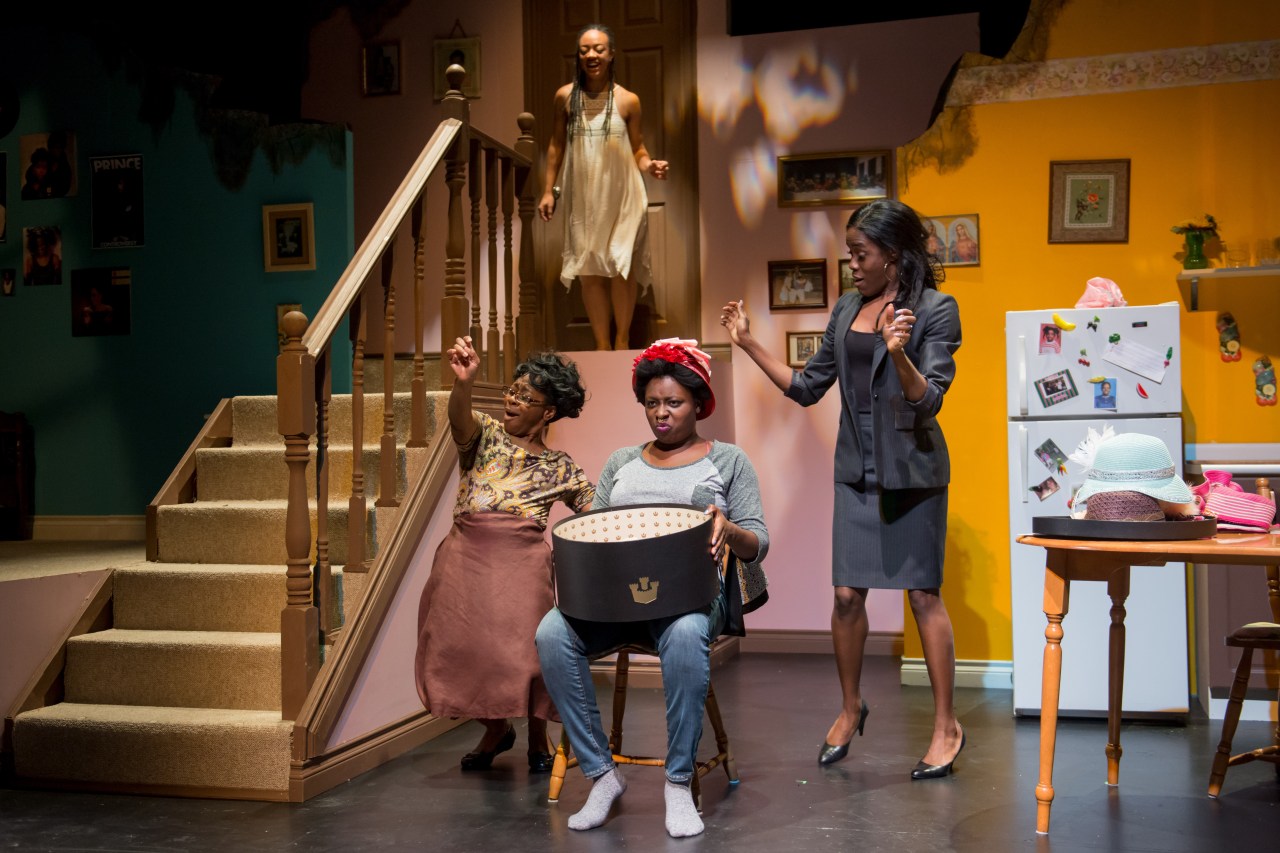
You could take the word Black out of the title of Trey Anthony’s play and it would still stand for the story she’s written. The strengths of How Black Mothers Say I Love You are at once its specificity and its universality, its personal and its political significance.

The play was inspired by the story of Anthony’s Jamaican grandmother who left children behind to seek a better life for them in England. To earn the money to reunite her family she swept the floors of the trains in the London transit system. It’s a familiar story in Canada, where in 1955, the federal government introduced a program to admit domestic workers with a promise of landed immigrant status. Successive generations of children left behind have felt the sting of separation and sense of abandonment.

This very well made play, directed by Trey in collaboration with Nisha Ahuja, runs on the emotional wars between a mother and her daughters, especially her eldest daughter. Claudette (Khadijah Roberts-Abdullah) won’t let her mother Daphne (Ordena Stephens-Thompson) ever forget the six years when she and her little sister Valerie (Allison Edwards-Crewe) were left behind with their grandparents while their mother went to Toronto and worked three jobs to give them a better life than the one she’d had as one of nine children living in a shack in Jamaica.

And now there’s another reunion, as Claudette comes home to Toronto from Montreal because her mother is dying of cancer. A new rift has opened between Bible-thumping mother and her eldest daughter, over Claudette’s sinful choice to love a woman. (Daphne to Claudette: “Stop acting like a man instead of trying to get one.”)

Death casts a long shadow in this play, not just Daphne’s imminent demise, but the earlier passing of her youngest daughter Chloe (Beryl Bain), a sickly child she had with a Toronto man after immigrating from Jamaica. The dead sister becomes more cause for Claudette’s resentment; she says of her mother, “she’d rather die and be with Chloe than live and stay with us.” Life is falling apart for everyone in this family – Valerie’s marriage to a wealthy white man is failing – and instead of pulling together, these women are duking it out with each other.

This show is no tragedy, though. Like Anthony’s rollicking da Kink in my Hair there’s much fun, song and dance, rolling out with an opening exchange between Valerie and Claudette about their mother’s obsession over the hat Miss Esme wore in her coffin. She may be refusing medical treatment, but Daphne ain’t going nowhere until they’ve obtained the perfect hat for her to wear at her funeral.

The staging of How Black Mothers, which had a good run last year, doesn’t leave much to argue with. Rachel Forbes’ set, costume and props are echt 80s Toronto. Michael Jackson and reggae discs on the turquoise walls of the teens’ room; Christ portraits and porcelain flowers in the yellow-painted kitchen. Gavin Bradley composed an original score that weaves together scenes that wouldn’t ordinarily occur in the same play: from gospel singing, say, we switch to meal preparation.

The actors are all superb, especially Ordena Stephens-Thompson as Daphne. Her role calls for grief, denial, anger, evangelical zeal, cheekiness and, finally, unbridled love for her daughters. She strikes the right note every time.

Trey Anthony has exceeded her expertise, however, by including dance. Some of the more organically occurring production numbers, such as the sequence of trying on outrageous hats, work. But the interpretative dance bits — the opening scene of women with suitcases and Chloe’s ghostly appearances with a violin bow — are embarrassing. Dancers trying to sing or vocalize can be cringe-inducing. The same goes for actors attempting modern dance.


How Black Mothers Say I Love You

Writer, director, executive producer – Trey Anthony

Actors – Beryl Bain, Allison Edwards-Crewe, Khadijah Roberts-Abdullah, Ordena Stephens-Thompson

Set design – Rachel Forbes

Lighting design – Steve Lucas

Music and sound design – Gavin Bradley

Choreography – Irma Villafuerte

Photography – Joseph Michael