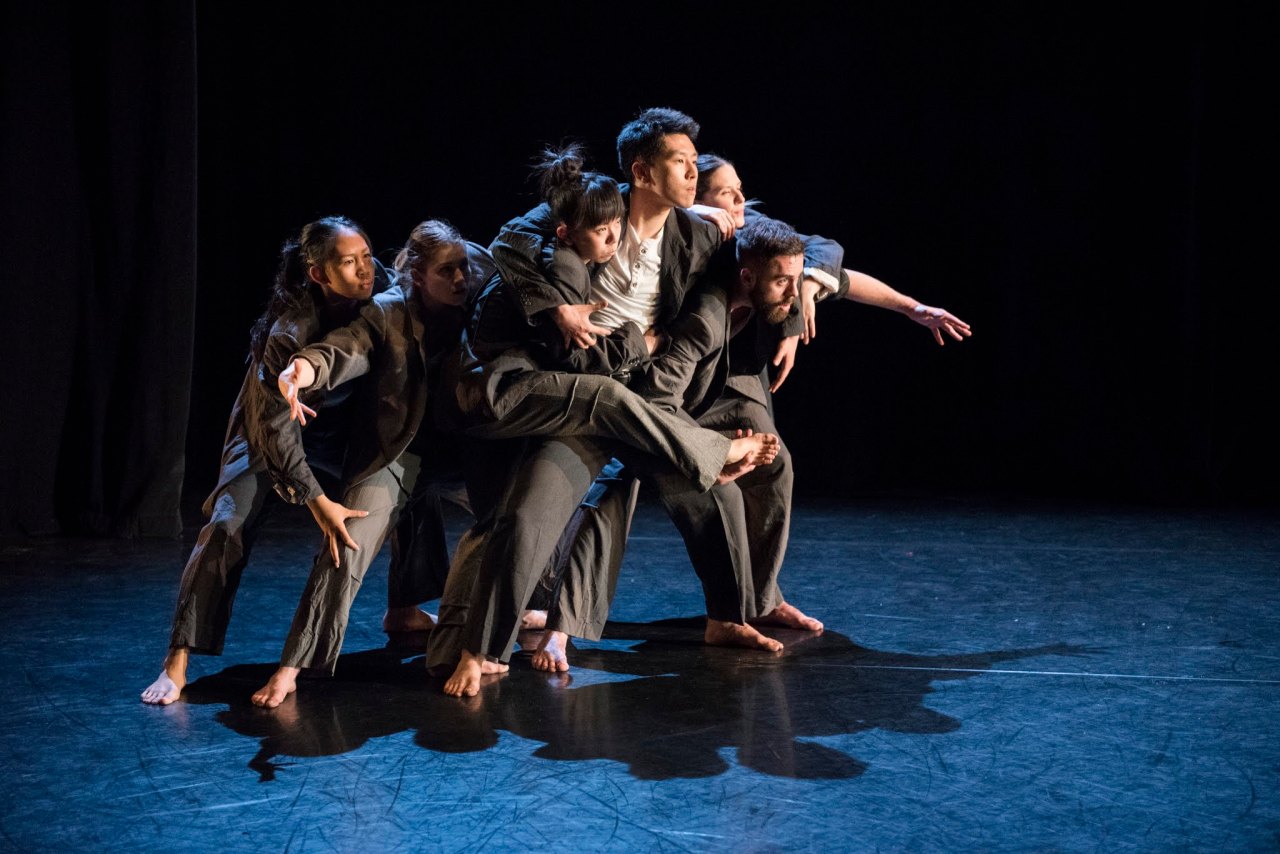
Sashar Zarif soars in dance

Moving Memories

Sashar Zarif Dance Theatre

Small World Music Centre

180 Shaw St. Studio 101

May 8 & 9, 8 p.m.


As complex and in a way alien to western dance as Sashar Zarif’s work is, there is no excuse for going away baffled from his show Moving Memories. The title refers to Zarif’s journey of rediscovery:  the roots of his dance in his grandmother’s practice and in the songs and folk dances of his home country of Azerbaijan. Elchin Musaoglu’s film, screening behind the performance space, documents the dancer’s trips back to Baku since 2004. Zarif discovered the reason for his quest in family memories he unearthed, both emotionally moving and literally causing him to move, to dance, to tell his story. There’s a touching moment when he is lying on a carpet his grandmother took with her everywhere: “What made me look for a home? It was her need to belong.”

Zarif has a home now, and it is in Toronto, Canada. Moving Memories is a culmination of all that he has learned in his research of his heritage, his dance aesthetic and himself. Rather brilliantly produced on a small budget, Moving Memories is a journey in dance. From his opening monologue to a closing, improvised dervish-y spin with drum and singing, Zarif takes us on a life dance, showing us the relationship between his culture, the need to be in the song (the Azerbaijani mugham) and for the song to be in him. Louis Laberge-Côté, in long flared white skirt, brings a contemporary interpretation to the Sama – the whirling dance done by shamans and Sufis. Mezmerizingly, he spins and dips, carving out the space with his arms, inhabiting the music with grace and power. At the centre of the show is Zarif’s solo, set to the poetry of Rumi: “The wound is the place where the light entres you.” The choreographer seems possessed as he utters deep growling, animal noises indicative of the essential self he has reached in for. It is a transformative dance showing the way to enlightenment. The whole thing is akin to an act of love.

As collaborator and dramaturge Elizabeth Langley informs us, when Zarif performs, he is so in the moment that there is no difference between living it and dancing it. Introducing him for the finale, she says, “Sashar will now experience the last work.” So he does and so do we.
A George F Walker double bill

Parents Night/The Bigger Issue

A Crazy Lady production

Theatre Passe Muraille, Toronto

Until May 17, 2015

George F. Walker says he’s only channelling the voices he hears when he wades into a contentious issue to witness injustice, dysfunction and people under the pressure cooker, trying to do good work in impossible situations — a general description of what’s going down in our schools. Walker’s wife is a teacher; they’ve had three children in the public system; how could he not be attuned to the voices of protest, burn-out, financial strain and frustration coming from both parents and teachers?

                As for Walker’s contention that “I’m just transcribing what they say,” we beg to differ. A lot of craft has gone into making those voices count and turning 65 minutes of hard-hitting tragicomedy into a cathartic event.

                Parents Night, first mounted last year in Hamilton, and The Bigger Issue, a world premiere, are the first two playlets in a theatre cycle focusing on education.

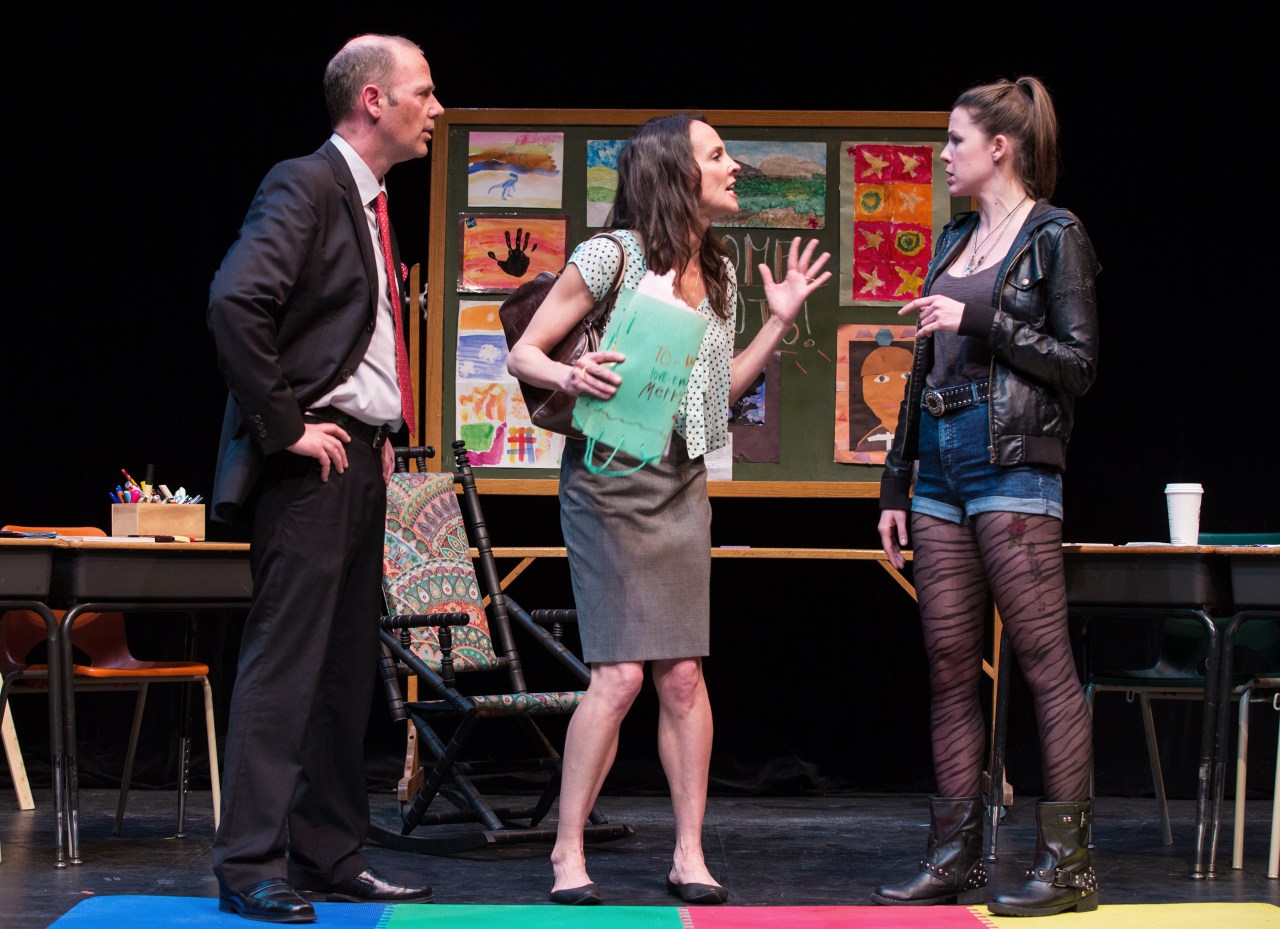
                First up is Parents Night, a tightly scripted, breath-takingly confrontational pas de trois between two parents of struggling seven-year-olds and the children’s beleaguered teacher.  Into the empty classroom, in which little desks flank a display board, strides business-suited John (Matthew Olver) loaded for bear before the teacher Nicole (Sarah Murphy-Dyson) has even appeared. He picks up an artwork, tosses it aside with contempt, then makes for the finger-painting by his son Patrick as if it was a homing device. Judging a little girl’s work as Asian, he spews forth a critique of “social engineering”, teamwork that shores up “slackers” and an accusation that his son’s seven-year-old deskmate might be a subversive North Korean. John is divorced, a cuckold and a parody. He’s soon withered by the breakdown of teacher Nicole. Already at the point of meltdown, she is in a puddle after learning of her father’s death.

                Enter Rosie (Dana Puddicombe), an even bigger shock to Toronto middle-class smugness. She’s dressed like a hooker and indeed is a lapdancer: cut-off jeans over zebra-striped hose, stuffed into black leather jacket and boots.  She’s parent to Sonia, a child who’s already declared she’s gay. Sonia’s father is a drug dealer; Rosie, to put it mildly, is a parent with a brief. Where does Nicole (“I’m already at the peak of my niceness”) get off judging her and her child for their homeless condition? Nothing is ever resolved in this play, a triangle of fictional proportions in which the teacher is totally defeated: “It’s people like you who ruin this job for me,” she says.

                Walker ratchets up the tension inherent in the conflicts by forcing a tragic storyline into a comedy format. In The Bigger Issue, concerning the parental complaints of Jack (Olver) and Maggie (Puddicombe), whose 12-year-olds are in teacher Irene’s (Murphy Dyson) class. Irene is accused of assault on a boy who’s “on the spectrum (of autism)” and who carries a butcher knife to class. Again a steady rant rises to an absurdist climax as the knife is pulled out. Through the din we hear a home truth from Irene: “I don’t want to be in this school. I might as well just join the police force.”

                Director Wes Berger makes the perfect interpreter, fine-tuning all the symmetry of Walker’s script. The cast, especially the wide-ranging Sarah Murphy-Dyson, is pretty much flawless in its timing. Only one quibble: with the intensity of the writing and the rapid-fire delivery, is it really necessary to have everyone shouting at full volume? We know we’re meant to be worn down. We don’t actually have to be pummelled into the back of our seats.

Above: Matthew Olver, Sarah Murphy-Dyson and Dana Puddicombe in Parents Night

Photo by Cylla von Tiedemann

Peggy Baker Dance Projects

loc√∫≈p∟0T

Peggy Baker Dance Projects

Betty Oliphant Theatre

April 29-30, May 1-3

A few years ago Peggy Baker, cruising the web, happened upon a cache of beautiful symbols and drawings of mathematical equations that spoke to her as descriptions of movement akin to choreographic renderings such as the Benesh notation system. Both pictorial alphabets are used to describe motion and the relationship of figures to each other: the speed, volume, duration, mass of bodies falling, rising or circling, moving through time and space.  These abstract equations looked like drawings for the blocking of a play. Baker felt a dance coming on.

First she sought out John Mighton, playwright and mathematician, to give her a quick tutorial on the meaning of the equations.  As Mighton drew diagrams and worked out an equation, she could envision dancers re-enacting one on stage.

Building the dance layer upon layer, Baker invited vocalist Fides Krucker to come in and give the dancers sounds to emit. These vocals comprise everyday sounds, such as growls, cries and whispers, repeated in the manner of chants made in kundalini yoga. Finally, the choreographer asked composer and musician John Kameel Farah to orchestrate a live electronic and acoustic piano soundscape to complement the dancers’ combinations and recombinations. Marc Parent’s lighting design makes cones of illumination over the whole thing.

The element of chance that contributed to the fluidity of the project, said Baker, a self-described formalist, “really rattled my cage.” Indeed to the viewer of Baker’s works over a couple of decades, this production is a paradigm shift from work she’s created in the past, and yet indubitably a Peggy Baker dance piece. Dancers Ric Brown, Sarah Fregeau, Kate Holden, Sean Ling and Sahara Morimoto are all fine interpreters of the Baker dance vocabulary and it is joy to behold the sharp, almost hieroglyphic, gestures that are the hallmark of her choreography.

Under a fall of light, Farah opens the show, with a tiny tinkling on the upper end of the piano keyboard. His sounds usher in the dancers into the performance space, in everyday shirts and jeans, as if marshalled by some unseen dance captain.  Above them on a screen, a diagram appears, of a hand-drawn equation, as if worked out on a scrap of paper (a pity that the lines from Mighton’s pencil couldn’t have been captured in live action). It doesn’t take much to see how the dance figures correspond to the numeric figures above them, as they mark out lines and vectors with their footsteps, the five of them arranging and re-arranging themselves in geometric patterns.

In mathematics, locus is defined as, “1. a curve, etc. formed by all points satisfying a particular equation between coordinates . . . moving according to mathematically defined conditions. Or 2. the centre or source of something.” The definition for plot is “1. a ground plan, map or diagram,” and “2. a plan or outline of the main events in a play, novel or film.” Or dance. With each new equation posted in  locus≈plot, the dancers reconvene, speaking in cries, growls and whispers, communicating in an animal and human way – following a plot.

From very abstract, nearly random movement, the dances become more formal, culminating in a circular sequence in which the performers call out “centre. diameter. circumference. radius.” As Farah’s score builds to a crescendo of rolling thunder, their voices draw our attention to the breath. Without mindful breathing there would be no dance, no life, no creation, no connection with the Earth.

And so it is with a sense of exhilaration that we watch Kate Holden, wearing a short, white shift, dance a muscular, grounded solo. Crouched stage front, she that ends on a deep crouch, loudly expelling the yogic breath of fire, in affirmation of the dance of life, depicted in the shadowy forms who caper about behind her.

Above: Kate Holden in locus≈plot Photo by Makoto Hirata

Burpee/Chin: Two New Works, Toronto Dance Theatre April 9-12, 15-18

It isn’t entirely clear how the neologism in Peter Chin’s Returning Empathis (empathy/emphasis) plays out in the work at hand. But never mind. We get the references to deep listening and empathy. Five dancers cluster around a throne-like chair to listen and watch as soloist Naishi Wang performs a tremendously articulate dance, all hands, limbs, sharp emphatic gestures – as if speaking to them.
When we watch dance we are practising a form of empathy, dancing in the dancers’ shoes, as it were. And we go into the dance and out of it, as do the watching dancers here, entering the empty space — the space of awareness — breaking into duets, quartets and solos, almost signing with finger gestures in their harmonic arrangements. Each entry onto the stage is a reinvention of oneself, akin to a reincarnation. Cheryl Lalonde’s costumes in the colours of Tibetan monks enhance the understanding of Eastern forms of thought. Chin’s marvellous soundscape, a haunting surround of chants from Tibet, music of Burkina-Faso and Madagascar and the ascendant choir of voices singing Thomas Tallis’ O Salutaris hostia provides the other chamber for this dance of ever-cycling life and death. Along with Naishi Wang, performers Alana Elmer, Yuichiro Inoue, Pulga Muchochoma and Jarrett Siddle make wonderful music together.
The Asian elements to the piece are a reminder that dance began in temples, in sacred spaces. It is a shame Chin’s piece couldn’t have been performed in a wide open white space, sun streaming in at a side angle. As it is, the bare, scarred walls of the Winchester stage, with its armature of industrial lighting equipment make a distraction requiring a very willing suspension of disbelief.
Speaking of which, Susie Burpee’s Making Belief (OR Seven Stages for Transformation, as played by a Willing Character) is a charmingly manic discourse on what it means to put on a character, go in and out of character, reveal the trickery behind the curtains and generally romp about in a swirl of artifice. Naishi Wang puts on a sad-face mask and white wig, while Pulga Muchochoma, his comic opposite, strides in like a loopy, vaudevillian Mr. Bojangles, grinning and manipulating Wang’s geriatric, tentative sadsack to perform — damn it. The metaphors get a little mixed as the rest of the company joins them, alternately role-playing as audience and back-up ensemble. A muscular Jarrett Siddall does deep breathing and holds his breath as if it was an athletic feat: maybe a sly jab at the tendency of some performers to overachieve on stage.
In any case, it’s a whole lot of fun, and to see Toronto Dance Theatre in all its current diversity – culturally, physically and stylistically – is to imagine we could have watched them dance all night.

Making Belief. From left: Danah Rosales, Christianne Ullmark, Megumi Kokuba, Naishi Wang, Alana Elmer, Nathan Todd

Photography by Ömer K. Yükseker.