Gallery

Alice’s Adventures in Wonderland a phantasmagoria to behold

Lewis Carroll’s Alice’s Adventures in Wonderland is a story of the precisely rational overturned by the absurd. It’s a delightful fantasy fit to charm the young yet satirically entertaining enough for parents seeking to decode its characters and plot.

And so goes Christopher Wheeldon’s adaptation of the 1865 novel. A full-length three-act show that breaks the mold of the romantic story ballet, it was co-commissioned by the Royal Ballet and the National Ballet of Canada and premiered on both stages in 2011.

Running throughout March Break, the National Ballet’s latest staging of Alice plays to the max to both sides of our brains, the cerebral and the emotional, with a tremendous cast of dancers supported by David Briskin’s rousing direction of the ballet’s orchestra playing Joby Talbot’s brilliantly innovative score.

Wheeldon had not made a full-length story ballet when he tackled Alice’s Adventures, an audiotape of which he’d listened to repeatedly as a child. Knowing it would be impossible to condense the whole plot into a traditional ballet format, he seized on the vivid characters, the humour and the imagery of Carroll’s book to fashion stunning, often zany dance tableaux. Talbot’s score carries the narrative arc.

Wheeldon chose Talbot as a co-creator, because coming from a background of scoring films, he had transitioned to dance with majestic soundscapes for works by Wheeldon and the Royal Ballet’s Wayne McGregor. “He created these unusual, shimmering orchestral colours that to me felt absolutely like the right direction for Alice’s Adventures in Wonderland,” says Wheeldon.

Talbot’s score illuminates the two worlds that Alice occupies and foregrounds the many transformations that occur in the ballet.

The opening of scene takes us into the upper-class 19th-century, ordered environment of Henry Liddell, Dean of Christ Church, father to daughters Lorina, Alice and Edith. Lewis Carroll, a mathematics professor and friend of the family reads to the girls and performs magic tricks, as tea is served on the lawn amid a game of croquet. Enter Jack, the gardener’s boy, a friend of Alice’s, who offers her a rose clipped from Mrs. Liddell’s sacred rosebushes. Alice in return gives him a jam tart. An enraged Mrs. Liddell pounces on Jack, accusing him of theft and dismissing him from the party.

Talbot describes the musical motif he found for Wonderland as “a strange, shifting bitonal music – a restless ticking clock.” This emphatic tick-tocking percussion also signals the plunge from Alice’s above-ground, secure family life into a dark netherland, where one pill makes you larger and one pill makes you small.

Bob Crowley’s ingenious graphic projections on the changing scrim take Alice down the black hole, following Caroll, now transformed into the White Rabbit, through a glowing jelly mould on the tea table into Wonderland. As the projections of doors on the scrim grow bigger or smaller, so does Alice with each substance she consumes, appear diminutive or gargantuan, against her graphic background.

The score makes Alice an active protagonist and not just an observer of events. She’s chasing the white rabbit, following the smoky messages of a hookah-smoking caterpillar, keeping up with a manic tap-dancing Mad Hatter (the dramatic Ben Rudisin) and encountering a wild-eyed, puppeteered Chesire cat made up of parts that come together and fall asunder.

Tirion Law, with her quick-silver steps and seamless transitions from sheltered girl to able adventurer, strikes just the right balance between portrayal of a child and a sophisticated guide to her wonderland. She and Naoya Ebe as Jack/the Knave of Hearts make a beautiful pairing, especially in the climactic pas de deux.

Talbot gave several of the main characters a musical signature. Donald Thom, a formidable shapeshifter who doubles as Lewis Carroll and the White Rabbit, comes on to the strains of the celesta. Peng-Fei Jiang, in a sinuous solo as the Caterpiller, dances to a middle-eastern-sounding oboe d’amore piece.

Svetlana Lunkina gives an hilarious character portrayal as Alice’s mother, reappearing as The Queen of Hearts. She’s a neurotic, controlling hostess and mistress of ceremonies spoofed by her King, Rex Harrington in one of the campiest, funniest performances of his late career. Talbot gives the queen a tango to perform and themes her with a semi-tone sharpened solo violin to indicate her high-strung nature.

Wheeldon and Talbot pay such attention to the telling detail – the backwards-running hands of a huge pocket watch dangling over Alice’s adventures in a surreal landscape representing many a childhood fear, hangs overhead accompanied by cacophonous, dissonant musical crescendos – that the audience willingly suspends disbelief to enjoy outstanding dancing mixed with a little delirium.

Alice’s Adventures in Wonderland

Choreography  Christopher Wheeldon

Music  Joby Talbot

Scenario  Nicholas Wright

Set and costumes  Bob Crowley

Performed by the artists of the National Ballet of Canada

At the Four Seasons Centre for the Performing Arts, Toronto

March 6 to 17, 2024

Trailer: Alice’s Adventures in Wonderland | The National Ballet of Canada (youtube.com)

Photos by Kira Kuras, from left: Tirion Law and Naoya Ebe as Alice and the Knave of Hearts; the Dormouse, Alice, The Mad Hatter and the March Hare; Donald Thom as the White Rabbit, with Tirion Law. Courtesy of the National Ballet of Canada

The Answer lies in Sami Culture

The answer is land, but what is the question? Perhaps: how can we continue to exist on our ever-shrinking territories and preserve our culture on traditional lands heavily beset by global warming?

Sámi choreographer Elle Sofe Sara articulates it better. About Vástádos Eana/The Answer is Land, opening tomorrow at Harbourfront’s Fleck Dance Theatre, she says, “It’s about inviting the audience into a state where we are all here together. The [performers] are standing equally on the same ground and we take the audience on a journey, one that is based in spirituality.”  

The Answer, created in 2021, is about kinship and the shared sorrow of the Sámi people, colonized for decades, herded into residential schools like the indigenous peoples of Canada, their language and culture suppressed, their Sápmi territories drastically reduced.

Today, the approximately 2 million Sámi peoples, historically occupying the land for about 12,000 years, are confined to lands in the northern tips of Norway, Sweden, Finland and the Kola Peninsula in Russia.

Elle Sofe Sara’s prize-winning show is a celebration of the still thriving Sámi culture and a defiance:  the dancers are literally standing their ground in the face of a global crisis.

A special aspect of the show is the result of collaborating with southern Sámi yoiker and composer Frode Fjellheim, best known on this side of the pond for the adaptation of his 2002 song “Eatnemen Vuelie”, as the opening number for the animated film Frozen.And what is a yoik, you say? Check YouTube and you’ll see a Laplander in traditional dress, softly pounding an indigenous rhythm on a skin-drum while singing songs remarkably similar to those of the British Columbia coastal peoples.

The seven dancers in the show, all women, and some Sámi, perform Fjeillheim’s polyphonically arranged songs in during the show, creating a complete aural and kinetic sphere of Sámi origin. As seen in the trailer, the dance, with its ritualistic movement, is reminiscent of Jean-Pierre Perrault’s 1983 breakthrough show, Joe, which also invited the audience into the bodies of the dancers on stage to share in their unity of purpose.

Sara is known for her globe-trotting creations and has been to Canada before, once performing for the Arctic Winter Games when they were held here. Last year her company performed The Answer in Montreal. Born in the Norwegian villageGuovdageaidnu, she never saw professional dance on stage, but somehow by 16, she knew dancing was for her. Getting dance training, she says, “Opened up a whole new world for me” and was the spark for a life of creation. She holds a master’s degree in dance and received dance training at London’s Laban Trinity School. She’s also an accomplished filmmaker, whose works have appeared on the slate of the Imaginative festival. When not touring Sara lives in the village of her birth, with her partner, a reindeer herder.

As the jury said, in awarding Elle Sofe Sara the 2023 Telenor Culture Prize, “Elle Sofe Sara is an artist who really transcends boundaries. She is a choreographer, a director, and a filmmaker – and to all her productions she brings a lot of playfulness and curiosity as she continues to combine different elements to great effect. She is unafraid to challenge established ideas about the limitations of the performing arts and remains eager to explore new ways of engaging with her audiences.”

Personally, I’m keen to join those viewers

The Answer is Land

Choreography Elle Sofe Sara

Composer Frode Fjellheim

Costume design Line Maher

Set Elin Melberg

Lighting Øystein Heitmann

Toronto premiere runs in the Fleck Dance Theatre, March 6 and 7

See The Answer is Land trailer here: https://vimeo.com/724070129

Louise Lecavalier, simply the best

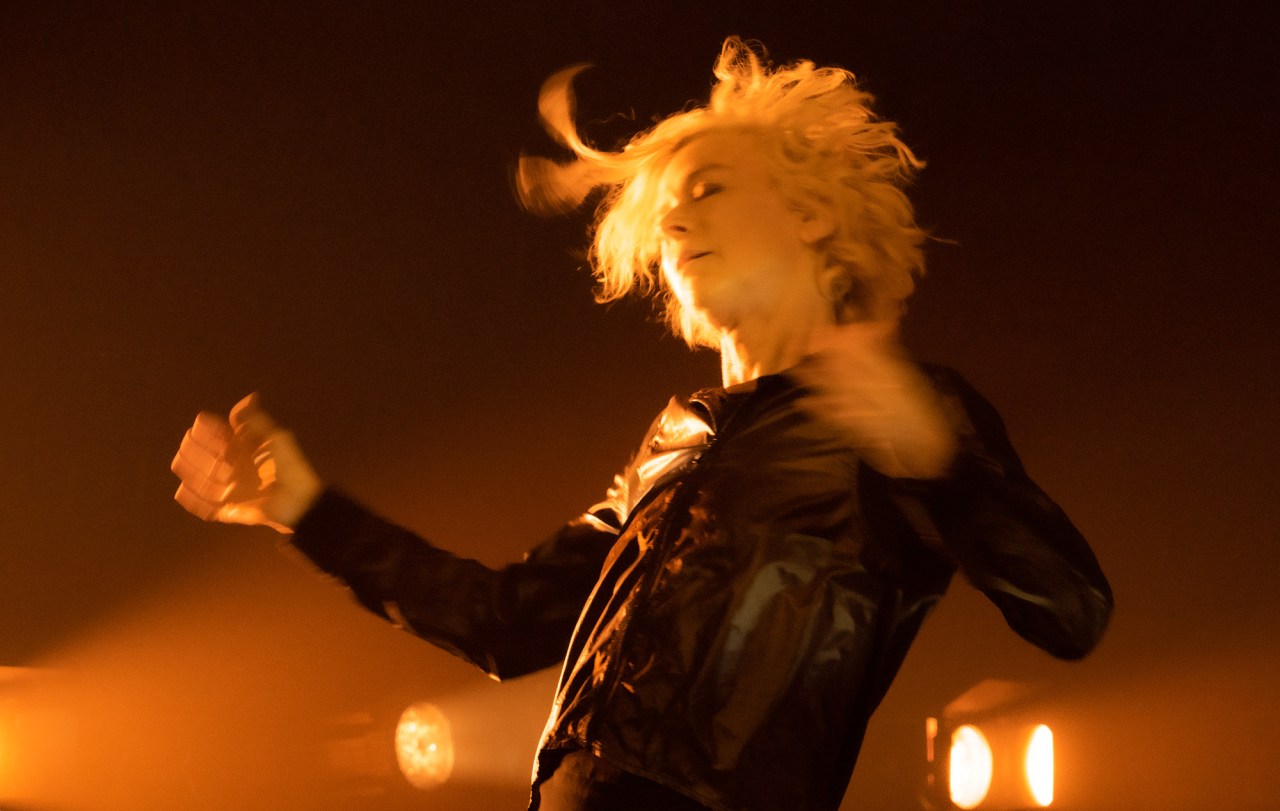
Under a spotlight on a darkened stage, a breathtaking sight: her platinum blonde mane flashing, an embodied force of nature, the dancer in the black bustier explodes into barrel rolls, airborne, gathering speed. This was Louise Lecavalier dancing with La La La Human Steps in the 1990s.

And she’s still rolling: Lecavalier will perform her own solo, Stations, at the Fleck Dance Theatre in Toronto from November 23 to 25.

Muse to Edouard Lock, artistic director of La La La Human Steps, Lecavalier has continued as a solo performer and choreographer since she struck out on her own in the early 2000s.

She’s been a legend in her own time, a dancer one never forgets. “When you’re holding a bomb in your hands, what do you do with it?” says a male dancer in Raymond St-Jean’s 2018 documentary Louise Lecavalier: In Motion.

Born in Montreal in 1958, Lecavalier was dancing professionally by the time she was 18. She joined La La La in 1981 and helped define that company’s unique style of dancing. Interviewed by the CBC in 1989 alongside Lecavalier, Lock noted that dance had historically been about shapes, beautiful bodies arranged in artful positions. “I think it’s more interesting to see a flux of energy. Someone moving has no shape and that’s really interesting; it’s almost an abstraction.” Lock and Lecavalier’s collaborations ended in 1999.

Her hair shorter now, Lecavalier has continued as a notable presence on the international stage, commencing with establishment of her own company, Fou Glorieux, in 2006. Its mandate: “to bring together dancers and collaborators of all ages and horizons around a fully mature performer to carry out creation projects in a flexible, open framework.”

In 2006, Lecavalier collaborated with Crystal Pite, who choreographed a solo for her, Lone Epic, which was boldly set to Bernard Herrmann’s music for Citizen Kane. In the 2009 piece Children, choreographed by Nigel Charnock, Lecavalier danced with Patrick Lamothe to the music of Leonard Cohen, Brownie McGhee, Billie Holliday and others. Described as a narrative of a long relationship breaking down, Children is highly physical, the performers taking on the appearance of overgrown kids.

Battleground, the piece Lecavalier choreographed for herself partnering Robert Abubo, is based on the characters in Italo Calvino’s novella, The Non-Existent Knight. These duets seem to deepen Lecavalier’s intensity, as she pits herself against a dancer of equal energy, the results definitely greater than the sum of the parts.

“Increasingly, over time, I have become the subject of my research,” says Lecavalier. “I take the risk that my various existential battles as a dancer may resemble those of others, trusting that the new difficulties I come up against or inflict upon myself in the movements will always provide an answer and perhaps a true space of freedom. I go back into the studio to discover the previously unrevealed movements that will allow me to renew and clarify what my body needs and what inspires me now. I seize upon new steps as if it were a matter of sheer survival.”

Hence, Stations, which premiered in Dusseldorf in 2020. The wild white-blond hair is part of this performance, which finds Lecavalier, no worse for punishing years on stage, whirling and contorting in a fascinating blur to the original, jazzy music of Antoine Berthiaume. Clearly Louise Lecavalier is the Mick Jagger of contemporary dance: electrifying, inimitable.

Stations

Created and performed by Louise Lecavalier

November 23 to 25, 2023

Fleck Dance Theatre, Harbourfront Centre, Toronto
Photo of Louise Lecavalier by André Cornellier

Raising the roof with red-hot ballet

As thunder snow and lightning engulfed Toronto on opening night, the energy of dozens of dancers on the stage of the Four Seasons Centre felt sufficient to lift the roof off – and indeed lifted the National Ballet of Canada’s opening-night audience multiple times out of their seats.

The mixed program, which resumes March 22 and 23, is all about the new and the renewed. In her first season as NBoC artistic director, Hope Muir has shown dedication to new work, new choreographers and development of a dynamic and thrilling cadre of performers.

This mixed program — something old (George Balanchine’s Symphony in C), something new (Rena Butler’s Alleged Dances) and something new to the National Ballet (David Dawson’s Anima Animus) – engages one’s imagination like no other dance show in recent memory.

George Balanchine’s Symphony in C, created for the Paris Opéra Ballet in 1947 and first performed by the NBoC in November 1984, is dazzlingly renewed with this staging, the last for dancer and Balanchine répétiteur Joysanne Sidimus, who is retiring from her work as a Balanchine interpreter for the National Ballet for the last 38 years. In its lightness of mood and step, its speed and its clean lines and stripped-down classicism, Symphony in C embodies the spirit of modernism that Balanchine brought to ballet. The four movements of the ballet, challenging in the precision needed for difficult pas de deux and pas de trois, are here outstandingly executed by pairs Koto Ishihara and Harrison James, Genevieve Penn Nabity and Ben Rudisin, Jenna Savella and Naoya Ebe and Tina Pereira with Keaton Leier.

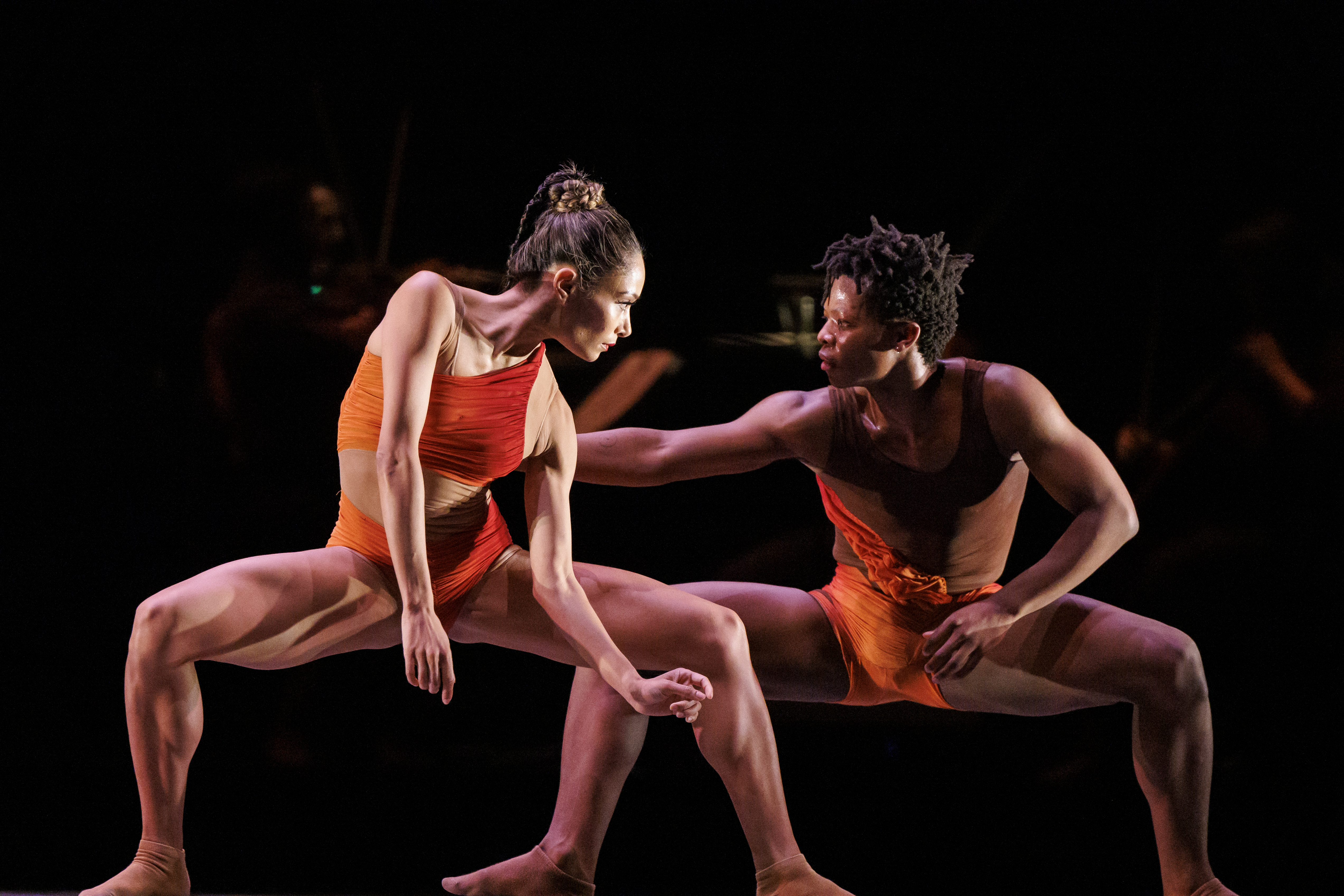
Rena Butler, a Chicagoan who shares with Muir a history at Hubbard Street Dance Chicago and is the 2019 recipient of the Princess Grace Award for Choreography, more than meets expectations with her first piece for the National Ballet, Alleged Dances. Butler engendered a piece in which the ballet’s dancers share the stage with a live string quartet (Aaron Schwebel, Jamie Kruspe, Joshua Greenlaw and Olga Laktionova) that shifts on its platform across the stage as they play American composer John Adams’ John’s Book of Alleged Dances (1994), creating a spectacle of red-hot, sexy and sassy dance, at once playful and awe-inspiring.  Siphesihle November performs the part of a playground leader, as Teagan Richman-Taylor, Noah Parets, Tina Pereira, Alexander Skinner, Josh Hall, Emma Oullet, Tene Ward and Arielle Miralles, play a game of tag involving pigtail-pulling, or hide-and-seek, or truth or dare. Alleged Dances is a high-octane, ever transforming romp that borrows from social dance and at some points looked like a country hoedown. Hogan McLaughlin’s blazing red, minimal costumes brilliantly highlight the singular movement of each performer.

The ten dancers who made David Dawson’s Anima Animus their own upped the bar even higher, supercharged as they were with the emotion-filled music of the late Italian composer Ezio Bosso. The British choreographer, associate artist at Het Nationale Ballet and associate choreographer for Semperoper Ballett, is a prolific contemporary dancemaker with whom Muir has frequently collaborated. Having been moved by the San Francisco Ballet’s 2018 premiere performance of Anima Animus by the San Francisco Ballet, Muir was eager to bring Dawson’s work to the National Ballet as an opportunity for the dancers to deepen their individual capabilities.

As hinted in its title, Anima Animus mixes up traditional ballet gendering, with the women, particularly Calley Skalnik, doing as much of the heavy lifting as the men in what was a beautifully, organically constructed performance, seemingly evolving before our eyes and ears. All the enduring elements of ballet – especially the pure joy of movement and partnering – were present, the dancers’ movements emphasized in Yumiko Takeshima’s unisex costuming that outlined each undulating spine. For all the abstraction of set and costume, the piece appeared to grow as if in nature, establishing a fragile order and following the geometry of desire toward a culminating exultation.

Anima Animus & Alleged Dances & Symphony in C

Choreography by David Dawson, Rena Butler and George Balanchine

Performed by the National Ballet of Canada at the Four Seasons Centre for the Performing Arts, Toronto

March 22 and 23, 2023

Photo of Tina Pereira and Siphesihle November in Alleged Dances by Bruce Zinger, courtesy of the National Ballet of Canada

Newton throws a bang-up birthday party

Ask Newton Moraes — celebrating 25 years of the company that bears his name — how he got into dance in Brazil and the first word that comes out of his mouth is “Bob”. By that he means the late Bob Shirley, an anthropologist from the University of Toronto whose studies were concentrated in Brazil.

“I met Bob in 1985. I was studying physical education at Unisinos University in Porto Alegre.” They became friends and later, partners. Moraes, who had done some samba dancing, admired a company called Ballet Phoenix. “He said, ‘Why don’t you start taking class with them? So I did and I took some jazz and some ballet classes.”

He recalls with fondness the 86-year-old dancer, Tony Petzholds, who taught the ballet classes. “She was a fabulous dancer. She was doing a penché and I couldn’t believe this woman had her leg up here (he demonstrates). ‘This is how it is supposed to be done,’ she said. Even the dancers in the company would look at her and say, ‘holy fuck’.”

While still living in Porto Alegre Moraes also took lessons from a jazz dancer, Annette Lubisco. Three years after meeting Newton, Bob had to return to his job at U of T. But the two kept in touch. By 1991, Moraes was dancing in Porto Alegre and even teaching. On a visit, Bob said, “Newton, you are very talented. I should take you to Canada. Believe me, you are going to love it.”

So in 1991, with minimal dance experience, no English and few prospects for work, Newton — thanks to a letter Bob wrote to immigration authorities – was granted a visa and moved in with the anthropology professor in Toronto. Right away he enrolled in English classes during the day and dance classes at Toronto Dance Theatre at night. He auditioned for the School of Toronto Dance Theatre and in 1992 was accepted. Then, like a hot wind in winter, Newton Moraes burst upon the dance scene.

“Six months later, I was on stage.” Toronto Dance Theatre was performing Court of Miracles at the Premiere Dance Theatre (now the Fleck) and they brought in students, including the first-year men, to fill out the cast. “There I was performing with Patricia Beatty, David Earle and Peter Randazzo.”

Students at the TDT School were encouraged to create. “I started to make my little choreographies for the student shows at the Coffee House. And Trish Beatty said, ‘You have something to share: carry on.’ ”

By 1994, with Bob Shirley’s assistance, Newton and the students mounted a show at the George Ignatieff Theatre on the UofT campus. It was all free and the theatre was packed. Soon, he was dancing at the Fringe Festival of Independent Dance Artists and even got a gig at the Music Gallery. The first time I saw Newton dance, it was a solo based on his batuque religion. Scantily clad, moving slowly and deliberately on the FfIDA stage, he was spellbinding, doing something I had never seen before.

More lessons, in jazz, invitations to perform at German festivals, a stint at York University and more networking led to the formation of Newton Moraes Dance Theatre presenting its first show May 22 and 23, 1997. The company continued into the new millennium, funded through a combination of Bob’s generosity, government grants, teaching classes in Afro-Brazilian dance and Newton’s willingness to take on day jobs, usually as a cleaner.

Over the years, Newton Moraes Dance Theatre has employed dozens of dancers and given work to outstanding dance professionals, including Sharon DiGenova, lighting designer for the anniversary show Life Under My Skin. His Brazilian influences and dance foundation have always been detectable in his choreography, especially in works such as Brazil: The Land of Tears and Soul, from 2013. Nevertheless, Moraes credits major mentors such as Denise Fujiwara, Danny Grossman and choreographer/dancer Jean Sasportes, the long-time Pina Bausch associate, for his growth as a choreographer.

Life Under My Skin has been in development for months. Collaborating with composer Edgardo Moreno and the troupe of eight dancers, Newton built a dance that asks the universal questions about why artists are forced to create and how they survive when money is scarce. Questions Newton himself knows the answers to. Funding from the Toronto Arts council, Ontario Arts Council and Canada Council for the Arts has also enabled the creation of a documentary film about the company. It’s going to be a bang-up birthday for Newton Moraes Dance Theatre.

Life Under My Skin

By Newton Moraes Dance Theatre

Fleck Dance Theatre, Harbourfront Centre, Toronto, 8 pm, November 24-26, 2022

Photo of dancers Maggie Armstrong, Daniela Carmona, Emilio Colalillo, Rumi Jeraj, Aryana Malekzadeh, Jianna Neufeld, Andrea Rojas, Brendan De Santis by David Hou.

Kaeja d’Dance going strong and stronger at 31

“Kaeja d’Dance is driven by a commitment to innovation in the performing arts through the expression of dance and gesture. We explore identity, personal stories and the complexity of the human experience . . . [through] mediums of live performance, dance film and community engagement.”

The mission statement is no mere window-dressing. On the 31st anniversary of the company they formed, in the 37th year of their relationship, Allen and Karen Kaeja are innovating as much as ever. For this dance company, curiosity and imagination have allowed the participants – dancers, composers, filmmakers and directors always their co-creators – to evolve according to the opportunities presented to them.

From November 11 to 13 at Harbourfront Centre Theatre, Kaeja d’Dance presents 31, a double bill that in several ways sums up the themes and direction the company has taken since its founding. In both pieces – Allen’s I am the Child of… and Karen’s TouchX – it is possible to see the fruits of a commitment to innovation and community involvement.

On Zoom from their home in Toronto, the married couple, parents to 29-year-old Aniya and 24-year-old Mika, give a clear account of how they got to this production.

Speaking about innovation, Allen, who came to dance through the martial arts, says of 31, “we are the first dance company in Canada to fully integrate immersive AR in a dance stage production. And Karen’s work is totally cutting edge in the integration of community and professional dancers.”

If there’s a rough division of labour here, Allen’s focus has been on making dance film and technological innovation, Karen’s on collaborating with community. Both have been heavily involved in dance training, which is an ongoing practice for the company, offering workshops to schools, professional dancers and individuals with no prior dance training. As co-artistic creators, they’ve racked up more than forty awards, created more than 200 original works and 35 dance films. They’ve also published EXPRESS DANCE: Educators’ Resource to Teaching Dance.

“We have worked with hundreds and hundreds of dancers over the 31 years. People who brought their beautiful talents to our work,” says Karen. The annual summer series Porch View Dances, inaugurated in 2012, is an example of the meaningful community engagement the Kaejas strive for.

After turning the porches and front yards of Toronto’s Seaton Village into outdoor stages, Porch View has also expanded to other cities. The project, says Karen, is about “honouring people who live in the community we’re working with, revealing the stories that live in the houses and bringing those stories alive on the front porches and front yards, working with professional choreographers.“ The format involves a tour guide who leads the audience around the neighbourhood telling stories from the area, “some true, some less true.”

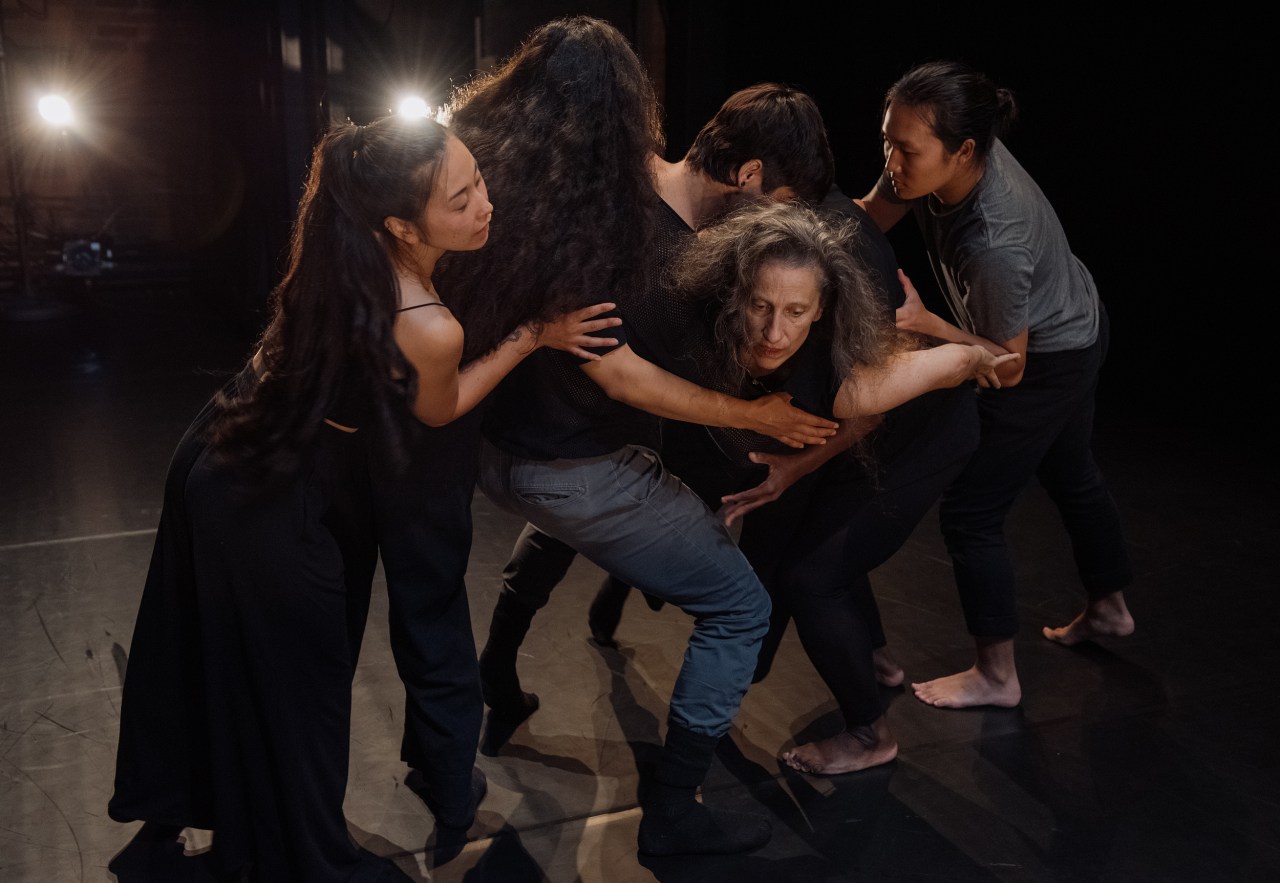
The development, over seven years, of TouchX is allied to Karen’s work with communities. “It is based on an exploration of touch in all its fabulous and not so fabulous aspects. The fragility of touch, the agency of touch, the wanted touch, the unwanted touch and all the different kinds of responses that touch can evoke.” A late arrival to dance, Karen was drawn to its sensorial aspects at age 18. She alludes to childhood trauma when she talks about how enrolment in York University’s dance program led to a fascination with improvisation and contact dance.

For TouchX, Karen invited different generations of community participant dancers to join the professional dancers on stage. Needless to say, the pandemic, with its enforced social distancing shed a new light on the importance of touch in all our lives. “It’s great,” says Karen of COVID strictures, “because it’s pushed the work. It’s been wonderfully challenging.”

I am the Child of … had its genesis in a Facebook post Allen put up in 2015, reacting to the Harper government’s determination to stop middle eastern refugees from coming to Canada. “I am the child of a refugee,” it was titled. Allen told the story of his father, Morton Norris, a holocaust survivor whose entire family was murdered by the Nazis. He sought to enter Canada and a cousin warned him, “They don’t want our kind here.” But when the government of that day fell, Allen’s father was admitted to Canada. His story exemplifies the value that refugees bring to whatever country they land in. “What do refugees do? My father built a world; he built a community; he made a new family. He was made an honorary police officer because of his work in the community.”

Bruce Barton, a performance director, dramaturg and creator based in Calgary, has worked with Allen Kaeja on five productions. With I am the Child of… they have been co-creators from the outset of workshops and residencies that built the show, which engages 13 dancers, eight live and on stage, five who exist in augmented reality. Audience members for Child are encouraged to bring their devices, for an enhanced experience of the show.

The Kaejas had experimented with AR for a site-specific commission from ArtworxTO that had to go virtual after a new wave of COVID imposed lockdowns. But for this show, says Barton, he and Allen were entering uncharted territory: creating the appearance of live and AR dancers interacting on stage.

“We had to be sure that the AR aspects were thoroughly integrated thematically into the piece, and not just a novelty,” says Barton, who with his partner Pil Hansen (one of Karen’s dramaturgs for TouchX) is an artistic director of Vertical City Performance. To achieve this goal, they engaged Toasterlab, a Toronto-based outfit with experience in using “extended reality” in performance. Edgardo Moreno, who has been composing sound and music for Kaeja d’Dance for thirty years, has created a soundscape for Child that employs the performers voices in speech and song, with no instrumentation.

Allen’s genius, Barton says, is in creating a framework for the dancers to explore different themes in the piece, one of which is “how we connect, or fail to connect, with one another through the stories we tell about ourselves.” (See links below to trailers.)

So, much to celebrate. And when asked what they are looking forward to as Kaeja d’Dance heads into the future, both artistic directors are pretty sure they won’t run out of ideas. What’s more, says Karen, it is vital to engage with younger generations, as the company tends to do.

“Thank goodness for them,” she notes, “because we more mature artists have a lot to learn from their new thinking.”

Kaeja d’Dance: 31 (TouchX + I am the Child of …)

November 11 and 12 at 7:30 pm, Nov. 13 at 2 pm

Harbourfront Centre Theatre, Toronto

Links to trailers: https://drive.google.com/file/d/1VFFhvUpHiVqSM4kWVvXS1iSgZiGvCz7S/view

https://www.kaeja.org/k31

Photo of I am the Child of…: Aria Evans, Karen Kaeja, Ethan Kim, Geanderson Mello, Mio Sakamoto

Photographer: Kevin Jones

Fall for Dance North takes over Toronto

Nothing says accessible more enticingly than a $15 ticket to a live performance. That price point is the key to the success of Fall for Dance North, as it launches its eighth festival (September 17 to October 8) across multiple venues indoors and out, live and digital, diverse as dance can be in form and artistic origins.

Fall for Dance North (FFDN) is modelled on New York City Center’s Fall for Dance Festival, which began in 2004, and like that festival is designed to build new audiences for dance. But says FFDN artistic director Ilter Ibrahimof, the Toronto festival has developed its own identity, both commissioning new work and drawing on partnerships — this year with 13 arts organizations — to present three weeks of dance – a huge growth from the initial three-day event held in Toronto’s Meridian Hall.

This year’s festival marks a return to live performances after two years of pandemic restrictions. It’s what motivates Ibrahimof, a theatre person from his earliest awareness, growing up in Istanbul. “Wwe’re bringing people closer to these amazing performers who are magicians and athletes and superheroes. To put that dedication to performance and artistry and beauty in front of people is very exciting.”

Yet the pandemic prompted innovation for FFDN, allowing programming to expand digitally with livestream events, film, podcasts and to introduce outdoor presentations, all featured in this year’s festival.

Heirloom, the outdoor performance series inaugurated last year, launches the fest this year with a high-energy display of dance, juggling and sleight-of-hand magic entitled In Blue Rooms. Choreographers Zack Martel and Santiago Rivera both have training in circus arts and their show, performed by four accomplished Montreal jugglers and dancers, is bound to bombard the senses. Musicians Michael Bridge (accordion), Daniel Hamin Go (cello) and Brad Cherwin (clarinet) accompany the dancers live in what is described as “witty repartee between music and physical storytelling.” Heirloom plays at the First Ontario Performing Arts Centre in St. Catharines on Sept. 17, the Evergreen Brick Works in Toronto on Sept. 20, the Leacock Museum in Orillia on Sept. 22 and the Peterborough Square courtyard on September 25.

On the mainstage at Meridian Hall, from Oct. 6 to 8, the FFDN signature program Arise promises to be an exciting and eclectic feast of movement and music. Softly Losing, Softly Gaining, a commissioned piece from Toronto tap choreographer Dianne Montgomery is up first, followed by Kau Hea A Hiiaka a work based on traditional Hawaiian hula created by Honolulu artist Kaleo Trinidad. The second half of the evening leads off with a screening of Zipangu, a short film by Michael Greyeyes, accompanied by the Soundstreams’ Ensemble. The grand finale is the title work, Arise, a ballet created by Jera Wolfe, performed by 110 students from Canada’s National Ballet School.

Phoenix-based Indigenous Enterprise performs the Canadian premiere of Indigenous Liberation on Oct. 7 and 8 in the Theatre at the Creative School at Toronto Metropolitan University. Combining traditional pow-wow dancing with video, feather- and beadwork for a jubilant performance from seven Indigenous creators Indigenous Liberation aims to inspire and herald a time of reconciliation.

More dance discoveries await night owls who take in three different Night Shift programs from Sept. 29 to Oct.1 at the Citadel: Ross Centre for Dance on Parliament St. in Toronto. Produced by Citadel + Compagnie and co-presented with FFDN, Night Shift showcases nine world premieres from a diverse group of Ontario dancers.

FFDN 2021-2022 artists-in-residence Natasha Powell and Kimberley Cooper are behind three shows of jazz dance and music at the Theatre of the Creative School (Sept. 30 to Oct. 2). Powell and an all-female cast premiere Margarita, an homage to old-time chorus girls and Calgary’s Decidedly Jazz Danceworks perform Cooper’s Family of Jazz. After each show, audience members are invited to join the dancers and musicians on stage for a round of social dancing.

And there’s much more in this full-immersion dance festival. 8-Count, a short dance film series screens Sept. 23 and 24 and on Oct. 3 at Meridian Hall, FFDN presents Crystal Pite: Angels’ Atlas, a documentary film about the making of the extraordinary ballet made for the National Ballet of Canada. Union Station is the setting for The Big Social; admission is free for a lindy-hop and jazz dance workshop followed by social dancing. A lunchtime preview and background discussion of Indigenous Liberation at the Four Seasons Centre for the Performing Arts on Oct. 6 is also free.

Program details, festival packages and single tickets are available at ffdnorth.com

Photo by Bruce Zinger: Arise by Jera Wolfe

The Miserere Project

In 1981 David Earle created a dance inspired by Gregorio Allegri’s Miserere mei Deus, composed in 1638 for services in the Sistine Chapel. Miserere was first performed by Toronto Dance Theatre, the company founded by Earle, Peter Randazzo and Patricia Beatty, as part of a program entitled Exit, Nightfall, Miserere.

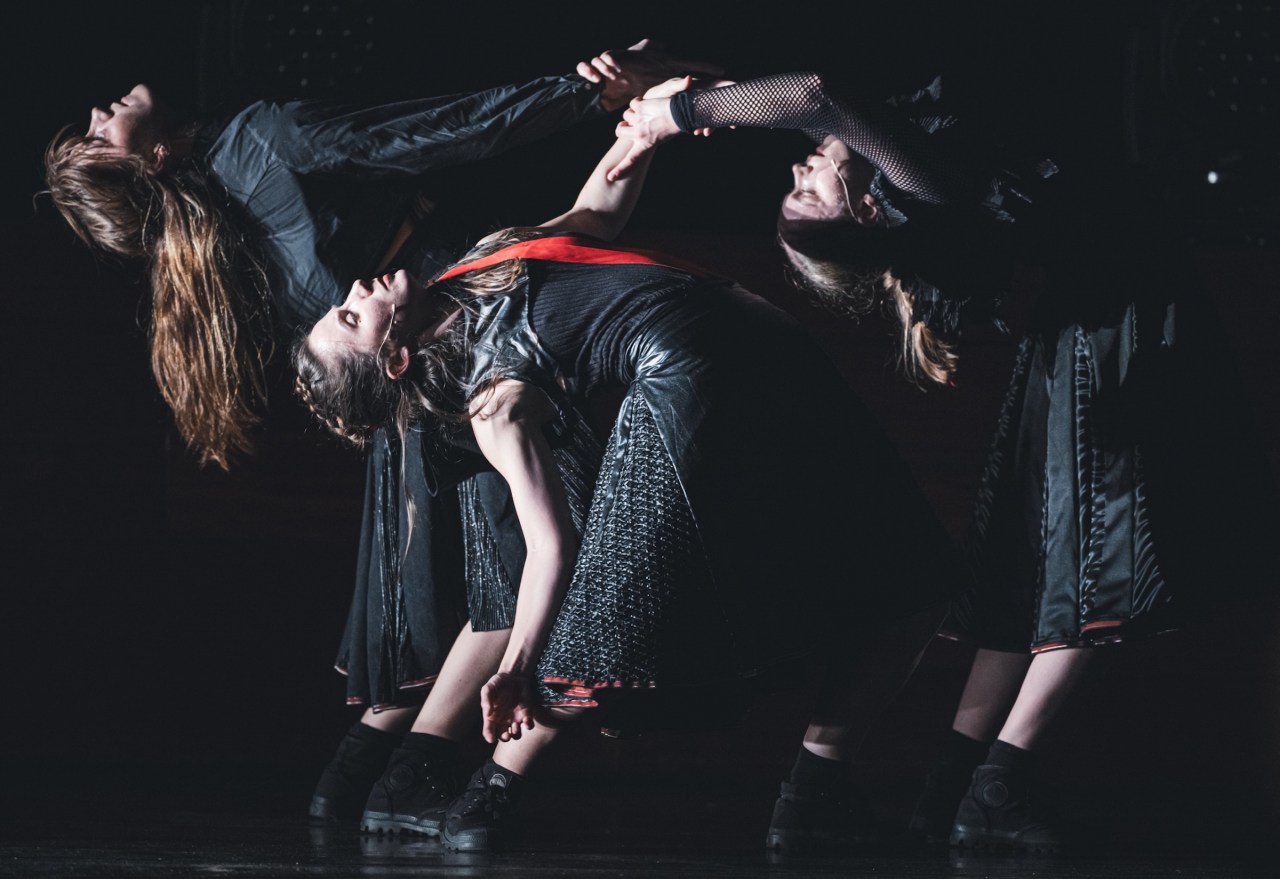
Danielle Baskerville, inspired by Earle’s choreography, which is set to the profoundly moving choral piece, has produced The Miserere Project for Citadel + Compagnie’s Bright Nights series. She commissioned three choreographers to reinterpret Earle’s piece and Earle recast the work himself. The 90-minute show, available as a livestream recording through May 23, is pretty dazzling.

Earle’s reimagining of his own choreography compresses the original in a dance performed by Sierra Chin Sawdy, Robert Kingsbury, Anh Nguyen, Bee Pallomina and Evadne Kelly. The dancers move in sync, often clasping hands as one beautifully transforming unit of five.

As with the original, Earle choreographs a piece of architecture, the movements slow and deliberate, but mesmerizing. The contrapuntal structure of the music, performed by two choirs of four and five singers respectively, is echoed in the formations that call to mind a cathedral dome, angels and prayer. These dancers — at one point on the floor to create a five-point star — are well rehearsed and interpret the music with all the solemnity and celebration it deserves. The piece is true to Earle’s desire to pass on learning and training: “I was fortunate to see many strong works by such luminaries as Martha Graham and José Limon in my first years as a creator.”

Baskerville called on Penny Couchie, an Anishinaabe dancer and choreographer whose ancestry is the Nipissing First Nation in Ontario, as the second interpreter of Earle’s piece. Couchie made a dance film featuring herself, Sid Bobb, Animikiikwe Couchie-Waukey, Michaela Washburn and Christine Friday.

The film opens and closes on an overhead shot of the four dancers in winter wear sprawled on the surface of a frozen lake. A voiceover narration accompanies the film, the choral music serving as a score to a series of solos. “Love fights” is the title and the refrain in a poetic recitation of historic struggle: “A war was waged against our people . . . I engage in rage,” a female voice intones.  One woman dancer does a solo waist deep in lake water, throwing up a fantail of water with her head. Another solo involves a slow slide into the water’s edge from a bank of crusty, melting snow. Couchie’s theme is consistent with Earle’s intentions: united we stand; divided we fall.

Brodie Stevenson, an accomplished dancer and choreographer from British Columbia, choreographed “Inter Alios,” performed by Drew Berry, Sierra Chin Sawdy, Irvin Chow, Connor Mitton and Tyra Temple Smith. This Miserere is an intelligent response to Earle’s show in the broad context of modern dance. The dancers, in blue, black and white costumes and stocking feet, make an impersonation of the music, in strong, tight formations such as one in which the dancers form crucifix shapes on the floor. As with the original Miserere, we get the feeling of a quintet of dancers embodying one transforming creature.

The collective Same as Sister (S.A.S), based in Toronto and New York City, comprises Toronto-born sisters Briana Brown-Tipley and Hilary Brown-Istrefi. They created “This is NOT a Remount.” It’s difficult to comprehend this interdisciplinary collage meant to be a behind-the-scenes look at Miserere. But perhaps the salient point behind this hodgepodge of video and live performance from talking dancers is that Earle’s original dance was made for 15 dancers, three of whom later died of AIDS-related causes.

In any case, The Miserere Project is a fascinating dance endeavour that one hopes will not die with this month’s performance at the Citadel.

The Miserere Project

Produced by Danielle Baskerville for Citadel + Compagnie

May 18 to 23, 2022

http://www.citadelcie.com

Photo of Brodie Stevenson’s “Inter Alios” courtesy of Citadel + Compagnie

A tantalizing taste of live dance to come

American dancer/choreographer Kyle Marshall gives us a taste of what it will be like to see dance live in a theatre once again in Stellar, a production streaming on the digital platform of the Baryshnikov Arts Center in New York City until June 21.

“A feeling of being in space,” that is, weightless, was a starting point for Marshall who worked through improvisation to create Stellar with his fellow performers.

Watching Stellar makes one a witness to creation in progress. In the best contemporary dance tradition, the dancers provide the movements; the viewer interprets the body language.

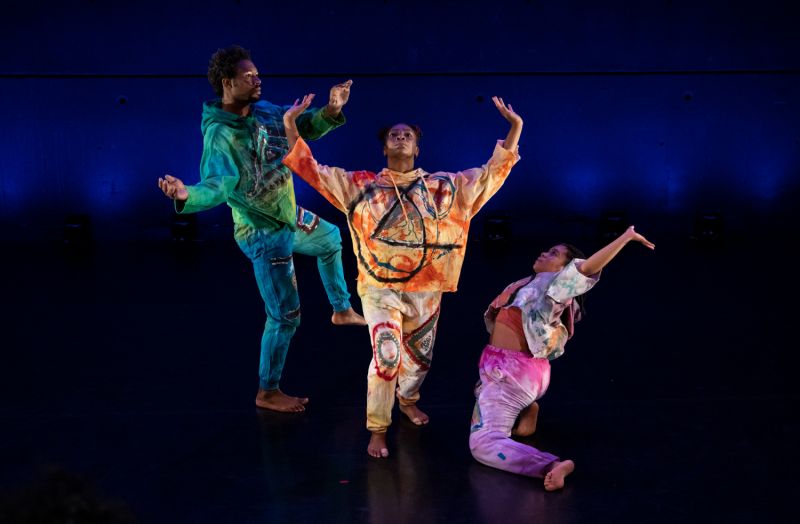
As the lights come up, Marshall, Bree Breeden and Ariana Speight emerge out of darkness, costumed in tie-dyed hoodies and loose pants. They might be out in space, so light do they appear. Sound designer Kwami Winfield, on stage playing and working the control board to convey interstellar sounds, makes a fourth performer.

An opening single note, as if played on a saxophone or trumpet, sounds over the dancers as they gradually form an orbit on the black box stage. The trio is walking, then running, skipping, striding with little hops or taking steps common to social dancing.

Marshall calls Stellar a work of speculative fiction, the music inspired by John Coltrane and American jazz performer and composer Sun Ra. The loose baggy costumes designed by Malcolm-x Betts are colourful and evoke the ‘60s era of Sun Ra’s Arkestra. There is lots of play, but strength and confidence in the solo moments especially.  

Winfield plays with a string of shells that make a sea sound as Marshall, Breeden and Speight start to dance together in a loose pas de trois. The thing about the central form this dance takes – the circle – is that there is no leader in a circle formation.

Soon hands and feet make the rhythms a one-two-three-four beat that seems to take over from the music until Winfield comes back with live drumming that is synched to the claps and foot-stomping.

The camera affords advantages in not only directing our gaze, but allowing for multiplication and overlapping of imagery so that at points three dancers become six.

This dance is short and open-ended, perhaps to be continued when we can all sit together in a theatre once more.

Stellar streams for free until June 21 at Kyle Marshall — Baryshnikov Arts Center Digital (bacnyc.org)

A child’s paradise regained

“This is a story about childhood. It’s in at least two languages, some spoken, some not . . . We’ll remember . . . falling off your bicycle, stealing money off your mother’s dressing table . . . .”

A man sits with a book on his lap stage left as two dancers enter the space, then put on harlequin costumes and proceed to (artfully) cavort like children at play. Seen on one’s computer screen, this is Les Paradis Perdus / Remix, a delightfully layered online presentation, featuring commentary from the four participants.

Laurence Lemieux created the duet in 2005 for herself and Bill Coleman, commissioning Christopher Butterfield to compose music based on childhood memories Lemieux submitted to him. Had the COVID-19 pandemic not arrived, Jimmy and Juliette Coleman, the couple’s very able dancers, were to perform Les Paradis Perdus at the Citadel on May 14.

Swallowing her disappointment at the theatrical shutdown, Lemieux, artistic director of Citadel + Compagnie, has mounted a 10-week online performance series that began on April 28. Every Tuesday at 2 pm EDT until June 30, a new work is released on www.citadelcie.com. The series so far has included work by Naishi Wang and Sabina Perry.

Les Paradis Perdus / Remix went up May 12, introduced with a cyber conversation among Lemieux, Butterfield and Luke Garwood and Erin Poole, the dancers who performed Les Paradis in 2015.

When what performers need most – bodies in seats watching them – is not available, what can one do to bring an element of spontaneity to a production? What the CetC team wanted most to avoid was presenting a relic of a show; hence the remix, a newly edited version of the recording.

On a shared screen we see Lemieux’s handwritten notes for Butterfield’s score. The composer tells us he removed certain syllables to create his score. In the recording we can see and hear him, intoning lines like a choir singer or standing with a furled roll of paper to speak as if through a megaphone.

Meanwhile, Garwood and Poole, entering in street clothes, appear to regress as they don their joker/harlequin costumes, reproducing the spirit of childhood and adolescence in Lemieux’s inventive choreography.

On the Zoom screen, Poole reflects on how an audience might adapt to the reality of lockdown entertainment. “I wonder if one might watch (at home) from under the covers,” she says, remembering another childhood transgression: reading stories with a flashlight after lights-out.

Next up on the Citadel + Compagnie online series: unmoored by Peggy Baker and Sarah Chase (May 19) and Malcolm by James Kudelka (May 26)

Watch here: https://www.citadelcie.com/les-paradis-perdus-remix-citadel-online/

Photo of Erin Poole and Luke Garwood by Jeremy Mimnagh