Now you see it, now you don’t

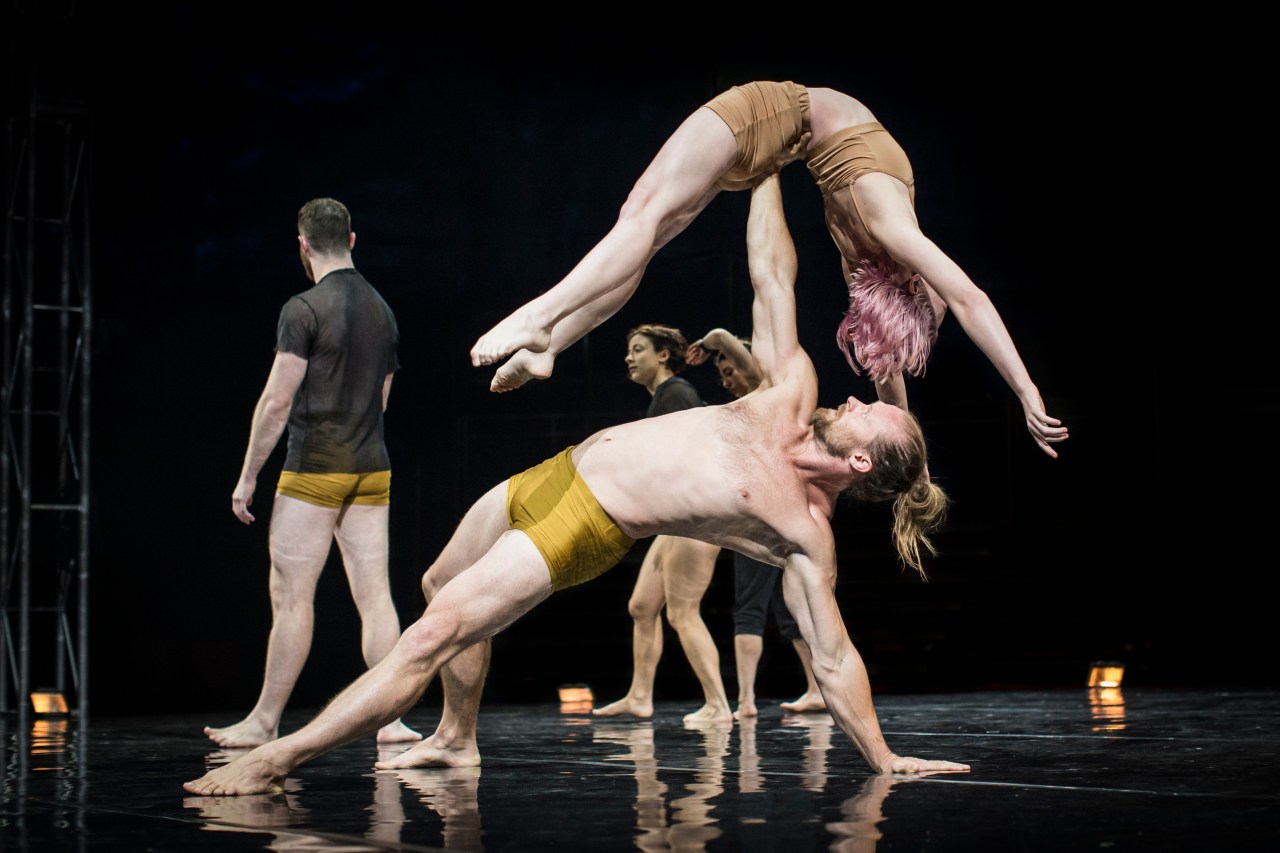
“Poetry in the flesh,” said my seatmate at the end of Humans, an artful act from Australia’s Circa Contemporary Circus, performed for one night, November 9, at Toronto’s Sony Centre.

Under the artistic direction of Yaron Lifschitz, Circa is a Brisbane-based company established in 2004. That its 10 performers are Olympic-level gymnasts and skilled acrobats, tumblers, trapeze artists and contortionists is a given.

But Humans is no mere circus act. It’s a 70-minute highly choreographed show with no props, other than a swing and ropes, no scenery, no costumes: just briefs and tee-shirts or bras.

These sturdy men and women are not what we’ve come to expect from champions of the mat or dancers at the barre. Built like discus throwers, they are nevertheless lithe, agile and move like quicksilver.

Never mind the contemplative description of the show: “what it means to be human and how our bodies, our connections and our aspirations all form part of who we are.” Humans is sheer joy from beginning to end.

As we take our seats in the theatre, we see the acrobats getting out of street clothes and into skimpy dance gear; one woman hunched under her coat and trousers like a land tortoise, extricates herself in a funny bit of contortionism.

Soon they are coming and going, each on her own path, entering the stage and exiting and entering again, in a musical and yes, poetic, flow set to tunes as disparate as Blixa Bargeld’s “I Wish I was a Mole in the Ground,” Astor Piazzolla’s “Ave Maria,” Andy Williams’s “The Impossible Dream” and a nostalgic accordion tune, “Waltz for Jb.”

Moving, leaping, tumbling, erecting themselves as human totem poles, spreading across the stage in weird poses that would stymie any yoga expert, Circa calls for maximum attention spans. Stunning highlights stick in memory: one man shouldering five men and women joined in a chain. Bridges made of standing acrobats are walked over, as if heads were river stones. Bodies are wrapped around torsos like so much dead, pliable weight. It may be called “extreme acrobatics,” but Humans, to this watcher, was everything a dance can be, to lift the spirits and take us beyond the flesh.


A dance back from the brink of hell

On any sensible list of performers you must see before you die, Akram Kahn would figure prominently. And if, as he’s said, Xenos is to be his last solo creation, then Torontonians may feel some urgency to see the show, running through October 21 at the Bluma Appel theatre in the St. Lawrence Centre.

Xenos (a Greek word meaning stranger), a complex collaboration of the kind that has earned Khan’s company kudos for innovation, is a tribute to the 1.3 million troops from colonial India who fought, with little acknowledgement of their sacrifice, in World War I.

The 65-minute piece, which has Kahn performing with musicians and vocalists, is spell-binding; it transcends the language of kathak and contemporary dance and words spoken in Hindi or whispered English, to go straight to the heart. Such is the power of Kahn’s expressive and taxing performance.

The subject matter becomes a container for themes of memory, loss and belonging. Xenos is history as it might have been written by the foot soldiers instead of the generals.

Kahn’s character is emphatically alone, confused, battered and bruised but as Xenos unfolds, he becomes a universal figure, a man or a woman, a father, a son, a brother, connected to all other beings, alive or remembered or persisting on a spiritual plane.

Vocalist Aditya Prakash and percussionist B C Manjunath are playing on stage as the audience gathers. It’s as if we’ve entered their salon and their ease has the effect of lulling us before the onslaught to come.

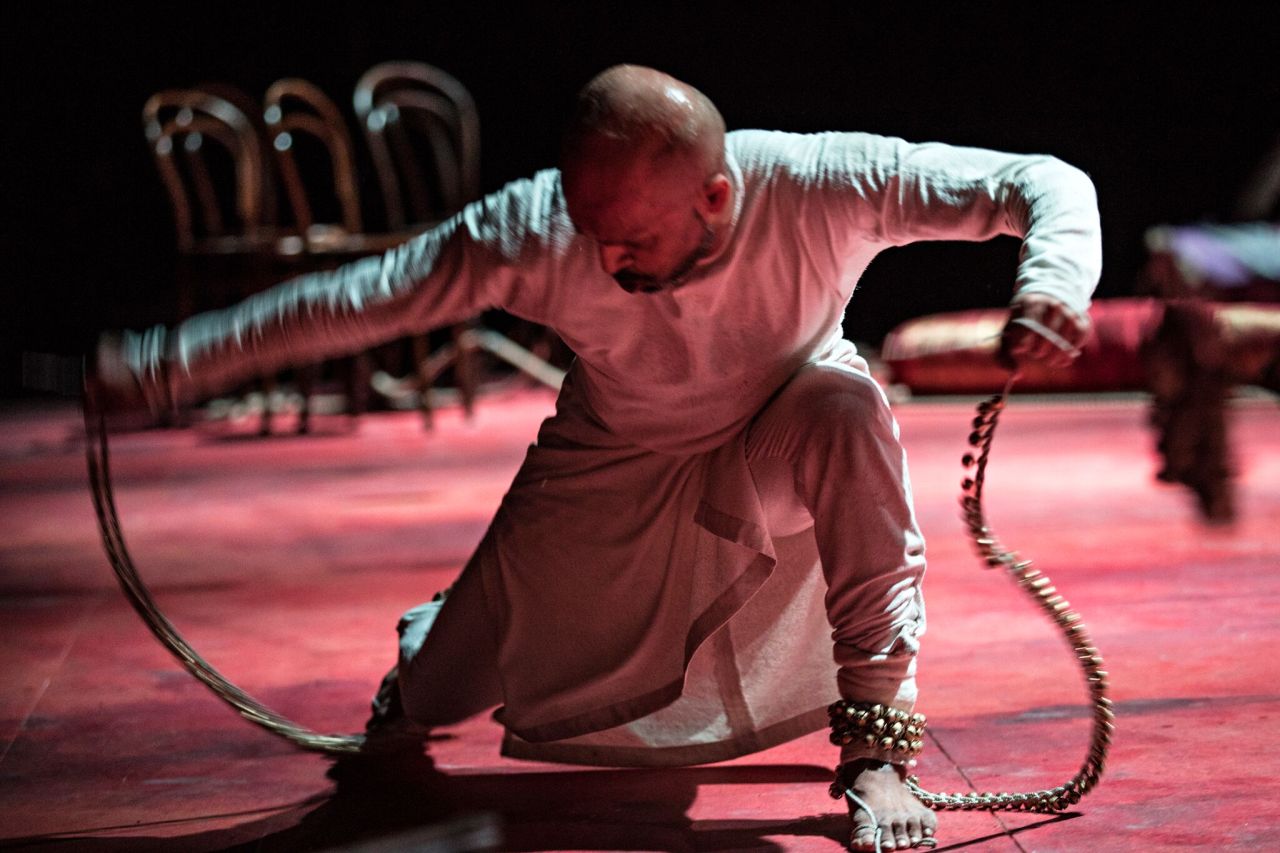
Akram Khan, born in London in 1974, to Bangladeshi parents, has been a Kathak dancer since he was seven. His unique style of dance seamlessly fuses Kathak and contemporary technique, but in Xenos we see him first in long white tunic, rows of ankle bells wrapped below his calves, doing what looks like pure Kathak – erect, confident, mesmerizing.

The dancer, pulling a long thick cord, like the rope that holds a big ship at anchor, begins to unwind, symbolically untying the ankle bells and attaching them to other ropes lying coiled upon a steep ramp that could be a hill or the slope of a trench. All this to the sound of bombs blasting and the overheard words, “this is not war; it’s the ending of the world.”

He is a man confused, swirling in a psychic tumult. There’s a blackout and when Kahn next appears he’s in a short soldier’s tunic, heavily soiled by the earth that has been sliding down the ramp at him.

A huge metal horn of what could be a gramophone, a megaphone or the speaker of an old radio, beckons, emitting scratchy sounds after the dancer links rope to rope to get a current flowing.

Kahn struggles, climbing, crawling, prostrate, supine, desperately gathering up dirt in his hands – a man abandoned by his culture, embroiled in the war to end all wars.

A violinist (Clarice Rarity), a double bass player (Nina Harries), a saxophonist (Tamar Osborn), percussionist and  vocalist appear in a rectangle of dim light suspended above the ramp. They play and sing and will ultimately serve as a heavenly chorus. Below them, the soldier struggles in a rising crescendo of battle sounds. Kahn is now stripped to the waste, covered in dirt, wasted.

It would be a shame to give away the spectacular finale. Suffice it to say this unknown soldier, this formidable dancer, has created an indelible memory.

Xenos

Directed, choreographed and performed by Akram Khan

Presented by Canadian Stage

Bluma Appel Theatre, Toronto, October 18 to 21

Photo by Jean-Louis Fernandez


Sensational dance compels attention

Tightly choreographed yet sprawling, replete with narrative elements but hardly episodic, RUBBERBANDance Group’s  Ever So Slightly feels like a work in progress. Which is not to say disappointing, for every one of its 75 minutes is filled with sensational dancing.

With so much talent on stage – in dancers Amara Barner, Jean Bui, Daniela Jezerinac, Sydney McManus, Dana Pajarillaga, Brontë Poiré-Prest, Jerimy Rivera, Zack Tang, Ryan Taylor and Paco Ziel – this show’s strengths are also its weakness: an overabundance of dance ideas.

Billed as a demonstration of “behavioral mechanisms, reflexes we develop to face aggression and the constant flow of annoyances bombarding us every day,” Ever So Slightly is set on a bare stage with all the lighting and tech apparatus exposed. Musicians Jasper Gahunia and William Lamoureux and their instruments, laptop and turntable are positioned on a platform to the side. It looks like a warehouse, an impression reinforced by the appearance of the dancers, who are all wearing workers’ coveralls.

They begin slowly on the floor, rolling and scissoring to a kind of serenade from stringed instruments, gradually getting upright and picking up the pace. As the music introduces an element of discord, the ensemble, working in precise unison, begins to fall apart.

Soon we are witnessing what looks like an update of West Side Story, menacing moves of rivals undermining the power balance. Their bodies concealed by the coveralls, the dancers are barely distinguishable as male or female; all become combative. And now when they move together, in ever more aggressive ways, it looks like mob rule.

These performers are driven by forces both external and internal – equally misunderstood and uncontrollable. It’s only when they’ve stripped down to skimpy underwear, after pulling off each other’s clothing, that we can appreciate their technical mastery. Urban dance moves slide into balletic lifts and arabesques; martial arts grappling becomes exquisite partnering. Rough and howling one moment, they grow calm, silent, tender. To the pounding of liturgical organ chords, they bow in reverence. Then it’s more combat and a scene that looks like soldiers tossing bodies into a mass grave.

Meaningful stares are exchanged; the dancers fall into momentary relationships. Then one or two break out – a female with a shaved head runs laughing around the stage, like the girl at the party whose drink was spiked with Ecstasy. A lithe young male is wracked with spasms from some psychological breakdown, like a man possessed by demons. The others look on helplessly. They are bathed in blood-red light, as the soundscape turns ominous.

For a while there’s a discernible arc to the show – from unity of purpose to Lord of the Flies pandemonium to reunification. It’s when the dancers turn their coveralls into headgear, striding or partnering like blinded Elephant Men, that you start to feel as if Ever So Slightly is going madly off in all directions. With more performances, this show will evolve into something more coherent. As it is, RUBBERBANDance choreographer and artistic director Victor Quijada has rallied some amazing movers and set them in very compelling scenes that demand our whole attention.

Ever So Slightly

RUBBERBANDance Group

DanceWorks 227

October 11 and 12

Fleck Dance Theatre, Toronto

Photo by Mathieu Doyon

Fall for Dance North kicks up a storm


There’s huge bang for your dance buck to be had at the Fall for Dance North festival. Fifteen dollars gets you a seat at any one of three brilliantly orchestrated programs presented at the Sony Centre and Ryerson Theatre, while a noon-hour interactive dance performance from Montreal’s Compagnie Marie Chouinard today at Union Station is free for the watching.

First up in Program 1 is Red Sky Performance with Adizokan, a show made in collaboration with the Toronto Symphony Orchestra that premiered last October. With the Toronto Symphony Youth Orchestra playing a composition by Eliot Britton live in the pit, the show combines indigenous dance, song, drumming and musicianship with contemporary non-native music and sky-high video projections in celebration of First Nations’ art, culture and spirituality. Most impressive are the elaborately costumed grass dancers, who swirl to the rhythms of Nelson Tagoona’s throat boxing, a hybrid of hip hop beat boxing and throat singing. At times there is too much going on, with either the symphonic music or the video projections overwhelming the dance, choreographed by Jera Wolfe and Sandra Laronde. But Adizokan clearly conveys a message of spirit and earthly beings in harmony with one another.

The extraordinary dancers from Compagnie Marie Chouinard perform excerpts from Chouinard’s Radical Vitality, Solos and Duets, a precis of her work, going back as far as 1991. These short pieces display the choreographer’s hallmark animalistic, sexually charged – and often humorous – theatrical tendencies. In Love Attack #2, Clémentine Schindler licks and nips at Scott McCabe, like a lovelorn puppy, as he voices a parody of a mating call. Eroticism is the thread that unites these bits, as shock gives way to joy, especially in Finale, where nude dancers wearing baby face masks make an arresting display of innocence acting out in provocative ways.

The Cuban company Los Hijos Del Director presents an excerpt from La Tribulación de Anaximandro, choregraphed by artistic director George Céspedes, a high-energy display of power plays and rough and tumble that looks like a martial arts class on steroids. Male and female dancers don shirts that obscure their gender differences, so attaining gender equality in tightly ordered combinations of creation, destruction and re-creation.

The Soweto Skeleton Movers arrived on the world’s concert stages from the streets of the South African township where they developed their unique form of “pantsula” a fusion of breakdancing, acrobatics, contortionism and sleight-of-hand hijinks. Junior Hlongwane, Jabulani Manyoni, Topollo Ntulo and Molefi Rakitla all appear to have more moving parts than the typical human body, as they perform tricks, such as levitating a spinning hat, or forming themselves into bicycle, that ends the program on a high note of joy. Program 1 runs once more on the Sony Centre stage at 7:30 tonight.

Program 2, opening Friday at the Sony Centre and running again on Saturday, presents Toronto’s Asah Productions performing Obeah Opera 2019, an all-female theatrical piece created by Nicole Brooks and based on stories from the Black diaspora. Jiri Kylian’s Lieder Eines Fahrenden Gesellen (Songs of a Wayfarer) is performed by the Netherlands company Introdans with the Mahler score played live by 10 musicians and mezzo-soprano Georgia Burashko. The National Ballet of Canada dances Justin Peck’s Paz de la Jolla, an homage to his youth in southern California. Compagnie Hervé Koubi from Cannes, France will do an excerpt from What the Day Owes to the Night. And Montreal’s La Otra Orillia takes flamenco in a contemporary direction with RITE/ a flamenco ceremony.

The final performance of Program 3 goes up tonight at the Ryerson Theatre, with performances from Anne Plamondon and Emma Portner in a piece commissioned by Fall for Dance North called Counter Cantor. Ballet Kelowna performs Mambo, billed as “sweet, silly, sensual and sassy.” And Introdans does Canto Ostinato, a contemporary ballet piece choreographed by American artist Lucinda Childs.


Fall for Dance North,

October 2 to 6

Sony Centre, Ryerson Theatre, Union Station in Toronto

Co-presented by the Sony Centre for the Performing Arts

Photos from top left, clockwise: Compagnie Marie Chouinard, Asah Productions’ Obeah Opera 2019, Anne Plamondon + Emma Portner and Soweto Skeleton Movers

A thrilling spectacle to stir the heart

The Sleeping Beauty, jewel in the crown of the National Ballet of Canada’s classical repertoire, boasts more bravura dancing per square meter per minute than one could ever hope for in any other ballet. Not to mention enough brocade, velvet, feathers, ermine and sparkling jewels to furnish a Liberace concert.

Sumptuous visually, musically and balletically, the Tchaikovsky/Petipa grand ballet, first performed in the Mariinsky Theatre in St. Petersburg in 1890, is the ultimate showcase for the highly accomplished classical ballet dancer. In 2006, artistic director Karen Kain restaged Rudolf Nureyev’s opulent 1972 production for the company with refurbished set and costumes; The Sleeping Beauty made the company’s spectacular entrance on to the stage of the newly opened Four Seasons Centre for the Performing Arts. At the same time Kain upped the ante for the dancers, giving the audience a continuous round of high-octane, dazzling variations en pointe and en aire.

Yet drama is not sacrificed to athletic spectacle. Ivan Vsevolozhsky’s libretto provided Tchaikovsky with a poetic interpretation of the Charles Perrault fairy tale, inspiring the composer to create what he considered one of his best works, meticulously crafted and arranged to express in dance the powerful themes of the conquering power of love over hatred and envy, innocence and joy over corruption and power-mongering. (Vsevolozhsky also specified the ballet be set in the opulent – to the point of decadent — Versailles court of Louis the XIV.)

In 1890  Marius Petipa placed Princess Aurora at the centre of the ballet, to present the virtuosity of the Italian prima ballerina Carlotta Brianza. When Nureyev choreographed his production of The Sleeping Beauty, he created a more elaborate role for Prince Florimund, inserting himself as the melancholy prince prominently into Act II. But the central storyline remains that of Aurora, whose transformation from 16-year-old innocent full of joy, through ethereal, romantic ideal in the vision the Lilac Fairy presents to the prince, to mature womanhood constitutes the drama of the ballet.

Heather Ogden’s Aurora makes this fairy tale journey come true, in her spirited embodiment of a girl’s blossoming as if lit from within. She is sublime in the famous Rose Adagio, when the princess is presented to her four suitors (gallant Félix Paquet, Nan Wang, Peng-Fei Jiang and Ben Rudisin), balancing elegantly on the tip of one pointe shoe for the culminating moment, like Botticelli’s Venus Rising.

Guillaume Côté, once out of his velvet jacket and over-the-knee boots, which seem dated and too preening for the romantic hero Prince Florimund, arrives with such attack he seems to fly across the stage in his Act II solo. He and Ogden make a formidable pair in the grand pas de deux, the culmination of many fine set pieces —


including the diamond pas de cinq in Act III performed by Chelsy Meiss and Diamond Man Jack Bertinshaw — rising on rounds of applause in the balletic expression of a rebirth after a century’s journey into the darkness.

The performance of the Variations in Act I are no mere warm-up for the grand pas de deux to come. Hannah Fischer is particularly brilliant in the solo First Variation, but all six performances are stand-outs, highlighting the beauty and the symmetry that brings order amidst the chaos sown by Carabosse with her evil curse to eliminate Aurora and bring down the kingdom. Alejandra Perez-Gomez’s Carabosse is a deeply malevolent force, close to the ground and pagan, pitted against Taya Howard’s radiant Lilac Fairy who floats across the stage as she casts her spell to put the court to sleep for a hundred years.

Jonathan Renna brings a delightful curve of the calf to the dancing he’s afforded as King Florestan to Sophie Letendre’s Queen.

This production preserves the high-camp elements that, along with the pussycats in Act III bring an element of comic relief in the form of outlandish headgear, overly abundant male wigs and the over-the-top evil obsequy of Carabosse’s slimy attendants and the caricature witches, who preside over the birthday party like a black cloud. Such details are reminders of what happens in worldly realms when excess and inward-looking vanity leaves room for rot to set in. And they set off the grace and joy expressed in the many-splendored, stiffly tutued, flawless ensemble dances, such as that of the maids of honour and their pages, that take us through scene by scene in this thrilling feast of a ballet.

The Sleeping Beauty

Music by Pyotr Ilyich Tchaikovsky

Produced by Rudolf Nureyev after Marius Petipa

Staged by Karen Kain and the artistic staff of the National Ballet of Canada

Set and costume design by Nicholas Georgiadis

At the Four Seasons Centre for the Performing Arts, Toronto, through March 18

Photo of Heather Ogden and Guillaume Côté by Bruce Zinger.


Made in Canada a mixed blessing

You have to wonder whether the choice of “made in Canada” as the selection criterion for the National Ballet of Canada’s mixed program was somehow forced upon the company. For this homegrown program is decidedly mixed and not entirely in a good way.

Toronto-born Robert Binet, choreographic associate at NBoC since 2013, has in a short time created an impressive number of works for the company and for several European companies including the Royal Ballet. The Dreamers Ever Leave You, a co-production of the ballet and the Art Gallery of Ontario, was created in 2016 as a response to the exhibition The Idea of North: Paintings by Lawren S. Harris as a piece of “immersive dance.” In other words, while the dancers performed, presumably in close proximity to the paintings and the piano on which composer Lubomyr Melnyk played his trademark Continuous Music, the audience members were free to move around observing the dancers up-close and personal. But transferred to the huge Four Seasons stage and seen from a great distance, the pianist in the pit, Dreamers leaves its audience behind. In place of the changing perspective afforded by the viewers walking about the dancers, we get slowly moving, sometimes obscuring abstract panels, stand-ins for Harris’s arctic mountain peaks, and some chilly shifting lighting. Melnyk’s rapid and difficult sequences (in the 70s in Paris he composed music for modern dance) bears no apparent relationship to the choreography and comes off as monotonous, lulling us into indifference. Were it not for the staging, we might well have appreciated much more the outstanding performers in this piece, among them Hannah Fischer, Heather Ogden and Harrison James.

Particularly well made in Canada might be the headline for James Kudelka’s The Four Seasons, first performed in 1997 and often restaged but never failing to excite. The 45-minute piece became the signature dance for Rex Harrington on whom Kudelka created the role of A Man, placing him at the centre of the Vivaldi composition (1720-23) inspired by the landscape paintings of Marco Ricci. The sublime four violin concerti, with their accompanying sonnets in tribute to the spirit of the seasons, have attracted quite a few choreographers. But Kudelka’s genius is in matching the intricacy of the music with very complicated steps and partnering while turning up the passion and the drama of a man for all seasons — in the stages of love, in maturity and finally dogged by Death. Guillaume Cote here achieves the balance of emotion and technical mastery required in the role of A Man. Jillian Vanstone is spritely as Spring and Greta Hodgkinson somehow sexy, sultry and majestic all at once as A Man’s Summer partner. Xiao Nan Yu in Winter is similarly a strong presence, in the role of accomplice to the other side, with the promise of rebirth contained in the achingly beautiful music. The inspired costumes designed by TRAC, adding layers to the dancers with the passing of the seasons, are integral to the drama, as is the extraordinary lighting design of David Finn, bathing the dancers in rich projections of ever-changing shades of green, red, yellow and blue.

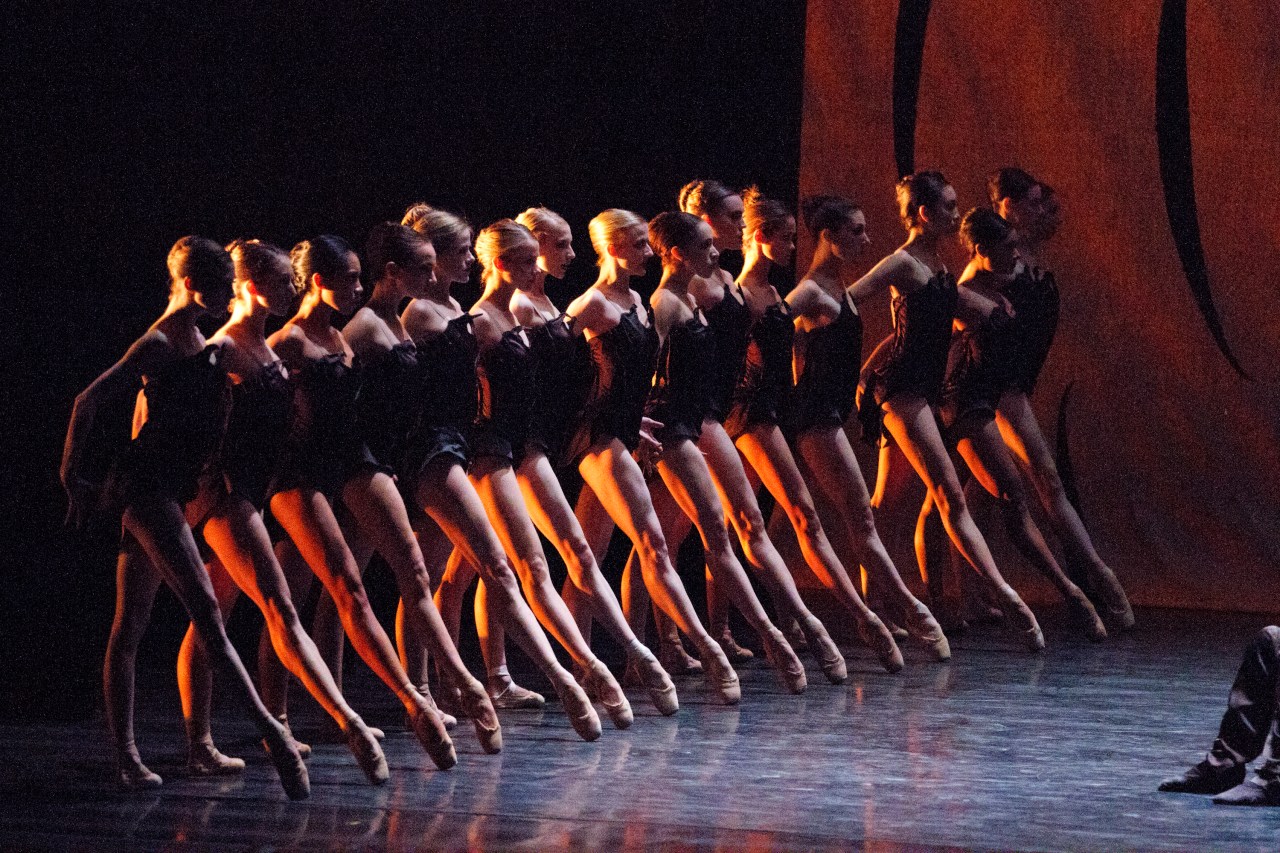
Emergence, the 30-minute dance that closes the mixed program, is a piece commissioned by NBoC from Vancouver-based choreographer of well-earned renown Crystal Pite in 2009, relatively early in her career. Pite took a scientific approach to the challenge of creating work on the hierarchy of a ballet company. As she said at the time, “I wanted to look for a parallel in nature, at a hierarchical structure that creates amazing complex structures.” Looking at beehives, ostensibly a top-down structure ordered by the Queen, she discovered the swarm – the hivemind — an intelligent being that operates on a complex system of consensus-building. Which is what we see in the powerful ensemble dancing of nearly 40 dancers, the women dressed in black-widow leotards for needle-like point work and the men bare-chested with powerful legs and arms like enlarged, menacing insects with a common purpose. Owen Belton’s soundscape of electronic high-pitched humming, marching sounds and cricket-like communication gives shape to the swarm that emerges – a collective unconscious that operates like a secret language. Seen in the light of Pite’s more recent work for her company Kidd Pivot, Emergence appears underdeveloped; she had only a short time to create the piece. But its revival serves as a taste for better things to come, as Pite will create a full-length piece for the National Ballet’s 2019-2020 season, something to be richly anticipated.

Made in Canada

Mixed program of the National Ballet of Canada

At the Four Seasons Centre for the Performing Arts, Toronto, through March 4

Artists of the Ballet in Emergence; photo by Bruce Zinger.

Gallery

Mapping lives in dance

Map by Years is a feast for Toronto dance fans. Peggy Baker has assembled an all-star cast of dancers, choreographers, musicians and designers to present three of her stellar pieces from the past and to perform herself in a solo dance story created with Sarah Chase.

The outline of windows on the rear wall of the Theatre Centre space turn it into a salon, an intimate private space to experience virtuosity.

Jessica Runge is a wonder in “Her Heart,” a piece Baker made on herself in 1993 and revised in 2005. It is one of the earlier instances in which Baker performed with a live musician, choreographing both performers.

Here pianist Cheryl Duvall plays the four sections of the Johannes Brahms Intermezzo in tandem with Runge, who appears to ride the music. The music is in her, leading her, as it is in pianist Duvall. Runge, with her incredible fluidity, wearing the blue velvet long A-line dress designed by Caroline O’Brien, makes “Her Heart” her own, leaving with a look of peace and hope, as if she were giving us a piece of her heart.

Andrea Nann, another of Baker’s well chosen legacy dancers, revives “Krishna’s Mouth” (2003) in her inimitable style. The lines of the narrative are choreographed to repeat as Nann (Natasha Bakht performs on alternate nights) speaks/dances and cellist Anne Bourne keens and plays Karen Tanaka’s “Song of Songs.” As a child, Krishna the Hindu god of compassion and love, puts a clot of earth into his mouth. When his mother investigates she “sees the entire universe in her baby’s mouth.” Nann, hair braided in a long pigtail, wears a translucent tunic over top and square-cut pants and engages in very geometric moves, sweeping across the stage, crouching low, lying down and rising up, the energy driving her from her core. Musician and dancer are balanced; both are a vehicle for expression of the music. Acoustics may need some adjustment as there are moments when the women’s voices and the music overwhelm each other.

Baker created the silent solo “Portal” (2008) with lighting designer Marc Parent. Kate Holden (Mairi Greig on alternate nights) embodies Baker’s notes: “I was forced to consider the edges of time and space at the brink of death.” Holden appears in a cone of light that makes a lit square just big enough to accommodate the performer. She wears an expression of sadness, almost defeat. But the dance defies death, the movement and the breath making all the necessary music. The stage goes black and Holden reappears in a new space of light, bare arms windmilling, each half of her body appearing to act independently of the other, strong and under control.

“Portal” makes a natural transition to “unmoored,” Baker’s second creation with Sarah Chase. The two first made “The Disappearance of Right and Left” in 2003, based on 102 stories Chase asked Baker to write, two for each year of her life up until then. But Baker omitted an important tale, that of her marriage to musician and composer Ahmed Hassan. Last year she came back to Chase, ready to tell that story.

Out of 30 pages of Baker’s writing, done in a room near the Mediterranean in Bogliasco, Italy, Chase has shaped a performance that Baker speaks, sometimes reading, sometimes reciting, raw in its emotions and polished in its performance. Two chairs, a table and a music stand make three stations among which she moves. What we see in our mind’s eye are the rooms Baker describes, from apartment to nursing home to hospital, where her long-time husband died, age 55, after living with multiple sclerosis for many years.

There’s a principle, it seems, fundamental to all choreography – you can see it in ballet, in bharatnatyam  and in modern dance – that makes the spine the centre from which all else moves. In Baker’s work, this full-frontal first position is often seen; as if her spine, running through neck and torso, were the driveshaft for the movement.

In black shirt, belted black jeans and low-heeled boots, Baker faces us, very erect, then moves through her story extending her arms to give it to us, accompanied by the vocals of singer Maryem Hassan Tollar, Ahmed Hassan’s sister. Everyone is moved, including the dancer.

As an artist Baker needed to make this dance story, for it marks the renewal of creativity, going forward with undying love on the wings of a poem by Rumi.

Map by Years

Works by Peggy Baker|Sarah Chase

Produced by Peggy Baker Dance Projects

At the Theatre Centre, Toronto, through February 25

Photo of Peggy Baker (top left) by Aleksandar Antonjevic. Clockwise: Andrea Nann and Ahmed Hassan

Dance, define, decode, delight

For anyone unfamiliar with, yet fascinated by the vocabulary of bharatnatyam dance, the idea of a decoding wrapped in a performance is a welcome prospect.  

Nova Bhattacharya’s decoding bharatnatyam is both a learning experience and an entertainment. As the choreographer explains, the three works in the show, “investigate the places where cultures overlap – where the influence of Indian dance produces fresh and exciting contemporary Canadian art.” 

Montreal dancer/choreographer José Navas, who has created works on ballet companies, made Calm Abiding for Bhattacharya in 2006. Aptly titled, the dance begins and ends in stillness and draws on bharatnatyam and modern dance modes of expression.

The silver polish on Bhattacharya’s fingernails direct our attention to the hand gestures or mudras of bharatnatyam dance. As with the mimes of classical ballet, the gestures, especially in combination with eye movement, have a narrative significance. So we take note when Bhattacharya’s eyes are closed or open. All is simplicity here, from the dancer’s basic black tunic and capri pants to Marc Parent’s minimalist lighting, signalling the changing sections of the dance. Alexander MacSween’s electronic and acoustic music turns Bhattacharya’s words and laugh into rhythmic repetition. Throughout, we are reminded how any movement in the body of a highly trained dancer can convey meaning at a subliminal level.

The decoding becomes literal in Breaking Lines, a duet that Bhattacharya created with bharatnatyam dancers Neena Jayarajan and Atri Nundy in 2016. Jayarajan, who trained with Menaka Thakkar for more than 28 years, wears a blue hoodie over black pants. Nundy, who learned bharatnatyam over decades with Lata Pada, wears a sari and ankle bells. They talk, they laugh, they join hands and they make fun of each other, in what is presented as a rehearsal. “What are you doing?” asks one of the other dancer, who appears to be picking blossoms. “Putting flowers in my bath,” is the answer.

Nundy and Jayarajan engage in the rhythmic tiki-teki rhythmic recitative that is an important feature of classical Indian dance. Hands on the ground is a greeting to Mother Earth, another gesture over the eyes means a blessing. A raised pinkie finger can be interpreted as a bridge or a lifting of something heavy as if it were light as a feather. We also take note of their feet, which move in heel-to-toe fashion, sometimes while the dancer is in a deep plié position, pounding out the rhythms as if feet could talk. In one amusing passage, Nundy describes the vision of a handsome man, urging her partner forward as if to approach him. They dance to a timer; at 20 minutes the alarm signals the end of the performance.

Lucy Rupert, director of Blue Ceiling dance company, comes from a contemporary dance background. Arriving on stage in Alaap, a piece Bhattacharya created with her in 2013, she wears a long black jumpsuit, with split pants that reveal her legs, ankle bells attached above bare feet. An electronic bubbling sound (music from B1 Ólafur Arnalds and Nils Frahm) accompanies her movement. An ingenious bit of lighting by Noah Feaver gives her shadows in two directions, one lime green, one hot pink, an expression of a divided self coordinated through dance. Striding upright, then sashaying into floor work, Rupert cuts a wide swath across the Citadel stage, circumscribing the space as she takes command of it, one long pinkie finger held high.

decoding bharatnatyam

Choreography by Nova Bhattacharya and José Navas

At The Citadel, Toronto, through February 17

Photo of Neena Jayarajan and Atri Nundy by Ed Hanley


Transformational, entrancing dance

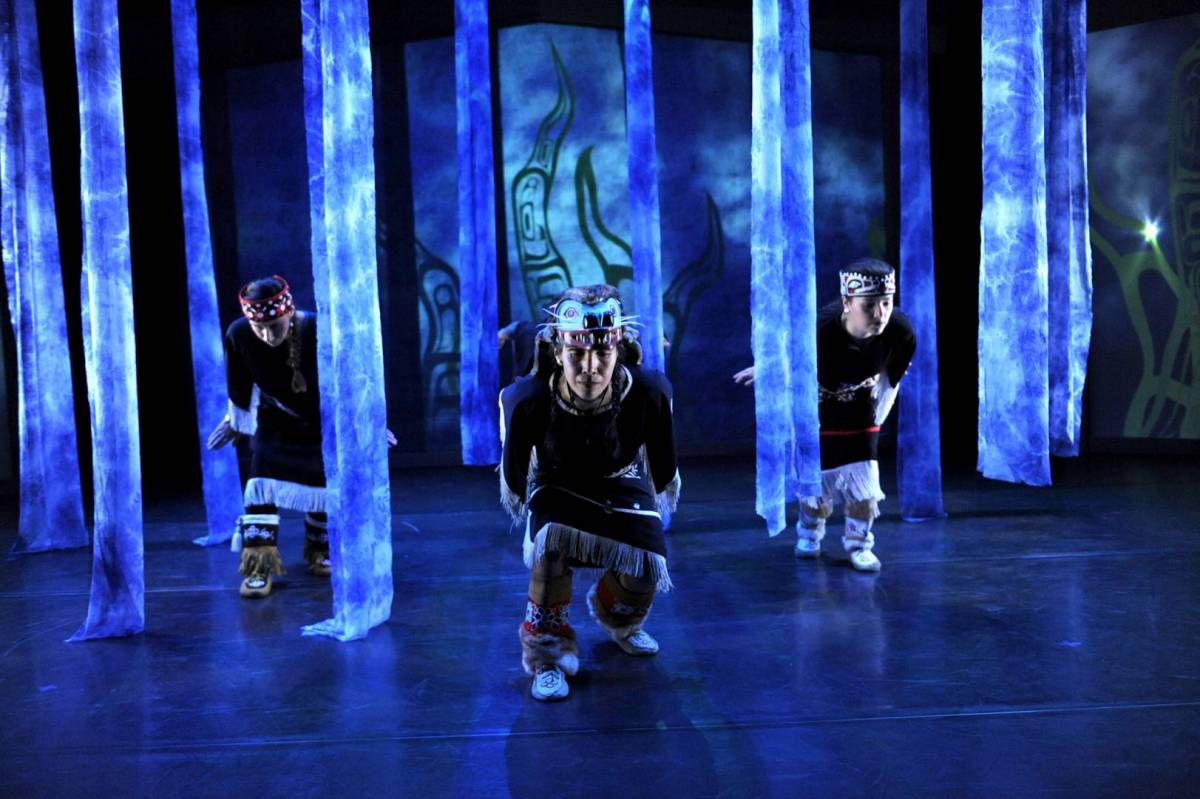
Rarely in Toronto does one get the chance to see indigenous dancing from the west coast.  DanceWorks 224 is just such an occasion, featuring the Dancers of Damelahamid from Vancouver performing Flicker. A show commissioned by the Vancouver East Cultural Centre in 2016, Flicker presents a northwest coast first nations aesthetic in the costumes, the masks, the graphic art and, movingly, in the video running on a scrim framed by the outline of an indigenous big house. These large assembly rooms, which can be found in many coastal communities, are where potlatches are held, at which mask dances are performed on the occasion of a wedding, a birth, a coming of age or a memorial for one who has passed. Families would own particular dances and the masks and regalia that go with them; the dances would be passed on from fathers to sons and mothers to daughters.

Choreographer Margaret Grenier, artistic director of Dancers of Damelahamid, grew up in such a family, members of the Gitxsan Nation, whose traditional territory is accessed from the Skeena River north of Haida Gwaii. In her work as a contemporary choreographer and performer, Grenier has adapted for the stage what are basically sacred dances.

The flicker of the title is the woodpecker, whose tail feathers and long pointy beak figure in the design of masks and costumes. The split-U design so common to Northwest coast art, derives from the appearance of a bird’s feathers. Damelahamid uses Flicker as a metaphor for the flickering of light, the changes wrought through the rising and setting of the sun, moon and stars, or the flames and sparks of an energy-giving fire. Transformation is always an element in these dances and the intangible – the spirits of the animals and the trees and mythic creatures – flickers into being as we watch the show.

Dancers Margaret Grenier, Nigel Grenier, Raven Grenier, Rebecca Baker and Kristy Janvier perform admirably, softly stepping in moccasined feet, holding up feather fans like birds, or flapping arms like humans imbued with the ability to fly.

Their movements behind the scrim, especially when one dancer appears in brightly lit-up Flicker wings, headdress and tail feathers, make for some magical moments. The soundscape of singing and drumming and a woman reciting a story in her native language is spell-binding, as it is meant to be.  But it is not until Nigel Grenier, who has been performing as a hunter, comes on and does a powerful rendition of a flicker dance, that one is truly stirred. As he bends and steps to the rhythm of singing and drumbeating, Grenier becomes the flicker, a pencil-like red tongue darting out like an anteater’s from his long beak.

A Haida artist once told me how he’d carved and painted a salmon mask with no idea about the dance that animated it. But once the mask was placed over his head, the dance, thousands of years old, came to him, as if the mask were directing his feet and limbs. That’s how powerful these dances are.

Flicker

Created and performed by the Dancers of Damelahamid

DanceWorks 224

At Harbourfront Centre Theatre, Toronto until February 10

Photo by Derek Dix

Must-see pageant of excellence in dance

An important project, Solo Dance Xchange brings together 22 performers — on screen and live – from a broad spectrum of dance disciplines.

Introduced by producers Karen and Allen Kaeja, the show combines a film in which each of the dancers improvises a dance in the location of his/her choice and a staged segment when the dancers do two-to-three-minute solos accompanied by live music from Eric Cadesky, Laurel MacDonald and Phil Strong.

The outcome? Some predictably fine performances, some merely predictable and a few quite surprising delights.

Allen Kaeja’s 30-minute film, XTOD: Moments in Reel Time, is a nicely edited panoply of 22 dancers doing minute-long improvised solos in locations of their own choosing. Using only natural light, DOP Hernan Morris captures some lovely movement, but the footage lacks the finesse of a studio dance film. By virtue of the subject matter, the HD video reels feels improvised.

Many performers chose water settings, and even long-time Toronto residents will be surprised by the natural beauty found within the confines of Hogtown. Some are romanticized: Jasmyn Fyffe walks a watery concrete pier in a flowing robe; Claudia Moore goes pagan atop the giant rock in Yorkville; Karen Kaeja gyrates on the foredeck of a yacht, the CN Tower looming over her shoulder.

Some, such as Nova Bhattacharya posing on the rim of the fountain pond amid bank towers, opt for high contrast; Delicate-boned Hari Krishnan goes gangsta under an expressway. Two indigenous performers partner with nature, Brian Solomon enraptured in the branches of an old maple tree, Santee Smith, in a long blue gown, dipping into the waters below the Scarborough bluffs. Allen Kaeja charges into a wild tumble off a bicycle down a grassy ravine slope.

As the lights go down on the Streetcar Crowsnest stage, a few dancers, who will sometimes double as stage hands, sit in a row of chairs facing the audience, the trio of musicians set up stage right.

Solo Dance Xchange is in no way a competition, but mastery will out, and can’t help but draw an audience closer to the stage and inside the dancer’s moves, if only we could. The magnificent Peggy Baker in sleek jeans and grey t-shirt grasps a stick like a baton across her upper chest. In a few exquisite minutes, she strikes out with it like a warrior, uses it as a pivot point for a series of graceful floor manoeuvres, crawls hand over hand, then rises up free and strong with her mast held high.

Robert Desrosiers is electric: arms spread or held tight; tiny rapid steps accelerating to the beat of drums, sculpting the air with measured, vocalizing from whispered breaths to almost silent howl.  And Robert Stephen, bare-chested in blue tights, executes a breathtaking pas d’un that is all about virtuosity without showing off.

Others in this category are Bhattacharya, androgynous and fascinating in a barely Bharatanatyam, modern dance progression and William Yong in long black straight hair, holding a daisy, simpering from farce to dignified, balletic beauty. Shawn Byfield taps like a genius in white pants, adding his own rhythms to the tradition of black tap dancers.

Unexpected delights of Solo Dance Xchange include: Esmeralda Enrique, girlish in a short black dress and shocking red flamenco shoes, clacking her castanets along a diagonal path of light; Ben Kamino, in nothing more than his tattoos, comically hefting a heavy folded table like frail, trembling muscleman in need of more strength; and Emily Law, who partnered with her costume, a full-length, diaphanous, kimono-like gown, its sleeves fluttering banners in her stately procession toward and away from us. Also, versatile Michael Caldwell in an Asian pointed straw hat, face obscured to the percussion of gongs and bells, moving with control toward a deliberate crumbling of his own spectacle.

So go see Solo Dance Xchange – tonight’s the last – no matter what you fancy in the way of dance. You can’t be disappointed.

Solo Dance Xchange

Dancers: Mi Young Kim, Roula Said, Robert Desrosiers, Santee Smith, Michael Caldwell, Roshanak Jaberi, Esmeralda Enrique, Nova Bhattacharya, Allen Kaeja, Ofilio Sinbadinho, Jasmyn Fyffe, Pulga Muchochoma, Benjamin Kamino, Emily Law, Karen Kaeja, Shawn Byfield, Peggy Baker, William Yong, Claudia Moore, Robert Stephen, Brian Solomon

Soundscore: SDXtet Eric Cadesky, Laurel MacDonald, Phil Strong

At Streetcar Crowsnest, Toronto, Feb 1 through 3 at 8 pm

Photo of William Yong by Aleksandar Antonijevic; Peggy Baker by Chris Hutcheson; Pulga Muchochoma by Allen Kaeja