Powerful remount of a Canadian classic

A Line in the Sand

By Guillermo Verdecchia and Marcus Youssef

Factory Studio Theatre, Toronto

March 8 to 27, 2016

Fulfilling the promise of the “naked” season at Factory, A Line in the Sand is a Canadian classic and has been re-staged to pack even more of a wallop than it did in its original productions in 1996. Director Nigel Shawn Williams has put the play into the small Studio theatre, placing the actors in a big sand box flanked on two sides by the audience. With that decision, he has made the play a pressure-cooker performance that strikes us in a visceral way.

The energy that flashes from the first encounter between Canadian soldier Mercer and a Palestinian teenager, Sadiq, never lets up, although the dynamics of the first half of the show are very different from the second half. The setting is somewhere between Iraq and Kuwait in the 1990-91 Gulf War, on a beach where Mercer goes to escape his fellow soldiers at the nearby Canadian base. Morgan David Jones plays Mercer, by turns jumpy, angry, sad, needy, hand on the trigger. Danny Ghantous is Sadiq, fearless, cavalier, an opportunist with pornographic pictures to sell to the soldier and a dreamer who believes he’s bound for a better life in Kansas. In the USA, according to Sadiq, everybody can be rich. “Only lazy people poor in America.”

Much depends on dialogue and body language in this well made two-hander, where mood can shift in a sentence. Guillermo Verdecchia and Marcus Youssef bring a lightness of touch and a seriousness of purpose to this play. Ghantous is a highly credible Sadiq, with flawless accent and a way with words as he shouts “Canada Dry” and sings “Frere Jacques” to win over the cautious Canadian soldier. He smells his need but when Mercer turns on him, Sadiq crumbles.

Jones is equally adept on an emotional scale from stoic to abject. The first act of A Line in the Sand is about the development of a real bond between these two young, men, estranged from their fathers, missing their mothers, and caught in a conflict that makes no sense. Their exchanges are punctuated with blackouts and strobe lighting and the sounds of gunfire  ̶  war scenes captured through the light of an explosion. The beauty of this play is that it takes the political and embeds it in the personal.

Before the intermission the actors, including John Cleland, whose main role is in the second half, step out of the play to circle the stage reciting statements by Prime Ministers Brian Mulroney at the time of the Gulf War and Stephen Harper announcing Canada’s engagement in further middle east conflicts. This interlude serves no dramatic purpose and seems unnecessary: A Line in the Sand resonates with us as powerfully today as it did 20 years ago.

The lights come up on the second act with a Canadian colonel (John Cleland) interrogating Mercer, literally scared stiff, about the murder of a young Arab who has been captured, tortured for no apparent reason and subsequently shot dead in the back. The victim is Sadiq and the language of the report the Colonel reads is graphic. The colonel is, or pretends to be sympathetic to Mercer, who has developed a bad stammer. He tells Mercer he wants to get him off the hook. Jones plays Mercer as completely hollowed out, struggling to maintain a soldierly mien whilst clearly devastated by events. His culpability is not the issue here, so much as the psychological hell he’s arrived in. The colonel completes the job of tearing him down, a process apparently started in the home: Mercer is a foot soldier, but his father is a powerful bureaucrat in the Department of National Defence. The denouement is searing and very affecting.

The sand in which the players are mired is an effective motif: proffered in handfuls as something for nothing, pouring out of a canteen as a phantom life-saving drink of water, or slipping through hands like time running out for salvation. Mercer’s camera becomes a device for establishing truth, where no truth – including who killed Sadiq – can be established. Like the photos that titillate but are no substitute for Mercer’s girlfriend, the camera brings no guarantee of a hard, undeniable reality.

Photo of David Morgan Jones and Danny Ghantous by Dahlia Katz

Big Mouth speaks volumes

Big Mouth

By Valentijn Dhaenens

SKaGen and Richard Jordan production

Presented by David Mirvish

East Vancouver Cultural Centre, Vancouver

February 11 to 21, 2016


A unique opportunity to witness the power of words from the mouth of a skilled performer, Big Mouth resumes its Canadian tour on Friday in Vancouver.

Working on his own to develop his first one-man show, Valentijn Dhaenens, a Belgian stage and screen actor, read more than a thousand speeches, going back to the ancient Greeks and forward to the 21st century. “I tried not to force speeches to relate to one another but simply put them in stacks hoping that one day they would start communicating with each other,” Dhaenens writes in his notes for the show.

The one-man show that emerged is not meant as political or social commentary. The associations that Dhaenens found between, for example Nazi minister of propaganda Joseph Goebbels and American general George S. Patton, urging their countrymen into war, make a fascinating demonstration of the art of manipulation. Big Mouth captivates not just by the words, which even unspoken retain their power, but by the way that Dhaenens chooses to replicate those speeches.

Intercutting between Goebbels and Patton, the actor delivers Goebbels’ incendiary words, in calm, hushed tones (“a cry of vengeance will arise from their throats making the enemy tremble with fear”) as if he were a university professor giving a lecture. Jumping to another mike, Dhaenens gives Patton’s crude words the full gestural treatment (“the very idea of losing is hateful to American men”), flinging his arms out like a cowboy at the rodeo.

The artist calls Big Mouth a “speech machine.” When it first played in Belgium, it was all in Dutch and delivered in lecture auditoriums where he had a long podium with microphones set up. The touring show reproduces this long table fitted with a variety of mikes from different eras and a screen above that works like a blackboard displaying the authors of the oratories he’s enacting.

Jumping up on the table to sit cross-legged, Dhaenens sends out a message from Osama bin Laden from 1996, making the el Qaeda kingpin sound as reasonable as any leader protecting his own territory. Musical interludes throw another element into the mix. As Dhaenens begins to sing into a microphone, say Vera Lynn’s “We’ll meet again,” light and sound designer Jeroen Wuyts, works the soundboard to loop Dhaenens’ crooning into a choral pattern. It’s all live.

In his Q&A following the 85-minute show, Dhaenens confesses that he has tried from time to time to substitute more recent oratory – Barack Obama’s among them – but such insertions upset the dynamics of the piece, which has no speeches more recent than 2007 (from Belgian right-wing nationalist/racist Frank Vanhecke). It’s easy to see how Big Mouth gained a life of its own, in which the audience makes its own associations. Near the end, for instance, we hear the words of Ann Coulter, American conservative commentator, sounding much more bellicose than the Republican president of the time, George W. Bush.

Even given the set script of Big Mouth, every show must be different, depending on the inflections Dhaenens gives to the languages – Dutch, German, English, French – of his delivery. Nicola Sacco’s 1927 Italian-accented wail to the court prior to his execution interacts with Socrates’ similar address, in a hoarse whisper, to his judges in 399 BC in a way that will strike each listener differently.

The magic of Big Mouth derives from its author’s first insight: how so much can be accomplished, how millions can be moved in a new direction, with the vocal chords and a small hole in a human face.


Kiss & Cry kisses and tells

Kiss & Cry

By Michèle Anne De Mey and Jaco Van Dormael

A Charleroi Danses production presented by Canadian Stage

Bluma Appel Theatre, Toronto

February 4 to 7, 2016

Toward the end of the magical 90 minutes of Kiss & Cry we learn the source of the title. It’s the name given by figure skaters to the bench behind the ice where anxious couples await their scores in international competition. The reference from Thomas Gunzig’s text for this highly innovative performance evokes the pictorial, musical and choreographic themes of Michèle Anne De Mey’s multi-media show – not to mention its happy-sad, profound-cheesy, tragic-melodramatic tone.

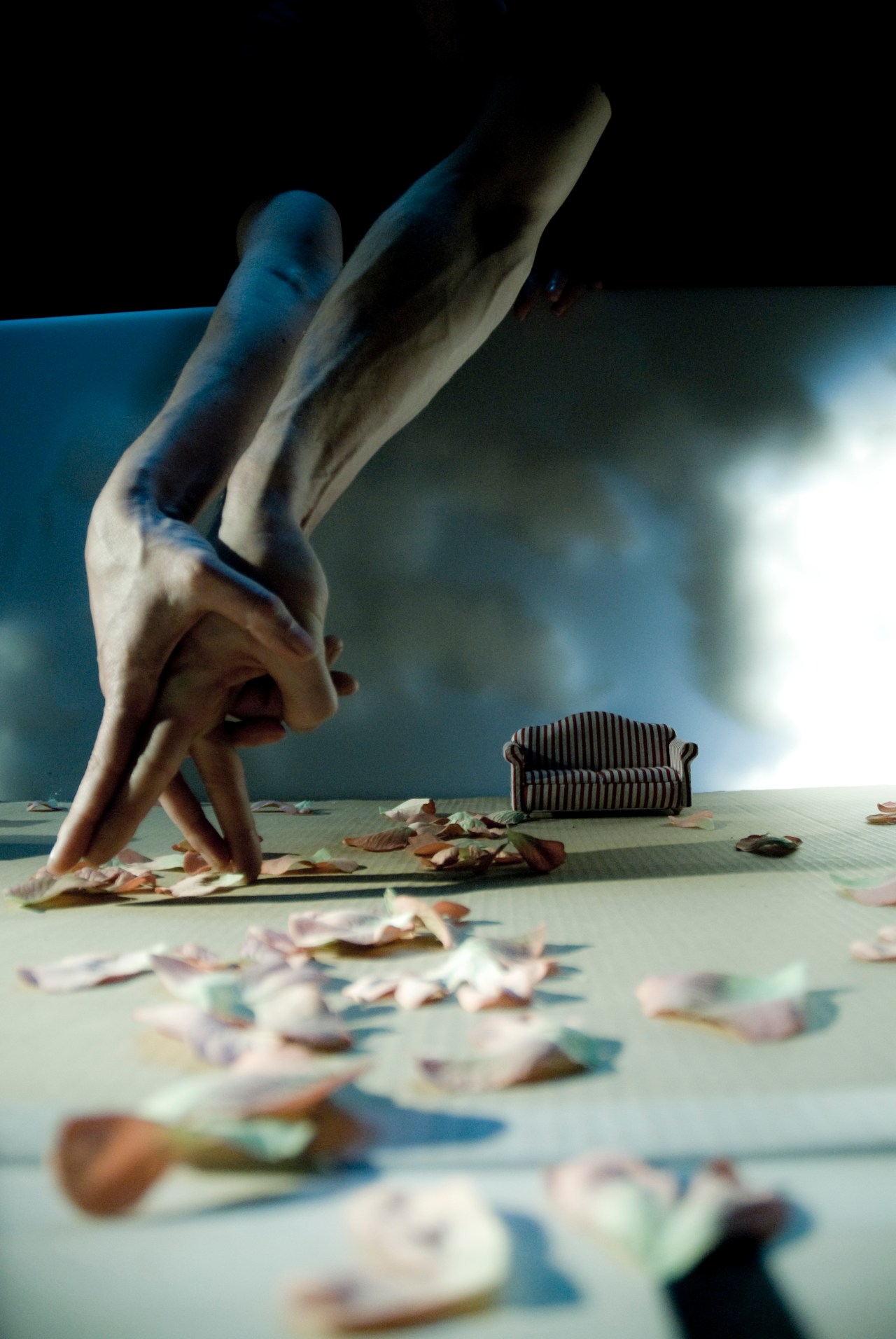
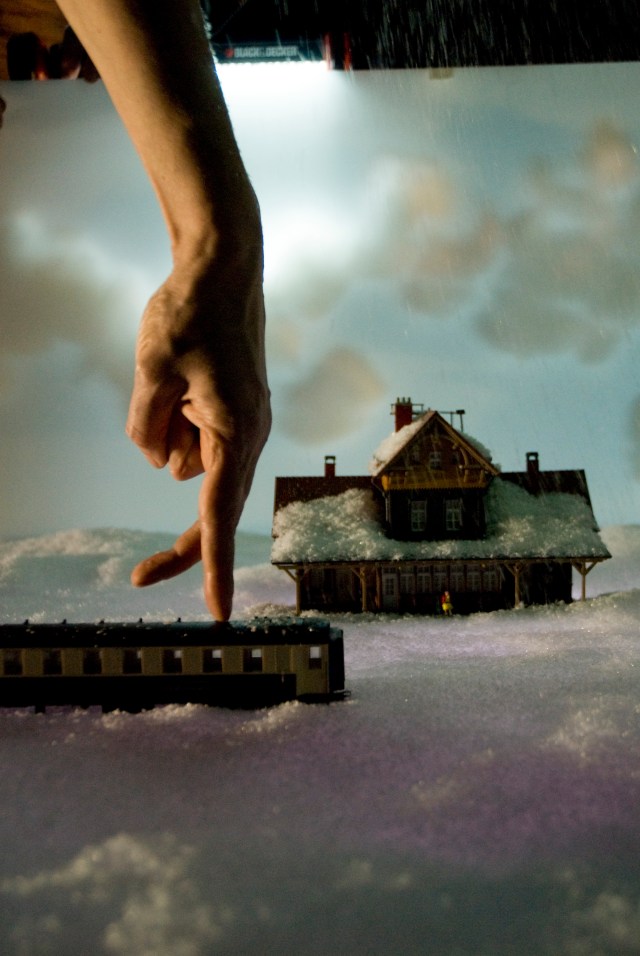
Kiss & Cry is like a visit to a movie set, a night at the cabaret and a live dance performance all rolled into one mezmerizing experience. Gisele, an elderly woman (represented as a tiny plastic figure) sitting on a bench at a train station, reflects on her lost loves. Her swirl of memories, from lover number one to lover number five, is danced by the agile fingers of De Mey and Grégory Grosjean as a crew of seven moves about to set up scenes, light them and shoot live video projected on the wide screen above. From the audience we take it all in, both the production-in-progress and the screen projection animated by a soundtrack ranging from classical lieder to schmaltzy pop songs, such as “Autumn Leaves,” to techno buzz.

The mystery is that there is so much mystery surrounding a production that reverses the usual behind-the-scenes action to put it in the foreground. Gradually it becomes clear that those seven people manoeuvering underneath the lighting armature between the dolly track, the tables and toy train sets are as much the performers as De Mey and Grosjean.

Kiss & Cry trades in metaphor, the toy trains providing the requisite imagery of romance, the use of sand going down a shoot or shifting with the tides accompanying the narrative of memories lost or regained, tormented or blissful.

Director Jaco Van Dormael, De Mey’s spouse and artistic collaborator, brings a film director’s eye and a clown performer’s whimsy to the show. And it’s not just in her expressive finger movements that De Mey reveals her dance pedigree. (A graduate of Maurice Béjart’s Brussels dance school Mudra, she began choreographing in the early 80s and worked with Belgian choreographer Anne Teresa De Keersmaeker for six years, notably on De Keersmaeker’s renowned Rosas danst Rosas.) She is a beautiful mover and paired, literally hand-in-glove, perfectly with Grosjean.

There’s a hilarious scene done with fingers moving in mirrored sync that recalls Momix and manages to mimic a figure clutching his genitals. Four-fingered pas de deux shift from the sublime to the obscene with the flip of a digit – or the removal of a glove finger. Some gorgeous scenes of tiny figures in snow – so obviously shot by on-set camerawoman Aurèlie Leporcq – are nevertheless transporting. And as for the reveal of a man making the shape of a sand dune, one is still baffled as to how it could have been pulled off before our watchful gaze.

Gunzig’s voice-over narrative careens easily from the poetic to the banal, providing as much fake poignancy as truly moving moments. “Love evaporates like water,” it goes, or “memory was a lover who never deceived,” or “love affairs are like cheese graters – great for cheese, but not much else.”

And that’s not all: Kiss & Cry is the set-up for next week’s North American premiere of the collective’s Cold Blood, a co-production with Canadian Stage. It would be useless to speculate on their next move.


Kiss & Cry 5 - Maarten Vanden Abeele

Fun with philosophers

6. Germinal - Photo by Be a Borgers

Halory Goerger, Ondine Cloez, Denis Robert and Arnaud Boulogne in Germinal.                 Photo by Be a Borgers


Germinal

By Halory Goerger and Antoine Defoort

L’Amicale de production at World Stage

Fleck Dance Theatre, 231 Queens Quay W., Toronto

January 20 to 23, 2016


In the beginning there was darkness – black – but for a pool of dim light in the middle of the stage. Germinal is a creation story for the theatre. Slowly, lights come up on some dim shapes on stage: performers Halory Goerger, Arnaud Boulogne, Ondine Cloez and Denis Robert. Each is concentrating on a handheld computer, connected with a long wire to the wall of the black box they inhabit.

As tall, thin Halory strolls around the stage, stroking a key on his keyboard, his thoughts take shape in white letters beamed from a surtitle panel high on the back wall. In a Eureka moment, he draws Ondine to his discovery: thoughts transferred with the click of a key. Ondine’s thoughts are manifest on a second surtitle panel. They beckon to the other two – a sulky Arnaud and insular Denis —  to join them. Soon words, whole sentences are flashing on and off at the speed of dialogue, as the characters begin erecting the structure of a play, starting with a system of communication.

If Jacques Derrida ever gave a lecture in the form of a song and dance show, it might have looked something like Germinal.

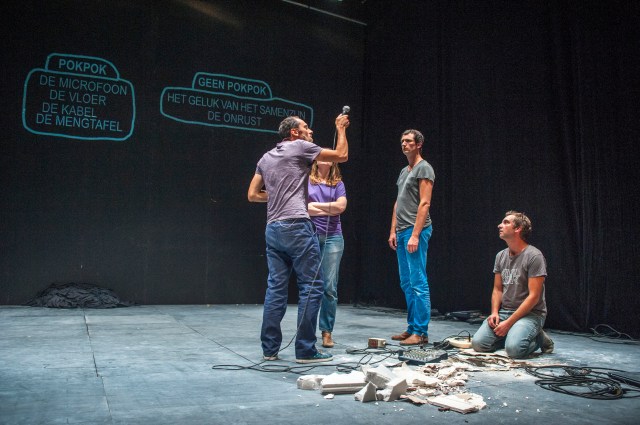
After all this intellectual to-ing and fro-ing, Ondine literally chews up the scenery. Approaching a section of the stage with a pick-axe, she begins to tear it up, creating a hole and a pile of rubble. Arnaud pulls a microphone out of the hole and becomes the mouthpiece for more exchanges, each character now speaking French, but with their words displayed in English. The microphone sound “poc poc” becomes a system for categorization: items and concepts are listed under “poc poc” and “non poc poc”. A laptop from the hole gives the world according to Windows: a menu allows a projection of a hill, a mountain, a swamp on the back wall. The scenery is described as an overlay on top of the wall.

Voices are raised – the letters grow bigger – and then comes choral singing.  Voila! Opera. Germinal manages to be at once highly cerebral and physically, noisily concrete, thought-provoking and laugh-out-loud funny. The production, thanks to a combination of advanced electronic effects and an old-school piece of stage trickery, is dazzling. But nothing happens.

Nothing except for a long, joint effort to describe a series of events occurring in space over time – the objects, the action and duration reduced to a chronological graph that marches across the back wall as words writing themselves on a blackboard.

Timing in theatre is everything: this show has bits we’ve never seen before. Without a trace of artificiality, four performers and almost as many lighting technicians mount a play that is a philosophical argument to totally captivate an unsuspecting audience.


Belfry goes a-Caroling

Scrooge 3 captioned

Kyle Atlas Stahl, Tom McBeath in A Christmas Carol. Photo by Don Craig

A Christmas Carol
By Charles Dickens
Adapted by Michael Shamata
Belfry Theatre, Victoria
Dec. 1 – 20, 2015

Michael Shamata’s A Christmas Carol is 25 years old now, getting on to be as enduring a classic as the Charles Dickens novella that inspired it. Toronto audiences first saw it on a wide proscenium stage, but Shamata has ingeniously adapted the show to the much smaller thrust stage of the Belfry Theatre in Victoria, still accommodating a cast of 14.
Christmas brings out the worst and the best in all of us, as Dickens so clearly saw when he wrote A Christmas Carol in 1843. Bringing the melodrama to the stage, Shamata has given new life to Dickens’ “Ghostly little book,” shaping dialogue and scenes for economy and speed.
And in this season of mass shootings, suffering migrants, homelessness and youth unemployment, the social ills of Dickens’s 19th-century London seem not far removed from ours in the 21st.
We watch this Christmas Carol the way we read it on the page; both writer and director, Shamata has conceived the show to engage our imaginations. Gerry Mackay frames the story for us as the narrator who asks us to follow the ghost light into another time/space. “Jacob Marley was dead . . . dead as a coffin nail.”
No separation can exist in live theatre between the dream characters of the past, present and future and the physically present Ebenezer Scrooge, played with aplomb by Tom McBeath. Scenes are conceived as if the whole theatre were our cranium. Blocking, choreography and some very deft stage directions manage the illusion. The first ghost arises out of a trapdoor in the stage in a column of misty light so he looks like a hologram. Scrooge stands high above London with the ghost of Christmas present observing the streets below: three performers encased in black puppeteers garb move around with painted streetscapes held aloft to give the impression of the city in the 1840s.
Nancy Bryant’s authentic costuming plays against John Ferguson’s minimalist set – a solid tall entranceway with a clock on top – to put all our focus on the characters and the action. Alan Brodie’s lighting design transforms the set from a snowy sidewalk to the cozy confines of the Crachit home on Christmas.
The superb Victoria cast keeps it moving from laughter to tears and a few opening-night improvs. Seven-year-old redhead Kyle Atlas Stahl is a memorable Tiny Tim; Anton Lipovetsky a pale-faced Bob Cratchit; Gerry MacKay as Marley and others is highly versatile; Brian Linds brings Mr. Fezziwig and several other characters to life as does Jan Wood as Mrs. Fezziwig; Amanda Lisman is just the kind of Belle that Scrooge could never forget; and white-faced spirits John Han and Jessica Hickman control the spooky atmosphere.
The universal appeal of A Christmas Carol is enhanced in this production. A theatre-goer could go multiple times and never see the same show twice: that is the charm of live performance.

Uno Fest – It’s a wrap

Magic Unicorn Island

Jayson McDonald

Metro Studio, Victoria

May 22, 2015

The Incompleat Folksinger

Written by Pete Seeger

Adapted by Ross Desprez and Mark Hellman

Performed by Mark Hellman

Metro Studio

May 23, 2015

Nothing says boomer nostalgia like the word hootenanny. Add the Pete Seeger song list, a full-throated performer such as Mark Hellman and you’ve got yourself a 60-year reunion of old lefties, unionists and what’s left of the 60s protest movement. This show, the finale to a well curated line-up of solo artists, closed Uno Fest on Sunday with a rousing singalong.

Seeger, who died last year at 94, has hardly been forgotten, but this show, with Hellman impersonating the lifelong activist as well as narrating his story, reminded us of what an influential artist the New York singer was. Son of a musicologist, he used to go along with his father on folk tune-gathering expeditions to the deep South. In his late teens, a Harvard dropout, Seeger heard his calling in singing for political causes. In 1945, he was a founder, with Woodie Guthrie and others, of the People’s Songs organization; from that moment on there wasn’t a protest that could get very far without Pete Seeger.

Hellman is less assured as a narrator than a singer. But he certainly underscored the Seeger dictum, “a good song can only do good.” From Seeger’s days in union halls with Woodie Guthrie (“Solidarity Forever”/ “I’m sticking to the Union”) to his civil rights activism and support for Paul Robeson (“We Shall Overcome”) to  participation in Vietnam War protests (“Where Have all the Flowers Gone”) and prosecution by the House Unamerican Activities Committee (he beat the rap), The Incompleat Folksinger is a piece of musical/political history that entertains as much as it edifies.

The same might be said for Magic Unicorn Island, created and performed by Jayson McDonald of London, Ontario.

The show had a strange opening, a post-apocalyptic scene of a caveman type cooking over a fire made of discarded furniture: all in mime. That didn’t bode well, but once McDonald launched into his script, playing multiple roles in an uproarious dystopic scenario set in the aftermath of planetary collapse, the fun began. A Bush-like persona with an imperious mien is president of the United Empire, the one big global state. Another glib character is a TV presenter, delivering the news as if it were a game show (Big news is an appearance by “ageing pop star Rihanna.”). A legislator delivers one of the latest dicta: “You have the constitutional right to bear arms, also you will be shot on sight. Endless war is discussed. And then the kicker: in pursuit of the one world state, the government of the United Empire declares war on its own children. They’ve abandoned the parents, left them to greed and conflict and established their own country on Magic Unicorn Island. A summit between the 14-year-old head of MUI and the Scotch-sipping prez of United Empire fails to avert the crisis. You can guess the outcome.

A clever mix of Swiftian satire, comedy, speculative fiction and shock tactics – in one tireless performer — Magic Unicorn Island summed up what Uno Fest does best: makes us laugh and makes us uncomfortable, in about equal parts.


Three cheers for Uno Fest

Uno Fest

Metro Studio +

Intrepid Theatre Club

May 8-24, 2015

Only an issue as urgent as the extinction of marine life through ocean acidification – the subject of Alanna Mitchell’s 2009 book Sea Sick – could have compelled a newspaper journalist to take to the stage. As she said herself, on the last night of Sea Sick (May 14) at Victoria’s Uno Fest, “this is breaking all the rules.” Journalists are the messengers, not the message, but this was an important story that Mitchell lectured on with her book’s publication. Toronto artistic director Franco Boni saw the potential for a one-woman show and with Ravi Jain helped the writer create a script to ignite audiences across Canada.

Mitchell’s storytelling skills and self-deprecating humour easily adapt to the theatre. Casually, she relates her own story: growing up on Prairies, nurtured by her artist mother and zoologist father. Hence a natural curiosity, drive to investigate and gift for painting narratives in words.

Three years ago, Mitchell, a mother of two, set out to document the accelerating crisis in the world’s oceans: 99 percent of the planet’s living space. Her findings are alarming, to say the least. Way, way down under the sea in a submersible, she got a first-hand glimpse of extinction underway. Literally drawing her conclusions on a chalkboard, Mitchell spells out the doomsday scenario: with warming comes acidification, killing essential marine life. Without plankton, no oxygen; with no life in the oceans, no life on land. Despite the chilling stats she rhymes off, this journalist-turned-actor brings a message of hope that humanity is finding ways to save the planet.

Sea Sick is the sort of innovative, edgy performance that Victoria’s 18-year-old Uno Fest of solo performances showcases. Each May, the three-week festival presents an engaging line-up of shows from Canada, and occasionally abroad, to unsettle and entertain us, including works in development with Intrepid Theatre Club. The final four days of Uno Fest features seven different one- to two-hour shows and the short, short (15 minutes) UnoWorks-in-progress. Not to be missed: Mark Hellman’s adaptation of Pete Seeger’s The Incompleat Folksinger; Zoë Erwin Longstaff’s Half Girl/Half Face; The Rendez-vous, a cabaret show from Krin Haglund; Jayson McDonald’s Magic Unicorn Island; Slick, by Karen Lee Pickett; and Shirley Gnome’s sultry musical, Real Mature.

A George F Walker double bill

Parents Night/The Bigger Issue

A Crazy Lady production

Theatre Passe Muraille, Toronto

Until May 17, 2015

George F. Walker says he’s only channelling the voices he hears when he wades into a contentious issue to witness injustice, dysfunction and people under the pressure cooker, trying to do good work in impossible situations — a general description of what’s going down in our schools. Walker’s wife is a teacher; they’ve had three children in the public system; how could he not be attuned to the voices of protest, burn-out, financial strain and frustration coming from both parents and teachers?

                As for Walker’s contention that “I’m just transcribing what they say,” we beg to differ. A lot of craft has gone into making those voices count and turning 65 minutes of hard-hitting tragicomedy into a cathartic event.

                Parents Night, first mounted last year in Hamilton, and The Bigger Issue, a world premiere, are the first two playlets in a theatre cycle focusing on education.

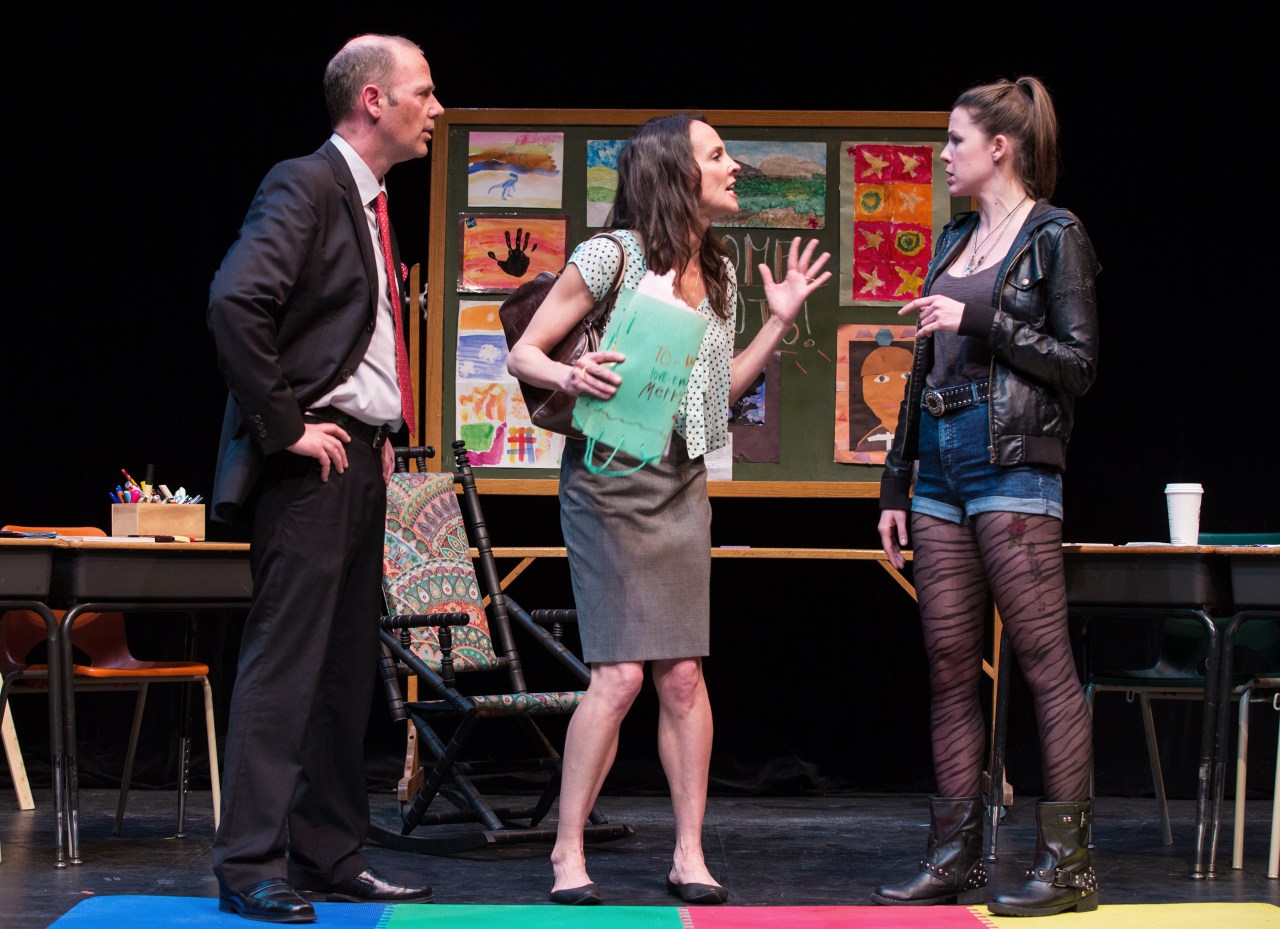
                First up is Parents Night, a tightly scripted, breath-takingly confrontational pas de trois between two parents of struggling seven-year-olds and the children’s beleaguered teacher.  Into the empty classroom, in which little desks flank a display board, strides business-suited John (Matthew Olver) loaded for bear before the teacher Nicole (Sarah Murphy-Dyson) has even appeared. He picks up an artwork, tosses it aside with contempt, then makes for the finger-painting by his son Patrick as if it was a homing device. Judging a little girl’s work as Asian, he spews forth a critique of “social engineering”, teamwork that shores up “slackers” and an accusation that his son’s seven-year-old deskmate might be a subversive North Korean. John is divorced, a cuckold and a parody. He’s soon withered by the breakdown of teacher Nicole. Already at the point of meltdown, she is in a puddle after learning of her father’s death.

                Enter Rosie (Dana Puddicombe), an even bigger shock to Toronto middle-class smugness. She’s dressed like a hooker and indeed is a lapdancer: cut-off jeans over zebra-striped hose, stuffed into black leather jacket and boots.  She’s parent to Sonia, a child who’s already declared she’s gay. Sonia’s father is a drug dealer; Rosie, to put it mildly, is a parent with a brief. Where does Nicole (“I’m already at the peak of my niceness”) get off judging her and her child for their homeless condition? Nothing is ever resolved in this play, a triangle of fictional proportions in which the teacher is totally defeated: “It’s people like you who ruin this job for me,” she says.

                Walker ratchets up the tension inherent in the conflicts by forcing a tragic storyline into a comedy format. In The Bigger Issue, concerning the parental complaints of Jack (Olver) and Maggie (Puddicombe), whose 12-year-olds are in teacher Irene’s (Murphy Dyson) class. Irene is accused of assault on a boy who’s “on the spectrum (of autism)” and who carries a butcher knife to class. Again a steady rant rises to an absurdist climax as the knife is pulled out. Through the din we hear a home truth from Irene: “I don’t want to be in this school. I might as well just join the police force.”

                Director Wes Berger makes the perfect interpreter, fine-tuning all the symmetry of Walker’s script. The cast, especially the wide-ranging Sarah Murphy-Dyson, is pretty much flawless in its timing. Only one quibble: with the intensity of the writing and the rapid-fire delivery, is it really necessary to have everyone shouting at full volume? We know we’re meant to be worn down. We don’t actually have to be pummelled into the back of our seats.

Above: Matthew Olver, Sarah Murphy-Dyson and Dana Puddicombe in Parents Night

Photo by Cylla von Tiedemann