This mutt’s a keeper

Métis Mutt, at Aki Studio Daniels Spectrum through February 5, 2017

Louis Riel once said, “My people will sleep for one hundred years, but when they awake, it will be the artists who give them their spirit back.” Sheldon Elter is the living fulfilment of that promise. This 90-minute Native Earth Performing Arts show imported from Edmonton will have you pressed against the back of your seat and engaged to the point you’ll wonder where the time went.

He jumps right into character — “My name is Sheldon Elter and I’ll be your native comedian for tonight” — grabbing the microphone to spew out a series of jokes that increasingly make all in the audience uncomfortable: What do you call an Indian on a bike? Thief. What do you call two Indians on a bike? Organized crime. Switching moods, gaining traction, this natural mimic and fascinating mover keeps several narratives going, dropping one for another and filling in the missing parts as he goes.

Elter creates a character named Sheldon whose life details are pretty much those of the man himself. His father, Sonny, was native. His mother, whose last name he took, was in her youth a fair-skinned, blue-eyed blonde. Elter has a brother Derek, three years younger. As children they witnessed the beatings, the alcoholism, the raging arguments between parents and lots more that children should never see.

Switching rapidly from one character to another, Elter gives voice to them all: medicine man, drunken dad, classroom bullies, medical specialists. He plays guitar, singing a hilarious homo-erotic composition about the Lone Ranger and Tonto and a ballad called “Self Love” – neither recommended for family listening. Pieced together with lots of comic interludes is the story of a Metis youth who tries to protect his mother and eventually escapes with her to be raised by a step-father, who drinks and does drugs, stops and relapses, but finally finds his calling – and redemption – on stage. Elter is a born showman: he even does a passing impersonation of a Broadway musical performer.

Just when your sides are splitting from a series of one-liners (“my wet-dream catcher”), Elter slips into a heart-wrenching tale of lost youth. There were 11 years when he didn’t see his father at all and when he and a cousin go to visit the dad in a broken-down trailer, Sonny doesn’t at first recognize his own son.  “At least he was sober,” the actor says.

A generous performer, Elter moves like lightning, breaking into break-dance, then singing a Cree song as he takes us to a northern sweat lodge ceremony. All the action unfolds against an ingenious screen, shaped like half of a circular hide drum, on which are projected images to help set the scene. Elter has been working on Métis Mutt for 17 years. The version here is directed by Edmonton’s Ron Jenkins and it is tight as a drum. Don’t miss it.

Métis Mutt

Created and performed by Sheldon Elter

Director: Ron Jenkins

Set and lighting: Tessa Stamp

Projection designer: T. Erin Gruber

Sound designer: Aaron Macri

Photo: Ryan Parker

Dancing up a storm

Infinite Storms, The Theatre Centre, Toronto, through January 29, 2017


By all accounts – including Nova Bhattacharya’s – migraines deliver some of the worst pain humans experience. But headaches, back pain, bowel obstruction, depression, any kind of pain, all have a common effect: they make the sufferer feel alone, watching in agony as everyone else appears to enjoy themselves, or at least function normally.

How such a subject could be effectively explored in a dance and still be called art is amply demonstrated in Nova Bhattacharya’s Infinite Storms.

A thorough and fascinating fusion of eastern and western concepts, dance forms and philosophy, the hour-long piece consists of one reveal after another, the finale the most surprising of all.

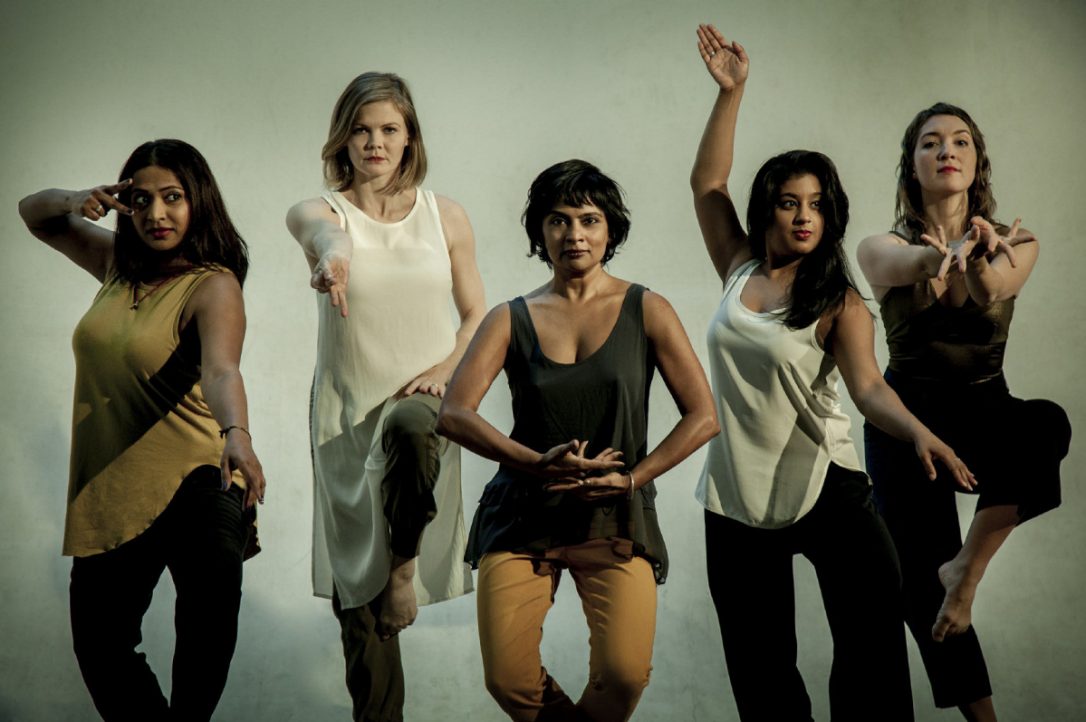
As viewers take their seats, four female figures sit in smokey twilight around a central wrapped pillar – a maypole. The saris of three of them are woven into the pole.

Accompanied by the sound of deep, yogic breathing, a fourth, untethered, figure in a sari begins to dance, Bharatanatyam style, playing two hand bells. Gradually the other women unwind their saris, get to their feet and leave their posts, dancing, posing, with modern, balletic and Indian classical gestures intertwined as carefully as the cloths around the maypole. But the pole is actually Bhattacharya, tightly wrapped in darkness up til now and soon looking like a martyr being burned at the stake.

The others – Kate Holden and Molly Johnson, Atri Nundy and Malarvilly Varatharaja – are meanwhile moving, stomping bare feet, swinging arms and making broad facial expressions.

The other thing about pain is that it can quickly turn to pleasure, tears morphing to laughter, or simple relief.

Anyone in the audience could find something to identify with in Infinite Storms and apply a personal interpretation. Opening so soon after the women’s march, this all-female work also evoked the sense of solidarity experienced when one individual in pain connects with another and all find they are not alone, but actually connected in their suffering.

Bhattacharaya’s program notes end on the word “samsara” a Sanskrit term often found in Buddhist teachings to express the circularity and constancy of change in life as we know it. And it is this concept that ties together sound, tabla rhythms, colour changes, dance repetitions and symmetries, in one glorious carnival that ends with a maypole dance and a final, ingenious, laugh-inducing tableau.

Choreographer: Nova Bhattacharya

Collaborator: Louis Laberge-Côté

Performers: Kate Holden, Molly Johnson, Atri Nundy, Malarvilly Varatharaja, Nova Bhattacharya

Lighting: Marc Parent

Costume design: Tina Fushell

Sound/Tabla: Ed Hanley

Handout photo


Flying in the face of ennui

I Forgot to Fly Today

Created and performed by Trent Baumann

Downunderground production

Victoria Fringe Festival, Metro Studio Theatre

Thursday Sept 1, 8:15pm; Friday Sept 2, 6:45pm


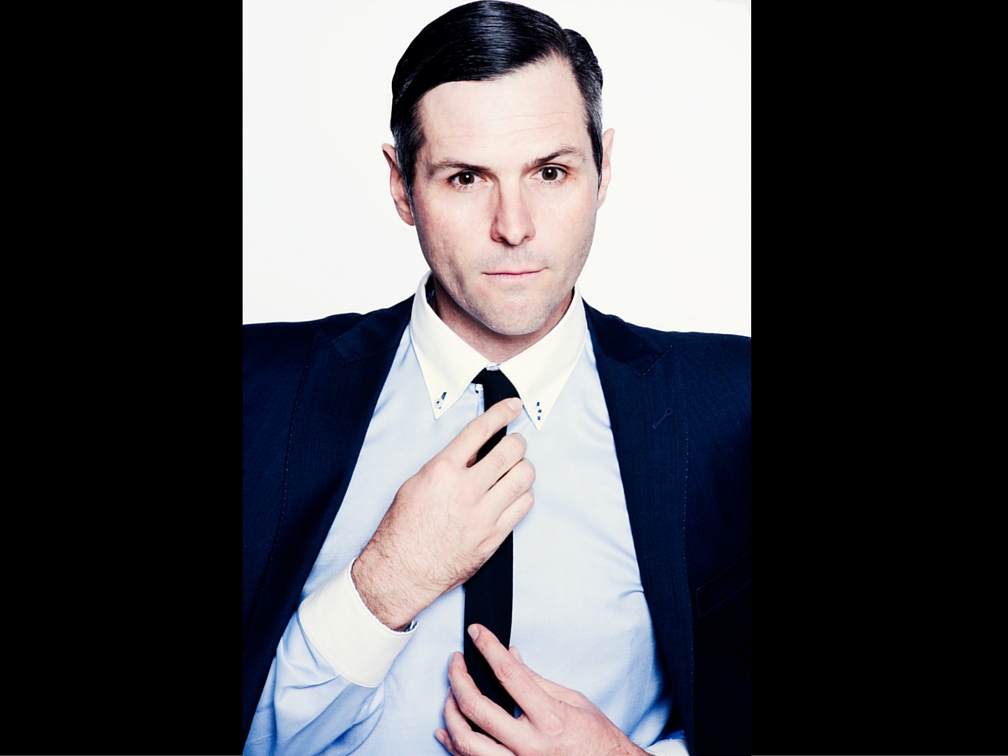
For the world premiere of I Forgot to Fly Today, i.e., the first time he’s ever performed the piece, Trent Baumann appeared a little under-rehearsed.  And a little less than captivating. But as the minutes wore on, Baumann got into the rhythm and concluded with a trick that is completely original and truly spectacular.

Baumann, who lists his home as Surfer’s Paradise, Australia, is a veteran of the international fringe circuit. Victoria loves him, and so does Victoria, Australia, his native state. He’s best known for Birdmann, described as 21st-century vaudeville. He’s toured that show around the world and made a hit of it at the top-tier Edinburgh Fringe. It’s now available online as a “live” video.

Like Birdmann, I Forgot to Fly Today is part magic show, part circus act, part mime and part stand-up. The script could use a little tweaking but don’t be lulled into inattention by the repeated platitudes about living your dream and minor musings such as, “Maybe the world is just like life. It has a future and it has an ending, just like life.”

The origami paper-made piano playing, balloon tricks and an audience participation feature done before in Slava’s Snowshow lighten things up, but Baumann’s tendency to embrace the mundane gives way to aimlessness in the middle of I Forgot to Fly Today.

Teetering atop his plastic milk-carton arrangement in his cloud-atlas suit, the performer manages to overcome our ennui at his lame mimes and carries us through with a stand-up routine (“I found myself in a park. I knew I’d turn up one day”) followed by a shedding of his suit.

Don’t be tempted to exit before the end, though, because Baumann’s finale is more than worth the price of admission.


A birds-and-the-bees message

Field Zoology

Created and performed by Shawn O’Hara

Animalia Productions

Downtown Activity Centre, Victoria Fringe Festival, Victoria, BC

Mon Aug 29, 6:00pm; Wed Aug 31, 8:00pm; Fri Sept 2, 6:30pm; Sat Sept 3, 4:15pm


A leading incubator for Canadian talent of all kinds – think Steve Nash, David Foster, Silken Laumann, Eric Metcalfe – Victoria boasts a fringe festival remarkable as a showcase for emerging artists. Shawn O’Hara, creator of the Fringe show Field Zoology, is a fine example of the above.

Whether it’s because we’ve all had teachers like Dr. Bradley Gooseberry or because O’Hara is a fiend at engaging an audience, he had us at the first “stand up, please” (immediately followed by “now sit down”). All willingly stood, faced east and repeated  the zoologist pledge: a promise to respect all animals – with the exception of the mongoose (“they know what they did”).

In his Indiana Jones hat, fake moustache, polo shirt and all-important cargo shorts (over bare, hairy legs in socks and thick-soled Blundstones), Dr. Gooseberry gives us a quick account of his beginnings as a zoologist in the Amazon. The Amazon central warehouse in Petaluma, California, that is. His zoological career began among the rat inhabitants, a study that included an investigation (don’t ask) of “rat gonorrhea.”

O’Hara’s humour is both physical and cerebral. Using an overhead projector, Gooseberry displays crudely drawn animals and titles sometimes running off the page to illustrate his lesson. (“These transparencies are expensive. Don’t use permanent marker.”) Manipulating them before our eyes, he gives us animated action, slipping transparencies over each other to demonstrate one creature devouring another.

A master of deadpan, O’Hara runs a steady patter that keeps his audience in stitches. You will be marking your own papers, he informs us. “I’ll be damned if I give up my weeknights to grade your horseshit essays. It’s my time to watch ‘Bachelor in Parasdise’.” He veers wildly from sarcasm to the absurd, weaving in a major theme in zoology: seduction. Porn, he advises, can be found “on your father’s laptop in the secret folder called ‘work graphs’.” Admitting to his own proclivities, Gooseberry alludes to the arousing features of “a curvaceous water fountain in my apartment.”

A Q&A session that ends the piece features Gooseberry answering questions submitted by the audience. “Why do female lions do all the hunting?” he reads from an index card. “Because it’s 2016.” Touché.

The Victoria Fringe, featuring 53 shows from all over, runs through September 4 in seven venues.


Uno Fest takes off

The Unfortunate Ruth

Written and performed by Tara Travis at Uno Fest

Metro Studio, Victoria, BC

May 18 – 20, 2016


Shylock

By Mark Leiren-Young

Performed by John Huston at Uno Fest

Metro Studio

May 19 ­­­­­­­– 20, 2016


Victoria’s 19th Uno Fest, an annual event produced by Intrepid Theatre, is off to a terrific start to 10 days of performance of 14 solo shows.

The running gag in Tara Travis’s The Unfortunate Ruth, is “I have a hunch,” a line delivered by the Ruth, a buck-toothed hunchback receptionist in a white coat. Ruthie, her Doppelganger, is also a receptionist – in a clinic that performs ultrasounds on pregnant women.

I have to admit that I didn’t quite get this show, which grew out of Travis’s fascination with “identical twins, parallel universes, the work of Mind of a Snail and a particularly rare medical condition called fetus in fetu.”

Buck-toothed Ruth has a fetus in her hump that makes its presence known by gripping Ruth’s heart with its legs. Ruth calls the fetus Cordelia, Cordy for short. The other Ruth, known as Ruthie (a quick on-stage costume change takes place), has a fetus growing in her abdominal cavity. She could see it herself with her ultrasound wand, if she cared to. Then, just to complicate things, there are talking cartoon fetuses projected on a screen behind each Ruth. In one video scene, one fetus eats the other. There’s a confusion of names: who knows where the fetus Gertrude fits in? what about this unicorn and the ashes in the urns? And which of the Ruths is the one who survives surgical removal?

Travis, a Vancouver performer who brought this show to the Vancouver Fringe in 2014, gets off some good lines and disports herself with aplomb, puzzling as her show remains to this viewer.

                Victoria playwright Mark Leiren-Young’s Shylock is the stuff of great solo performances and John Huston is the actor to do it justice. Essentially a lecture, this Shylock soliloquy is a literal undressing as an actor bares his heart before his post-show audience.  Huston is John Davies, an actor trained in the classical tradition (think the Stratford Festival as run by an Englishman), and currently embodying a villainous, obnoxious Shylock in a festival’s controversial production of Merchant of Venice. He enters — swarthy, dirty, costumed with a hawk-like nose, grey page-boy wig and full Elizabethan accoutrement  — and delivers his most memorable soliloquy. “I am a Jew. Hath not a Jew eyes? hath not a Jew hands, organs, dimensions, senses, affections, passions? . . If a Christian wrong a Jew, what should his sufferance be by Christian example? Why, revenge. The villany you teach me, I will execute . . .”

                This Shylock is either a victim of anti-Semitism, or a reason for inciting it. In his one-sided “talk-back” address to the audience,  Davies, Jewish himself, answers his critics (“you must be a Jew-hating Jew,”) and makes a plea for returning to theatre that is about art and not about pandering to patrons or protecting the public from things they’d rather not acknowledge. Davies believes Shakespeare was an anti-Semite; Shylock is his villain, not someone with whom we need to sympathize.

As he’s raising issue after issue, eloquently displaying the power of “dangerous words,” the actor is wiping off his make-up, removing his wig, working down to his leggings and stocking-feet.  Huston holds our attention every minute. (He performs  an adaptation of  The Screwtape Letters at Christ Church Cathedral, Saturday, May 21 at 7:30 pm.)


Erasing borders with jazz

Song of Lahore

Directed by Sharmeen Obaid-Chinoy and Andy Schocken


Song of Lahore

Directed by Sharmeen Obaid-Chinoy and Andy Schocken

Cinecenta, University of Victoria

May 17 to 19, 2016

This documentary opens on a very sad note, as the camera follows some Pakistani  musicians – artists who all learned at the knee of a father or uncle –  through the ruins of the once vibrant Lahore music scene. After independence in 1947 tabla, flute and sitar players, violinists and guitarists enjoyed fame and thrived, making music for the Bollywood film industry. In the cold war years, an American program of jazz ambassadors, including Duke Ellington, Charlie Parker and other greats, introduced the subcontinent to a form of music that was similar to their own centuries’ old instrumentation. Improvisation came naturally to them and the rhythms were not hard to match.

Then in 1977 came General  Zia, Sharia law and suppression of music and all the other arts. The Taliban only made things worse. At the time this film was made, musicians were still playing in semi-secret in Pakistan’s second largest city. And they feared a complete loss of a proud and complex musical tradition. It would be like losing your language.

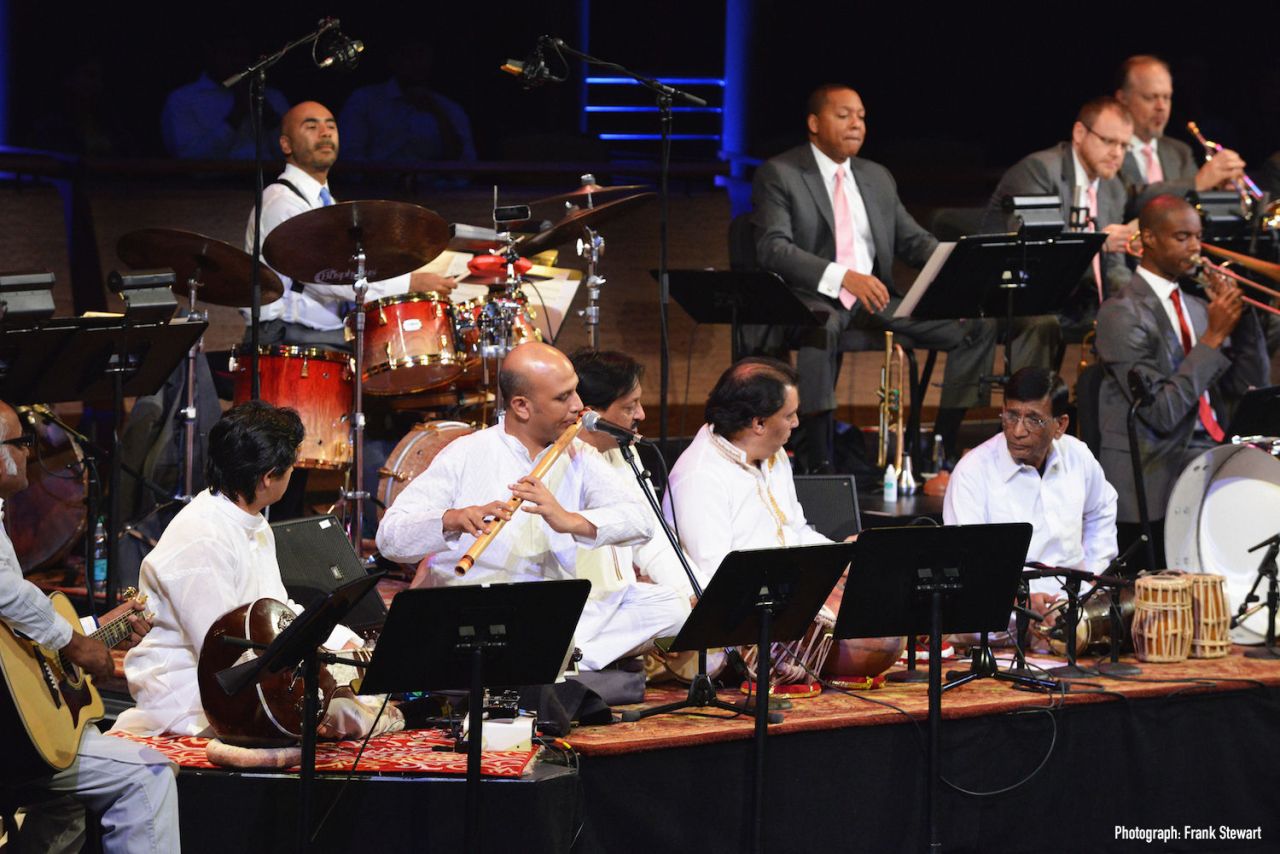
As we hear from Saleem Khan, son of Namdar Khan, considered the country’s finest violinist, things had come to such a pass that instruments were broken beyond repair and in scarce supply. No musician could make a living with his art form. But in 2004 Izaat Majeed pulled together seasoned players and started the Sachal Studios for recording music. Returning to the jazz they’d heard as young men, the players recorded Dave Brubeck’s “Take Five” on tabla drums, Indian keyboard. flute and sitar. It went viral.

Next came an invitation from Wynton Marsalis to perform with his band for a special concert in the Lincoln Center program “Jazz at Lincoln.” In one scene we’re in the grimy lanes of Lahore and in the next six brown guys are strolling through Times Square, jamming with the Naked Cowboy.

Conductor Nijat Ali, who loses his father and mentor during the course of the film, has to struggle to bring off this unusual merger of East and West, but as Marsalis says, musicians will always come together. What started as a lament becomes an uplifting story of how art overcomes difference and conflict in a vivid documentary that recalls Wim Wenders’ Buena Vista Social Club. The closing credits roll over images of the musicians finally getting to give a concert before a huge audience in Lahore.

Photo credit: Frank Stewart


Gallery

Hogging it: Rosenblatt and Callaghan

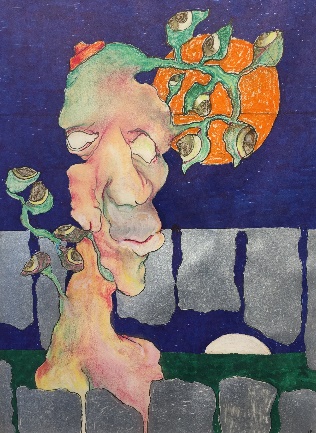
Stomachs UniteDrawing #11Chow DownDrawing #18

It’s anything but hogwash: an intellectual and artistic engagement between two CanLit titans entitled Hoggwash, because Joe Rosenblatt’s letters are addressed to James Hogg, Barry Callaghan’s alter ego and poetic protagonist. The release of the book, published by Exile Editions and subtitled The Callaghan and Rosenblatt Epistolary Convergence, is accompanied by an exhibition of Callaghan’s and Rosenblatt’s drawings and paintings on at the GN Studio in Oakville until May 11.

The works displayed on two walls at GN Studio are all new. (Those pieces reproduced in the book are no longer in the artists’ possession.)These pictures seem to converse across the room. Callaghan’s surrealistic, Dali-esque beings, all feet and lips and teeth, address Rosenblatt’s birds, cats, fish, dogs and other half-human creatures with much on their minds, and not all of it philosophic.

Hoggwash began with a proposal from Rosenblatt.  “Ten years ago I suggested to Barry that I would like to write to the leading protagonist in his epic poem, James Hogg and ask him a series of philosophical questions, pointed questions, as to the birth, or reincarnation of Hogg who emerges on an ice floe in Toronto Harbour and is set upon by thugs and crucified. Barry as Hogg would answer my questions, referring to our mutual friend Barry Callaghan.”

The epistles would also serve as a forum for the two authors’ thoughts on religion, philosophy, poetry and literature in general. The result (full disclosure; I acted as copy editor) is a unique Canadian literary document and a lively entertainment.

Callaghan sets the pace for Hoggwash in an opening Q&A with Rosenblatt, quoting liberally from Rosenblatt’s poetry. “You seem to me to be a blue angel, always in a delirium of poems and in this delirium you are, over and over again, born like death, with burning branches growing . . . .”

Rosenblatt describes himself as a “disillusioned romantic” and admits to a strange kind of voyeurism, the study of bees and their pollinating ways. Hogg is captured in a poem as a man living through “an endless winter of endless / nights, . . . sitting / squat hour after hour by a seal hole in the ice, / waiting for the snout of the seal . . . .” Hogg is in some ways the straight man to Rosenblatt’s remarks on Hogg’s musings about Martin Heidegger, God, the Virgin Mary and his Toronto subway Stations of the Cross. As for Callaghan, Hogg remarks, he “can be a bit of a gadabout and a rounder.”

This is not the first time either poet has emerged as a visual artist to be reckoned with. Writing about Callaghan’s Hogg works for an Ottawa exhibition, artist Vera Frenkel identified him as “a naturally skilled draughtsman.” Drawing and painting were something he did from an early age, prompting a poet visiting the Morley Callaghan household to ask what his son was to be, “poet or painter?”  But like Rosenblatt, Callaghan needs a theme and Hogg (the actual James Hogg immigrated to Upper Canada in 1824 from Glasgow) has provided him with lots of inspiration.

Among the Callaghan watercolours on display at GN, a large picture of limbs and lips locking, called “Hogg Remembers the All of their Love,” is a tender depiction of two lovers. Other paintings are more in-your-face, even sinister, such as “Hogg in Purgatory” or “Hogg Pursued by Devils in Hell.” These Hogg paintings are expressive in their jumble of body extremities and Janus-like visages of the earthly/heavenly polarities in Hogg’s thinking.

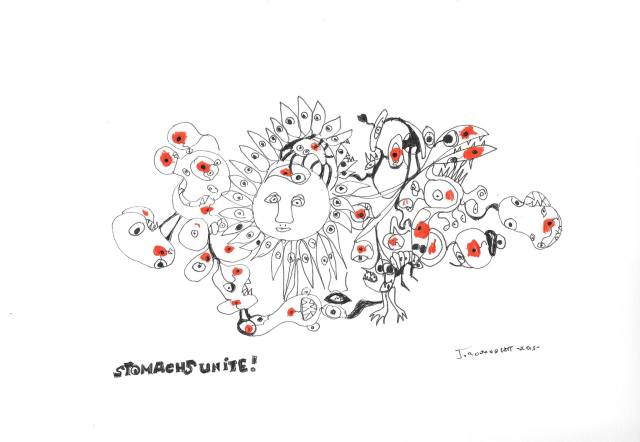
Drawing and painting is more of a constant pursuit for Rosenblatt, who has a solo show concurrently running at Yumart Gallery in Toronto. Making his artist’s statement, the poet says, “In my drawings personalities grow exactly like limbs . . . . Those creatures in my landscape carry my genetic material. . . . The drawing paper demands its form. It wants to be fed and craves for limbs. And perhaps a spiritual envelope called the soul.” At GN you can see in Rosenblatt’s black-and-white drawings accentuated with bright splotches of paint that the hand that draws the lines is the same one whence Rosenblatt’s thoughts proceed on paper. “Stomachs Unite” is a good illustration of the Stoma principle under discussion in Hoggwash. Other works, such as “Chow Down” and “Eat or Be Eaten” could be visual equivalents of his ripostes to Hogg.

There’s plenty of food for thought in Hoggwash, both the book and the art works; readers and viewers might well demand a sequel.

“Hoggwash: The Exhibition,” April 16 to May  11, gnstudio / contemporary art, 123 Lakeshore Road West, Oakville, ON

“Angels, Demons and Spirits,” works by Joe Rosenblatt, May 7 to 28 at Yumart Gallery,  401 Richmond St. West, Suite B20, Toronto, ON

Hoggwash: The Callaghan and Rosenblatt Epistolary Convergence, Exile Editions, 118 pages, $17.95 pbk.

Art work courtesy of the artists, from top: “Stomachs Unite”; “Compared to What,” Drawing #11; “Chow Down”; “Compared to What” Drawing #18


Gallery

Indigenous dance from two sides

NGS 1 - Angie Cheng & Karina Iraola - Credit Marc J ChalifouxIndigenous Dance Double Bill

Luu hlotitxw: Spirit Transforming by Dancers Damelahamid

NGS (Native Girl Syndrome) by Lara Kramer

Native Earth Performing Arts and DanceWorks CoWorks

Aki Studio, Daniels Spectrum, Toronto

April 21 to 23, 2016

Native Earth Performing Arts presents two indigenous dances that are poles apart, both geographically and culturally.

Luu hlotitxw: Spirit Transforming is based on traditional Pacific northwest Gitxsan dancing, singing and storytelling about a young man’s self-realization as he meets life’s challenges. NGS (Native Girl Syndrome) is purely contemporary in form, based on the degrading urban experience of the choreographer’s grandmother; it is a journey into alienation and self-destruction. Both need to be seen.

In Luu hlotitxw, Rebecca Baker, choreographer Margaret Grenier and Jeanette Kotowich enter the stage in long fringed dresses, button blankets emblazoned with totems, beaded headbands, moccasins, leg wrappers and decorated dorsal fins sticking out of their backs. These are the spirits of the orca and they move in ways to suggest the playful rising and diving of the Pacific killer whales – seen life-size in a video projected on the back screen. They chant as they move with silent footfalls in circular patterns.

Nigel Grenier sings too, in melodic phrases repeated with slight alterations (“yay ha hay /yo ha ho”). On first entry he bears a large bear mask in front of his face. The women surround him as he returns, bare-chested, to kneel on stage. They place cedar fronds in front of him. These are understood to be healing or protective.

The young man paints a black X on his chest with a paste given him by one of the women. He wears a second mask on re-entry, like the face of a small hunted animal. It is marvellous to see how these masks are animated by the dancer’s movement, so we sense without being told what this story is all about.  Another figure, a warrior with a very elaborate mask, comes in. The warrior attaches little heads to his mask, making him more animal-like and fierce, while the young man removes pieces of his mask to reveal the human beneath. In a clever bit of staging, we see him as a silouette on the screen depicting a forest, taking his rightful place in the universe.

In Montreal choreographer Lara Kramer’s dance for Angie Cheng and Karina Iraola, NGS, the women of the street, drugged, drunk or beaten down, are made faceless, their hair or their headwear obscuring their identities. This is a powerful reminder of the missing or murdered aboriginal women of Canada: unknown and unsought. The ubiquitous duct tape is a symbol of how they piece together a precarious existence.

Dressed like hookers in assorted found and damaged items, they stagger about, Iraola pushing a stroller and Cheng leaning over an old pram with a native symbol painted on it. At the back of the stage, a huge plastic tarp hangs in the rough shape of a teepee. Iraola makes her way  to music that goes from a loud, scratchy din to rock songs, such as “These Eyes,” to heavy metal music and drumming to something with the ironic lyric “…walk easy, walk slow.” In a head-hanging stupor, Iraola dresses in fake fur and huddles under her makeshift tent. Cheng, bare-breasted for part of her perambulations, rolls out a Canadian flag with a native image over the maple leaf. From one of her bags, she pulls out plastic miniatures of people and animals and places them in neat rows on the flag, as if this would make a home.

NGS takes a stereotype, magnifies it and flings it in our faces. The long silence at the end, as the two performers lay hunched over in the dark, is particularly affecting.


Top: Angie Cheng & Karina Iraola  Photo by Marc J Chalifoux

Below: Dancers Damelahamid  Photo by Derek Dix

Damelahamid 6 - Credit Derek Dix

Dance distilled to its essence

Jackie Burroughs is dead & what are you going to do about it

By D. A. Hoskins

Harbourfront Centre Theatre, Toronto

April 7 to 9, 2016

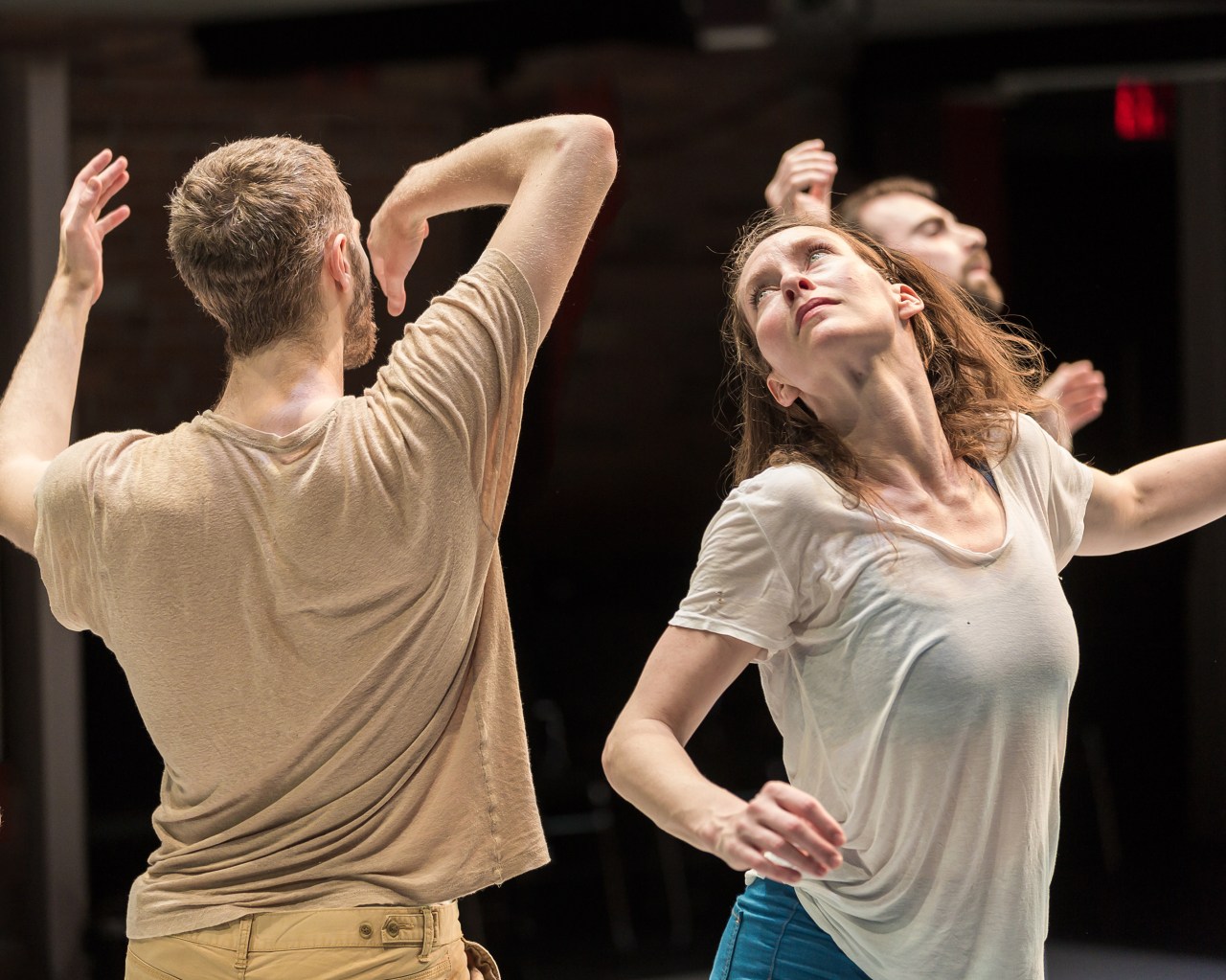
You might think that a title alluding to the late, great actor Jackie Burroughs might be attached to a dance with strong narrative, dramatic elements. You would be wrong.

Over four years of preparing this show, D.A. Hoskins and his performers, sought to reduce dance to its basics: sound and movement. As Hoskins says, they were trying to isolate the “physical” in “physicality.”

The audience is positioned around three sides of the performance space, on the same level as the dancers and musician. As we take our seats, Danielle Baskerville, Luke Garwood  and Robert Kingsbury, dressed formally, are standing and strolling around, speaking in low voices to each other. It’s as if we’ve walked in on a cocktail party seen through a soundproof glass.

That prelude serves to distinguish life from art. For when the lights come back up on the show, the performers enter in socks, wearing unremarkable T-shirts and jeans. At the corner of the performance space, musician Christopher Willes, crouched on the floor, is surrounded by his electronic devices. The sound accompaniment for Jackie Burroughs is a shell, a literal auditorium, consisting of a steady hum only slightly modulated from movement to movement of the hour-long show.

To go this minimal and demand this much attentiveness from an audience requires disciplined  and accomplished performers.  Baskerville, Garwood and Kingsbury fit this bill and their presence keeps up a feeling of hopeful anticipation as they go their meandering way, expressionless and unconnected for the first portion of the show.

Gradually they dance together, in pairs, and as a trio, whirling occasionally into muscular solos. The choreography is classic modern, contract and release, with a principle of over-balancing informing the folding and unfolding of limbs and torsos. Repetitive shapes, such as a kind of sideways falling arabesque, make patterns we can almost decode. There are some lovely lines and graceful partnering among the intricate combinations , but never any suggestion of a dramatic arc. Eye contact is rare and meaningless.

Dance distilled to this kind of physical abstraction can make its own story and the language here – the flowing movements of each dancer, reaching , straining, collapsing and rising again – is for the most part engaging. Rather as if the statues in the garden came to life under the moonlight.

Hoskins runs the risk of allowing minor distractions to take one’s attention, which the appearance of Garwood’s underwear, the stage lighting staining the face of a spectator or Willes’s tinkering with a mylar sheet and skewers placed in a tin can certainly do.

Worse is the electronic sound itself, sometimes suggestive of water rushing, or a distant avalanche, but mostly irritating, like radio static; for some maybe anxiety-inducing.

This is a show to attend for the exercise it is. An hour in which we appreciate the elements that go into a great performance. Something Jackie Burroughs understood well.

Photo of Robert Kinsbury, Danielle Baskerville and Luke Garwood by Jeremy Mimnagh

Akram Khan delivers in Toro

Toro

By Israel Galván and Akram Khan

Performed by Akram Khan

Presented by Canadian Stage

Bluma Appel Theatre, Toronto

March 9 to 12, 2016

After a knee injury forced Spanish flamenco dancer Israel Galván de los Reyes to stand down from his collaborative show with British dancer Akram Khan, Torobaka became Toro (meaning “contest”). Re-envisioned without Galván it is not half a show, and not exactly a solo dance, but given the flamenco dancer’s virtuosity, generates less excitement than the original.

Conceived as a conversation between two classical dance forms and two giants of contemporary dance, Toro is set in a circular stage reminiscent of a bull ring. Flamenco has its roots in India and it is easy to see the parallels in the northern Indian kathak dance form in which Khan was trained. The stamping of the feet, the heavy percussive beat of the music and the dominance of the male are common to both.

Akram Kahn is a phenomenal performer and doesn’t disappoint. His four musicians take up the part of the missing flamenco dancer, coming into the circle either to partner Khan, as does palmero Bobote in an opening scene of clapping and flamenco foot-stamping, or to perform duets of their own, as do countertenor David Azura and contralto Christine Leboutte. Indian percussionist B.C. Manjunath holds the whole show together, with his drumming and his recitation of the hard-consonant sounds of the rhythmic “bols.”

Reformatting the duet involves improvisation and has prompted some playfulness. Returning to the stage on bent knees, Kahn wears Galván’s white flamenco shoes on his hands tapping out the rhythms to build to a crescendo. The singers’ interactions at times invoke the chatter of the spectators at a bull fight and at others they seem like birds in call and response.

The most impressive aspect of Toro is Kahn’s embodiment of flamenco and kathak in the complex, high-energy choreography. It is hard to separate the dancer from the dance.

Most frustrating, for those to whom Sanskrit and Spanish are a mystery, is the impossibility of understanding the storytelling that is so basic to these dance forms. Toro makes a wonderful platform for Kahn, a dazzling and precisely expressive dancer, but doesn’t quite coalesce into a unified piece.

Photo of Bobote and Akram Khan by Jean-Louis Fernandez