A high-energy sporting success

Sporting Life

By Julia Sasso

DanceWorks DW214 Julia Sasso Dances

Harbourfront Centre Theatre, Toronto

March 3 to 5, 2016


It is an all too rare occasion when a piece of contemporary dance gets revived. Months of workshopping, fundraising, rehearsing and grant writing go into a production; it gets three or four performances and poof! – the show is truly over.

Taking her title from a British term for gambling, Julia Sasso made her first full-length dance for presentation by DanceWorks in 1997. Energetic, menacing, dramatic, Sporting Life makes a welcome return in the current Harbourfront season.

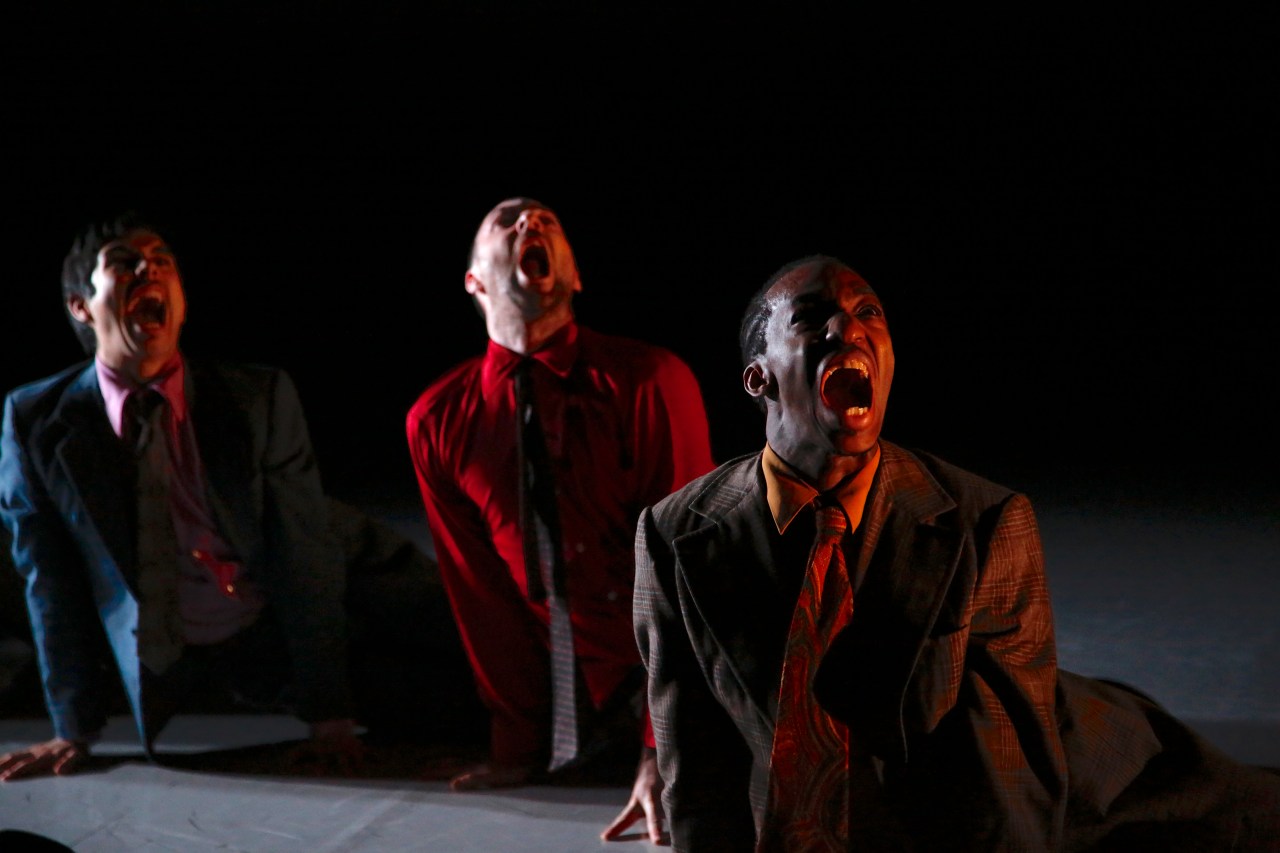
It is a show of many moods, original movement and striking imagery: a frame upon which several narratives could hang. From the bursting entry of five dancers in men’s suits, the clatter of their oxfords on hard floor providing percussion, we sense imminent violence.

This is a dance that calls for terrifically skilled performers and character actors. Timing must be impeccable, their faces working as hard as their feet, their body slams demanding the resilience of a wrestler. Sporting Life recalls the great years of Serge Bennathan’s Dancemakers, when Sasso was both performer and choreographer.

Rushing and leaping, throwing themselves to the floor to rise up again like puppets on strings, the dancers are gradually revealed as individuals. It’s a few minutes before we realize one of them is a woman: Jesse Dell.  Sporting Life is patterned into a fearful symmetry. Over the hour the dancers separate and combine in trios and duets, gaining identity with each shifting scene. Matthew Cuff wears a jacket with a plaid weave;  Mateo Galindo Torres, Irvin Chow and Daniel McArthur with his shaved head have a similar gangsta mien. All five shed sportsjackets to reveal vivid shirts and ties, bringing to mind the colour-coded thugs in Quentin Tarantino’s Reservoir Dogs.

Eric Cadesky’s soundscape and musical composition drive the production. From a heavy electronic dissonance, to train sounds to siren-like violins to a moody saxophone, or a Johnny Mathis ballad, the music shifts as violently as the hard-driving choreography. In an especially affecting moment, two fallen dancers make a tom-tom beat with one of their shoes tapping the floor like sticks in the hands of a drummer.

Gabriel Cropley’s lighting design creates the settings on a bare stage: a cone of light with criss-crossed bars suggests a prison setting, a splatter of blue hexagons on the floor a ballroom.

The quick scene changes evoke still relevant themes: crime and punishment, torture, bullying, gender-bending, playing at dangerous games that could end in death.

Dressing and undressing becomes the motif for a lot of shape-shifting. Having stripped down to their skivvies (Dell’s hands over her breasts), they re-dress, re-combine and then in a momentary lull in the action put on black evening dresses, preening and applying lipstick in a line before imaginary mirrors.

This dramatic shift ushers in tenderness and celebration. Light shines on a final, poignant grasp of an unseen hand before Torres exits, parting from his companions in a heap on the floor.

It’s a winning gamble for Danceworks and Sasso, who leaves nothing on the table in this brilliant revival.


Photos by Aria Evans

A horror in action

Betroffenheit

By Crystal Pite and Jonathon Young

Kidd Pivott & Electric Company

Presented by Canadian Stage

Bluma Appel Theatre, Toronto

February 18 to 21, 2016


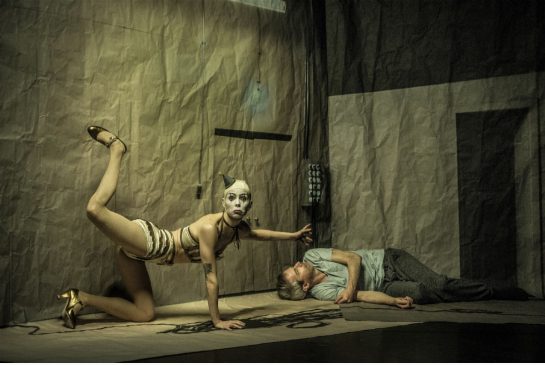
Something very menacing is certainly going on as the lights come up on Betroffenheit. In an industrial room with a pair of doors, an electric panel, and a wall-mounted telephone, there’s a tangle of dangerous-looking cables. One of the thick cables, and then another and another, comes alive and snakes across the floor and up the wall. This scene was enough to get a serpent-scared viewer into a state of high anxiety, even before the unseen figure huddled in a corner (Jonathon Young) rises to his feet in a panic. (Hence the title, a German word that means a state of shock and bewilderment in the wake of disaster.)

Betroffenheit could serve as a very good depiction of post-traumatic stress syndrome, its causes and cures. But artistically, Crystal Pite and Jonathan Young have achieved something unsurpassed with this show, developed at the Banff Centre and premiered at the Pan American games in Toronto in July.

A lot of dialogue, repeated and mouthed by Young and other performers, runs through the first part of Betroffenheit, along the lines of “system failure . . .hold on, hold on . . . stay put . . . repeat: do not move . . .collapse approaching . . .” Young appears as the chief victim, trapped in a room where doors don’t open and the phone doesn’t connect.

Simultaneously, a show is being mounted as performers carrying props and costumes parade through, exiting by another door on the bare set. The dialogue could equally apply to the process of putting on a variety show, which always involves potential disaster, perfect (or imperfect) timing and changes of approach.

It’s the profound contrast between an obvious accident and vaudevillian routines, done in jaunty style, that heightens the nervousness we experience in part one. This troupe of six performers is astonishing.  The first to appear in clown face-paint is Jermaine Spivey, a Kidd Pivott member since 2008. He plays doppelganger to Young’s figure. When, in spangled turquoise three-piece suits and patent-leather shoes they perform a soft-shoe number, you don’t know whether to laugh or cry.

Interspersed with their antics, a white-faced Cindy Salgado in a sequined two-piece that might have been created by Liberace, spiders around the set like a trapeze artist who lost her way. A canvas bearing a painting of the room forms a moving, collapsing building as the dancers cross the stage under it. The many exits and entrances drive this first 45-60 minutes like so many horrible distractions. The state of confusion we feel is complete as the curtain comes down at the intermission.

A tall steel pillar in shadow dominates the bare stage in the second part of Betroffenheit. The shadowy column at first suggests a possible escape route, and then serves as a kind of memorial. Owen Belton’s soundscape of gritty, industrial, electronic emergency sounds alternates with a moving piano piece and other totally encompassing sounds as the dancers, now in drab blue and grey gym clothing, work through a series of intricately choreographed combinations that amount to a catharsis in motion.

Notable are the ways that Spivey and others make puppets of themselves, tugging at their knees to manipulate their own feet. The imagery of duality brings to mind the way a person in a disaster might be at once suffering and watching himself go through it.

The timing involved in the rapidly morphing ensemble makes Betroffenheit a wonder in performance terms alone. The group forms a tumbling, ever-changing entity, a metaphor for the feelings a participant in disaster must undergo. The last man on stage makes a quiet, slow exit to music suitable for a requiem, and brings a lump to the throat.

Togetherness is bliss

Akshongay

By Nova Bhattacharya and Louis Laberge-Côté

Presented by Coleman Lemieux & Compagnie

The Citadel, Toronto

February 10 to 13, 2016


Akshongay is the Bengali word for “together” and both the title and the dance itself make a good summing up of the 15-year collaboration between Nova Bhattacharya and Louis Laberge-Côté.

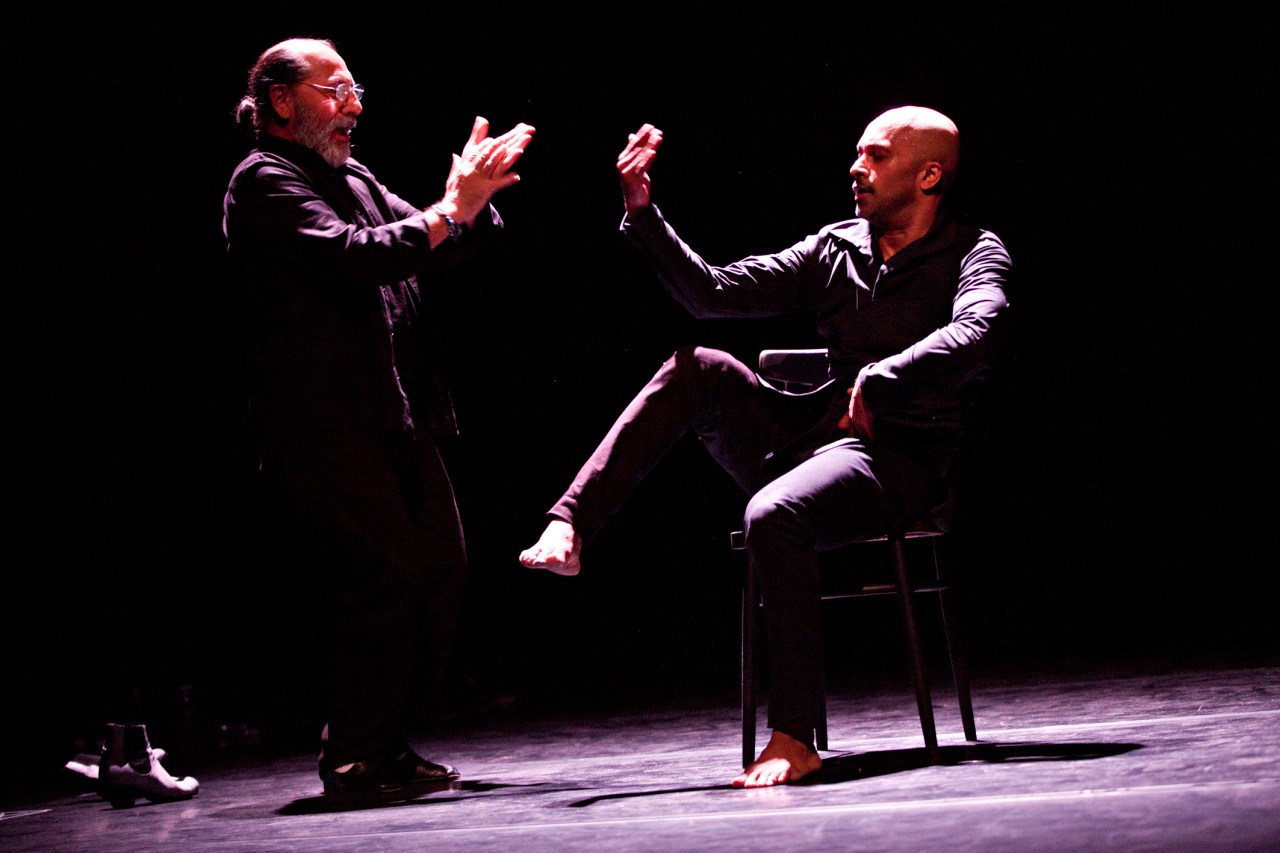
The two dancer/choreographers are the performance equivalent of an old married couple. Watching them interpret each other’s dance vocabulary  – Graham-esque modern in his case, Bharatanatyam in hers – is akin to witnessing a long-married husband and wife finishing each other’s sentences.

Emerging from the fog as the lights go up, the couple sits cross-legged, draped in a crimson Indian silk throw, facing each other, knees touching. Infectious laughter ripples through their shoulders, until Laberge-Côté buckles over in heavy sobs.  Stretching themselves out over the full performance space, they give a sense of the compass of this togetherness. A couple of times, standing in front of each other, their arms and a leg are manipulated to make the many-armed Hindu goddess Kali. A few words of dialogue (“without her he is nothing”) ground the idea of together-forever.

Akshongay, Laberge-Côté  and Bhattacharya’s first full-length show, was first performed in 2013. Repeated performances have allowed for development of the piece.  As Laberge-Côté related in their talk-back at the Citadel, the proportion of improvisation to set steps has altered considerably – in favour of improv – since the premiere of the duet.

The viewer senses the aliveness and spontaneity in the performance as the relationship between the two dancers morphs before our eyes.  Smiles and seriousness alternate with their transformations: she dons a sari, he puts on a jacket. Bhattacharya’s eyes establish the changing mood, from flirtation to seduction to confrontation. Dressing and undressing appears natural, in the flow of their rapidly changing movements.  A brief solo by each performer gives breathing room in the piece.

Each change of focus of the lights – Marc Parent’s lighting design is the only set element – brings a new vignette. As the dancers intertwine, with a focus on the breath, their coupling seems tantric, their unfurling in modern or Indian classical moves a delightful flowering.

Philip Strong’s music employs a French-Canadian fiddle motif for Laberge-Côté  and a tabla track for Bhattacharya that adds another narrative layer to this intensely moving piece. Water sounds enforce the notion of an ever-changing relationship.

Akshongay wouldn’t suffer from a trim of a few minutes, but as last week’s show proved, any opportunity for a remount only makes this work better.

Photo by John Lauener


Death – from chilly to silly

Cold Blood

By Michèle Anne De Mey,  Jaco Van Dormael and the Kiss & Cry Collective

Presented by Canadian Stage

Bluma Appel Theatre, Toronto

February 10 to 14, 2016


“It’s dark . . . you see nothing . . .you think you are in a theatre, but you’re elsewhere . . . 1, 2, 3 . . . You’re sleeping.” So begins a hypnotic stage show on the subject of the Big Unknowable: the afterlife.   “It’s chilly,” says the androgynous narrator of the first death  ̶  a stupid death. “You think maybe you should have brought a jumper.”

A follow-up to the Belgian company’s Kiss & Cry – a tough act to follow if there ever was one – the multi-media, finger-dancing production Cold Blood is not a disappointment.

Less transparent than its predecessor, the show opens with a jet plane travelling through a murky sky on the big screen.  As the screen slowly rises to reveal performers and crew at work, we see a model plane moving like a puppet on a stick in a tank of water cloudy with paint. As if in the process of making a radio drama, the production team is situated at different stations, the sound effect of a powerful storm coming from a drum hand-wound by a crew member. Director Jaco Van Dormael can be seen cueing and arranging, like the emcee of a three-ring circus.

This show is funnier too, thanks to Thomas Gunzig’s absurdist, voiced-over narrative. The first of seven deaths explored is stupid because he/she was the only fatality – having gone to the on-board toilet at the crucial moment.

Death can be gentle, violent, boring, unexpected, we hear.  The thing is, only in fantasies like Cold Blood does anyone get to tell about it. Never mind. The imagery of air travel – from the opening crash to the ending space launch enacted to David Bowie’s powerful  “Space Oddity,” stitches together the disparate scenes suggestive of heaven. Cars play a big role, most hilariously in the second death: by car wash. Two stagehands manipulate cylindrical feather dusters attached to drills, while Van Dormael  applies the big rinsing brush.  A window was left open and some part of the car-wash machinery is responsible for the catsup bloodbath that follows.

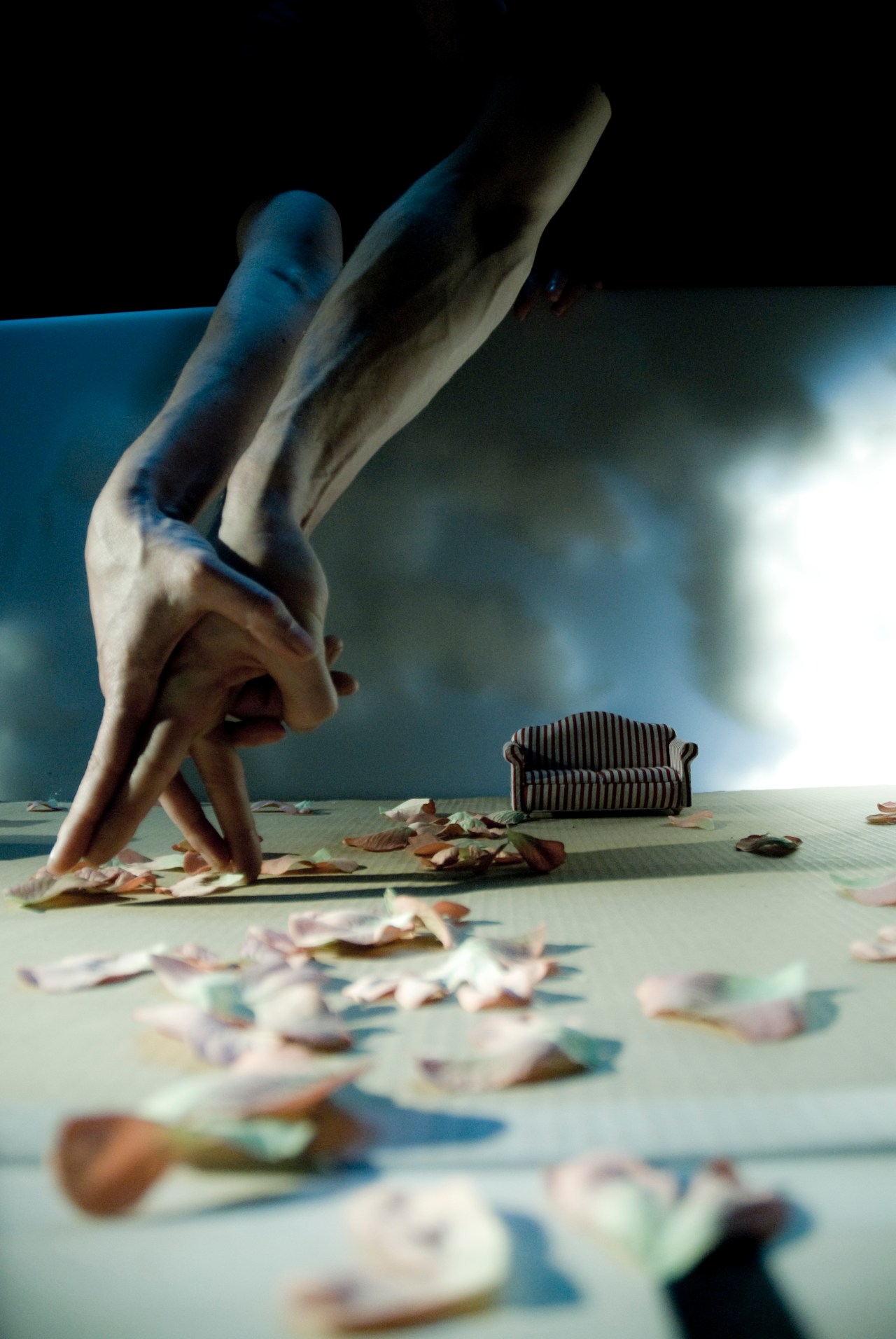
Cold Blood runs on the imagery and sound of popular film and music. Dance fans will love the 30s-style, tap-dance routine done on a glittering set with fingers in thimbles, not to mention the Busby Berkeley-esque  synchronized swimming number in which three pairs of hands with reflectors make beautiful kaleidoscopic moves through water. The hand doing a pole dance is pretty sexy too. Switching back and forth between the ridiculous (the latex glove worn by the astronaut hand) and the sublime (Anne De Mey’s sinuous solo seen through a window), Cold Blood draws our attention in many directions, including self-ward, when the audience gets its close-up in the klieg lights  ̶  through the curtains of a miniature stage where a finger-danced Bolero is performed.

All to say, another spectacle that shouldn’t be missed.


Big Mouth speaks volumes

Big Mouth

By Valentijn Dhaenens

SKaGen and Richard Jordan production

Presented by David Mirvish

East Vancouver Cultural Centre, Vancouver

February 11 to 21, 2016


A unique opportunity to witness the power of words from the mouth of a skilled performer, Big Mouth resumes its Canadian tour on Friday in Vancouver.

Working on his own to develop his first one-man show, Valentijn Dhaenens, a Belgian stage and screen actor, read more than a thousand speeches, going back to the ancient Greeks and forward to the 21st century. “I tried not to force speeches to relate to one another but simply put them in stacks hoping that one day they would start communicating with each other,” Dhaenens writes in his notes for the show.

The one-man show that emerged is not meant as political or social commentary. The associations that Dhaenens found between, for example Nazi minister of propaganda Joseph Goebbels and American general George S. Patton, urging their countrymen into war, make a fascinating demonstration of the art of manipulation. Big Mouth captivates not just by the words, which even unspoken retain their power, but by the way that Dhaenens chooses to replicate those speeches.

Intercutting between Goebbels and Patton, the actor delivers Goebbels’ incendiary words, in calm, hushed tones (“a cry of vengeance will arise from their throats making the enemy tremble with fear”) as if he were a university professor giving a lecture. Jumping to another mike, Dhaenens gives Patton’s crude words the full gestural treatment (“the very idea of losing is hateful to American men”), flinging his arms out like a cowboy at the rodeo.

The artist calls Big Mouth a “speech machine.” When it first played in Belgium, it was all in Dutch and delivered in lecture auditoriums where he had a long podium with microphones set up. The touring show reproduces this long table fitted with a variety of mikes from different eras and a screen above that works like a blackboard displaying the authors of the oratories he’s enacting.

Jumping up on the table to sit cross-legged, Dhaenens sends out a message from Osama bin Laden from 1996, making the el Qaeda kingpin sound as reasonable as any leader protecting his own territory. Musical interludes throw another element into the mix. As Dhaenens begins to sing into a microphone, say Vera Lynn’s “We’ll meet again,” light and sound designer Jeroen Wuyts, works the soundboard to loop Dhaenens’ crooning into a choral pattern. It’s all live.

In his Q&A following the 85-minute show, Dhaenens confesses that he has tried from time to time to substitute more recent oratory – Barack Obama’s among them – but such insertions upset the dynamics of the piece, which has no speeches more recent than 2007 (from Belgian right-wing nationalist/racist Frank Vanhecke). It’s easy to see how Big Mouth gained a life of its own, in which the audience makes its own associations. Near the end, for instance, we hear the words of Ann Coulter, American conservative commentator, sounding much more bellicose than the Republican president of the time, George W. Bush.

Even given the set script of Big Mouth, every show must be different, depending on the inflections Dhaenens gives to the languages – Dutch, German, English, French – of his delivery. Nicola Sacco’s 1927 Italian-accented wail to the court prior to his execution interacts with Socrates’ similar address, in a hoarse whisper, to his judges in 399 BC in a way that will strike each listener differently.

The magic of Big Mouth derives from its author’s first insight: how so much can be accomplished, how millions can be moved in a new direction, with the vocal chords and a small hole in a human face.


Kiss & Cry kisses and tells

Kiss & Cry

By Michèle Anne De Mey and Jaco Van Dormael

A Charleroi Danses production presented by Canadian Stage

Bluma Appel Theatre, Toronto

February 4 to 7, 2016

Toward the end of the magical 90 minutes of Kiss & Cry we learn the source of the title. It’s the name given by figure skaters to the bench behind the ice where anxious couples await their scores in international competition. The reference from Thomas Gunzig’s text for this highly innovative performance evokes the pictorial, musical and choreographic themes of Michèle Anne De Mey’s multi-media show – not to mention its happy-sad, profound-cheesy, tragic-melodramatic tone.

Kiss & Cry is like a visit to a movie set, a night at the cabaret and a live dance performance all rolled into one mezmerizing experience. Gisele, an elderly woman (represented as a tiny plastic figure) sitting on a bench at a train station, reflects on her lost loves. Her swirl of memories, from lover number one to lover number five, is danced by the agile fingers of De Mey and Grégory Grosjean as a crew of seven moves about to set up scenes, light them and shoot live video projected on the wide screen above. From the audience we take it all in, both the production-in-progress and the screen projection animated by a soundtrack ranging from classical lieder to schmaltzy pop songs, such as “Autumn Leaves,” to techno buzz.

The mystery is that there is so much mystery surrounding a production that reverses the usual behind-the-scenes action to put it in the foreground. Gradually it becomes clear that those seven people manoeuvering underneath the lighting armature between the dolly track, the tables and toy train sets are as much the performers as De Mey and Grosjean.

Kiss & Cry trades in metaphor, the toy trains providing the requisite imagery of romance, the use of sand going down a shoot or shifting with the tides accompanying the narrative of memories lost or regained, tormented or blissful.

Director Jaco Van Dormael, De Mey’s spouse and artistic collaborator, brings a film director’s eye and a clown performer’s whimsy to the show. And it’s not just in her expressive finger movements that De Mey reveals her dance pedigree. (A graduate of Maurice Béjart’s Brussels dance school Mudra, she began choreographing in the early 80s and worked with Belgian choreographer Anne Teresa De Keersmaeker for six years, notably on De Keersmaeker’s renowned Rosas danst Rosas.) She is a beautiful mover and paired, literally hand-in-glove, perfectly with Grosjean.

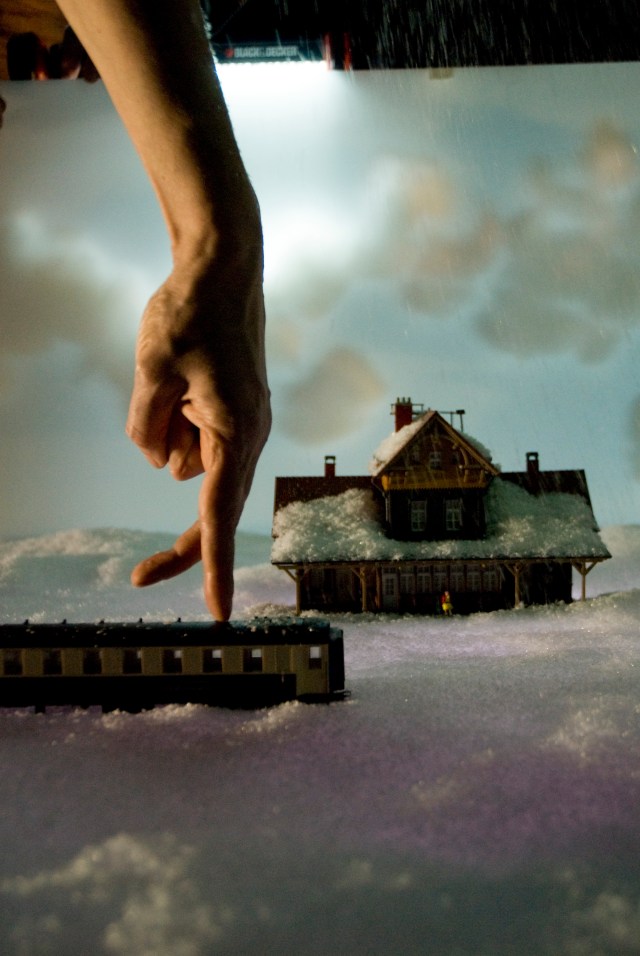
There’s a hilarious scene done with fingers moving in mirrored sync that recalls Momix and manages to mimic a figure clutching his genitals. Four-fingered pas de deux shift from the sublime to the obscene with the flip of a digit – or the removal of a glove finger. Some gorgeous scenes of tiny figures in snow – so obviously shot by on-set camerawoman Aurèlie Leporcq – are nevertheless transporting. And as for the reveal of a man making the shape of a sand dune, one is still baffled as to how it could have been pulled off before our watchful gaze.

Gunzig’s voice-over narrative careens easily from the poetic to the banal, providing as much fake poignancy as truly moving moments. “Love evaporates like water,” it goes, or “memory was a lover who never deceived,” or “love affairs are like cheese graters – great for cheese, but not much else.”

And that’s not all: Kiss & Cry is the set-up for next week’s North American premiere of the collective’s Cold Blood, a co-production with Canadian Stage. It would be useless to speculate on their next move.


Kiss & Cry 5 - Maarten Vanden Abeele

Another fabulous Baker girl

phasespace

Peggy Baker Dance Projects

Betty Oliphant Theatre, Toronto

January 22-24 and 27-31, 2016

The heroine of Friday night’s performance of phasespace was Sahara Morimoto, who not only beautifully performed in a trio and a solo, but stepped in on very short notice to take the place of an injured Sean Ling in a duet with Andrea Nann.

Much was made, in the before-show chat from Baker and Fides Krucker, of the vocal scores that Krucker composed from the dancers’ own pre-verbal and non-verbal sounds. The voice, Baker maintained, provides a direct link to the performer’s body and to the audience. But it was Morimoto’s silent solo that was the highlight of the night.

In the noisiest piece, the trio performed by Ric Brown, Sarah Fregeau and Morimoto, there was little sign of the narrative that Krucker had seen forming while working with the dancers. Three sets of standard straight-backed chairs, one human-sized the other a miniature, made an aimless allusion to Alice in Wonderland. The dancers came and went and moved themselves and the chairs through space. John Kameel Farah, perched above and behind the dancers played and improvised acoustically and electronically on the piano and computer keyboards, but did not seem a part of the piece as he did in last year’s Baker show locus plot. Marc Parent’s well designed lighting defined performance spaces. All of these elements should have added up to a unified piece, but it was hard work to find coherence in this piece.

Morimoto was a character shaking with the giggles, a high tittering sound. Brown was a howling dog. Fregeau careened about and each of them phased in and out of a whispered chatter that had no obvious connection to their movement. Such distractions took away from the well-rehearsed dance steps.

In Baker’s introduction to the show, she referred to a starting point: recognizing her own choreography in the body memories of her dancers. When it came to the Morimoto solo, first mounted in 2013, we could see Baker’s vocabulary, alive and present in a dynamic way. The Tokyo-born dancer, who has worked with Baker since 2008, displayed the long, wind-milling arms, the precise hand gestures and the fluid, almost flying movement that have long been Baker’s hallmarks. Inside a diamond shape etched in blue light, Morimoto created a world of her own. It was a simple, abstract solo, a purity of movement expressed through facial and body gestures as only dance can do.

Andrea Nann added a new element to the gallery of dances. Not only is she a fine interpreter of Baker’s dance; she is an established performer of her own choreography. In the duet that Baker made on her and Ling in 2014, Nann’s prolonged, sinuous movements made a kind of dance alchemy.

Kate Holden, who has been a fine interpreter of just about every contemporary choreographer of note, performs the new Baker solo, also vocally scored by Krucker. Her performance stretched the boundaries of the space and she broke out of her invisible box with long, slow strides and a final winding-out, a Ginsbergian howl that seemed to come from some place deep within her.

CREDIT: Sahara Morimoto in a solo, one of four dances in phasespace. Photo by Jeremy Mimnagh


Fun with philosophers

6. Germinal - Photo by Be a Borgers

Halory Goerger, Ondine Cloez, Denis Robert and Arnaud Boulogne in Germinal.                 Photo by Be a Borgers


Germinal

By Halory Goerger and Antoine Defoort

L’Amicale de production at World Stage

Fleck Dance Theatre, 231 Queens Quay W., Toronto

January 20 to 23, 2016


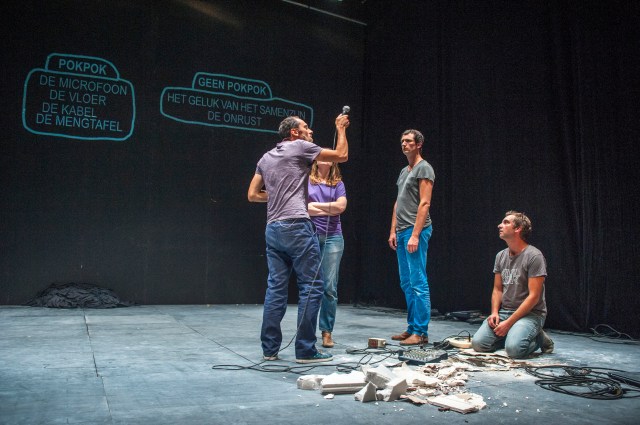
In the beginning there was darkness – black – but for a pool of dim light in the middle of the stage. Germinal is a creation story for the theatre. Slowly, lights come up on some dim shapes on stage: performers Halory Goerger, Arnaud Boulogne, Ondine Cloez and Denis Robert. Each is concentrating on a handheld computer, connected with a long wire to the wall of the black box they inhabit.

As tall, thin Halory strolls around the stage, stroking a key on his keyboard, his thoughts take shape in white letters beamed from a surtitle panel high on the back wall. In a Eureka moment, he draws Ondine to his discovery: thoughts transferred with the click of a key. Ondine’s thoughts are manifest on a second surtitle panel. They beckon to the other two – a sulky Arnaud and insular Denis —  to join them. Soon words, whole sentences are flashing on and off at the speed of dialogue, as the characters begin erecting the structure of a play, starting with a system of communication.

If Jacques Derrida ever gave a lecture in the form of a song and dance show, it might have looked something like Germinal.

After all this intellectual to-ing and fro-ing, Ondine literally chews up the scenery. Approaching a section of the stage with a pick-axe, she begins to tear it up, creating a hole and a pile of rubble. Arnaud pulls a microphone out of the hole and becomes the mouthpiece for more exchanges, each character now speaking French, but with their words displayed in English. The microphone sound “poc poc” becomes a system for categorization: items and concepts are listed under “poc poc” and “non poc poc”. A laptop from the hole gives the world according to Windows: a menu allows a projection of a hill, a mountain, a swamp on the back wall. The scenery is described as an overlay on top of the wall.

Voices are raised – the letters grow bigger – and then comes choral singing.  Voila! Opera. Germinal manages to be at once highly cerebral and physically, noisily concrete, thought-provoking and laugh-out-loud funny. The production, thanks to a combination of advanced electronic effects and an old-school piece of stage trickery, is dazzling. But nothing happens.

Nothing except for a long, joint effort to describe a series of events occurring in space over time – the objects, the action and duration reduced to a chronological graph that marches across the back wall as words writing themselves on a blackboard.

Timing in theatre is everything: this show has bits we’ve never seen before. Without a trace of artificiality, four performers and almost as many lighting technicians mount a play that is a philosophical argument to totally captivate an unsuspecting audience.


Swirling in the glass


Within The Glass, Tarragon Theatre

Paul Braunstein, Philippa Domville, Nicola Correia-Damude and Rick Roberts in Within the Glass. Photo by Cylla von Tiedemann

Within the Glass
By Anna Chatterton
Tarragon Theatre, Toronto
To February 14, 2016

Dashed expectations might be two words to sum up the well-made play that Anna Chatterton has written about two couples struggling – in four different directions – over an in vitro fertilization gone terribly wrong.
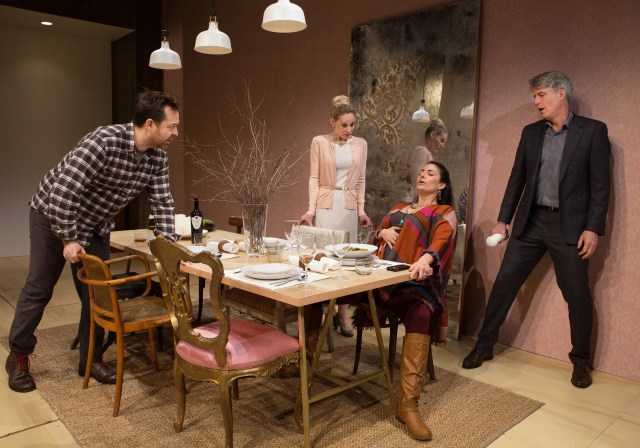
Upwardly mobile, in fact very much arrived, Michael and Darah are on tenterhooks in their perfectly appointed living/dining room, anticipating the arrival of a couple they’ve never met before. Scott and Linda, poet and artist, have it seems been given the wrong petri dish and now Linda’s bearing a foetus that is legally not her own. Scott and Linda’s embryo didn’t prove viable in Darah’s uterus – nor did the previous five fertilized eggs of her own. What is to be done?
The scenario sounds like the set up for a debate on reproductive rights, but Within the Glass is a lot more dynamic than that. It’s a black comedy of manners with many tragic elements. Ravenous eating is the central metaphor in a performance in which all are hungering for something they’ll never get.
In structure reminiscent of Who’s Afraid of Virginia Woolf, this parlour drama directed by Andrea Donaldson defies audience expectations at every one of its many turns of mood, as if both men and women were running wild on hormones. Julia Fox’s detailed set and costumes reinforce the theme of how our animal natures lie just below the surface of civilized behaviour and confound our drive for order, fairness and decency.
A bearded Paul Braunstein plays Scott, a gruff guy with the unlikely occupation of renowned poet. He makes it clear as he enters with his pancho-ed wife Linda (Nicola Correia-Damude), the glow of pregnancy full upon her, that he hasn’t come for a social occasion. A suave, Rick Roberts in bespoke suit is Michael, the investment banker who assures his careerist wife Darah (Philippa Domville) that he can make a deal and they will get the baby they’ve been longing for.
Over the 90-minute course of highly physical theatre all four characters exit and enter, switch and shed their stereotypes, revealing themselves to be driven by nothing but self-interest. The show is staged like a mad minuet.
Linda sets the action in motion by announcing she wants to keep Darah and Michael’s baby; she is after all, carrying it. This is unwelcome news to Scott who thought they’d decided to abort. Dinner, arranged so fastidiously, from the scotch and tzatziki (“all the way from Greece; we like to support the local shops”) to the capon (“Linda’s a vegetarian”) never does get properly served as husbands and wives turn on each other and reveal hidden facets of themselves, such as Michael’s way with a foot massage for another man’s wife.
The words “foetus” and “baby” become loaded missiles hurled across the floor, as men become mothering and women go on the attack. This is a play about identity turned into a game of musical chairs, but the stakes are high and it is never clear whether anyone comes out a winner.


Cracking good Nutcracker

The Gift of the Nutcracker

Paul Destrooper story and choreography

Ballet Victoria

Cowichan Performing Arts Centre, Duncan

December 12, 2015

Royal Theatre, Victoria

With the Victoria Symphony

December 27 to 29

Imaginative, funny, well performed, unexpected – The Gift of the Nutcracker, Ballet Victoria’s twist on the Christmas classic, is everything a parent and her dance-mad children could wish for. Without a multi-million-dollar budget to provide all the bells and whistles of, say, the National Ballet of Canada’s Nutcracker, artistic director Paul Destrooper engages audiences with a Pandora tale of a gift box that should not be opened, but when it is, lets loose chaos in the family home.

Destrooper himself anchors the production as Uncle, the traditional Drosselmeyer, who is a magician who can’t  ̶̶  to much laughter – seem to get his act together. His magic handkerchief gets stuck up his sleeve and then he blows his nose on it; his efforts at orchestrating the Christmas tree decoration are less than adequate. Anna Hulbert in the role of Pandora – Clara in the original Nutcracker – is a lithe and lively dancer whose performance provides the thread through the story. When she opens the red box, out come the creatures that upset the Christmas festivities: navy blue and yellow-clad Minions, a long line of pot-bellied mice and a snaky Chinese dragon. Uncle summons Princess Elsa (Snow queen) to put a freeze on the situation. Eventually, the creatures are induced to return to the box (a bookcase is transformed into a human-sized gateway).

Surely no other Nutcracker on earth features a musical interlude of Dave Brubeck’s “Take Five” in the Christmas Eve dances. Bruce Monk choreographed the unusual 5/4 score such that the viewer hardly notices the steps deviating from the 4/4 dance signature. In Victoria, conductor Guiseppe Pietraroia will drop his baton and take up a saxophone to play the Brubeck jazz classic.

Destrooper’s versatility as choreographer ensures that the familiar classical ballet steps are well integrated with more contemporary forms. Victoria Ballet’s Andrea Bayne leads a cast of accomplished dancers. She is an elegant, long-armed Princess Elsa/Sugar Plum Fairy. Guest artist Yui Watanabe from Japan makes a snappy Nutcracker Princess in full uniform/tutu. BC native Jessie Gervais is a well rounded performer who does double duty as Pandora’s father and Jack Frost. Matthew Cluff, also BC-born, partners Andrea Bayne with aplomb. Japanese guest artist Risa Kobayashi shows clean lines in several roles, including Pandora’s mother. Ottawan Luke Thomson does a lovely turn with Risa Kobayashi in a closing pas de deux.

Lighting, projection and costume designers Roger Traviss, Jason King and Jane Wood earn full marks for this production, in which ingenious lighting and projections make for very effective backdrops and magical transformations and detailed costumes show off the dancers’ prowess.

BC dance fans must be grateful for this pocket ballet company that outpaces many small companies. Ballet Victoria is one of only five professional companies in Canada that offers five programs a year, Destrooper’s Gift among them. The show has all the makings of a Christmas tradition.

Above: Scenes from A Gift of the Nutcracker. Photos by Gail Takahashi