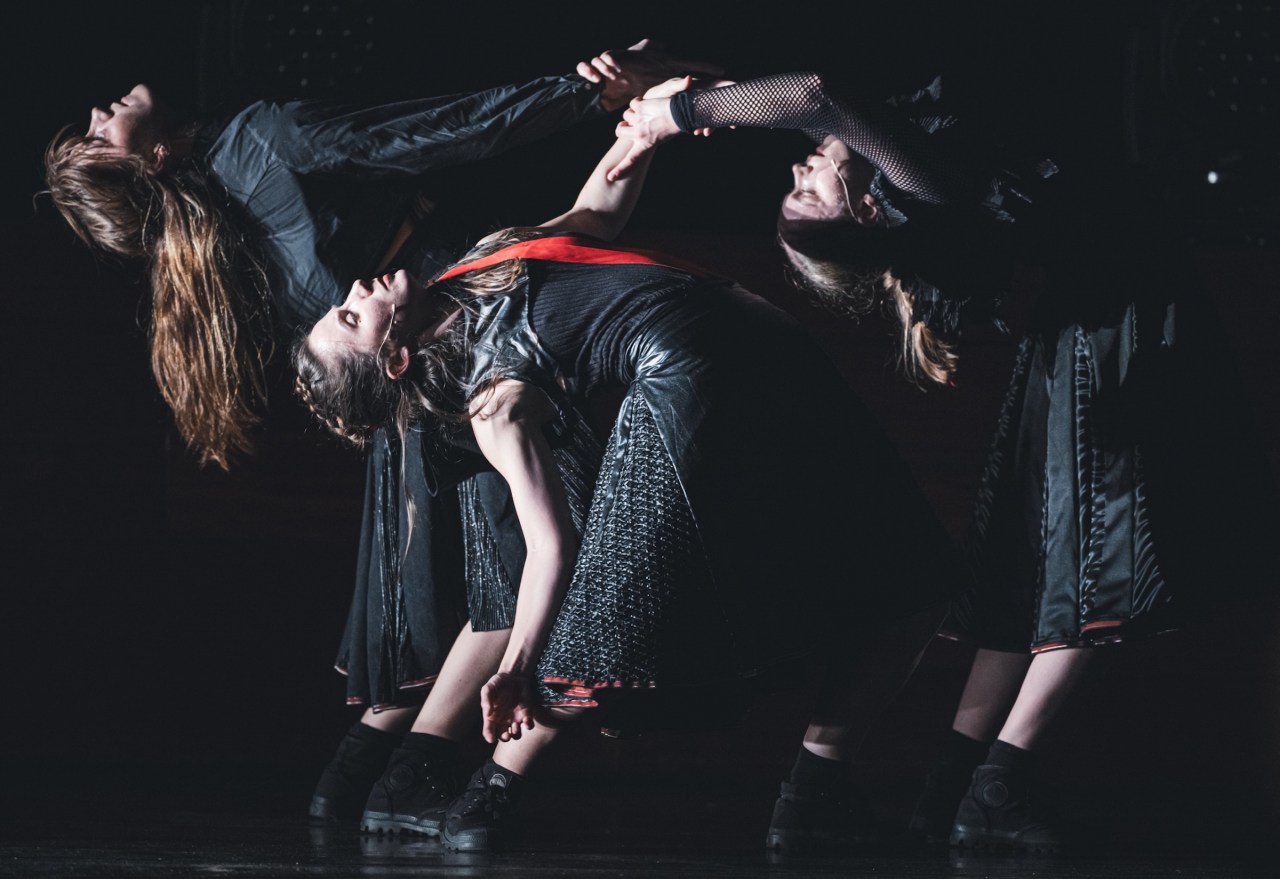
Rosencrantz and Guildenstern Alive, Revived and Hilarious

Billy Boyd and Dominic Monaghan lead a stellar cast in a fine production from Halifax’s Neptune Theatre that is a joy to behold and as bracing an engagement for the mind and the funny bone as one is likely to find on stage this season.

First performed in 1966, Tom Stoppard’s absurdist, existentialist play, running at the CAA Theatre until April 6, is as delightfully playful and funny as it ever was, yet newly challenging of our perceptions and our understanding of the uses of theatre.

It’s not as if director Jeremy Webb simply took the play out of mothballs. He enlivens and enriches Rosencrantz by casting experienced and agile actors and giving them plenty of physical activity, music and song. Set designer Andrew Cull’s ingenious use of a pair of movable bleachers makes the transitions in and out of the play at hand and the play performed by the tragedians in William Shakespeare’s Hamlet seamless.

Rosencrantz and Guildenstern Are Dead is above all else a comedy, full of snappy dialogue, wordplay and philosophical badinage. It is also makes a lively commentary on the purpose of theatre, life and death and the whole business of existence and

Webb’s casting of the wondrous Scottish actor Billy Boyd (Pippin in the Lord of the Rings trilogy) with his Lord of the Rings cast mate, the prominent television actor Dominic Monaghan, is the making of this production. This Guildenstern and Rosencrantz, lifted out of their minor roles in Hamlet to become Stoppard’s protagonists, are post-modern versions of Samuel Beckett’s Vladimir and Estragon, passing the time with verbal game-playing and like any of Shakespeare’s clowns and commentators, as nimble of foot as they are of tongue:

ROSENCRANTZ: We might as well be dead. Do you think death could possibly be a boat?

GUILDENSTERN: No, no, no…Death is… not. Death isn’t. You take my meaning? Death is the ultimate negative. Not-being. You can’t not-be on a boat.

ROSENCRANTZ: I’ve frequently not been on a boat.

The curtain comes up on the two of them sitting on bleachers playing at coin tossing in an impossible sequence of flips in which every one of 76 tosses has resulted in heads. The theme of chance and fate and is firmly established. Also, the idea that that it’s only a thin veil that separates concrete reality from make-believe. Behind Rosencrantz and Guildenstern, through a flimsy black curtain we can see figures on bleachers viewing the coin tossers as if they were giving a performance, which of course they are.

Enter the Player, performed by Stratford veteran Michael Blake, a magisterial, yet often regretful, leader of a pack of tragedians – those who perform The Murder of Gonzago in Hamlet – but also the chief roles of Hamlet (a powerful Pasha Ebrahimi), Polonius (Walter Borden), Ophelia (Helen Belay), Gertrude (Raquel Duffy), Claudius (Jonathan Ellul) and others.

It’s all a delightfully complicated, an ironic display of theatricality and the play of language (“Words, words. They’re all we have to go on,” says Guildenstern. “Rhetoric! Game and match!” rejoins Rosenkrantz.)

Entertaining, enlightening and absurdly absorbing.

Rosencrantz and Guildenstern Are Dead

By Tom Stoppard

Directed by Jeremy Webb

Movement director Angela Gasparetto

Set designer Andrew Cull

Lighting designer Leigh Ann Vardy

Sound designer/ composer Deanna H. Choi

Produced by the Neptune Theatre

Presented by Mirvish Productions at the CAA Theatre in Toronto until April 6, 2024

Photo by @stoometzphoto: Dominic Monaghan as Rosencrantz, Billy Boyd as Guildenstern

Gallery

Alice’s Adventures in Wonderland a phantasmagoria to behold

Lewis Carroll’s Alice’s Adventures in Wonderland is a story of the precisely rational overturned by the absurd. It’s a delightful fantasy fit to charm the young yet satirically entertaining enough for parents seeking to decode its characters and plot.

And so goes Christopher Wheeldon’s adaptation of the 1865 novel. A full-length three-act show that breaks the mold of the romantic story ballet, it was co-commissioned by the Royal Ballet and the National Ballet of Canada and premiered on both stages in 2011.

Running throughout March Break, the National Ballet’s latest staging of Alice plays to the max to both sides of our brains, the cerebral and the emotional, with a tremendous cast of dancers supported by David Briskin’s rousing direction of the ballet’s orchestra playing Joby Talbot’s brilliantly innovative score.

Wheeldon had not made a full-length story ballet when he tackled Alice’s Adventures, an audiotape of which he’d listened to repeatedly as a child. Knowing it would be impossible to condense the whole plot into a traditional ballet format, he seized on the vivid characters, the humour and the imagery of Carroll’s book to fashion stunning, often zany dance tableaux. Talbot’s score carries the narrative arc.

Wheeldon chose Talbot as a co-creator, because coming from a background of scoring films, he had transitioned to dance with majestic soundscapes for works by Wheeldon and the Royal Ballet’s Wayne McGregor. “He created these unusual, shimmering orchestral colours that to me felt absolutely like the right direction for Alice’s Adventures in Wonderland,” says Wheeldon.

Talbot’s score illuminates the two worlds that Alice occupies and foregrounds the many transformations that occur in the ballet.

The opening of scene takes us into the upper-class 19th-century, ordered environment of Henry Liddell, Dean of Christ Church, father to daughters Lorina, Alice and Edith. Lewis Carroll, a mathematics professor and friend of the family reads to the girls and performs magic tricks, as tea is served on the lawn amid a game of croquet. Enter Jack, the gardener’s boy, a friend of Alice’s, who offers her a rose clipped from Mrs. Liddell’s sacred rosebushes. Alice in return gives him a jam tart. An enraged Mrs. Liddell pounces on Jack, accusing him of theft and dismissing him from the party.

Talbot describes the musical motif he found for Wonderland as “a strange, shifting bitonal music – a restless ticking clock.” This emphatic tick-tocking percussion also signals the plunge from Alice’s above-ground, secure family life into a dark netherland, where one pill makes you larger and one pill makes you small.

Bob Crowley’s ingenious graphic projections on the changing scrim take Alice down the black hole, following Caroll, now transformed into the White Rabbit, through a glowing jelly mould on the tea table into Wonderland. As the projections of doors on the scrim grow bigger or smaller, so does Alice with each substance she consumes, appear diminutive or gargantuan, against her graphic background.

The score makes Alice an active protagonist and not just an observer of events. She’s chasing the white rabbit, following the smoky messages of a hookah-smoking caterpillar, keeping up with a manic tap-dancing Mad Hatter (the dramatic Ben Rudisin) and encountering a wild-eyed, puppeteered Chesire cat made up of parts that come together and fall asunder.

Tirion Law, with her quick-silver steps and seamless transitions from sheltered girl to able adventurer, strikes just the right balance between portrayal of a child and a sophisticated guide to her wonderland. She and Naoya Ebe as Jack/the Knave of Hearts make a beautiful pairing, especially in the climactic pas de deux.

Talbot gave several of the main characters a musical signature. Donald Thom, a formidable shapeshifter who doubles as Lewis Carroll and the White Rabbit, comes on to the strains of the celesta. Peng-Fei Jiang, in a sinuous solo as the Caterpiller, dances to a middle-eastern-sounding oboe d’amore piece.

Svetlana Lunkina gives an hilarious character portrayal as Alice’s mother, reappearing as The Queen of Hearts. She’s a neurotic, controlling hostess and mistress of ceremonies spoofed by her King, Rex Harrington in one of the campiest, funniest performances of his late career. Talbot gives the queen a tango to perform and themes her with a semi-tone sharpened solo violin to indicate her high-strung nature.

Wheeldon and Talbot pay such attention to the telling detail – the backwards-running hands of a huge pocket watch dangling over Alice’s adventures in a surreal landscape representing many a childhood fear, hangs overhead accompanied by cacophonous, dissonant musical crescendos – that the audience willingly suspends disbelief to enjoy outstanding dancing mixed with a little delirium.

Alice’s Adventures in Wonderland

Choreography  Christopher Wheeldon

Music  Joby Talbot

Scenario  Nicholas Wright

Set and costumes  Bob Crowley

Performed by the artists of the National Ballet of Canada

At the Four Seasons Centre for the Performing Arts, Toronto

March 6 to 17, 2024

Trailer: Alice’s Adventures in Wonderland | The National Ballet of Canada (youtube.com)

Photos by Kira Kuras, from left: Tirion Law and Naoya Ebe as Alice and the Knave of Hearts; the Dormouse, Alice, The Mad Hatter and the March Hare; Donald Thom as the White Rabbit, with Tirion Law. Courtesy of the National Ballet of Canada

The Answer lies in Sami Culture

The answer is land, but what is the question? Perhaps: how can we continue to exist on our ever-shrinking territories and preserve our culture on traditional lands heavily beset by global warming?

Sámi choreographer Elle Sofe Sara articulates it better. About Vástádos Eana/The Answer is Land, opening tomorrow at Harbourfront’s Fleck Dance Theatre, she says, “It’s about inviting the audience into a state where we are all here together. The [performers] are standing equally on the same ground and we take the audience on a journey, one that is based in spirituality.”  

The Answer, created in 2021, is about kinship and the shared sorrow of the Sámi people, colonized for decades, herded into residential schools like the indigenous peoples of Canada, their language and culture suppressed, their Sápmi territories drastically reduced.

Today, the approximately 2 million Sámi peoples, historically occupying the land for about 12,000 years, are confined to lands in the northern tips of Norway, Sweden, Finland and the Kola Peninsula in Russia.

Elle Sofe Sara’s prize-winning show is a celebration of the still thriving Sámi culture and a defiance:  the dancers are literally standing their ground in the face of a global crisis.

A special aspect of the show is the result of collaborating with southern Sámi yoiker and composer Frode Fjellheim, best known on this side of the pond for the adaptation of his 2002 song “Eatnemen Vuelie”, as the opening number for the animated film Frozen.And what is a yoik, you say? Check YouTube and you’ll see a Laplander in traditional dress, softly pounding an indigenous rhythm on a skin-drum while singing songs remarkably similar to those of the British Columbia coastal peoples.

The seven dancers in the show, all women, and some Sámi, perform Fjeillheim’s polyphonically arranged songs in during the show, creating a complete aural and kinetic sphere of Sámi origin. As seen in the trailer, the dance, with its ritualistic movement, is reminiscent of Jean-Pierre Perrault’s 1983 breakthrough show, Joe, which also invited the audience into the bodies of the dancers on stage to share in their unity of purpose.

Sara is known for her globe-trotting creations and has been to Canada before, once performing for the Arctic Winter Games when they were held here. Last year her company performed The Answer in Montreal. Born in the Norwegian villageGuovdageaidnu, she never saw professional dance on stage, but somehow by 16, she knew dancing was for her. Getting dance training, she says, “Opened up a whole new world for me” and was the spark for a life of creation. She holds a master’s degree in dance and received dance training at London’s Laban Trinity School. She’s also an accomplished filmmaker, whose works have appeared on the slate of the Imaginative festival. When not touring Sara lives in the village of her birth, with her partner, a reindeer herder.

As the jury said, in awarding Elle Sofe Sara the 2023 Telenor Culture Prize, “Elle Sofe Sara is an artist who really transcends boundaries. She is a choreographer, a director, and a filmmaker – and to all her productions she brings a lot of playfulness and curiosity as she continues to combine different elements to great effect. She is unafraid to challenge established ideas about the limitations of the performing arts and remains eager to explore new ways of engaging with her audiences.”

Personally, I’m keen to join those viewers

The Answer is Land

Choreography Elle Sofe Sara

Composer Frode Fjellheim

Costume design Line Maher

Set Elin Melberg

Lighting Øystein Heitmann

Toronto premiere runs in the Fleck Dance Theatre, March 6 and 7

See The Answer is Land trailer here: https://vimeo.com/724070129

A rousing play to celebrate Maryusa Nikiforova, martyred Ukrainian anarchist-resister of her day

It takes an anarchist to know one. And it took Norman Nawrocki, Montreal playwright, musician, novelist and anarcho-artist-activist to create MARUSYA NIKIFOROVA: Ukraine’s legendary anarchist warrior. First mounted in 2023, at the 16th annual Montreal International Anarchist Theatre Festival, the one-act, 30-minute play is screening on YouTube until March 8, International Women’s Day, as a fundraiser for the Ukrainian resistance – feminists, environmentalists, anarchists and activists, working on the frontlines against Russian invaders and occupiers.

You can take in the teleplay on Nawrocki’s YouTube channel here: https://youtu.be/Lv05Vd9n1iY and watch for the prompts in the show credits to donate to the Ukrainian resistance group Solidarity Collectives.

Maria Hryhorivna Nikiforova (1885–1919), better known as Marusya, was born in Oleksandrivsk — present-day Zaporizhzhia — a strategic location on the banks of the Dnieper River. Maryusa’s father had fought as an officer in the Russian-Turkish war of 1877-1878. After leaving home at 16, the androgenous teenager (actually intersex) found whatever work she could to support herself and wound up on a factory floor washing bottles in a vodka distillery. Taking up with a communist anarchist group, Maryusa engaged in terrorist acts against the Russian empire, including bombing, expropriation of property and armed robbery.

Imprisoned in 1908, she served time in exile in Siberia, incited a prison riot and once released, joined the international anarchist movement, saw action with anarchists in Spain, enlisted with the French Foreign Legion and fought on the Macedonian front against the Russian empire.

The outbreak of the 1917 Russian revolution forced Nikiforova back to Oleksandrivsk (Aleksandrovsk), where she took up active combat against the Bolsheviks, collaborating with other anarchist/soldiers to form the Ukrainian Peoples Republic of Soviets. She stole from the rich to support the poor, led armed militia into battle and was a chief resistor of and terrorist toward the Bolsheviks and later the White army. Nikiforova even accepted a mission to assassinate Alexander Kolchak, Supreme Ruler of Russia.

Maryusa’s heroic, ceaseless fight to defend Ukrainians against the Russian state stands as profound inspiration for the Ukrainian armed forces and the brave civilian resisters acting against the ongoing Russian assault on their country.

She and her Polish anarchist husband Witold Brzostek were arrested on August 11, 1919 in Crimea, where they had planned to assassinate the White army’s commander-in-chief Anton Denikin. Court-martialed and sentenced to execution by firing squad, they were both shot to death, Nikiforova first having tearfully bid her husband good-bye.

Nawrocki, himself of Ukrainian-Polish descent, has created a stirring, succinct, one-hander, employing an overhead voice as narrator and projections of archival photos to set the scene. His star, Ukrainian actor Mariya Hadubyak, a Montrealer since her immigration to Canada in 2022, performs with the Ukrainian troupe Sozhary. She gives life and soul to Maryusa under Nawrocki’s spirited direction. Vancouver-based musician and composer Vivian Nawrocki (Nawrocki’s sister) created the soundtrack. Producer Babushka Theatre is a Montreal theatre laboratory dedicated to the staging of Ukrainian-Canadian[1]Polish plays.

The YouTube run ends March 8; time enough to show our solidarity with the Ukrainian resistance.

MARUSYA NIKIFOROVA: Ukraine’s legendary anarchist warrior

Written and directed by Norman Nawrocki

Performed by Mariya Hadubyak

Soundtrack by Vivian Nawrocki

Produced by Babushka Theatre

Screening on YouTube until March 8 at https://youtu.be/Lv05Vd9n1iY

For more information about the Ukrainian resistance, go to https://www.solidaritycollectives.org/en/main-page-english

Photo: Mariya Hadubyak as Maryusa Nikiforova in Paris, 1912-13, where she met with international anarchists and Russian exiles.

Stephen Bigsby 1946 – 2024

My friend Stephen Bigsby was a remarkable person. It’s not often you find kindness, supreme intelligence, generosity, political astuteness and laugh-out-loud quick-wittedness in one man. I knew Stephen for most of my life, because his sister Gail was my best friend from grade 1 at Monterey elementary school in Oak Bay, BC.

Meeting the Bigsbys and spending much of my early years at their grand home on the corner of Beach Drive and St. Patrick Street, exploring tide pools on the rocks or dunking in the chilly waters of McNeil Bay, was for me a formative experience. Harry Bigsby, a superintendent of music for the Victoria School Board, oversaw a school program that ensured several generations of Victoria students got a sound musical education. Tall and handsome, and sometimes a little formidable, Harry, unlike most other dads in the 1950s actively engaged with his children and their friends. His American wife Dorothy, whom he met in the music faculty at the University of Washington, was a beautiful singer. She was the cool mum–full of fun, an avid golfer, outgoing and happy to chat with her children’s friends. She was the rare ‘50s mum who had a job, notably in the Hudson’s Bay Company’s record department during the Elvis era. Dorothy was the mother some of us wished our mothers might emulate.

Jim was the eldest. Five years older than Gail and I, he was a high school Somebody when we were still in bobby socks and saddle shoes. After graduating from the University of Victoria and Simon Fraser, Jim developed a business designing and implementing innovative educational materials. An enthusiast of the best kind, Jim was a musical force in Victoria. For decades he directed the Goward House Singers, a choir I joined in 2009, much to my benefit, for Jim was a gifted conductor, educator and orchestral arranger. Tragically, we lost Jim on January 20, only 13 days before his brother Stephen’s death from cancer on February 2, his exuberance stolen by vascular dementia. But that illness never robbed Jim of his expansive spirit, his brilliant smile and magnetic good looks. He leaves his wife Suzanne, steadfast and loving throughout Jim’s final years, son David, daughter Caitlin and their families.

Stephen, only 20 months older than Gail, was from his early teens a force to be reckoned with. He could be highly entertaining: joking, clowning and firing off zingers. Or he could be laser-focused on scholastic achievement, with a drive that saw him and his Oak Bay High School teammates win the BC Grand Champions title on Reach for the Top in 1964. The Bigsby household was not like mine. Here people laughed, joked and debated, expressed their feelings and followed their passions. Stephen was especially adept at debate. From high school, he was marked out for leadership — in politics, diplomacy and executive management.

Gail, lest we forget, was the little sister who more than held her own with her brothers, a talented artist and musician, and a champion golfer. She and I were friends, teammates and rivals on the honours list. We also got up to plenty of no good, starting from puberty. Gail was always the first to try anything forbidden or exciting: she made me do it.

As a first-year student at UVic, I re-encountered Stephen, in his capacity as the 1966-67 student president. He took on the role like the governor of a minor state. He encouraged me to apply for a Canadian Union of Students exchange scholarship that took me to Toronto for a mind-expanding year at York University. I was proud to join Stephen and his friends, including a previous UVic student president, Paul Williamson, at a weekly discussion group held in a downtown Victoria sauna bathhouse. The group was called the Socrates Society, if memory serves. Serious socio-political discussions took place as we sat in our bathing suits and damp towels. Although, it must be admitted, Paul and I also had less erudite pursuits in mind.

Stephen was a most educated man. In addition to a BA from UVic, he held an MA in political science from Carlton University and did a post-graduate year in economics in Stockholm, where he learned Swedish. On top of that, he earned an MBA at Université Laval, becoming a fluent French speaker. These studies were a methodical preparation for Stephen’s application to join the Canadian Trade Commissioner Service, where he worked in Ottawa and then secured an appointment to the Canadian consulate in Milan, Italy.

The fates served up the perfect match for Stephen, in the person of Elisabetta Recchi, a sharp-witted, well educated and cultured Italian, whom he hired to work in the trade commission office. Before long Stephen and Elisabetta were married. When they moved to Montreal in 1981, Stephen became Senior Industrial Commissioner (Europe) for Metropolitan Montreal’s Economic Development Agency. Elisabetta joined the RBC Financial Group, a move that eventually elevated her to the RBC executive committee. By 1997, Stephen and Elisabetta had moved to Toronto, where Stephen held the positions of vice-president at the Canadian Commercial Corporation and executive director at the Association of Canadian Pension Management.

After retirement, the couple travelled extensively, hopping between homes in Toronto, a condo in Victoria’s Swallows Landing and Elisabetta’s haunts in northern Italy. I got to know Stephen afresh and witnessed a marriage of true minds. They were amazing companions, sometimes during one conversation switching from English to French to Italian. Stephen was a loyal friend to those he’d grown up with and always stayed connected with them. He was also a benefactor from an early age, dating back to the summer he spent working for CUSO. A quiet but thoughtful philanthropist, he supported the arts and education.

On walks with him, Elisabetta and Gail, I noted that minor irritants such as a deceptive trail marking on a map of John Dean Park could set Stephen fuming. At the same time, he could, when faced with BC’s real estate speculation and money-laundering tax on their months-empty condo, compose a letter to the NDP government telling them precisely how to better reframe the tax, then post copies in the mail to every BC MLA.

Stephen wore his intelligence lightly; he never pontificated but could casually cast an analysis of Alexander Hamilton’s Federalist Papers, 50 years after he’d studied it. What’s more, he was a true gentleman, kind and considerate and always listening to what others had to say about the world.

I, along with all his friends and family, will miss Stephen fiercely, but we will never forget him. He was a man about whom you could say, he always showed up.

Photo: Stephen and Elisabetta on New York City’s Highline, December 2009, by Jack MacDonald

The secret order unveiled

Phil Comeau is an experienced francophone filmmaker with a long list of documentaries and features to his name. But even he looks a bit stunned by what he’s finding out about his father as he researches l’Ordre de Jacques Cartier in the NFB film The Secret Order.

The secret society established in 1926 was truly underground, its members recruited mainly through the church and its aims and rituals kept secret for life among most members.

A sinister air surrounds the francophone society as Comeau recreates an initiation ceremony in a very effective dramatization. The young men, having assembled at some point, don eye-masks for a blindfolded journey to an underground chamber. They must put a hand on the shoulder of the man in front and are led then by a member of the order to submit to five “ordeals” that will determine if they have what it takes to belong to Jacques Cartier brotherhood.  These tests involve holding a hand over a candle, walking a plank and having their heads held under water. In the film, one initiate decides the order is not for him. The ritual, led by a grand chief in a blue satin sash, was to show how solidarity was as important as secrecy in the operations of the order.

The Secret Order follows Comeau, a New Brunswick-born francophone, in his search through multiple archives to uncover the purpose of the secret society. The Jacques Cartier order was born of necessity: to assert the rights of French Canadians. Long before the 1963 Royal Commission on Bilingualism and Biculturalism, it was only through the Ordre de Jacques Cartier that francophones could establish the right to use their own language in their own country.

English oppression was so bad that as one Acadian former member of the order recalls, he was reprimanded by his boss at the post office for speaking French to a French-speaking customer.

For Phil Comeau, investigation into the order that his father was a member of was freighted with personal revelations. In one of the archives, he finds his father’s membership card. In another cache of materials, the actual eye coverings used in the initiation ritual. And his searches lead him to living family members as well as former members of the order, most of whom have never spoken of the secret society for a public audience.

Secrecy was paramount so each chapter or cell of L’Ordre de Jacques Cartier—as many as 850 across the country comprising 72,000 members—kept to itself. The goal was representation in government, in banks and on school boards, but recruitment focused on the rural population, which was where most Canadian francophones lived in the early 20th century.

By 1965, after Quebeckers began to agitate for their rights, the order was disbanded. However, The Secret Order is a testament to the many men (only one woman was ever made a member of the order) who helped secure the French language and francophone culture in Canada on a permanent basis. Among the prominent names were onetime mayor of Montreal Jean Drapeau and the first francophone premier of New Brunswick, Louis Robichaud.

No longer secret, L’Ordre de Jacques Cartier made an important contribution to Canadian democracy.

The Secret Order https://www.nfb.ca/film/the-secret-order/.

Photo: Young initiates taking the oath to the Ordre de Jacques-Cartier. Courtesy of the National Film Board of Canada

Louise Lecavalier, simply the best

Under a spotlight on a darkened stage, a breathtaking sight: her platinum blonde mane flashing, an embodied force of nature, the dancer in the black bustier explodes into barrel rolls, airborne, gathering speed. This was Louise Lecavalier dancing with La La La Human Steps in the 1990s.

And she’s still rolling: Lecavalier will perform her own solo, Stations, at the Fleck Dance Theatre in Toronto from November 23 to 25.

Muse to Edouard Lock, artistic director of La La La Human Steps, Lecavalier has continued as a solo performer and choreographer since she struck out on her own in the early 2000s.

She’s been a legend in her own time, a dancer one never forgets. “When you’re holding a bomb in your hands, what do you do with it?” says a male dancer in Raymond St-Jean’s 2018 documentary Louise Lecavalier: In Motion.

Born in Montreal in 1958, Lecavalier was dancing professionally by the time she was 18. She joined La La La in 1981 and helped define that company’s unique style of dancing. Interviewed by the CBC in 1989 alongside Lecavalier, Lock noted that dance had historically been about shapes, beautiful bodies arranged in artful positions. “I think it’s more interesting to see a flux of energy. Someone moving has no shape and that’s really interesting; it’s almost an abstraction.” Lock and Lecavalier’s collaborations ended in 1999.

Her hair shorter now, Lecavalier has continued as a notable presence on the international stage, commencing with establishment of her own company, Fou Glorieux, in 2006. Its mandate: “to bring together dancers and collaborators of all ages and horizons around a fully mature performer to carry out creation projects in a flexible, open framework.”

In 2006, Lecavalier collaborated with Crystal Pite, who choreographed a solo for her, Lone Epic, which was boldly set to Bernard Herrmann’s music for Citizen Kane. In the 2009 piece Children, choreographed by Nigel Charnock, Lecavalier danced with Patrick Lamothe to the music of Leonard Cohen, Brownie McGhee, Billie Holliday and others. Described as a narrative of a long relationship breaking down, Children is highly physical, the performers taking on the appearance of overgrown kids.

Battleground, the piece Lecavalier choreographed for herself partnering Robert Abubo, is based on the characters in Italo Calvino’s novella, The Non-Existent Knight. These duets seem to deepen Lecavalier’s intensity, as she pits herself against a dancer of equal energy, the results definitely greater than the sum of the parts.

“Increasingly, over time, I have become the subject of my research,” says Lecavalier. “I take the risk that my various existential battles as a dancer may resemble those of others, trusting that the new difficulties I come up against or inflict upon myself in the movements will always provide an answer and perhaps a true space of freedom. I go back into the studio to discover the previously unrevealed movements that will allow me to renew and clarify what my body needs and what inspires me now. I seize upon new steps as if it were a matter of sheer survival.”

Hence, Stations, which premiered in Dusseldorf in 2020. The wild white-blond hair is part of this performance, which finds Lecavalier, no worse for punishing years on stage, whirling and contorting in a fascinating blur to the original, jazzy music of Antoine Berthiaume. Clearly Louise Lecavalier is the Mick Jagger of contemporary dance: electrifying, inimitable.

Stations

Created and performed by Louise Lecavalier

November 23 to 25, 2023

Fleck Dance Theatre, Harbourfront Centre, Toronto
Photo of Louise Lecavalier by André Cornellier

Gallery

Beautiful, historic southwest Saskatchewan

Among the several reasons to visit Fort Walsh National Historic Site in southwest Saskatchewan, is the route that takes you there. Heading west out of Eastend, you’ll drive through the Cypress Hills, location of some of the most spectacular and unpredictable landscape to be found in Canada: white clay mounds rising out of hills riven with lush, treed coulees; wide open prairie where ferruginous hawks can swoop over the grasslands; and a winding upland highway that opens onto an alpine meadow.

Just beyond the meadow lies Fort Walsh, designated a national historic site because of the massacre of more than 20 Nakoda men, women and children on June 1, 1873. Behind the Assiniboine peoples’ deaths lies a complicated history. The Nakoda were the collateral damage in a fight for resources among various colonial and American parties over the land they lived on.

The wolf hunters, whiskey and fur traders who committed the massacre were mostly American, but there also Métis and Upper Canadian fur traders attracted to the territory by the dwindling herds of buffalo.

The massacre, news of which soon reached Ottawa, spurred the deployment of the Northwest Mounted Police, precursors of the Royal Canadian Mounted Police. Created by an act of Parliament in 1873, the force was already established at Fort Garry. But news of the massacre prompted a long march of Northwest Mounted Police, 300-strong, aimed at bringing law and order to the western territories and securing Canada’s sovereignty over the land in the face of American incursions from south of the border.

In their scarlet tunics and navy-blue trousers, the men set out from Dufferin, Manitoba on July 8, 1874 to make the 1,300-km march across the prairies on horseback, towing supplies in red river carts. The force split at La Roche Percée in what is now southwest Saskatchewan, one group going northwest to establish Fort Edmonton and the other heading for the territory where the American whiskey traders were still making trouble for the local indigenous people. And so it was that James Morrow Walsh, a NWMP superintendent, established a military base at Fort Walsh in 1875. Soon Canadian control of the territory was fixed, the whiskey traders routed and relations with the indigenous locals established.

The present fort is a reconstruction of the original, furnished and appointed as it was in the heyday of the NWMP as the force protected the territory for the English and French traders and settlers, including a substantial community of Métis, who became adept traders with the local first nations inhabitants. For better or worse, the presence of the NWMP also ensured the signing of treaties with the indigenous peoples.

Today, uniformed guides at Fort Walsh take visitors on an informative tour of officers’ quarters, stables and smithy, giving a clear picture of life in the fort nearly 150 years ago. Bernard (Cheng Hao), an excellent guide in full uniform, points out details in the reconstructed interiors of various buildings, including the commanding officer’s living quarters, non-commissioned officer’s quarters and a piece of artillery whose function he can demonstrate.

Outside the palisades, stroll down to two cabins, where guide Stephen Girard, dressed as a Métis trader, outlines the relationship between the local Métis, the NWMP, the settler population and the Indigenous communities. Hudson’s Bay blankets, dry goods, beaver and other pelts stock the shelves and counters. Girard explains how many bison hides (five or more) might be traded for one HBC blanket, marked with lines that show the height of pelts required in trade.

In search of living bison, a visitor might drive toward the border with Montana to a former ranch on the Old Man on His Back plateau, now designated a Prairie and Heritage Conservation Area. If you haven’t booked a tour, you can wander over the hills and plateau and if lucky, might see a bison or two grazing with cattle. It’s pretty exciting.

Photos, clockwise: Stephen Girard as a Métis trader, Old Man on his Back nature conservancy, Bernard in the Fort Walsh NCO quarters, cattle grazing in the Cypress Hills.

Raising the roof with red-hot ballet

As thunder snow and lightning engulfed Toronto on opening night, the energy of dozens of dancers on the stage of the Four Seasons Centre felt sufficient to lift the roof off – and indeed lifted the National Ballet of Canada’s opening-night audience multiple times out of their seats.

The mixed program, which resumes March 22 and 23, is all about the new and the renewed. In her first season as NBoC artistic director, Hope Muir has shown dedication to new work, new choreographers and development of a dynamic and thrilling cadre of performers.

This mixed program — something old (George Balanchine’s Symphony in C), something new (Rena Butler’s Alleged Dances) and something new to the National Ballet (David Dawson’s Anima Animus) – engages one’s imagination like no other dance show in recent memory.

George Balanchine’s Symphony in C, created for the Paris Opéra Ballet in 1947 and first performed by the NBoC in November 1984, is dazzlingly renewed with this staging, the last for dancer and Balanchine répétiteur Joysanne Sidimus, who is retiring from her work as a Balanchine interpreter for the National Ballet for the last 38 years. In its lightness of mood and step, its speed and its clean lines and stripped-down classicism, Symphony in C embodies the spirit of modernism that Balanchine brought to ballet. The four movements of the ballet, challenging in the precision needed for difficult pas de deux and pas de trois, are here outstandingly executed by pairs Koto Ishihara and Harrison James, Genevieve Penn Nabity and Ben Rudisin, Jenna Savella and Naoya Ebe and Tina Pereira with Keaton Leier.

Rena Butler, a Chicagoan who shares with Muir a history at Hubbard Street Dance Chicago and is the 2019 recipient of the Princess Grace Award for Choreography, more than meets expectations with her first piece for the National Ballet, Alleged Dances. Butler engendered a piece in which the ballet’s dancers share the stage with a live string quartet (Aaron Schwebel, Jamie Kruspe, Joshua Greenlaw and Olga Laktionova) that shifts on its platform across the stage as they play American composer John Adams’ John’s Book of Alleged Dances (1994), creating a spectacle of red-hot, sexy and sassy dance, at once playful and awe-inspiring.  Siphesihle November performs the part of a playground leader, as Teagan Richman-Taylor, Noah Parets, Tina Pereira, Alexander Skinner, Josh Hall, Emma Oullet, Tene Ward and Arielle Miralles, play a game of tag involving pigtail-pulling, or hide-and-seek, or truth or dare. Alleged Dances is a high-octane, ever transforming romp that borrows from social dance and at some points looked like a country hoedown. Hogan McLaughlin’s blazing red, minimal costumes brilliantly highlight the singular movement of each performer.

The ten dancers who made David Dawson’s Anima Animus their own upped the bar even higher, supercharged as they were with the emotion-filled music of the late Italian composer Ezio Bosso. The British choreographer, associate artist at Het Nationale Ballet and associate choreographer for Semperoper Ballett, is a prolific contemporary dancemaker with whom Muir has frequently collaborated. Having been moved by the San Francisco Ballet’s 2018 premiere performance of Anima Animus by the San Francisco Ballet, Muir was eager to bring Dawson’s work to the National Ballet as an opportunity for the dancers to deepen their individual capabilities.

As hinted in its title, Anima Animus mixes up traditional ballet gendering, with the women, particularly Calley Skalnik, doing as much of the heavy lifting as the men in what was a beautifully, organically constructed performance, seemingly evolving before our eyes and ears. All the enduring elements of ballet – especially the pure joy of movement and partnering – were present, the dancers’ movements emphasized in Yumiko Takeshima’s unisex costuming that outlined each undulating spine. For all the abstraction of set and costume, the piece appeared to grow as if in nature, establishing a fragile order and following the geometry of desire toward a culminating exultation.

Anima Animus & Alleged Dances & Symphony in C

Choreography by David Dawson, Rena Butler and George Balanchine

Performed by the National Ballet of Canada at the Four Seasons Centre for the Performing Arts, Toronto

March 22 and 23, 2023

Photo of Tina Pereira and Siphesihle November in Alleged Dances by Bruce Zinger, courtesy of the National Ballet of Canada