“. . . the most complex piece of highly organized active matter in the known universe that gives rise to consciousness.” That’s Dr. Christof Koch, describing the human brain and human thinking.
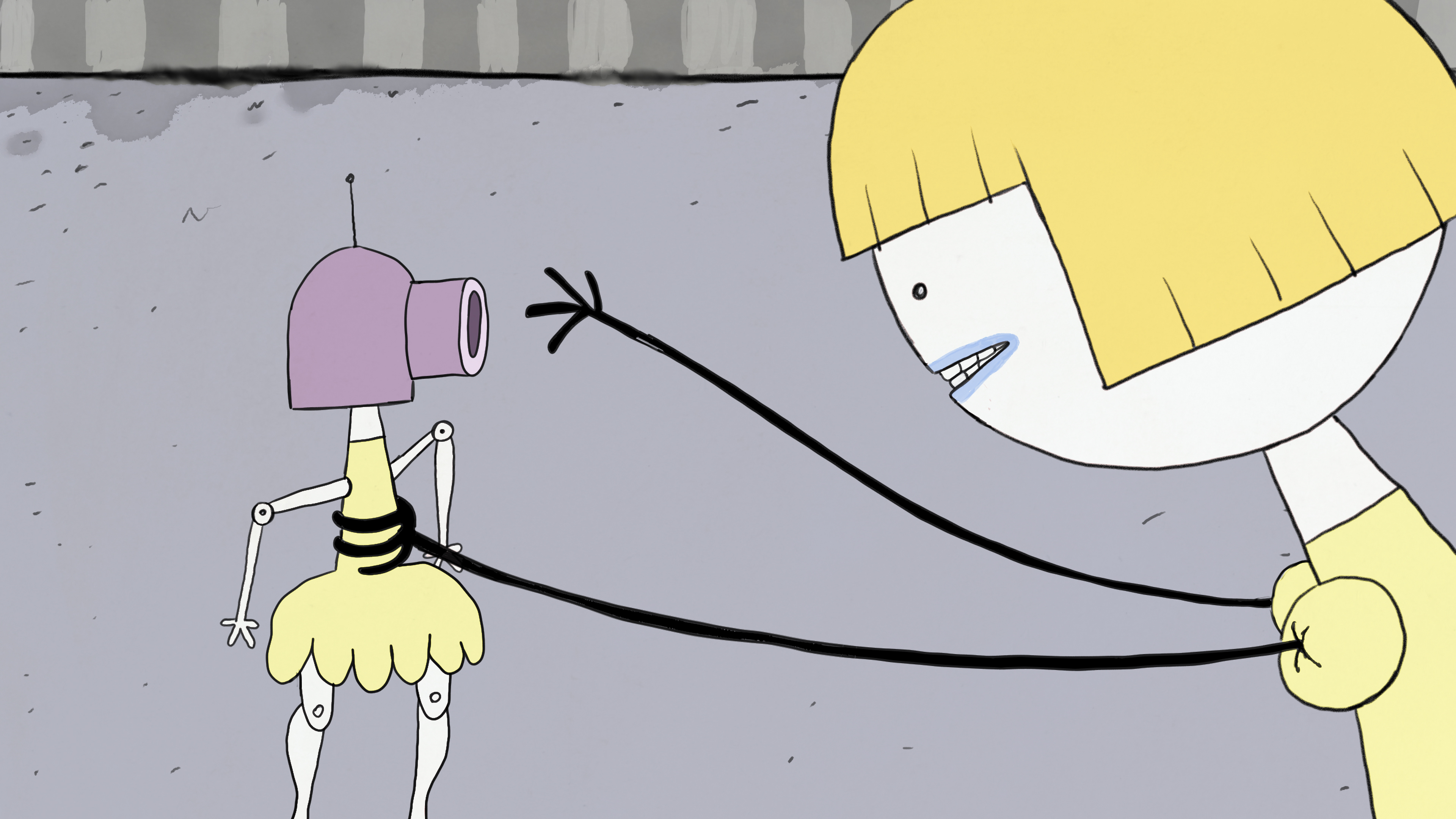
A little girl, voiced by grade 1 pupil Daisy Wolch, plays on the floor with a robot-like doll that she’s pulling apart. “Thinking,” she says, “is cool…” as she pulls off the head of her doll. “It shoots through your head like straight away, shorter than a second.”
In principle, the scientist continues, the brain must obey the same laws of physics as any other physical matter. “It’s a piece of furniture of the universe, if you want. It’s about being. It’s not about doing.”
These are the opening moments of Good Luck to You All (2025), Cordell Barker’s eight-minute animation probing a dilemma familiar to anyone who uses computers. Can a machine be conscious? Do we even need it to be conscious? Will we use AI to our benefit or will AI use, maybe even harm us?
A National Film Board production, Good Luck to You All poses such questions about AI and whether it’s possible to make a conscious, sentient robot and whether one would want to.
The film’s release is timely. The little girl in Good Luck to You All could represent all of us. A survey conducted this year showed 34 percent of Canadians believe the development of AI technologies is a bad thing. Only 30 percent of those surveyed viewed AI positively. And 78 percent of respondents worried that AI development would result in job losses.
Taking on the topic of artificial intelligence and making an engaging eight-minute animation out of it is not a straightforward process. Barker spends years making his short, animated films. What’s more, Good Luck to You All was a departure from previous works because the film is fact-based. That meant interviewing several scientists and others familiar with AI.
“It was one of my most torturous projects,” says Barker on a video call from his home in Winnipeg, where alarms regarding a tornado were going off. He remembers long walks in the morning with headphones on, going over statements made in about 17 hours of interviews he’d conducted with scientists and AI specialists. Once he found a statement he could use, he’d have to make a drawing he could animate and fit the images to the multi-layered soundtrack. “It’s like juggling sixty things at the same time and getting them all to flow somewhere.,” Barker says.
The title Good Luck to You All comes from a clip of a radio address made by 14-year-old Princess Elizabeth at the opening of World War II. It will be up to “the children of tomorrow to make the world a happier and better place,” she says, “Good night and good luck to you all.” Good Luck is more parable than cautionary tale, as the child in the film goes from pulling off the heads of her robot dolls to taking charge of a Frankenstein-like bot stalking earthlings. Since its appearance on the NFB website the short has garnered more than 217,000 views.
A good-looking, white-haired man who speaks with a lot of candour, Barker recalls how he found his vocation in high school. At 17, he was working with a mentor, Kenn Perkins, in a commercial studio in Winnipeg. It was early immersion for the teen with a passion for animation. He’d get on a bus after school and head for the studio. In those days, he says, “We worked with acetate cel sheets, inking the surface and then painting on the back with vinyl paint. I kind of miss that, a little bit, but only in theory. With [digital formats] everything is so much faster and it’s not so incredibly laborious.”
Barker was 26 and living in a tiny house he’d bought when he got an idea for a short that became The Cat Came Back. “I was drawing on the the walls that first winter and it was freezing because the house didn’t heat well. It got me thinking, ‘What if I was an old guy and had a pet cat that had no choice but to suffer with me in the cold?’ I went to the NFB office in Winnipeg to pitch it.” The NFB producers suggested Barker work with “The Cat Came Back,” a song about an undesirable and indestructible cat, written in 1893 by Harry S. Miller.
Barker ran with it, brilliantly choreographing the movements of the rather diabolical cat to the rhythm of the song. Darkly hilarious, The Cat Came Back came out in1988. The following year, it was nominated for best animated short film at the Academy Awards.
Then there’s quite a gap before Barker’s next NFB animated short. He had to make a living and was soon getting lots of commercial work. In one job he made about 60 ads for Bell Telephone. An ad agency in Montreal would give him the concept and he would fly from Winnipeg every two weeks to deliver his drawings and pick up the next assignment. A high-pressure job, he admits, “however, it boosted not just my income, but also awareness of me in the industry.”
It was 2001 before the NFB released a second Barker film, Strange Invaders, about the horrors of raising children. Then in 2009, he wrote, drew and directed a nine-minute production called Runaway. A cow wanders onto the railroad tracks. Barrelling towards him is a locomotive conducted by an officious guy in a Napoleon hat with an eye for a beautiful lady on board. Two passenger cars are coupled to the locomotive, one occupied a genteel group sipping tea, the other jam-packed with a party crowd. The totally unexpected action is synced to the rollicking music of Benoit Charest, who scored The Triplets of Belleville. It doesn’t take much insight to see the cheeky class critique in Runaway, in the portrayal of the toffs, particularly the conductor, and in the fates of all the passengers.
There is black humour in Runaway, but no gratuitous violence, Barker says. “And I say that knowing that I killed everybody in Runaway. Except for the dog and the cow. The characters who deserved to live survived.” The New Yorker bought the license to screen Runaway in their video library, ensuring that the film got Barker his biggest audience ever.
There are five short animations in the NFB’s Cordell Barker Collection, each one unique. It’s safe to say Barker now occupies the same space as two animators he’s always admired, Richard Condie (The Apprentice) and Paul Driessen (An Old Box).
Meanwhile, Cordell Barker fans won’t have to wait long for his next project. The NFB has just announced The Anta Claus of the South Pole, a 24-minute holiday season TV special aimed at children aged 8 to 12. It’s Barker’s biggest production by far, and something completely different from anything he’s done before.
Watch Good Luck to You All: Good Luck to You All – NFB
See the entire Cordell Barker Collection: The Cordell Barker Collection – NFB
 susan walker's artsblog
Hey, thanks for the great write-up on my career, Susan. Nicely observed, and very flattering.
cordell B.
LikeLike