It was an intense 14 days in early 2009, says National Ballet of Canada artistic director Hope Muir, when she supported Crystal Pite in the making of Emergence. Called upon by National Ballet artistic director Karen Kain to create her first work for a classical ballet company, Pite, then 38, had a notion for a piece that dealt with the hierarchal nature of a classical ballet company. Looking for a parallel in nature, she came upon Steven Johnson’s book, Emergence: The Connected Lives of Ants, Brains, Cities and Software.
What she found was not about hierarchy at all. The scientific fact is that bees and other insects can act collectively with no leader. The swarm behaves as if it’s one body, as do dancers when moving in synch with one another. Since the premiere of Emergence, the National Ballet has kept performing the piece and it has been staged by several other companies.
The November 13 opening of Emergence – along with Silent Screen — presented an evolved work, quite accessible to a person seeing it for the first time. Emergence is a word that might be applied to birth and that is what we saw in the first scene, as Genevieve Penn Nabity, awakes, stage right, limbs creakily unfolding, Naoya Ebe assisting her.
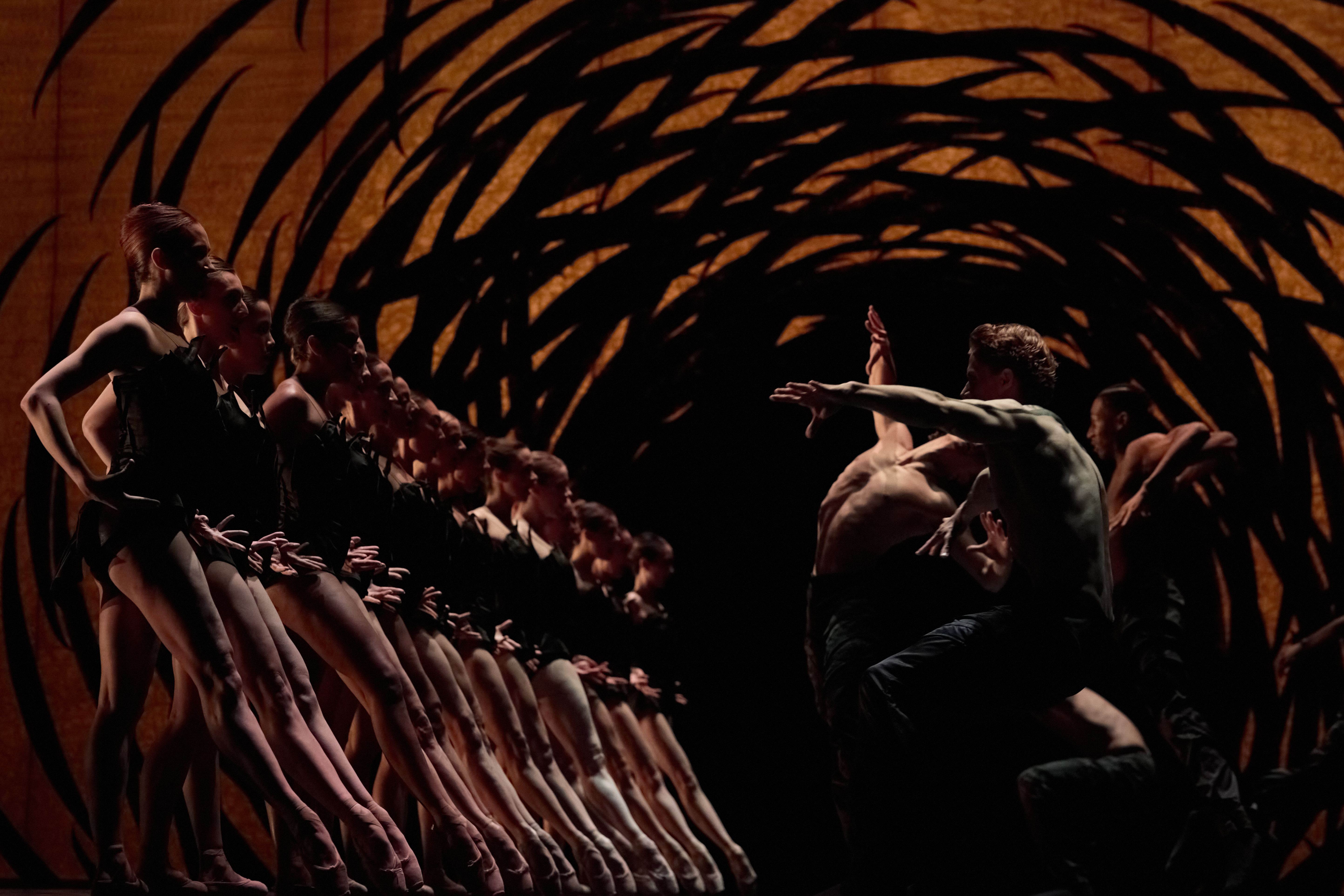
Soon thereafter, 30-some dancers emerge at a run from the opening of Jay Gower Taylor’s stylized beehive, spreading out upon the stage. Even at distance in the auditorium, Linda Chow’s costumes read “bees.” The bare-chested men have black caps on their heads, black tattoos spanning their shoulders; their long pants convey a stripey effect. The women, also black-capped, wear structured tutus, with bodices suggesting an insect’s torso, with short, flamenco-like skirts.
Owen Belton’s multi-layered score carries the dance, as any Tchaikovsky composition would a story ballet. There is the actual sound of buzzing insects, the imitation of crickets, electronic sound – all of it accompanying dance sequences. So when a swarm of female bees in point shoes rapidly move back and forth across the stage their audible taps synch with the music. And when a crowd of men crouched and moving en masse appear, it is to a marching beat; they could be soldiers advancing quickly toward the front. Another sound element is a chorus of dancers counting out numbers, which is what dancers must do when learning a piece.
Heather Ogden, who also danced in Emergence in 2009, emerges near the end of the 30-minute show, athletically dancing, blond hair swing. It’s a quality of Pite’s choreography to be muscular, demanding, vigorous. The National Ballet is up to the task. Dancers including Emma Ouellet, Svetlana Lunkina and Hannah Galway; Donald Thom, Shaakir Muhammad and Noah Parets were recognizable, but except in specific roles, moved in perfect coordination with their fellow dancers.
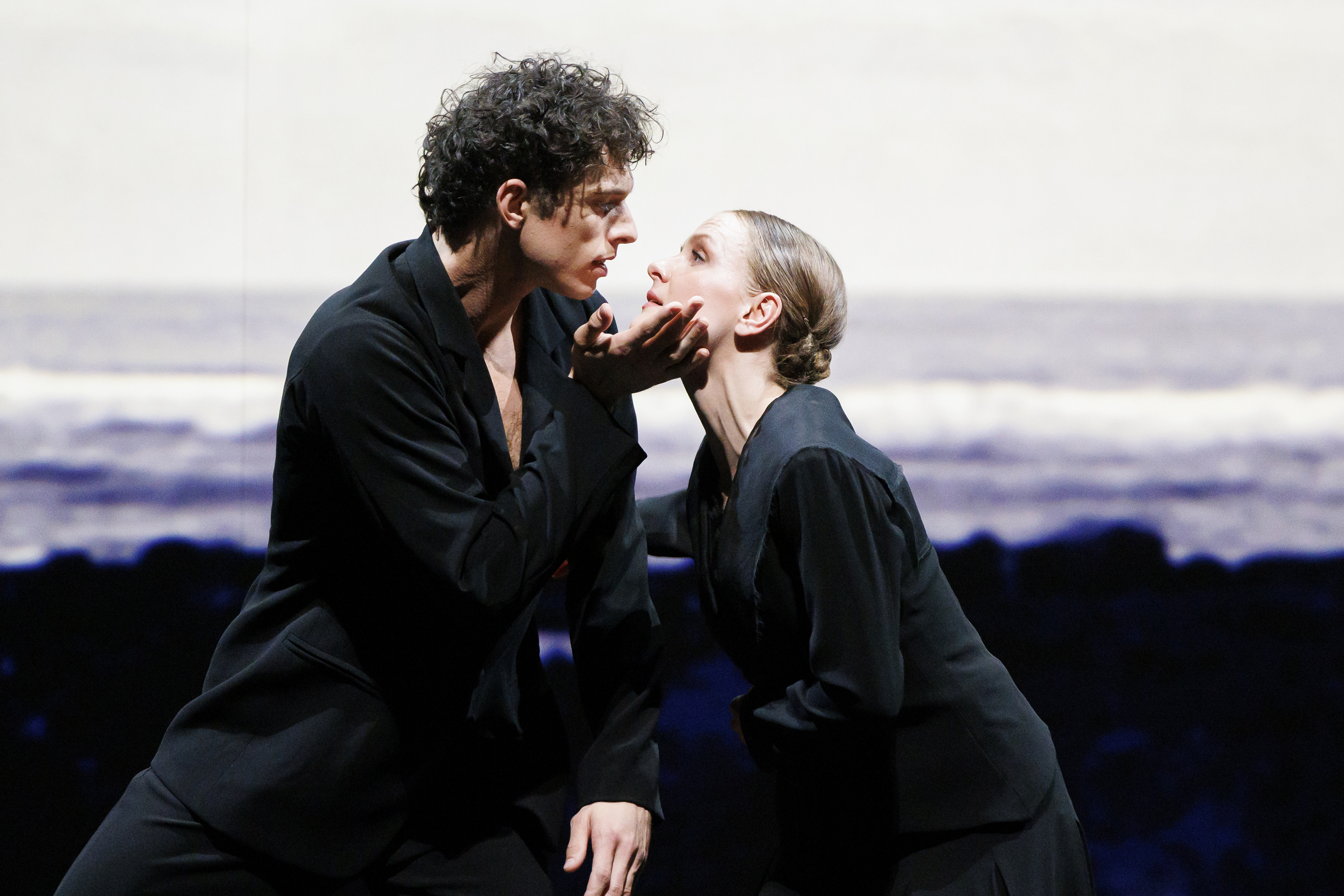
On first viewing, Silent Screen, which was choreographed by Sol León and Paul Lightfoot and premiered by Nederlands Dans Theater in 2005, is dreamy, almost mesmerizing and clearly a piece of storytelling. The National Ballet first performed Silent Screen in 2024. Thematically, the 50-minute dance fits with Emergence as a contemporary dance about connection. In this case the connections are between couples repetitively coming together, moving apart and then altered by the arrival of a third dancer.
Set to the music of Phillip Glass’s Glassworks and his soundtrack for the film The Hours, Silent Screen alludes to the silent movie era with moving images projected on a scrim that makes the background to the dance. The curtain comes up on the silhouettes of two men and a woman posed against a video showing a long path into a forest. The men wear black suits; the woman a simple black top and skirt. As the couple begin to dance, the other man proves to be part of the movie, walking away along the long path through the woods.
Hannah Galway and Christopher Gerty made an exciting duo, acting as much as dancing in this abstract yet readable piece. The Glass music opens with a piano refrain, played over and over, each section subtly altered throughout the orchestral score with the addition of a new instruments.
Spanish-born Sol León and British dancer-choreographer Paul Lightfoot have created more than 50 works together. As Silent Screen proceeds along with the swelling sounds of Glass’s music, a series of black-and-white videos sweep the screen: a beach with the waves rolling in, a spinning vortex, a night sky and, stunningly, a girl on the path through the woods wearing a red coat as the camera homes in on her face.
The viewer comes to view these scenes as a human journey and the experience akin to turning the pages of a picture book. At the centre of Silent Screen, the projections disappear. We see dancers, in pairs and solos and foursomes, in a black box space, beautifully enacting scenes from relationships. Then a woman with her back to us rises from below the stage trailing a long black gown that billows out until it fills the whole platform. In the shadows a man walks toward her.
Ben Rudisin, Matthieu Pagés, Ayami Goto, Shaakir Muhammad, Josh Hall, Emma Ouellet, Noah Parets, Oliver Yonick and Xiao Nan Yu all perform in a way that keeps us riveted on them, following the story closely. The second half of Silent Screen runs through the scenes in reverse order, only with new choreography. By the time nearly an hour has elapsed, you just want to watch this dance again, to see what you missed.
Emergence / Silent Screen
Choreography by Crystal Pite / Sol León and Paul Lightfoot
National Ballet of Canada
At the Four Seasons Centre for the Performing Arts, Toronto until November 20, 2026
Photos: Christopher Gerty and Hannah Galway in Silent Screen by Bruce Zinger; Artists of the Ballet in Emergence by Ted Belton

