ImagineNATIVE, a feast of indigenous film and media

At the Venice Biennale this summer visitors lingered long at the Canadian pavilion, captivated by One Day in the Life of Noah Piugattuk, as it played on three big screens, subtitled in Italian, French and English. A production of the Baffin Island Isuma collective, One Day is directed by Zacharias Kunuk and compellingly presents a story, in Inuktitut, of a day in 1961 when Noah (Apayata Kotierk) and his clan, out on the ice to hunt and trade, spy an approaching dog team and sled. This turns out to be a white man named Boss (Kim Bodnia), a Canadian government official who has come to tell Noah and his companions that they must prepare to leave their way of life and join a community where their children will go to school. Adding to the poignancy and authenticity of the film is the understood notion that the Inuit culture faces a still greater peril in the form of climate change and the melting of the polar sea ice.

Tonight, the film screens at Toronto’s Hot Docs Ted Rogers Cinema Hot Docs at the opening of the 20th edition of the imagineNATIVE Film & Media Arts Festival, 18 years after the opening night screening of Kunuk’s ground-breaking Atanarjuat The Fast Runner. imagineNATIVE, the largest indigenous festival of its kind in the world, serves as a platform, for first nations’ film and media and encompasses a professional development component, the imagineNATIVE Institute, as well as an awards program.

From tonight through Sunday, October 27, imagineNATIVE will present 126 film and video works in 30 languages from 18 countries and 101 indigenous nations, including nine features, 13 documentary features, and 12 short film programs. Watch for The Incredible 25th Year of Mitzi Bearclaw, a touching feature directed by Shelly Niro, starring MorningStar Angeline and featuring the amazing Billy Merasty as Mitzi’s father.

The outstanding filmmaker Alanis Obamsawin returns to the festival with an NFB production, Jordan River Anderson, the Messenger. This documentary tells the story of a Cree child born with overwhelming challenges and how a dispute over his care led to major changes in access to healthcare for indigenous peoples in Canada.

Among many short films of note, the 2001 Gwishalaayt – The Spirit Wraps Around You celebrates the life and work of ‘Namgis filmmaker Barb Cranmer, who died earlier this year. She was from the important Kwakwaka’wakw family in Alert Bay, British Columbia that did so much for the continuance and preservation of their art and culture.

Wik vs Queensland is a 2018 feature documentary from Australia directed by Dean Gibson relates how the aboriginal people of Wik take on the Queensland government and land developers to ensure rights to their traditional lands.

Among special events in the festival is a Friday presentation at the Art Gallery of Ontario of Lisa Reihana’s In Pursuit of Venus [infected], a multi-channel projection and immersive experience followed by a conversation with curator Julie Nagam. And on Thursday, the popular imagineNATIVE Art Crawl takes in five galleries with visual art works, curatorial and artist talks and a live performance, starting at Onsite Gallery and ending at the Toronto Media Arts Centre.

imagineNATIVE Film + Media Arts Festival
October 22-27, 2019 at Toronto locations

For more information call 416.585.2333 or visit www.imagineNATIVE.org

Photo: Still from One Day in the Life of Noah Piugattuk
A monologue in dance disturbs

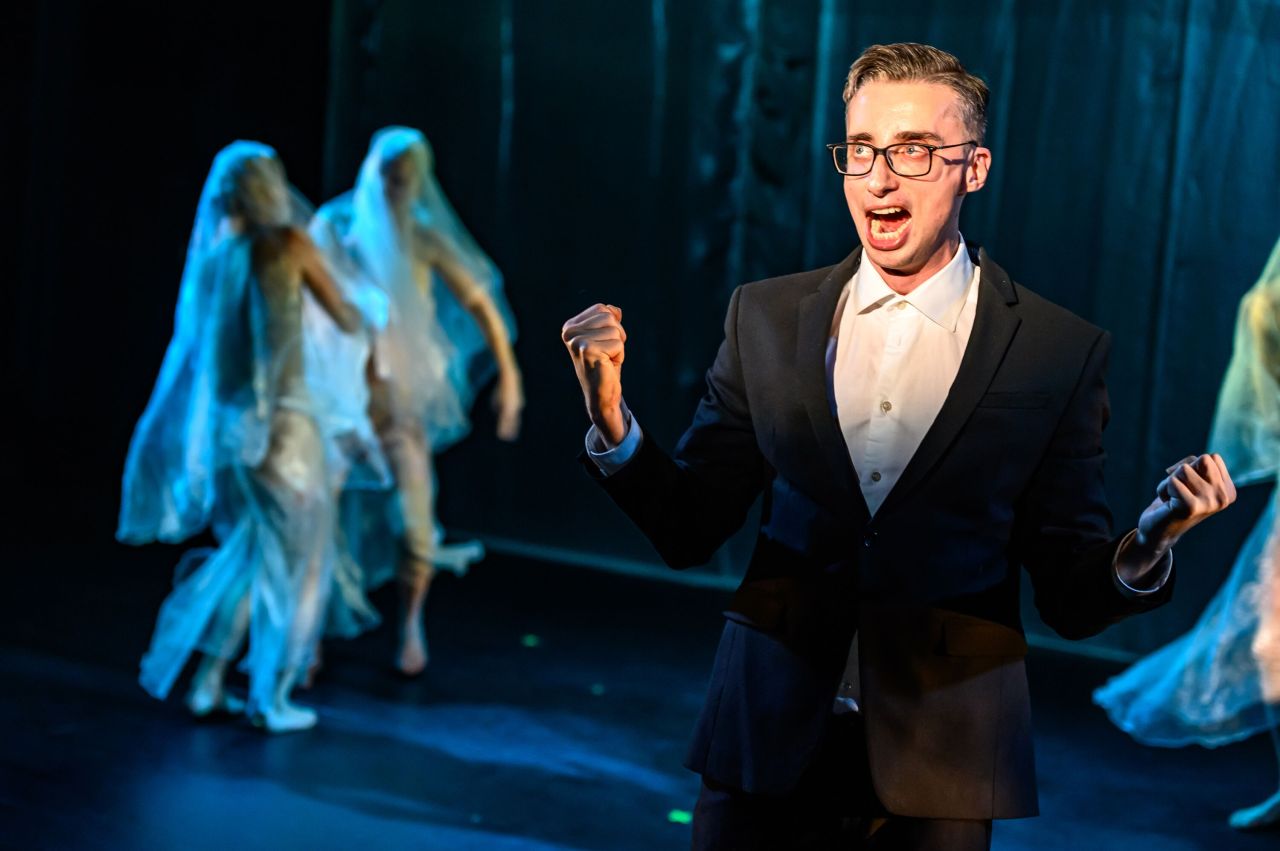
Toronto actor Simon Bracken has the only speaking role in The Particulars. He’s Gordon, a very twitchy, quite off-putting fellow suffering from insomnia complicated by a bad case of obsessive-compulsive disorder. He’s dressed in a loose satin robe sashed over oft-revealed underpants.

In the vein of monologists Spalding Gray and Eric Bogosian, Bracken tells Gordon’s story as he enacts it. Gordon, a single man, has a set routine that involves tending his garden, which has become infested with aphids, watering his orchid, daily buying a bouquet of fresh flowers and performing his clerical duties in an office job where he fears ostracization.

Accompanying Gordon as if they were ghosts are seven dancers, draped head to toe in sheer veils, like dead brides (except one is a man). Matthew MacKenzie, creator of the very successful show Bears, wrote and directed The Particulars as a fusion of dance and theatre. Alida Kendell choreographed the movement. The fusion is less than complete, in that one can focus on Gordon’s increasing agony – and it’s hard not to – or on the active ensemble of dancers, but the two performances never really meld. Mostly the dancers’ movements, especially when they’re balled up on the floor scratching themselves, merely illustrate a story we can easily imagine from Gordon’s words.

Gordon seems made for bullying and a figure to make fun of. For the first 30 minutes or so, we laugh at his desperate manoeuvres, such as studying hockey statistics so he can sound knowledgeable about the game among his male colleagues. The reason for Gordon’s insomnia and neurosis is not immediately made known. Once his tragedy is understood, laughing at him becomes a problem.

Dancers Amber Borotsik, Lara Ebata, Bridget Jessome, Richard Lee Hai, Krista Lin, Rebecca Sadowski, Kate Stashko and Raena Waddell, cast as “mourners”, are competent enough, but because their faces are veiled, it’s hard to engage in their expressive movements.

This show needs more of the inventiveness displayed when the dancers form a human tower, illustrating Gordon’s fear that the scratching that awakes him every night might come from a squirrel trapped in his chimney.

The Particulars

Written and directed by Matthew MacKenzie

Choreography by Alida Kendell

A Punctuate! Theatre production presented by the Theatre Centre

At the Theatre Centre until October 26; in Edmonton Nov. 1-2

Photo of Simon Bracken as Gordon by Dahlia Katz

Visibly talented minorities

A delightfully meandering show, Minorities is a multi-media production celebrating the 55 ethnicities that make up, along with the majority Han peoples, the population of China. Alternately instructive, comic and slightly controversial, Minorities is the third work in choreographer Yang Zhen’s Revolution Game trilogy.

A little background: Yang Zhen creates interactive, entertaining works for Red Virgo, a theatre and dance company based in Beijing and active since 2014. Red Virgo’s works always stem from traditional Chinese dances from different ethnic groups. The Canadian Stage presentation of Minorities marks the performers’ first time in Canada. The two previous shows in the trilogy, Just Go Forward (2014) and In the Field of Hope (2015) have been seen in Europe and Asia.

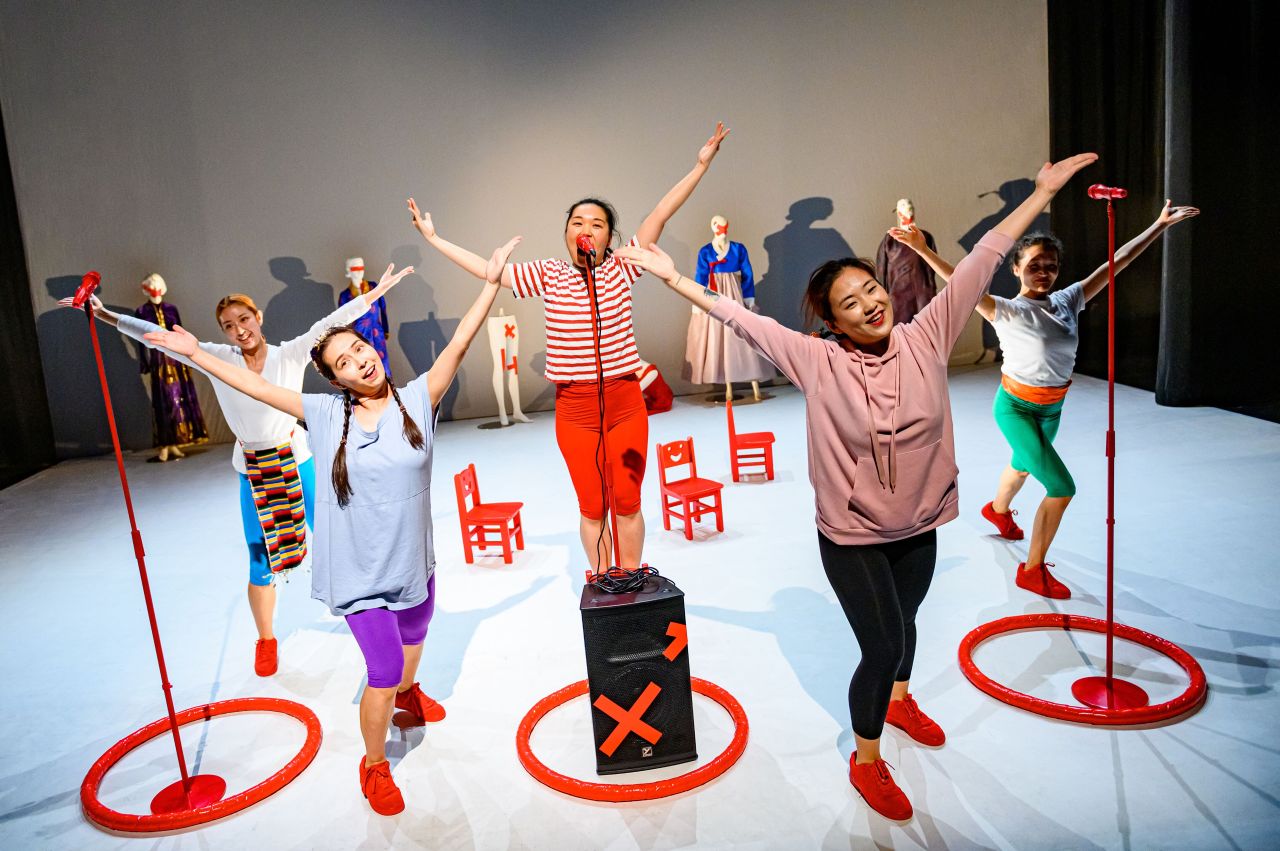
The red standing microphones and red X’s on the tables in the theatre lobby carry out a visual theme that threads through the show. A backstage video scrim of multicultural faces with a Mao-like figure in the centre gradually lights up in colours as the show begins. As heavy metal-like rock music plays, five female dancers spring up among the audience, shaking their booty and swinging their arms in the aisles and between the seats.

They are Lou Hio Mei, Ma Xiao Ling, Aodonggaowa, Gan Luyangzi and Guzhanuer Yusufu. Acting as emcee, an engaging Lou Hio Mei takes to the red microphone to introduce the show and the performers by background, and in turn asking audience members for their names and origins. The first part of the show concerns the ethnicities represented, their cultural dances and songs and the dancers’ feelings about their own cultures. At times we feel we’re in the classroom as documentary footage of dance demonstrations screens behind the mannequins wearing ethnic dress and the shape-shifting performers.

Lou Hio Mei is from Macao, once a Portuguese colony at the mouth of the Pearl River. She identifies as Han, the majority Chinese ethnicity. She introduces Uyghur dancer Guzhanuer Yusufu, Mongolian Aodonggaowa, Tibetan Gan Luyangzi and Korean Ma Xiao Ling. Even before they don their traditional dress, these performers express their identities through dance and song. It’s not hard to see how distinct their cultural differences are. Yusufu’s Uyghur dance shows elements of Indian classical dance. The Tibetan drum dance Gan Luyangzi performs employs a round skin drum similar to that used in indigenous dance and song in North America.

But Minorities is no earnest exercise in identity politics. It’s high-spirited, a little self-mocking and ultimately a patriotic ode to the joy of “56 brothers and sisters” that make up the Chinese mosaic. Lou Hio Mei’s topless, hula hoop hip rotations soon inspire  her fellow performers to return to leotards, their red running shoes signifying a common purpose. A song performed by Huang Ping in traditional style spans past and present, and suggests the continuity of an inclusive Chinese culture.

Minorities

Concept and choreography by Yang Zhen

Music and photography by Qi Ray

A Red Virgo production presented by Canadian Stage

At Berkeley Street Theatre, Toronto, until October 27

Photo (from left) of Gan Luyangzi, Guzhanuer Yusufu, Lou Hio Mei, Ma Xiao Ling and Aodonggaowa by Dahlia Katz


When in Rome, see this show

Bacon Freud The London School/La Scuola di Londra, on until 23 February 2020 at Chiostro del Bramante in a quiet corner of Rome, is an arresting show that puts artists Francis Bacon, Lucian Freud and their London contemporaries into a context that deepens our understanding of their art and their times.

Take Girl with a Kitten, a small 1947 oil painting by Lucian Freud that is the first work seen in the show. The picture is surprising enough in itself, a wide-eyed young woman, staring into the distance, gripping a kitten by its neck, as if about to strangle it. Girl with a Kitten is one of eight portraits Freud painted of his first wife Kathleen Garman, daughter of the sculptor Jacob Epstein. What curator Elena Crippa of the Tate in London saw in this portrait forms the premise for the exhibition. The art of the London School reflects the anxiety and despair that still gripped Londoners after war’s end, amid the rubble, burnout remains of buildings and melted windows left after the Germans’ Blitz of the city.

The young woman’s blank expression tells us nothing, but the grip on the kitten’s neck bespeaks an existential dread that was the common experience of those years in the city. The London gang, as they were sometimes called, comprised Francis Bacon, driven by his family out of Ireland to settle in London; Lucian Freud, forced out of Berlin by the Nazi takeover; Frank Auerbach, also a refugee from Nazi Germany; Michael Andrews, Norwegian-born and a student of Freud’s; Leon Kossoff, born in London to Russian-Jewish immigrants; and Paula Rego, sent from Lisbon at the age of 16 to complete her education at the Slade School of Art. Auerbach and Rego both live and work in London to this day.

Crippa’s essay for the show is titled “The Tactile at the Limits of the Visible” and her theme is elucidated in the pictures she selected for this show. Bacon (1909-1992), we learn, was self-taught and seemingly a creature of chaos. In his rag-and-paint-filled studio, he would assail an unprimed canvas, mixing his colours on his bare arm. In a painting such as the 1952 Study for a Portrait, done in oil paint and sand, it is not the man’s figure but his open mouth and the intense emotion it expresses that is the subject. Bacon’s aim was to mount an assault on the nervous system, in the way he depicted his subjects.

“I never visualise a picture before I start,” Frank Auerbach once said. “I have an impulse, and I try to find a form for that impulse.” Auerbach drew and painted the same scenes and figures and over again, as one sees in Head of E.O.W. (1959-60), a portrait in charcoal and watercolour paint on paper of Estella Olive West, an actor with whom he had a long relationship. He worked it and erased and reworked it to the point where the paper ripped and he had to apply a patch, that sits on Stella’s forehead. The brooding, painful quality exuded by this picture is a function of the way it was executed.

Melanie and Me Swimming (1978-79), a Michael Andrews acrylic painting has the same kind of physical unreality as Bacon’s portraits often display. The father and the daughter seems suspended in a black surround, that represents the pool, but more clearly conveys the vulnerability of child and the anxiety surrounding the possibility of a drowning. Andrews, who died in 1995, was focused on the relationship between humans and nature and revealing subconscious feelings and motives.

Of all the artists in the show – they were friends who gathered in the same bars and clubs of London—Leon Kossoff (1926-2019) seemed to enjoy the most conventional life. London became his subject from an early age, and his vigorously limned drawings of Christ Church, Spitalfields reveal the energy stimulated by observation of his environment. He too worked scenes such as Children’s Swimming Pool, Autumn Afternoon (1971) over and over, building up layers of oil paint until the paintings worked in three dimensions.

Paula Rego, born in 1935, exhibited work with the London gang in the 1950s. The edginess and fairy-tale quality to her work haunts the viewer. In a 1988 acrylic painting, The Dance, a young woman in folk costume seems to be dancing alone on the edge of a dance floor where couples and a trio are stepping out. But the scene takes place on a moonlit beach, a dream landscape that begs the question, Who is that woman and what story does she embody?

“I want paint to work as flesh,” Lucian Freud (1922-2011) declared. Three of his pictures in this show, David and Eli, Leigh Bowery and Standing by the Rags, do just that. A wordless short film by Enrico Artale that acts as a commentary on the exhibition, reinforcing the notion that these artists of the London school managed to do with paint and pencil what composers do with musical instruments: express the profound aspects of the human experience that course beneath the skin.

Bacon Freud: La Scuola di Londra, Chiostro del Bramante, Rome, until February 23, 2020

Photo from Bacon Freud: La Scuola di Londra, Skira, 2019: Lucian Freud, Girl with a Kitten (1947)

Reliving the 70s, 80s and 90s in style

Rick Miller is a treasure. The Montreal-born, Toronto-based writer, director and performer is the kind of guy who animates a set the minute he walks on stage. BOOM X, The Music, Politics and Culture of Generation X is the second in a trilogy of plays that began with BOOM, which chronicled the baby boom generation. (BOOM Y will premiere in 2021.)

The era of the baby boom generation (1945 to 1969) had a kind of homogeneity, Miller explains in his intro, that made BOOM a quite different proposition than the conflicted, messy and polarizing times of the 1970s, 80s and 90s. But just his thing, for Miller, born March 12, 1970, is a Gen-Xer.

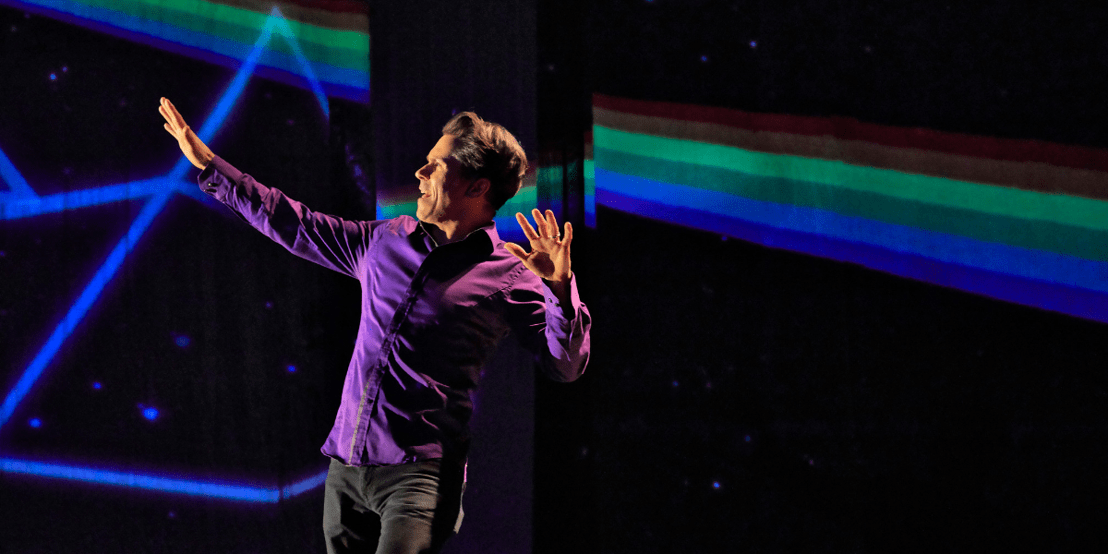
A gifted impersonator and rock musician, Miller conceived a show that depends on the light and production design of Bruno Matte, Nicolas Dostie and Irina Litvinenko to provide a multilayered, multimedia buzz. At more than two hours in length, BOOM X feels like a big show, but it’s just one man in multiple costumes and wigs, acting in front of or behind a scrim over which video is running – along with headlines from each year he’s re-enacting. (His Tina Turner and Alanis Morissette are not to be missed.)

A baseball metaphor, employing the history of the Montreal Expos, provides the through line. Miller’s four Generation X representatives are introduced and framed as if they were on baseball cards: Howard, born in Winnipeg; Annika from East Germany; Steph from the small town of Exeter, Ontario; and Brandon, youngest of them, the son of a white South African and his Jamaican wife.

BOOM X is ingeniously presented. Four scrims surround a thrust stage upon the Belfry proscenium stage and as video footage comes up rapidfire on the scrim – everything from a scene from Altamont to a commercial for LIFE cereal to the shooting of four students at Kent State university in May 1970 – Miller either lip syncs their performances and speeches or acts as a narrator, or impersonates Howard, Annika, Steph or Brandon, telling each of their stories of the Generation X years. By the end we find out how they become important figures in Miller’s life.

Social commentary, political and cultural analysis, family history – BOOM X is all of these. But above all it’s just good entertainment, sure to please any generation.

Trailer: https://vimeo.com/351489824

BOOM X

Written, directed and performed by Rick Miller

Produced by Kidoons and WYRD Productions, in association with Theatre Calgary and The 20K Collective

At the Belfry Theatre, Victoria BC, until August 18, 2019


Gallery

Eastend, Saskatchewan


“The river is important in my memory for it conditioned and contained the town. What I remember are low bars overgrown with wild roses, cutbank bends, secret paths through the willows, fords across the shallows, swallows in the clay banks, days of indolence and adventure where space was as flexible as the mind’s cunning and where time did not exist.” –Wallace Stegner, Wolf Willow


Eastend, Saskatchewan is one of my favourite places anywhere, anytime. In the valley of the Frenchman (formerly Whitemud) River, surrounded by some of the most beautiful of the Cypress Hills, the town of 500 permanent residents remains pretty much just as Wallace Stegner (1909-1993) described it in the 1950s, when he returned to his childhood haunts.

Today, Wallace Stegner House, the one the Iowa-born writer occupied as a boy, operates as an artists’ retreat. Writers, visual and performing artists can apply to spend one to three months there. Poet, fiction writer and editor Seán Virgo (Dibidalen; The Eye in the Thicket) once stayed in the Stegner house and Eastend has been his home for more than two decades. I first visited him in late March about 12 years ago, when the farms were covered in snow and the lands where cattle graze displayed white patches.

June or July is a different story. With rain, which came this year, the hills and trees are draped in many shades of glorious green. But in drought years, the summer hills are a dusty shade. Precipitation, or the lack of it, is the crucial factor in this farming community. Whether they’re raising Angus cattle or growing canola, mustard, wheat or alfalfa, Saskatchewan farmers can never be certain what summer will bring.

What draws travellers to Eastend is the landscape; Scotty, the Tyrannosaurus rex skeleton discovered there in 1991; and the local culture. In the footsteps of a guide like Virgo, you can take in the surrounding country from a bluff in Cypress Hills Interprovincial Park, noting a Hutterite community in the distance. The trees are mostly pines, the hills steep enough to raise the heart rate on a walk to the top. Nearer to Eastend, the Cypress Hills are rolling, showing bands of white clay where the groundcover has been washed off in the spring melt.

Ninety minutes south and east of Eastend is Grasslands National Park, where at the right time of day you can see bison gathering in the coulees and at any time you might spot an antelope, a coyote or hundreds of prairie dogs poking out of their burrows to chirp a warning to their fellows. On the ground, the prickly pear cacti, surrounded by blue gramma and needle-and-thread grass, show pale orange flowers.

Northwest of Eastend, about 24 km on Grid 614, you can see a point on the Continental Divide. North of an imaginary line, the creeks and rivers flow northeast to Hudson Bay, 1,808 km away. South of the line, creeks and rivers, including the Frenchman, flow south, 2,768 km to the Gulf of Mexico.

Coming from the Medicine Hat airport, as I was, you drive south from the TransCanada Highway, and enter Eastend across an old iron bridge. Just before the bridge, you’ll see signs pointing up the hill to the T. rex Discovery Centre. A beautiful structure embedded in the grassy slope, it houses the world’s most massive T. rex skeleton. The discovery of the skeleton, 65-million years old, occurred on August 16, 1991. An Eastend chemistry teacher named Robert Gebhardt, invited to a dig site by lead paleontologist Tim Tokaryk, came upon the fossils of the base of a tooth and a vertebra, sticking out of the bedrock. It was three years before paleontologists could start removing Scotty, named after the bottle of Scotch used in a toast by the digging crew. The skeleton, found 65 percent intact, was reconstructed and is 13 metres long and as high as a two-storey house. Scotty’s oblong skull is nearly two metres long. Visit the centre, open every day from 10 a.m. to 6 p.m. to view a film about Scotty, some amazing exhibits and the workspace where paleontological research and reconstruction continues.

Just before you cross the iron bridge to enter Eastend, you’ll see a farmhouse brightly renovated in with red vertical slats. It belongs to Stephen Langton Goulet, a BC-born artist and jack of all trades. On his acreage on the banks of the Frenchman River, Stephen is practising regenerative agriculture, attempting to replenish the topsoil. Some of his “rockatry” sculptures – impossibly balanced stones that look like inukshuks – stand on the property, also sculptures made of found metals such as barbed wire. Look but don’t trespass.

Upon entering the main street of Eastend, you’ll see a big sign for White Mud Clay, the studio and home of Stephen Girard, an Eastender by birth. He shapes and creates glazes for wonderful pottery made of local clays. Another Eastend potter is Nick Saville, son of a local rancher, who makes mugs, bowls and such, glazed in bright, almost neon colours. Not the only other artist in town, but a notable one is Grieta Krisjansons, sculptor of a horse in the market square, made of found metal elements, such as bicycle chains and tractor parts.

Writers, whether visitors or part-time residents, continue to flock to Eastend. Maureen Elder, a poet and foodie, lives part-time on farmland outside Eastend with her husband, musician and composer Shaun Elder. Maureen’s privately printed Honey Cumin Saskatoons; Cooking in a Special Place, is a compendium of delicious vegetarian recipes and poems, such as “Geologic”: “I recall this sea of grass / once sea of water: seen so, / my own few years seem / little matter.”

Barbara Klar, a Saskatoon writer who once planted trees in the Cypress Hills, is now a fulltime resident of Eastend. Her 2019 title, Cypress, is a gem. Here’s the opening of “South Benson Trail, The Stone Road:”

To walk uphill keep your eyes on the ground.

Stones distract from the work of climbing, show you

Their pace, the lung wish, the getting there

Not winded.

References:

Dibidalen, short stories by Seán Virgo, Thistledown Press; Eye in the Thicket, an anthology of nature essays, Seán Virgo, ed., Thistledown Press

Cypress, by Barbara Klar, Brick Books

T.rex Discovery Centre https://www.royalsaskmuseum.ca/trex

Eastend Historical Museum, https://saskmuseum.org

Grasslands National Park https://www.pc.gc.ca/en/pn-np/sk/grasslands

Whitemud Clay https://www.facebook.com/whitemudclaypottery

Stephen Goulet https://www.facebook.com/rockatier

Nick Saville Pottery https://www.nixavl.ca

Photos, clockwise from top left: Grieta Krisjansons’ horse, Stephen Girard pottery studio, the iron bridge over the Frenchman River, Scotty, Stephen Goulet’s rock sculptures

The heart-breaking story of Colten Boushie

Justice for Colten. Emblazoned on sweatshirts, written on protest signs, shouted by demonstrators and spoken in reply to any question about what the family of the murdered young Cree man Colten Boushie is seeking, becomes the running theme of Tasha Hubbard’s riveting documentary, nîpawistamâsowin: We Will Stand Up. By the end of the film, named Best Canadian Feature at Hot Docs 2019, there is little doubt that the Canadian justice system failed in the handling of the case, a message carried all the way to the United Nations Permanent Forum on Indigenous Issues.

 We Will Stand Up, which screens June 26 and 27 at Cinecenta at the University of Victoria, is an even-handed presentation of a story told from the perspective  of the Cree community that gathered together to protest not just Boushie’s death but the systemic racism that resulted in the acquittal of the man who shot him in the back of the head.

 Colten Boushie was a smart little boy who grew up on the Cree reserve of Red Pheasant, on the prairie northeast of Saskatoon. He was just 22 on the evening of August 9, 2016, when he and some friends were caught on the property of Gerald Stanley, who shot Boushie at close range with a restricted handgun.

Hubbard, a Cree filmmaker from the Peepeekisis First Nation in Saskatchewan, details the circumstances that led to Colten’s killing and reveals the depth of hatred expressed by the non-native rural inhabitants toward the Cree. “This is conflicted territory,” she says, “and Stanley’s actions have exposed longstanding wounds.” Red Pheasant is located on Treaty Six lands where the Cree were starved out in the late 1800s to make way for the railroad and violently suppressed when they fought in under leaders like Big Bear in what became known as the Northwest Rebellion. Eight warriors were tried, without representation, convicted and hanged in 1885.

The longstanding enmity plays out in the wake of Colten’s death. At the trial in Battleford, Stanley’s lawyers eliminate any potential jury members who are indigenous. The all-white jury declares Stanley not guilty of second-degree murder and an appeal of the verdict is turned down.

Two women emerge as the heroines of this story: Colten’s mother Debbie Baptiste and his sister Jade Tootoosis who becomes the spokesperson for the family and carries their case to Ottawa to meet MPs and Prime Minister Trudeau and then on to the UN in New York, where her testimony gets a standing ovation.

Justice for Colten becomes a cry for justice for all indigenous peoples caught in a system stacked against them. Hubbard’s film stands as a remarkable testament to the calm determination, dignity and united front Colton’s family and his community exhibit in the battle to balance the scales of justice.

nîpawistamâsowin: We Will Stand Up

Written and directed by Tasha Hubbard

A co-production of Downstream Documentary Productions and the National Film Board of Canada

Screening at Cinecenta, University of Victoria, June 26 and 27 at 7 and 9 pm

Photo of Colten Boushie driving with his mother Debbie Baptiste

Bravura dancing spanning the centuries

There’s nothing quite like Apollo to give an audience the experience of the sublime in dance. George Balanchine was only 24 when he choreographed the ballet to Igor Stravinsky’s Apollon Musagète. Apollo was first performed by Diaghilev’s Ballets Russes on June 12, 1928 and the performance gave Balanchine his first international recognition as the artist who would take 19th-century classicism into the 20th-century with a stripped-down modernist approach. The dance was first performed by the National Ballet of Canada in February 1999 and last night was not the first time Guillaume Côté, celebrating his 20th anniversary with the company, has performed the lead role.

Côté very much epitomizes the allegory of the young god of music, achieving ascendancy through art, in his instruction from the three muses, Calliope, with her tablet, the muse of poetry; Polyhymnia, muse of mime, bearing a mask; and Terpsichore, muse of dance and song, carrying a lyre. The stark set, bathed in dark azure, suggests the platform for a ritual in which the dancers, in pure white costumes, are like statues from an ancient classical frieze come to life in the moonlight.

Great strength and restraint are called for in the execution of the mesmerizing choreography. But also playfulness, as Heather Ogden’s Terpsichore, particularly nimble and expressive, Jeannine Haller’s Polyhymnia and Miyoko Koyasu’s Calliope lead the young Apollo to his destiny. There is a tension between symmetry and asymmetry, poise and disjuncture, that builds in unity with the music to the closing moment when all four ascends the steps to Parnassus and we breathe a sigh of fulfilment.

The danger in opening a mixed program with Apollo is that it will overshadow all that follows. But Night, the second piece in the program, succeeds by being something completely different. The choreographer of this 25-minute ensemble piece, Julia Adam, trained with Canada’s National Ballet School and performed in the corps de ballet with NBoC until she left in 1988 for a long career with the San Francisco Ballet, where she was a principal dancer, developing into a choreographer of note. Night, inspired by the dreamier paintings of Marc Chagall, is sustained mainly by Matthew Pierce’s inventive and soaring score, moving bodies in rather busy mythic-animal costumes, through space in acrobatic ways. Holding it all together is the dreamer, in this instance, Skylar Campbell, always thrilling to behold, effortlessly aloft or transiting the stage.

Night is followed by The Sea Above, The Sky Below, choreographed in 2017 by Robert Binet in celebration of Xiao Nan Yu’s 20th anniversary with the ballet, and remounted in this farewell season for Xiao. Performed to the Adagietto movement of Gustav Mahler’s Symphony No. 5, The Sea Above, featured Heather Ogden, dancing with great elegance and grace, both with and for Harrison James and Félix Paquet, in a short piece meant to highlight the integrity, sensitivity and directness Xiao Nan Yu brings to the creation of each role she performs.

As if to bookend the evening with more bravura dancing, going back to the pure classicism of 19th-century Russian ballet, the mixed program ends with Paquita, newly adapted by NBoC associate artistic director Christopher Stowell, after the 1881 version by Marius Petipa. A grand spectacle in stiff orange tutus embellished with a Spanish Moorish aesthetic, Paquita can’t help but present as something of a competition. But that sense in no way spoiled the excitement of watching an electrifying Jillian Vanstone and Francesco Gabriele Frola performing at peak levels.

Apollo, with Night, The Sea Above, The Sky Below and Paquita

Performed by the National Ballet of Canada

At the Four Seasons Centre for the Performing Arts, Toronto, March 1 to 21, 2019

Photo of Heather Ogden and Guillaume Côté in Apollo by Cylla von Tiedemann


The Revizor, revised, revamped and reborn as dance theatre

revisor is a parable for our times, adapted in a uniquely expressionistic form of dance and theatre from Nikolai Gogol’s play The Inspector General (Revizor in the original Russian) by writer/performer Jonathon Young and choreographer/director Crystal Pite. This is the same team (including composer/sound designer Owen Belton and scenic designer Jay Gower Taylor) that in 2015 brought us the brilliant Betroffenheit.

With revisor Young, Pite and their collaborating performers Doug Letheren, Rena Narumi, Matthew Peacock, David Raymond, Ella Rothschild, Cindy Salgado, Jermaine Spivey and Tiffany Tregarthen have raised the bar again, with great inventiveness and spectacle, leading us into a nightmare-in-progress, reflective of the very political deceit, fake news, divisiveness and government corruption that dominate our airwaves today.

Gogol’s 1836 play, both a farce and a satire, trades in the same themes. He developed the play from an anecdote related to him by Pushkin, about the case of a lowly clerical figure sent to a regional outpost of the czarist empire on some minor assignment. The clerk is mistaken for an official of influence and authority and soon has the local department head and others toadying before him. For Young and Crystal, the play presents “a matrix for both voice and body . . .malleable and resonant.”

Inspiration for this adaptation of The Inspector General came from accounts of a 1926 non-naturalist production of the play by the Russian theatre director Vsevolod Meyerhold (1874-1940). Meyerhold eschewed method acting for a kind of physical theatre that harked back to commedia dell’arte and expressed the symbolism he found in the text in the physical movements of his actors.

Ingeniously, Young et al created a spoken text that works like a score, the performers mouthing the words as they are heard overheard while performing exaggerated movements as if they were human puppets. These movements tell the tale of deceit, for the emotions they express often belie the words the actors are mouthing.

The performance of the farce in a series of tableaux – with Doug Letheren as Director of the Complex, Jermaine Spivey as the Postmaster, Tiffany Tregarthen (in removable beard) as the Revisor and a blousy, Cindy Salgado as the flirtatious Anna, wife of the Director – opens and closes the piece. What transpires in the middle is a dance deconstruction of The Inspector General, plumbing the emotional depths of the play, while stage directions are voiced overhead. Expressionism reaches its height with the appearance of a figure bearing a huge set of antlers that then get used as crutches.

The movement of the 10 performers is extraordinary, very dreamlike, an effect heightened by Owen Belton’s electronic, industrial soundscape and Jay Gower Taylor’s abstract video projections that trace needle-like paths on the scrim like an electronic circuit gone mad. The words of the text are repeated and broken down into phrases that apply the idea of the revisor to the dance – constantly regrouping, revising the movement, getting down to the elemental level.

All to say, catch revisor if you possibly can, and hope that there’s a chance to see it more than once, for its complexity demands revisiting.

revisor

Created by Crystal Pite + Jonathon Young

A Kidd Pivot Production presented by Canadian Stage

At the Bluma Appel Theatre, Toronto, until March 16

Photo of Ella Rothschild, Cindy Salgado, Jermaine Spivey, Tiffany Tregarthen, Doug Letheren, David Raymond, Rena Narumi, Matthew Peacock by Michael Slobodian.

Night travellers take us to our ancestral home

There must be millions of people in the world today who have never and may never experience a truly dark night sky. Such is the effect of urban and rural light pollution, that many will never witness the constellations or the Milky Way. The idea of losing the night came to Saskatchewan choreographer Shannon Litzenberger in 2014 when she took up an artist’s residency at Grasslands National Park, declared a Dark Sky Preserve in 2009.

That experience was the seed for World After Dark, a multi-media exploration in dance and words, of all that our connection to the night can mean, and how fragile our relationship to it has become. Christopher Dewdney’s book, Acquainted with the Night: Excursions through the World after Dark gave Litzenberger the impetus to assemble a dynamic creative team to collaborate in words, music, video imagery and especially dance in an exploration of the metaphors associated with night.

A poetic voiceover narrative — the work of playwright and dramaturge Guillermo Verdecchia, in part referring to and quoting from Dewdney’s text – is key to the coherence of this show. Rarely is speech employed so effectively in dance as it is in World After Dark, in the voiced-over narrations delivered offstage by Irene Pauzer and Dan Wild, and in short bits of spoken by the performers.

“Take a moment to let your eyes adjust (to the dark),” a narrator advises as the lights gradually come up on Linnea Swan, the personification of night. A goddess of darkness, she appears outfitted in designer Alexandra Lord’s black silky jumpsuit covered in shiny, spangly stars, as if she was wearing the night sky. Curled up on the floor in fetal position is Louis Laberge-Côté, our Everyman urbanite, as Swan takes us on the progress of night across the globe (courtesy of Elysha Poirier’s video projections on the upstage scrim). The night covers the Earth in darkness, as “dripping time passes . . . No trace of her is left on you.”

Aroused, agitated, Laberge-Côté voices a fragmented, disoriented shout of orders and numbers: “Six. . . Five . . .Rules . . . Sorry . . . This is the policy. . . I’m sorry . . . these are the parameters.” This is a desperate man, a bureaucrat trying to impose order, struggling against the darkness encroaching on him. Four figures in drab dungarees pull him down to the ground and remove him.

In the next scene, Ms. Night, relating the discovery of fire and the consequent light brought to early Earthlings, is our hostess at a disco bar or nightclub, where downtown workers seek the night to reinvent themselves, leaving behind their dreary occupations for more exciting identities on the dance floor. Syreeta Hector, Emily Law, Nikolaos Markakis and Kathia Wittenborn more or less depict themselves, as Swan continues her presentation. “Only losers will go to bed alone tonight,” she says.

And so it goes, with a voyage into the night forest in which our Everyman, fearful yet intrigued, recovers a connection to nocturnal creatures, including a mothlike being beautifully articulated in a solo by Wittenborn. There’s a brief sequence set to the text of Margaret Wise Brown’s famous children’s book, Goodnight Moon, and a beautiful monologue from Laberge-Côté about sneaking out of the house on summer nights to envelop himself in the darkness.

The choreography, with assistance from dance dramaturge Gerald Trentham and creative advisor Marie-Josée Chartier, is compellingly original, emerging organically from the story line and synched to John Gzowski’s haunting sound design, presented to advantage through Ken MacKenzie’s light and set design.

A huge creative effort went into the making of World After Dark and one only hopes it has a life beyond this premiere at Harbourfront Centre Theatre, perhaps in some dark sky preserve.

World After Dark

Concept, choreography and direction by Shannon Litzenberger

Harbourfront Centre Theatre, March 6 to 9, 2019, Toronto

Photo of Linnea Swan and Louis Laberge-Côté by Lyon Smith