Other Desert Cities; Catch it before they burn up

It says a lot about the dysfunctional Wyeth family, portrayed in John Robin Baitz’s Other Desert Cities,that the only truthful and nuanced character is a barely recovering alcoholic: Aunt Silda.

Silda (a similarly nuanced Deena Baltman), despite her struggles to resist alcohol, is the one family member who can look herself in the mirror and not profess to be something she isn’t. But she’s not the character who dominates this rousing Alumnae Theatre production of Other Desert Cities, the name derived from the  green signs over California Interstate 10, directing drivers to Indio California and “other desert cities,” i.e., Palm Springs. The show closes Sunday, February 2. Catch it if you can.

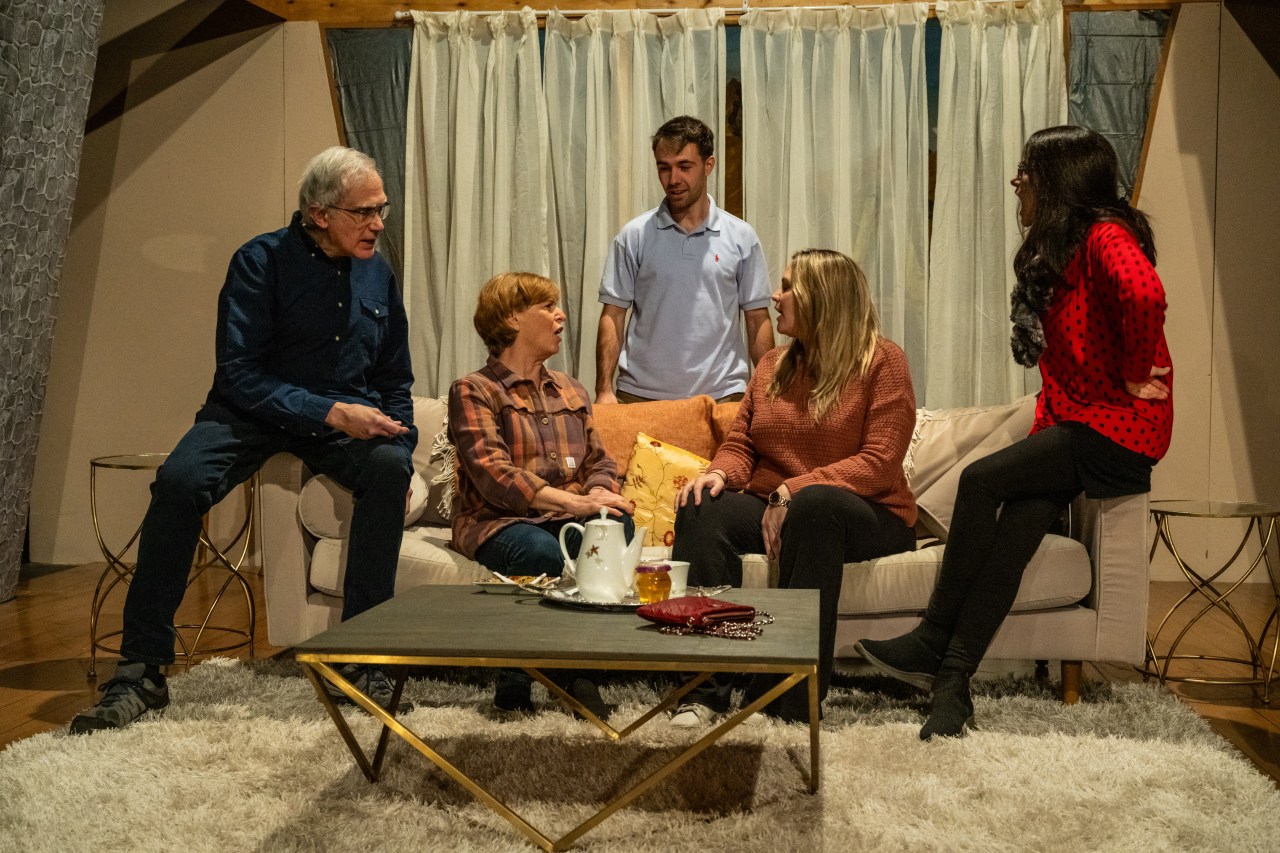
It’s the Wyeth mother, Polly, who drives this play. As embodied by a dynamic and convincing Lynn Oldenshaw, she’s the centre of the action, even when she’s not on stage. Polly is the expert, an old guard “Hollywood Republican,” friend to Nancy Reagan, fundraiser, socialite, happily sitting on top of her Palm Springs, California world. She quickly establishes her point of view, railing at her daughter Brooke (Melody Schaal) who’s come from New York to spend Christmas with her parents and brother Trip (Bobby Markov), a reality tv showrunner.

Here’s Polly on east coast lefties: “It’s all vegans and meth addicts.” Her children, particularly Brooke, belong to the “entitled Me generation.”

Polly is a big problem for daughter Brooke, a New York magazine writer turned novelist and memoirist. She’s suffered a mental breakdown in the not too distant past, protests her mother’s biases, Polly utters the classic denial statement: “I haven’t got a bigoted bone in my body.”

Brooke, is equally set in her ways. She’s a large person, but proud of her vulnerabilities. A bit of a whiner, she harbours huge resentment against her domineering mother, who just happened to be the person who nursed her in the midst of mental breakdown. “Why couldn’t you back your daughter instead of that wet little . . .,” she says of one of Polly’s favourite causes.

Trip is a hyperactive, hypomaniacal, Los Angeleno in the thick of a career he might have landed in easily, given his parents’ long run as minor Hollywood actors. He is trying his best to play the peacemaker, the bridge between his sister and his parents Polly and Lyman, and not succeeding very well.

Rob Scavone as Lyman Wyeth tries to project the authoritative actor and TV commercial spokesman whom Ronald Reagan later appointed an ambassador. But he’s bland enough for the role of peacemaker, especially with Brooke, burying the memory of his dead son and being suspiciously evasive on what happened to Henry.

The story is that Henry was implicated in the bloody bombing of a US military recruitment centre by some urban terrorists. He disappeared for three weeks after the incident in which a person was killed. The authorities find his body and it bears a suicide note.

In the in the climax to Act 1, Brooke announces her “novel” is actually a memoir. The New Yorker is about to publish excerpts from it. Her real purpose in coming to sunny Palm Springs, a place she hates, is to ask her parents to read her manuscript before some of its contents appear a short time hence. She would like their consent to publish it.

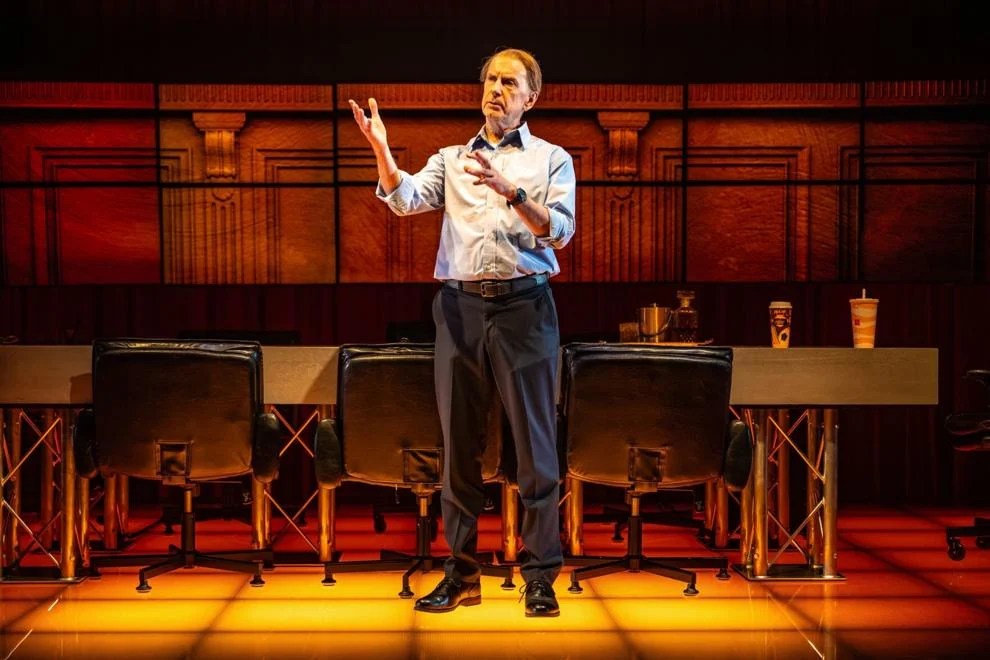
The second half of Other Desert Cities contains the explosive denouement. But even before that revelation, the play has descended into histrionics, with Silda coming into her own as the mirror up to her sister’s and niece’s behaviour; Polly going on full attack, threatening to sue her own daughter if the New Yorker publishes her; and Brooke getting increasingly angry, digging in her heels about publishing. As for Trip, he goes postal in an unnecessary way on the subject of why no one takes him seriously as the showrunner of a TV series about the courts, the judges, the juries, and so on. Lyman’s true role in the events now under discussion is finally revealed.

The lighting on the set was rather weird and the set itself, although well designed, just sits there. Palm Springs was traditionally the playground of Hollywood actors and directors because it was close enough to LA that performers could drive there on breaks and be back in time for shooting. But no effort is made to recreate that ambience.

The play could have used a soundscape to shape the mood, especially given the musical heritage of Hollywood. Nevertheless, Other Desert Cities demands to be seen.

Other Desert Cities

Written by Jon Robin Baitz, directed by Ilana Linden and produced by Amélie Martyn and Melody Schaal.

At the Alumnae Theatre, until Sunday February 2, 2025

Photo by Amanda Matlovich: From left, Lyman, Polly, Trip, Brooke and Silda

Rosencrantz and Guildenstern Alive, Revived and Hilarious

Billy Boyd and Dominic Monaghan lead a stellar cast in a fine production from Halifax’s Neptune Theatre that is a joy to behold and as bracing an engagement for the mind and the funny bone as one is likely to find on stage this season.

First performed in 1966, Tom Stoppard’s absurdist, existentialist play, running at the CAA Theatre until April 6, is as delightfully playful and funny as it ever was, yet newly challenging of our perceptions and our understanding of the uses of theatre.

It’s not as if director Jeremy Webb simply took the play out of mothballs. He enlivens and enriches Rosencrantz by casting experienced and agile actors and giving them plenty of physical activity, music and song. Set designer Andrew Cull’s ingenious use of a pair of movable bleachers makes the transitions in and out of the play at hand and the play performed by the tragedians in William Shakespeare’s Hamlet seamless.

Rosencrantz and Guildenstern Are Dead is above all else a comedy, full of snappy dialogue, wordplay and philosophical badinage. It is also makes a lively commentary on the purpose of theatre, life and death and the whole business of existence and

Webb’s casting of the wondrous Scottish actor Billy Boyd (Pippin in the Lord of the Rings trilogy) with his Lord of the Rings cast mate, the prominent television actor Dominic Monaghan, is the making of this production. This Guildenstern and Rosencrantz, lifted out of their minor roles in Hamlet to become Stoppard’s protagonists, are post-modern versions of Samuel Beckett’s Vladimir and Estragon, passing the time with verbal game-playing and like any of Shakespeare’s clowns and commentators, as nimble of foot as they are of tongue:

ROSENCRANTZ: We might as well be dead. Do you think death could possibly be a boat?

GUILDENSTERN: No, no, no…Death is… not. Death isn’t. You take my meaning? Death is the ultimate negative. Not-being. You can’t not-be on a boat.

ROSENCRANTZ: I’ve frequently not been on a boat.

The curtain comes up on the two of them sitting on bleachers playing at coin tossing in an impossible sequence of flips in which every one of 76 tosses has resulted in heads. The theme of chance and fate and is firmly established. Also, the idea that that it’s only a thin veil that separates concrete reality from make-believe. Behind Rosencrantz and Guildenstern, through a flimsy black curtain we can see figures on bleachers viewing the coin tossers as if they were giving a performance, which of course they are.

Enter the Player, performed by Stratford veteran Michael Blake, a magisterial, yet often regretful, leader of a pack of tragedians – those who perform The Murder of Gonzago in Hamlet – but also the chief roles of Hamlet (a powerful Pasha Ebrahimi), Polonius (Walter Borden), Ophelia (Helen Belay), Gertrude (Raquel Duffy), Claudius (Jonathan Ellul) and others.

It’s all a delightfully complicated, an ironic display of theatricality and the play of language (“Words, words. They’re all we have to go on,” says Guildenstern. “Rhetoric! Game and match!” rejoins Rosenkrantz.)

Entertaining, enlightening and absurdly absorbing.

Rosencrantz and Guildenstern Are Dead

By Tom Stoppard

Directed by Jeremy Webb

Movement director Angela Gasparetto

Set designer Andrew Cull

Lighting designer Leigh Ann Vardy

Sound designer/ composer Deanna H. Choi

Produced by the Neptune Theatre

Presented by Mirvish Productions at the CAA Theatre in Toronto until April 6, 2024

Photo by @stoometzphoto: Dominic Monaghan as Rosencrantz, Billy Boyd as Guildenstern

Remounting a play about regeneration

Talk about dramatic catharsis. The Belfry Theatre’s remount of Yvette Nolan’s enduring play The Unplugging takes us through the pain of exclusion and the suffering of shunned women, through to survival, remembering and reconnection to community. Filled with music and laughter and ending with a kitchen party musical jam, this unplugging opens up the heart and brings a lump to the throat. But those were tears of joy.

“It is, I guess, a reconciliation play. That’s not what I was thinking when I wrote it. But I’m a half-breed, right?” Yvette Nolan, chatting on Zoom from Stratford, where she’s teaching the young artists of the Birmingham Conservatory, comes across as a thoughtful, generous writer with a buoyant spirit and a sense of wonder about life and other’s lives.

“The source material is an Athabaskan story called “Two Old Women” told by an Alaskan Gwich’in woman,” says Nolan in an interview recorded for the Canadian Theatre Museum.

“It’s an old story — pre-contact, generations ago. Two old women, in a time of need are banished from their community because they are old and grumpy and useless. Instead of dying they must go inside themselves and remember their traditional knowledge and in order to survive.”  Learning that the banished elders are thriving and not dead, their band sends an emissary to bring them back home.

As Nolan was adapting the tale for a 21st century context, a series of warnings, from the Toronto blackout of 2003, to the Japanese earthquake and tsunami to the extreme weather events contributed to an apocalyptic vision: a complete collapse of the world’s electrical grid. In the aftermath, two older women, Elena and Bernadette — 60-ish and 50-something respectively — are cast out of a cult-like, post-digital community ruled by the Laird. Director Reneltta Arluk has chosen to cast Bernadette as non-Indigenous, cementing the theme of reconciliation.

The Unplugging plots Elena and Bern’s journey in lunar fashion from Sugar Moon to Bear Moon to Pink Moon, from despair to survival to hope and joy. Elena, who has been forcibly detached from her daughter and grandson, regains her indigeneity, her traditional knowledge. She ponders what was lost when the grid went down: “Think of all the information that disappeared, in a blink. All the things we stopped writing down and putting into books, all the things we stopped teaching our children, all the things we need to know now, like, what is the shelf life of tea.” Elena’s recovery of her indigenous skills and knowledge is done in concert with Bern’s recovery of her female vitality. She acts as a goad to Elena in her lowest moments and finds her inner strength. Along with it, she regains the joy of touch sexual congress with Seamus, the young man who suddenly shows up in the women’s forest sanctuary, an abandoned summer cabin.

Nolan, born in 1961 in Prince Albert, Saskatchewan, where her Irish-born father was teaching in the penitentiary there, moved with her family to Winnipeg when she was six. As a young ballet student in the school of the Royal Winnipeg Ballet, she found her calling after seeing the ballet’s adaptation of George Ryga’s 1970 play, The Ecstasy of Rita Joe.

“It was the first time I recognized that our stories – Indigenous people’s stories – could be told on those big stages. It didn’t matter to me that Rita Joe and Jamie Paul were danced by a Spanish dancer and an Italian. What I learned in that moment was the power of theatre to raise people’s stories, to make my stories visible.”

The playwright, dramaturg, director and educator – a stellar artistic director of Toronto’s Native Earth Performing Arts company from 2003 to 2011 – admits there’s something of her mum in Elena. Nolan’s Algonquin mother, Helen Thundercloud née Chabot, was born and raised in Kitigan Zibi, a reserve at Maniwaki, north of Ottawa.

“She had no formal education. She was sent to residential school in Spanish, Ontario and then Kenora in the 50’s.” Despite the lack of necessary schooling, Helen could speak three languages: Algonquin  French and English.  As Yvette, born when her mother was only 17 or 18, sees it, her mother grew up in one patriarchy, married into another and then had to endure the ultimate colonial experience: the harsh racism of pure laine Quebeckers whose references to her as “une sauvage” she all too painfully understood.

Helen Chabot met Yvette’s immigrant father, son of a Sinn Fein fighter, after he’d fled to Canada from a seaside town outside Dublin, refusing to be conscripted into the English army.  “He was my mother’s math teacher, ten years older than his student.” They grew together out of a shared sense of colonial oppression. “When she graduated from the residential school, the nuns gave them a little wedding.”  But the struggle continued for Kevin Nolan.  As he was always trying to find a better job, they moved often and Yvette, elder sister to two younger brothers, witnessed the scorching anti-Indigenous racism of the prairie provinces. But today, Nolan has happily settled in Saskatoon. “I’ve got some really special feelings about Saskatchewan, these days.”

The Belfry’s production of The Unplugging is also a kind of homecoming: the show had its premiere in October 2012 at Vancouver’s Arts Club Theatre. Director Arluk, an Inuvialuk/Dene/Cree raised by her grandparents on a trap line in the Northwest Territories, once put up a production of The Unplugging  for her own Akpik Theatre in Whitehorse. This time for the Belfry she went for maximum celebration, bringing in Krystle Pederson, a Cree/Metis actor, singer and songwriter as sound designer. On opening night, Pederson warmed up the audience with a full-throated rendition of “Red River Valley” then took her place on set among the trees, playing musical interludes she composed.  Daniela Masellis’s emblematic forest set and lighting enclose the action for what is a very intimate play.  All three actors — Lois Anderson as Bern, aaron wells as Seamus and Marsha Knight as Elena – are outstanding in their roles, making the play very physical and dancey. Winnipeg’s Marsha Knight as Elena really anchors this show, embodying a proud, motherly spirit of reconnection and hope for reviving the broken dreams of unity among Indigenous and non-Indigenous communities.  

The Unplugging

Written by Yvette Nolan

Directed by Reneltta Arluk

At the Belfry Theatre, Victoria BC until March 3, 2023

Photos, clockwise, from left: Marsha Knight as Elena, Lois Anderson as Bern, čačumḥi – aaron wells as Seamus; playwright Yvette Nolan. Photo credit: Don Craig

“I’m worried about your health…it seems to be improving.”

In its opening moments, Morris Panych’s Vigil is a straightforward black comedy about a man visiting his aunt on her deathbed. It’s a good text for a stand-up comic. Then as we get into the second act it’s pure theatre of the absurd. Looking back after the curtain comes down, you realize that Panych wasn’t just riffing on death and dying. He nailed another universal theme: the need to feel loved and accepted.

Panych himself directed the first production of Vigil, which took place at the Belfry Theatre in 1995. Glynis Leyshon was the Belfry’s artistic director then. Twenty-seven years later she has returned to the Belfry to direct this production. She shows a sure hand indeed. In the intervening years, Vigil took over lots of theatres in Canada and abroad. Of the many Panych plays – he’s written upwards of thirty of them – this one sticks in the mind like no other.

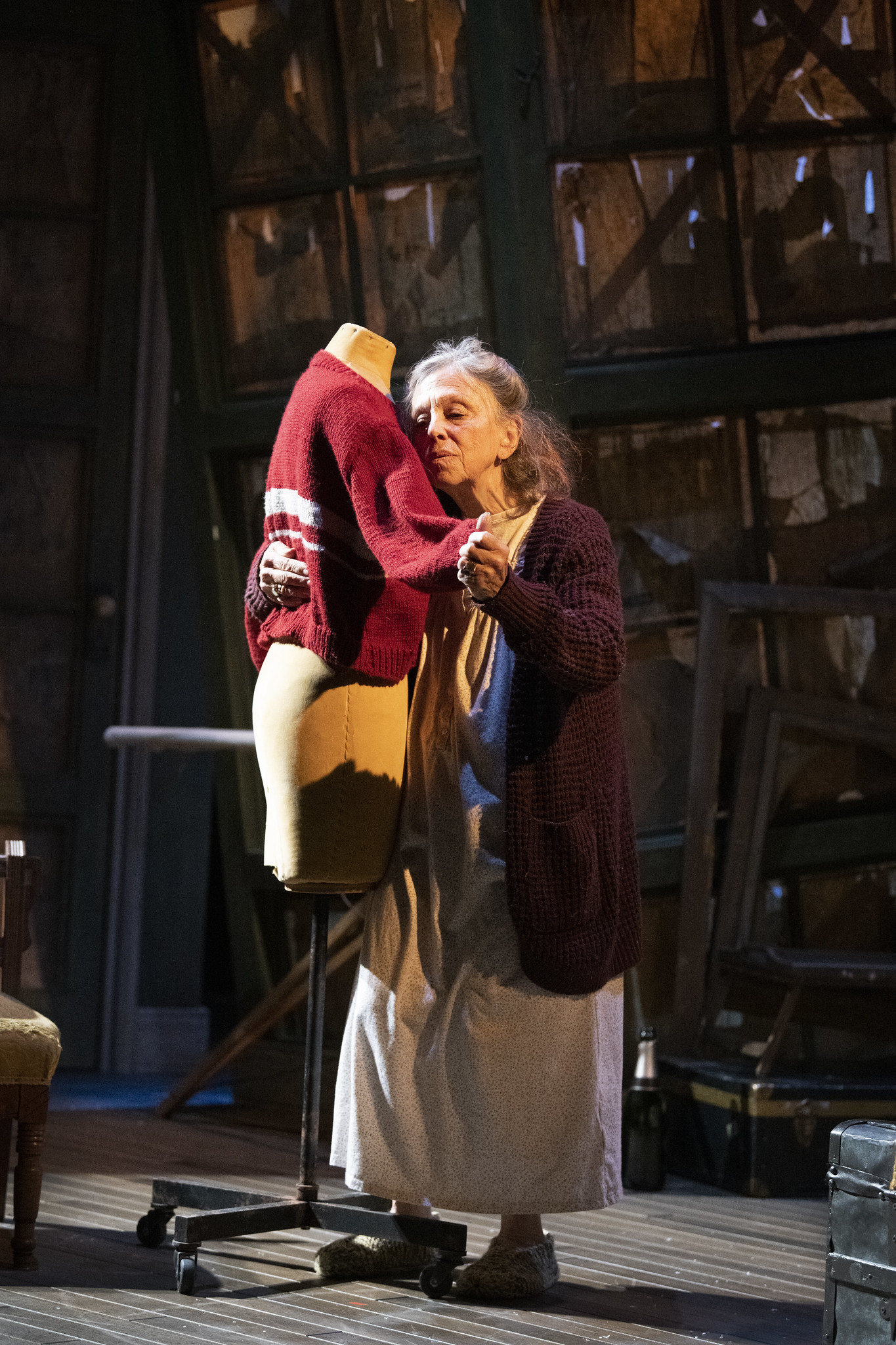
“Why are you looking at me like that. I’m your nephew. Okay – so I didn’t visit you for thirty years.” This is Kemp, played by Anton Lipovetsky, addressing Grace, who sits silent in her bed propped up by pillows. As Grace, Nicola Lipman must act without words, which she does very well.

It soon becomes clear that Kemp is more interested in his aunt’s death, and how it might benefit him than in tending to her in her final days. Bearing a clipboard, he proffers a will for her signature: “You are leaving it all to me.” The vigil lasts days, then weeks, then passes the year mark.

Kemp puts on a sham show of concern. “What am I supposed to wear to your service?” he asks. “Let’s not talk about anything depressing. Do you want to be cremated?” Grace, her meals served to her bed, alternately smiles, nods, rolls her eyes and occasionally hurls something her nephew.

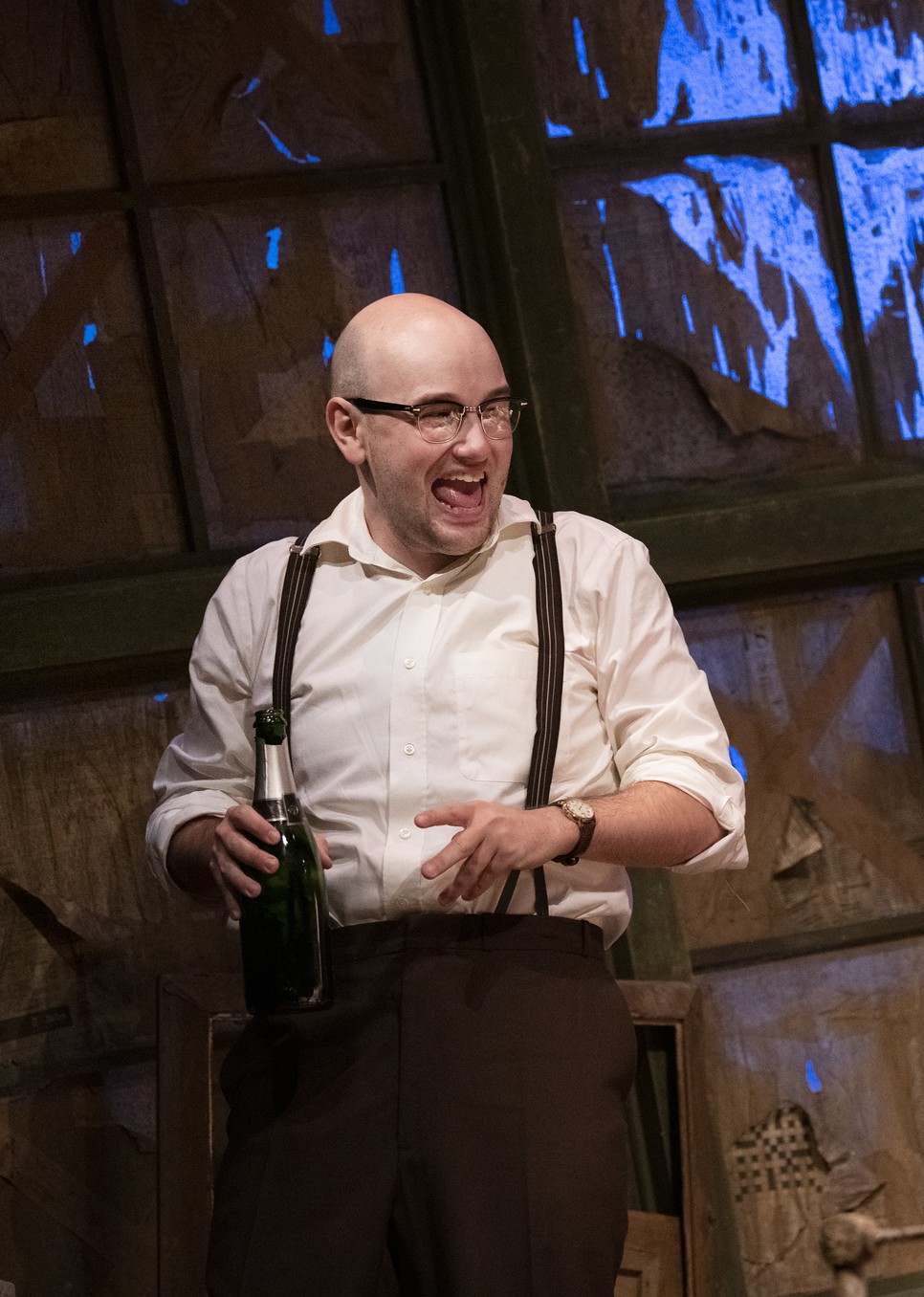
Vigil is a well honed play. Nearly all the spoken words are Kemp’s. He rambles from self-interest to self-pity to genuine concern, in the process confessing to crimes committed against him by an alcoholic mother. Unfortunately, Lipovetsky doesn’t express the nuances, delivering all his lines at much the same pitch and tone. Maybe he’ll grow into the part with the help of enthusiastic audiences. He can certainly move well.

Lipman makes an excellent bed-ridden aunt, except when her nephew is absent from the room. Then she’s delightfully spry, at one point circumambulating around her bed doing lunges and lifting (invisible) weights.

Ken MacDonald’s set is key to the action, with its aged walls, windows and doors skewed at crazy angles. The Belfry production underscores the durability of Panych’s plays. Long may he reign, in Gilbert Reid’s words, as “a driving force in the Vancouver and Toronto theatre communities.”

Vigil

By Morris Panych

Directed by Glynis Leyshon

The Belfry, Victoria BC

Live performances through December 11

Live-streamed November 29 to December 4 http://www.belfry.bc.ca

Photos of Anton Lipovetsky and Nicola Lipman by Emily Cooper

A hearty serving of satire and drama

Serving Elizabeth is a smash hit, well worth the 22 months’ wait to see live theatre again.

Out of a simple premise, playwright Marcia Johnson has forged an entertainingly complex production, full of satire, humour, drama, politics and provocative ideas.

Watching the first season of The Crown on Netflix in November 2016, Johnson was struck by the absence of any speaking roles for Kenyans in the episode covering Princess Elizabeth’s tour to their country in February 1952. The Crown screenwriter Peter Morgan’s dramatic focus was all on the royals and other white faces, as this was the occasion when Elizabeth’s father King George VI died, making her overnight the Queen of England and the Commonwealth.

Nigel Shawn Williams has his finest hour directing Serving Elizabeth, which premiered as a co-production of Western Canada Theatre and Thousand Islands Playhouse in February 2020. Cast and crew have worked this show to perfection.

In a village near the Nyeri Royal Lodge, a pompous Englishman (Ryan Hollyman) arrives at a tiny restaurant where he gets friendly service from Faith (Sia Foryoh) and an angry reception from her mother, the cook Mercy (Lucinda Davis). Turns out, after only briefly sampling the dishes served, that Lester Talbot, secretary to Princess Elizabeth, has come to offer Mercy an important job serving food to unnamed English dignitaries. Mercy will have none of it; only five years earlier she had participated in a women’s march protesting injustices done them by white settlers. The women were fined and rendered silent. But Faith is disappointed enough in her mother’s refusal to forge Mum’s signature on a contract big enough to guarantee Faith’s university education.

Ingeniously switching scenes through a swinging proscenium arch, the actors perform choreographed prop replacement to recreate a TV production office in London where Tia (Foryoh) is a Canadian intern learning about scriptwriting while doing a gofer job for Robin (Amanda Lisman), a politically charged lesbian and television showrunner. The problem at hand: Oscar-winning Brit playwright and screenwriter Maurice Gilder (Hollyman) has just turned in a dreadfully colonial, tacky script for a series about Queen Elizabeth, starting with the Kenyan episode.

Strangely, Kenyan-born Tia is not enthused about a trip to the country of her birth for the upcoming shoot. “But it’s part of your heritage,” says Robin. “So is the plague,” Tia responds.

Love interest comes in the form of a chauffeur to Lester Talbot, a man named Montague (“I have a French name,” he boasts to Faith.) Nathan D. Simmons plays Montague and then reappears in the TV production office as Steven, auditioning for the abominable Gilder script, which involves kissing the feet of a princess. This time he is smitten by Tia. We begin to see where this generational plot is going.

A highlight in the swiftly moving two-hour production is the scene where the BBC has just announced the death of the king. Princess Elizabeth (Lisman) is in the lodge awaiting the return of Prince Philip from an outing. Talbot doesn’t want his princess to hear the news on the radio and charges Mercy — now in white uniform and trained in proper comportment before royals — to keep Elizabeth occupied so that she may learn the news from her husband. Lisman’s princess is high-handed at first, but Davis unleashes Mercy’s fury in an attack on the princess, spelling out all the harms, including the death of her husband, that imperialism has brought to her and her compatriots. “It is refreshing to have someone speak to me as an ordinary person,” says the enlightened princess. Mercy extends her arm for a handshake.

Johnson made some intriguing choices in creating this play. The Kenyans sound more Jamaican than African, but the actors speak effortlessly and therefore sound completely authentic. Johnson gives Tia a backstory that reflects Sia Foryoh’s own birth and early childhood in Sierra Leone and Senegal, accurately reflecting 21st-century  global culture in contrast to the imperialism that lingers in Gilder, the pompous screenwriter.

And Johnson and her director pull off a tricky meta scene, showing Gilder reading potential revisions to his script while upstage Faith and Mercy perform it. Such business gets a lot of help from set designer Camellia Koo, composer, sound designer Joelysa Pankanea and costume designer Vanessa Magic.

Serving Elizabeth serves its audience very well indeed.

Serving Elizabeth

By Marcia Johnson

Directed by Nigel Shawn Williams

At the Belfry Theatre in Victoria BC until December 19, 2021

Photo of Lucinda Davis and Sia Foryoh as Mercy and Faith by Peter Pokorny

A popstar’s failure opens the door to success

Vivek Shraya makes a convincing case for How to Fail as a Popstar. But she’s a success in the “I Did It My Way” mold. On the evidence of this show, Shraya is a terrific writer and performer, with a great voice and a gift for mimicry.

Popstar, a world premiere at Berkeley Street Theatre, was written by the self-described queer, trans, brown performer. And Shraya made it as an author, with the bestselling I’m Afraid of Men.

A straightforward tale of failed dreams, this one-woman show is spiked with satire, jokes and laugh-out-loud impersonations of the people in the Canadian music industry who helped Shraya along on her way to failure. And songs, which she performs in period moves choreographed by William Yong.

Covering all the gender bases, she enters in a full-length spangly gold cape over a black shorts jumpsuit, in glittering black high-tops and sparkling eye shadow to set off her abundant long blond hair; we don’t miss the chest hair peeking through her V-neck top. “I did not become God. I never got to perform with Madonna,” she says in reference to her youthful ambitions.

It’s a long story. Vivek, the son of Indian immigrants, grew up and went to school in Edmonton. He was teased, called faggot. He was geeky. But he had his own style, which girls at his junior high school approved of — and a voice. “You were chosen,” Vivek remembers thinking at services in the Sai Baba Temple. “I could feel my own divinity.” To demonstrate, she sits cross-legged on the stage and sings a bhajan, one of the hundreds he/she learned at the temple.

In the section entitled “The Judge”, Shraya gets a lot of laughs with her portrayal of Edmonton as a city of malls. The Youth Talent Quest, which she finally won at 19, wound up in the West Edmonton mall in the biggest food court. Vivek’s win, after many tries, was for a song of her own, “Madrid.” The judges, most of them older women in “floral blouses with shoulder pads,” had a suggestion. “Have you ever considered wearing leather pants like Ricky Martin?”

Eventually, Shraya gets the break she needs to “get the fuck out of Edmonton” and with a $20,000 loan, guaranteed by her parents, starts recording her songs with a Toronto manager. Her temporary housing was in the apartment of an assistant to the manager who calls herself Mama Carla. “I should have done my research,” Shraya tells us. Mama Carla’s luxury apartment turns out to be in Mississauga and every time the budding popstar starts asking questions about his progress, Mama Carla demands a backrub.

There is much more delight, honesty and poignancy. Defeated by the Toronto music scene, Vivek decided she was going back to Edmonton. Vivek’s mother was so accepting she asked her son if he was sure he has finished what he must do in Toronto.

The end of the show is a recitation of forty reasons why Vivek failed as a pop star. “Number one: I was born in Edmonton . . .”

Failure is relative. Shraya actually reached a stepping-stone to musical success with a Polaris prize nomination for an album made with Queer Songbook Orchestra: Part-Time Woman. And she needn’t worry about failure from here on in.

How to Fail as a Popstar

Written and performed by Vivek Shraya

Directed by Brendan Healy

Choreography by William Yong; sound design by James Bunton

Set and costumes by Joanna Yu; lighting design by C.J. Astronomo

Photo of Vivek Shraya by Dahlia Katz

Sunlight brought to a Vancouver women’s world

Marjorie Chan has done wonderful work bringing forward the six characters from Sunrise, a 1936 Chinese play by Cao Yu, in a multi-layered contemporary drama set in a money-and-real-estate-obsessed Vancouver.

Lady Sunrise takes its name from a beauty pageant in which Penny (Lindsay Wu) was once a runner-up. A native of Richmond BC, she now prefers to be known as Lulu and her work as a model has led to gigs as a paid companion to politicians and celebs at public events. She’s learned the lingo of female success (“Believe in yourself. . . fight the patriarchy”), but failure lies just around the corner.

Her boyfriend is Frankie Pan (the “men of the male species” in this play are present only by word-of-mouth), a denizen of clubs and casinos.

Tawny Ku (Ma-Anne Dionisio) is Penny’s auntie, not her real mother, but someone who takes a controlling interest in her. Tawny, known to her banker as Crazy Ku, is big in real estate – thanks to money obtained through husbands past – and she is on the verge of closing a deal on construction of a Vancouver condo tower.

Banker Wong (Rosie Simon) is a marathon runner, as aggressive in her power suit as she is in running shoes. Dealer Li (Zoé Doyle) is a croupier at a Vancouver-area casino and she has a less glamourous tale to tell. “I was a cleaner here first,” she says. Then her husband lost his job and she had to go to work as a blackjack dealer, a job that entails long hours and long waits for public transportation at night.

Charmaine (Louisa Zhu) enters in more traditional Chinese silk pants and short tunic. She finds Banker Wong on the road crippled with a Charley horse and fixes her up with a calf massage. Apparently Charmaine runs a massage parlor. Sherry (Belinda Corpuz) is the victim of an accident or injury: she appears in a hospital gown.

So tightly written is Lady Sunrise, that sorting out the relationships in the play can be a challenge. Despite the strong element of satire, it’s clear some tragedy is about to unfold, but you have to backtrack in your mind to see how the various characters are connected to it.

Director Nina Lee Aquino has staged the play on a series of ramps, angled up to one corner stage back and offering the perfect metaphor for parallel lives. At intervals during a character’s monologue, the other four or five women enter in formation in belted trench coats and neon-coloured wigs. They don’t speak but make an effective Greek chorus in their fancy footwork.

All of the actors turn in absorbing performances. What strikes the viewer is not some insight into the lives of Asian-Canadian women, but the fact that their stories could involve women of any background. In a week when Harvey Weinstein was sent to jail for sexual assault, Lady Sunrise seemed especially well timed.

Lady Sunrise

Written by Marjorie Chan

Directed by Nina Lee Aquino

Set design by Camellia Koo; costume design by Jackie Chau

Lighting design by Michelle Ramsay; sound and composition by Debashis Sinha

Movement directed by Natasha Mumba

At Factory Theatre, Toronto until March 8

Photo of (back) Zoé Doyle, Rosie Simon, Ma-Anne Dionisio, Louisa Zhu, Belinda Corpuz and (front) Lindsay Wu by Joseph Michael


A monologue in dance disturbs

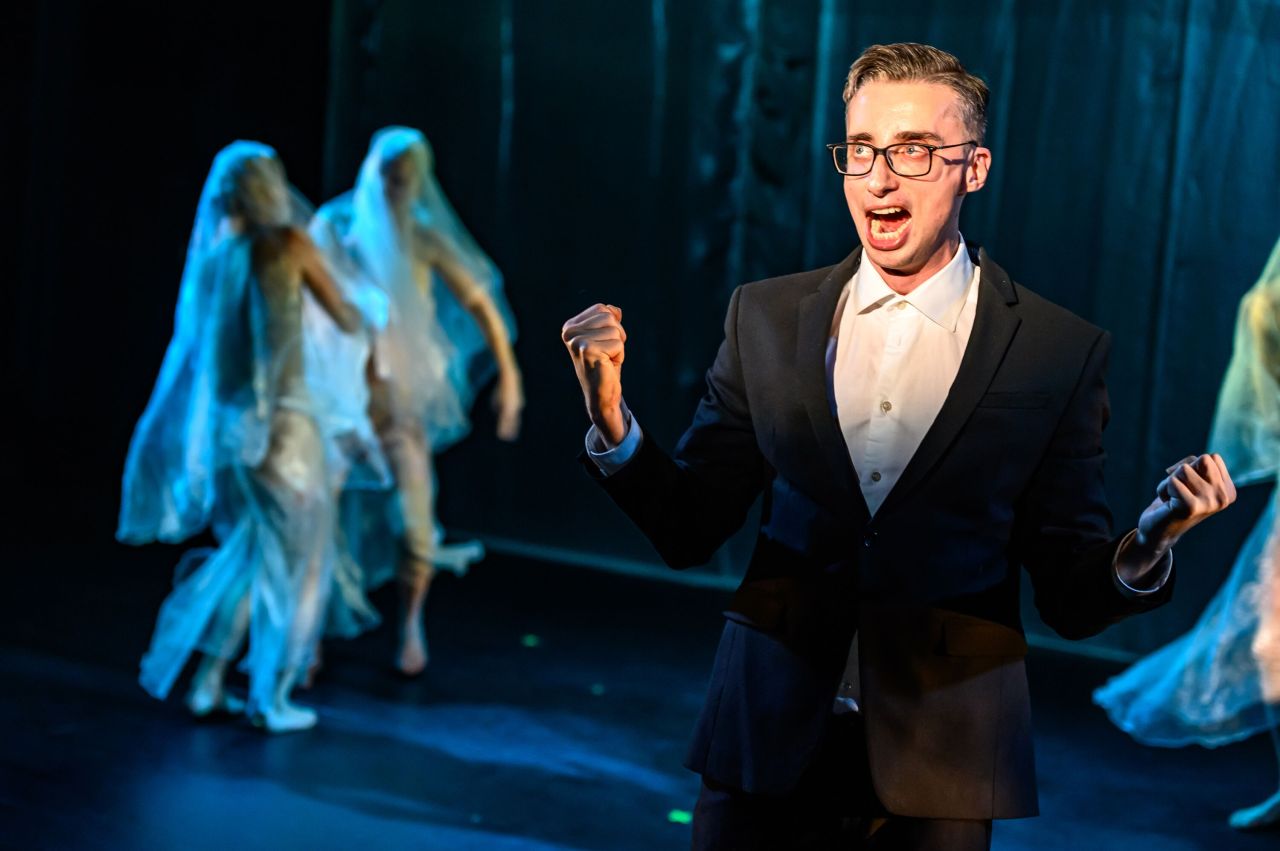
Toronto actor Simon Bracken has the only speaking role in The Particulars. He’s Gordon, a very twitchy, quite off-putting fellow suffering from insomnia complicated by a bad case of obsessive-compulsive disorder. He’s dressed in a loose satin robe sashed over oft-revealed underpants.

In the vein of monologists Spalding Gray and Eric Bogosian, Bracken tells Gordon’s story as he enacts it. Gordon, a single man, has a set routine that involves tending his garden, which has become infested with aphids, watering his orchid, daily buying a bouquet of fresh flowers and performing his clerical duties in an office job where he fears ostracization.

Accompanying Gordon as if they were ghosts are seven dancers, draped head to toe in sheer veils, like dead brides (except one is a man). Matthew MacKenzie, creator of the very successful show Bears, wrote and directed The Particulars as a fusion of dance and theatre. Alida Kendell choreographed the movement. The fusion is less than complete, in that one can focus on Gordon’s increasing agony – and it’s hard not to – or on the active ensemble of dancers, but the two performances never really meld. Mostly the dancers’ movements, especially when they’re balled up on the floor scratching themselves, merely illustrate a story we can easily imagine from Gordon’s words.

Gordon seems made for bullying and a figure to make fun of. For the first 30 minutes or so, we laugh at his desperate manoeuvres, such as studying hockey statistics so he can sound knowledgeable about the game among his male colleagues. The reason for Gordon’s insomnia and neurosis is not immediately made known. Once his tragedy is understood, laughing at him becomes a problem.

Dancers Amber Borotsik, Lara Ebata, Bridget Jessome, Richard Lee Hai, Krista Lin, Rebecca Sadowski, Kate Stashko and Raena Waddell, cast as “mourners”, are competent enough, but because their faces are veiled, it’s hard to engage in their expressive movements.

This show needs more of the inventiveness displayed when the dancers form a human tower, illustrating Gordon’s fear that the scratching that awakes him every night might come from a squirrel trapped in his chimney.

The Particulars

Written and directed by Matthew MacKenzie

Choreography by Alida Kendell

A Punctuate! Theatre production presented by the Theatre Centre

At the Theatre Centre until October 26; in Edmonton Nov. 1-2

Photo of Simon Bracken as Gordon by Dahlia Katz

Reliving the 70s, 80s and 90s in style

Rick Miller is a treasure. The Montreal-born, Toronto-based writer, director and performer is the kind of guy who animates a set the minute he walks on stage. BOOM X, The Music, Politics and Culture of Generation X is the second in a trilogy of plays that began with BOOM, which chronicled the baby boom generation. (BOOM Y will premiere in 2021.)

The era of the baby boom generation (1945 to 1969) had a kind of homogeneity, Miller explains in his intro, that made BOOM a quite different proposition than the conflicted, messy and polarizing times of the 1970s, 80s and 90s. But just his thing, for Miller, born March 12, 1970, is a Gen-Xer.

A gifted impersonator and rock musician, Miller conceived a show that depends on the light and production design of Bruno Matte, Nicolas Dostie and Irina Litvinenko to provide a multilayered, multimedia buzz. At more than two hours in length, BOOM X feels like a big show, but it’s just one man in multiple costumes and wigs, acting in front of or behind a scrim over which video is running – along with headlines from each year he’s re-enacting. (His Tina Turner and Alanis Morissette are not to be missed.)

A baseball metaphor, employing the history of the Montreal Expos, provides the through line. Miller’s four Generation X representatives are introduced and framed as if they were on baseball cards: Howard, born in Winnipeg; Annika from East Germany; Steph from the small town of Exeter, Ontario; and Brandon, youngest of them, the son of a white South African and his Jamaican wife.

BOOM X is ingeniously presented. Four scrims surround a thrust stage upon the Belfry proscenium stage and as video footage comes up rapidfire on the scrim – everything from a scene from Altamont to a commercial for LIFE cereal to the shooting of four students at Kent State university in May 1970 – Miller either lip syncs their performances and speeches or acts as a narrator, or impersonates Howard, Annika, Steph or Brandon, telling each of their stories of the Generation X years. By the end we find out how they become important figures in Miller’s life.

Social commentary, political and cultural analysis, family history – BOOM X is all of these. But above all it’s just good entertainment, sure to please any generation.

Trailer: https://vimeo.com/351489824

BOOM X

Written, directed and performed by Rick Miller

Produced by Kidoons and WYRD Productions, in association with Theatre Calgary and The 20K Collective

At the Belfry Theatre, Victoria BC, until August 18, 2019


The Revizor, revised, revamped and reborn as dance theatre

revisor is a parable for our times, adapted in a uniquely expressionistic form of dance and theatre from Nikolai Gogol’s play The Inspector General (Revizor in the original Russian) by writer/performer Jonathon Young and choreographer/director Crystal Pite. This is the same team (including composer/sound designer Owen Belton and scenic designer Jay Gower Taylor) that in 2015 brought us the brilliant Betroffenheit.

With revisor Young, Pite and their collaborating performers Doug Letheren, Rena Narumi, Matthew Peacock, David Raymond, Ella Rothschild, Cindy Salgado, Jermaine Spivey and Tiffany Tregarthen have raised the bar again, with great inventiveness and spectacle, leading us into a nightmare-in-progress, reflective of the very political deceit, fake news, divisiveness and government corruption that dominate our airwaves today.

Gogol’s 1836 play, both a farce and a satire, trades in the same themes. He developed the play from an anecdote related to him by Pushkin, about the case of a lowly clerical figure sent to a regional outpost of the czarist empire on some minor assignment. The clerk is mistaken for an official of influence and authority and soon has the local department head and others toadying before him. For Young and Crystal, the play presents “a matrix for both voice and body . . .malleable and resonant.”

Inspiration for this adaptation of The Inspector General came from accounts of a 1926 non-naturalist production of the play by the Russian theatre director Vsevolod Meyerhold (1874-1940). Meyerhold eschewed method acting for a kind of physical theatre that harked back to commedia dell’arte and expressed the symbolism he found in the text in the physical movements of his actors.

Ingeniously, Young et al created a spoken text that works like a score, the performers mouthing the words as they are heard overheard while performing exaggerated movements as if they were human puppets. These movements tell the tale of deceit, for the emotions they express often belie the words the actors are mouthing.

The performance of the farce in a series of tableaux – with Doug Letheren as Director of the Complex, Jermaine Spivey as the Postmaster, Tiffany Tregarthen (in removable beard) as the Revisor and a blousy, Cindy Salgado as the flirtatious Anna, wife of the Director – opens and closes the piece. What transpires in the middle is a dance deconstruction of The Inspector General, plumbing the emotional depths of the play, while stage directions are voiced overhead. Expressionism reaches its height with the appearance of a figure bearing a huge set of antlers that then get used as crutches.

The movement of the 10 performers is extraordinary, very dreamlike, an effect heightened by Owen Belton’s electronic, industrial soundscape and Jay Gower Taylor’s abstract video projections that trace needle-like paths on the scrim like an electronic circuit gone mad. The words of the text are repeated and broken down into phrases that apply the idea of the revisor to the dance – constantly regrouping, revising the movement, getting down to the elemental level.

All to say, catch revisor if you possibly can, and hope that there’s a chance to see it more than once, for its complexity demands revisiting.

revisor

Created by Crystal Pite + Jonathon Young

A Kidd Pivot Production presented by Canadian Stage

At the Bluma Appel Theatre, Toronto, until March 16

Photo of Ella Rothschild, Cindy Salgado, Jermaine Spivey, Tiffany Tregarthen, Doug Letheren, David Raymond, Rena Narumi, Matthew Peacock by Michael Slobodian.