Gallery

Indigenous dance from two sides

NGS 1 - Angie Cheng & Karina Iraola - Credit Marc J ChalifouxIndigenous Dance Double Bill

Luu hlotitxw: Spirit Transforming by Dancers Damelahamid

NGS (Native Girl Syndrome) by Lara Kramer

Native Earth Performing Arts and DanceWorks CoWorks

Aki Studio, Daniels Spectrum, Toronto

April 21 to 23, 2016

Native Earth Performing Arts presents two indigenous dances that are poles apart, both geographically and culturally.

Luu hlotitxw: Spirit Transforming is based on traditional Pacific northwest Gitxsan dancing, singing and storytelling about a young man’s self-realization as he meets life’s challenges. NGS (Native Girl Syndrome) is purely contemporary in form, based on the degrading urban experience of the choreographer’s grandmother; it is a journey into alienation and self-destruction. Both need to be seen.

In Luu hlotitxw, Rebecca Baker, choreographer Margaret Grenier and Jeanette Kotowich enter the stage in long fringed dresses, button blankets emblazoned with totems, beaded headbands, moccasins, leg wrappers and decorated dorsal fins sticking out of their backs. These are the spirits of the orca and they move in ways to suggest the playful rising and diving of the Pacific killer whales – seen life-size in a video projected on the back screen. They chant as they move with silent footfalls in circular patterns.

Nigel Grenier sings too, in melodic phrases repeated with slight alterations (“yay ha hay /yo ha ho”). On first entry he bears a large bear mask in front of his face. The women surround him as he returns, bare-chested, to kneel on stage. They place cedar fronds in front of him. These are understood to be healing or protective.

The young man paints a black X on his chest with a paste given him by one of the women. He wears a second mask on re-entry, like the face of a small hunted animal. It is marvellous to see how these masks are animated by the dancer’s movement, so we sense without being told what this story is all about.  Another figure, a warrior with a very elaborate mask, comes in. The warrior attaches little heads to his mask, making him more animal-like and fierce, while the young man removes pieces of his mask to reveal the human beneath. In a clever bit of staging, we see him as a silouette on the screen depicting a forest, taking his rightful place in the universe.

In Montreal choreographer Lara Kramer’s dance for Angie Cheng and Karina Iraola, NGS, the women of the street, drugged, drunk or beaten down, are made faceless, their hair or their headwear obscuring their identities. This is a powerful reminder of the missing or murdered aboriginal women of Canada: unknown and unsought. The ubiquitous duct tape is a symbol of how they piece together a precarious existence.

Dressed like hookers in assorted found and damaged items, they stagger about, Iraola pushing a stroller and Cheng leaning over an old pram with a native symbol painted on it. At the back of the stage, a huge plastic tarp hangs in the rough shape of a teepee. Iraola makes her way  to music that goes from a loud, scratchy din to rock songs, such as “These Eyes,” to heavy metal music and drumming to something with the ironic lyric “…walk easy, walk slow.” In a head-hanging stupor, Iraola dresses in fake fur and huddles under her makeshift tent. Cheng, bare-breasted for part of her perambulations, rolls out a Canadian flag with a native image over the maple leaf. From one of her bags, she pulls out plastic miniatures of people and animals and places them in neat rows on the flag, as if this would make a home.

NGS takes a stereotype, magnifies it and flings it in our faces. The long silence at the end, as the two performers lay hunched over in the dark, is particularly affecting.


Top: Angie Cheng & Karina Iraola  Photo by Marc J Chalifoux

Below: Dancers Damelahamid  Photo by Derek Dix

Damelahamid 6 - Credit Derek Dix

On the road with a flipbook artist

Portraits in Motion

By Volker Gerling

World Stage 2016

Harbourfront Theatre Centre, Toronto

April 13 to 16, 2016

As viewers take their seats, Volker Gerling lurks in the shadows near the stage, where a podium with an overhead projector is prepared for his performance, a woman’s face already projected on the screen. This is a photographer, one thinks; he must be closely observing us all – are we potential subjects for his latest wanderings?

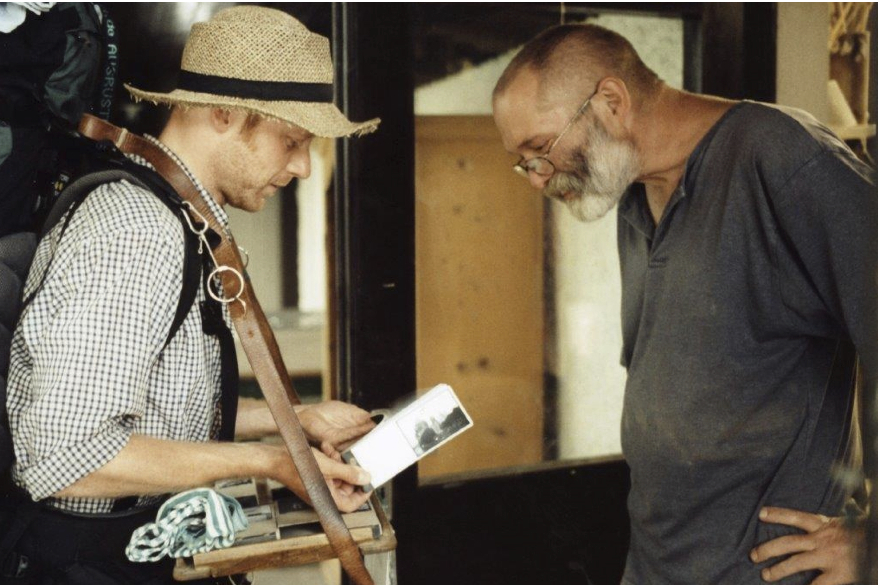
Gerling is more than a man with a camera; he’s a flâneur, that poetry-inclined stroller whose observations transcend external reality and become a work of art. It all began, he tells us in rather stilted English, with his purchase of a camera that snaps a series of photos in 12 seconds for processing into a flipbook. He experimented with a friend, a young woman in a red coat with lots of curly hair, whom he instructed to walk between two trees and hide behind them. The shoot was a failure, but out of that came the concept of the dropbook: Gerling flops down under the projector lamp a series of colour prints that reveal the sequence of the peek-a-booing friend, her disappearing shoulder and a couple of close-ups of tree trunks.

Around the same time, Gerling, whose show has toured 16 countries and won an award at the Edinburgh Festival Fringe, got into long-distance walking. His first big walk was from his home in Berlin to Basel Switzerland, a distance of 1,300 kilometres. Walking led to more subjects for his flipbooks, as well as the concept of the travelling exhibition, which consists of Gerling walking his route bearing a large backpack and a tray strapped to his front. The flipbooks are arrayed on the tray for the curious, who are invited to flip through them.

As for the photographs themselves, they are nothing remarkable, but for the way the subjects respond to being snapped multiple times. As Gerling remarks, 12 seconds can be a long stretch. On stage, Gerling thumb flips his books under the projector three times each so we can notice the sometimes minute changes of pose on the big screen. A man who looks like the artist Christopher Pratt barely moves, but appears to give a small sigh. A mother and daughter confront the camera and then turn to each other. A shirtless boy in front of a canal outside Münster wipes his nose.

Some subjects get into the role with gusto; a woman at a bar pulls up her sweater to show us her breasts, daring the camera to keep shooting. Others try defiance. In one flipbook where the portrait of a man and a boy appears unchanged over 12 seconds, Gerling asks us to notice a moving blade of grass – proof that the sequence is authentic.

The walks introduced Gerling to some colourful characters, including an old widower he met on the road who took the photographer into his home. But Gerling is not a born storyteller and his sing-song delivery and awkward phrasing make one feel he’s merely making fun of this charming old German. When he found that by creating bigger time gaps between shots he released “power and poetry,” Gerling embarked on some epic projects: photographing a building over many hours so that the moon appears to fly across the sky; shooting a scene from his Berlin building over four seasons; or following the movements of men using the urinals in a public washroom over an evening. In some cases, like the woman who posed for seven and a half hours while a candle burned down, we grow weary with this work.

By the end of the 75-minute show we’ve seen enough, although Gerling does get laughs and maybe even some customers. Viewers are invited up on stage to see the flipbooks, priced at $30 each.


Volker Gerling with his travelling exhibition of flipbooks.  Photo by Susanne Schule

Urgent stories of refugees from an eye witness

Spur Festival

Various venues, Toronto

April 7 to 10, 2016

Not all the news from the frontlines of the international refugee crisis is bad. British journalist Ben Rawlence spent four years in a 25-year-old African refugee camp, becoming an eye witness to a humanitarian crisis that few have observed so closely. Dadaab, a camp in the middle of the north Kenyan desert accommodating an ever-growing population of Somali refugees, was where Rawlence uncovered stories that spell out the tragedy as well as the glimmers of hope for displaced people whose inadequate, temporary accommodations have become home.

Both an investigative journalist and a fine storyteller, Rawlence has an urgent message to relate, encompassed in City of Thorns: Nine Lives in the World’s Largest Refugee Camp (Picador).

“Guled grew up in Mogadishu, playing amid the wreckage of the American helicopters shot down in 1993, the year he was born,” said Rawlence, relating one of the stories in his book for a session of the Spur festival in Toronto.  In 2010 Guled, an orphan, was captured by Al-Shabaab operatives in his school classroom and wound up as a teen patroller for the terrorist organization, seeking out those who failed to observe fundamentalist restrictions and targeting them for whippings. Eventually he was able to escape his captors and make the 644-kilometre trek to Dadaab, an unfenced small city of five suburbs where everything is built of thorn tree branches and found materials. The camp is surrounded by a 90-kilometre stretch of waterless desert.

“It’s a city of sticks and mud,” he said, where because of its designation as a camp, the Kenyan government forbids the use of bricks and mortar or concrete or the construction of anything as permanent as proper toilets. Refugees are also forbidden employment.

Working out of the UN compound in Dadaab, Rawlence interviewed more than a hundred people, while gathering statistics and reporting on the larger story of refugees. The crisis has escalated since 9/11, he said. “In the past, large-scale repatriation occurred. Today, countries are accepting far fewer refugees.” Repatriation for the several generations of Somalis now living in Dadaab becomes an ever-receding dream; only possible if peace is established in their home country. The refugee population meanwhile has grown from 100,000 to nearly 500,000. And with all the attention focused on Syrians, these Africans fear they’ve been forgotten.

On the upside of the refugee experience, for people who think of their lives in the future tense, the camp provides education, empowerment for women, a democratic form of governance and a lively black-market economy. “It’s the biggest market between Nairobi and Mogadishu, generating an estimated $30 million a year in transactions.” If governments were to legitimize this activity, Rawlence said, they could benefit from tax income.

Spur Toronto, a festival of politics, art and ideas put on by the Literary Review of Canada and Diaspora Dialogues, continues Friday night with a talk-show format in which podcaster Vish Khanna hosts discussions with festival speakers and authors.  A panel on LGBT media activism, moderated by Susan Cole, takes place Saturday morning at Hart House. The festival runs through April 10. For times, venues and program details, go to http://www.spurfestival.ca

Dance distilled to its essence

Jackie Burroughs is dead & what are you going to do about it

By D. A. Hoskins

Harbourfront Centre Theatre, Toronto

April 7 to 9, 2016

You might think that a title alluding to the late, great actor Jackie Burroughs might be attached to a dance with strong narrative, dramatic elements. You would be wrong.

Over four years of preparing this show, D.A. Hoskins and his performers, sought to reduce dance to its basics: sound and movement. As Hoskins says, they were trying to isolate the “physical” in “physicality.”

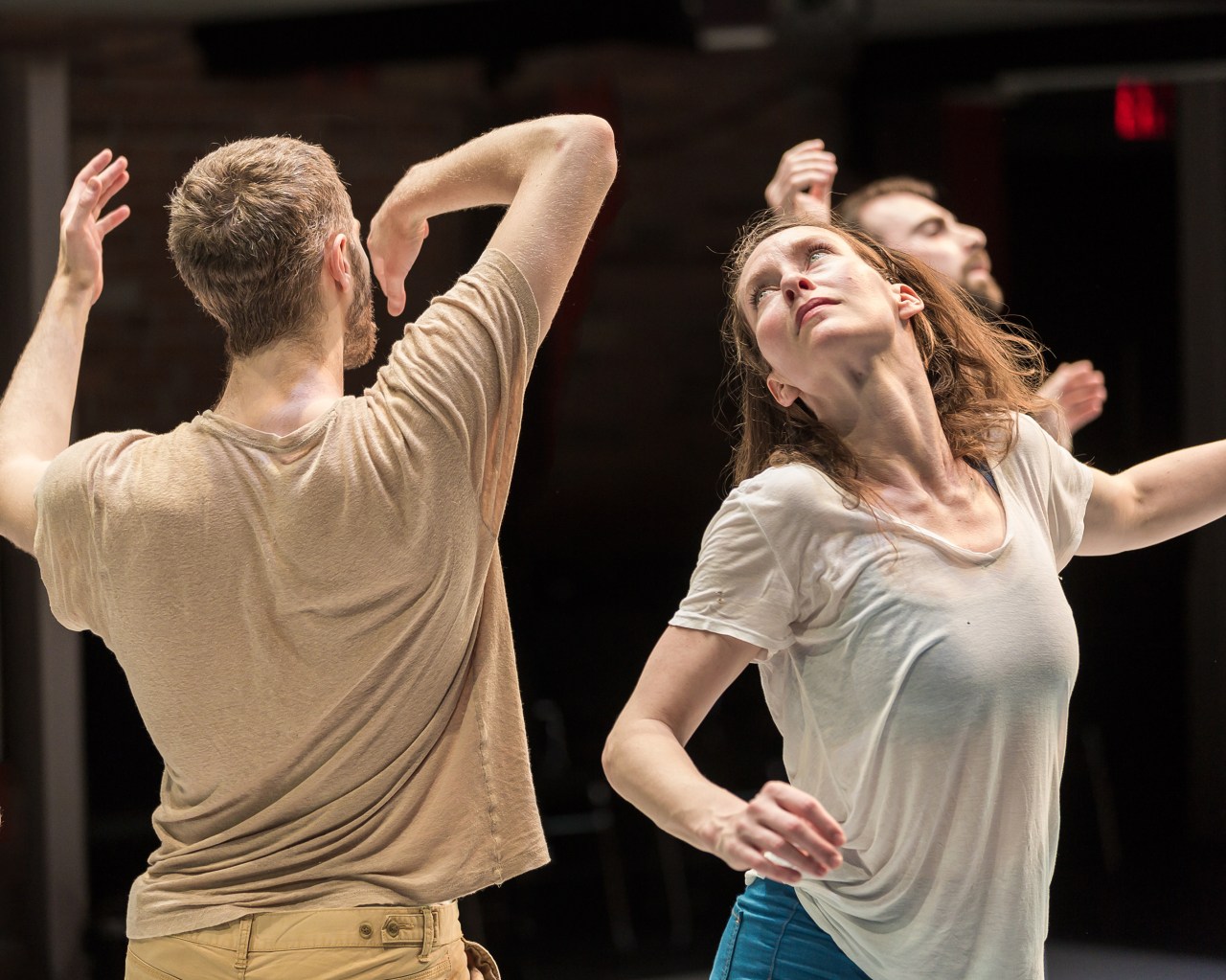
The audience is positioned around three sides of the performance space, on the same level as the dancers and musician. As we take our seats, Danielle Baskerville, Luke Garwood  and Robert Kingsbury, dressed formally, are standing and strolling around, speaking in low voices to each other. It’s as if we’ve walked in on a cocktail party seen through a soundproof glass.

That prelude serves to distinguish life from art. For when the lights come back up on the show, the performers enter in socks, wearing unremarkable T-shirts and jeans. At the corner of the performance space, musician Christopher Willes, crouched on the floor, is surrounded by his electronic devices. The sound accompaniment for Jackie Burroughs is a shell, a literal auditorium, consisting of a steady hum only slightly modulated from movement to movement of the hour-long show.

To go this minimal and demand this much attentiveness from an audience requires disciplined  and accomplished performers.  Baskerville, Garwood and Kingsbury fit this bill and their presence keeps up a feeling of hopeful anticipation as they go their meandering way, expressionless and unconnected for the first portion of the show.

Gradually they dance together, in pairs, and as a trio, whirling occasionally into muscular solos. The choreography is classic modern, contract and release, with a principle of over-balancing informing the folding and unfolding of limbs and torsos. Repetitive shapes, such as a kind of sideways falling arabesque, make patterns we can almost decode. There are some lovely lines and graceful partnering among the intricate combinations , but never any suggestion of a dramatic arc. Eye contact is rare and meaningless.

Dance distilled to this kind of physical abstraction can make its own story and the language here – the flowing movements of each dancer, reaching , straining, collapsing and rising again – is for the most part engaging. Rather as if the statues in the garden came to life under the moonlight.

Hoskins runs the risk of allowing minor distractions to take one’s attention, which the appearance of Garwood’s underwear, the stage lighting staining the face of a spectator or Willes’s tinkering with a mylar sheet and skewers placed in a tin can certainly do.

Worse is the electronic sound itself, sometimes suggestive of water rushing, or a distant avalanche, but mostly irritating, like radio static; for some maybe anxiety-inducing.

This is a show to attend for the exercise it is. An hour in which we appreciate the elements that go into a great performance. Something Jackie Burroughs understood well.

Photo of Robert Kinsbury, Danielle Baskerville and Luke Garwood by Jeremy Mimnagh

Crackwalker reimagined, with all its original punch

Crackwalker

By Judith Thompson

Factory Theatre, Toronto

March 22 to April 10, 2016

Judith Thompson’s plays are poetry for the stage. As such, ungovernable, a bit messy, exhilarating, affecting at a level beyond the intellect. All the better, then that she should direct this latest production of Crackwalker, a play she wrote in 1979, shortly after graduating from theatre school. Her inspiration came from work she’d been doing in Kingston with the provincial Ministry of Community and Social Services.

But the language ­– the stories – came from some deep well that only Thompson knows.  Don’t expect any neat resolution at the end of Crackwalker. For Factory’s production, the last in its Naked season, Thompson has reimagined the role of the Crackwalker. Played by the Anishnaabe performer Waawaate Fobister, he is a storyteller, a spirit guide, a reflection of the demons that haunt the others and a redeemer. Crackwalker opens the play, doing a grass dance on the bare stage, the floor painted with shapes in primary colours pieced together in a circle. Throughout  the play Crackwalker weaves in and out of the action, sometimes wearing a mask, delineating different, sometimes opposing, realities.

Enter Theresa, played by Yolanda Bonnell, speaking in infantile fashion to herself.  The first words out of her are enough to get our attention: she’s been accused of “suckin’ off queers.” Theresa’s only friend, Sandy (Claire Armstrong), arrives to accuse Theresa of having sex with Sandy’s husband Joe (Greg Gale) in their home. Theresa accuses Joe of raping her: “I didn’t want to,” she whines. The two women patch it up, until Joe appears to assail the “retarded whore” in the language of this doomed urban landscape of generational poverty — words such as “poke”and “hole” – to deny any wrongdoing. As if Theresa was everyone’s property, to do with as they will.

Theresa is wanted and loved, though, by Alan (Stephen Joffe), a car-crazy barely employed friend of Joe’s, who looks up to him as would a man in need of a father. Alan calls Theresa his Madonna. They will marry and have a child – in defiance of the “cock-sucking” social workers’ order to have Theresa’s tubes tied. The second half of the play concerns the death of their baby and a reconciliation of sorts between the warring Joe and Sandy.

The physical and verbal violence of Crackwalker is relentless. (Fight director Casey Hudecki did her job well.) Only Theresa finds any non-combative way to behave, giggling at inappropriate moments or withdrawing into her fantasies. Everyone else wants only one thing –“We gotta get out of this place,” Joe sings. Anger over threatened masculinity (Joe), sexual betrayal (Sandy), control by government or doctors (Alan) simmer close to the surface at all times. Peace, calm, salvation are but receding goals.

Offsetting the shouting, thumping and nightmarish visions (a tumour like a cauliflower emerging from a woman’s vagina) are moments of sick humour: Theresa feeds her baby baloney; a knock at the door could be Charlie Manson.

The interplay between the Crackwalker and the other characters gives a spiritual depth to this production.  Confronting Alan with his own demons, he alludes to the Ojibway story of two rivers flowing in different directions, one a river of poison, the other clean, clear water. Crackwalker is sometimes a guardian angel, giving away a fossil – a kind of talisman to protect one on a journey. Finally, he seems to embody the spirit of Theresa’s dead infant. All of the roles present challenges for the actors. The surprisingly agile Yoland Bonnell has to gain our sympathy as Theresa,  doomed but not entirely guileless. Greg Gale asserts a moral authority despite his obvious shortcomings as the drunken, disappointed Joe. Claire Armstrong projects Sandy’s meanness, but eventually has to convince us of true feeling for her husband. And a bristly Stephen Joffe has to transform from innocent boyfriend to vengeful son and husband.

A crude painting hangs above the stage:  a naked woman, her womb highlighted, flanked by two vivid orange spheres. It isn’t clear what function this sole prop serves. This production is so well directed as to transport us to various hells without need of set or properties.

Photo: Stephen Joffe and Yolanda Bonnell. Credit: Joseph Michael


Powerful remount of a Canadian classic

A Line in the Sand

By Guillermo Verdecchia and Marcus Youssef

Factory Studio Theatre, Toronto

March 8 to 27, 2016

Fulfilling the promise of the “naked” season at Factory, A Line in the Sand is a Canadian classic and has been re-staged to pack even more of a wallop than it did in its original productions in 1996. Director Nigel Shawn Williams has put the play into the small Studio theatre, placing the actors in a big sand box flanked on two sides by the audience. With that decision, he has made the play a pressure-cooker performance that strikes us in a visceral way.

The energy that flashes from the first encounter between Canadian soldier Mercer and a Palestinian teenager, Sadiq, never lets up, although the dynamics of the first half of the show are very different from the second half. The setting is somewhere between Iraq and Kuwait in the 1990-91 Gulf War, on a beach where Mercer goes to escape his fellow soldiers at the nearby Canadian base. Morgan David Jones plays Mercer, by turns jumpy, angry, sad, needy, hand on the trigger. Danny Ghantous is Sadiq, fearless, cavalier, an opportunist with pornographic pictures to sell to the soldier and a dreamer who believes he’s bound for a better life in Kansas. In the USA, according to Sadiq, everybody can be rich. “Only lazy people poor in America.”

Much depends on dialogue and body language in this well made two-hander, where mood can shift in a sentence. Guillermo Verdecchia and Marcus Youssef bring a lightness of touch and a seriousness of purpose to this play. Ghantous is a highly credible Sadiq, with flawless accent and a way with words as he shouts “Canada Dry” and sings “Frere Jacques” to win over the cautious Canadian soldier. He smells his need but when Mercer turns on him, Sadiq crumbles.

Jones is equally adept on an emotional scale from stoic to abject. The first act of A Line in the Sand is about the development of a real bond between these two young, men, estranged from their fathers, missing their mothers, and caught in a conflict that makes no sense. Their exchanges are punctuated with blackouts and strobe lighting and the sounds of gunfire  ̶  war scenes captured through the light of an explosion. The beauty of this play is that it takes the political and embeds it in the personal.

Before the intermission the actors, including John Cleland, whose main role is in the second half, step out of the play to circle the stage reciting statements by Prime Ministers Brian Mulroney at the time of the Gulf War and Stephen Harper announcing Canada’s engagement in further middle east conflicts. This interlude serves no dramatic purpose and seems unnecessary: A Line in the Sand resonates with us as powerfully today as it did 20 years ago.

The lights come up on the second act with a Canadian colonel (John Cleland) interrogating Mercer, literally scared stiff, about the murder of a young Arab who has been captured, tortured for no apparent reason and subsequently shot dead in the back. The victim is Sadiq and the language of the report the Colonel reads is graphic. The colonel is, or pretends to be sympathetic to Mercer, who has developed a bad stammer. He tells Mercer he wants to get him off the hook. Jones plays Mercer as completely hollowed out, struggling to maintain a soldierly mien whilst clearly devastated by events. His culpability is not the issue here, so much as the psychological hell he’s arrived in. The colonel completes the job of tearing him down, a process apparently started in the home: Mercer is a foot soldier, but his father is a powerful bureaucrat in the Department of National Defence. The denouement is searing and very affecting.

The sand in which the players are mired is an effective motif: proffered in handfuls as something for nothing, pouring out of a canteen as a phantom life-saving drink of water, or slipping through hands like time running out for salvation. Mercer’s camera becomes a device for establishing truth, where no truth – including who killed Sadiq – can be established. Like the photos that titillate but are no substitute for Mercer’s girlfriend, the camera brings no guarantee of a hard, undeniable reality.

Photo of David Morgan Jones and Danny Ghantous by Dahlia Katz

Akram Khan delivers in Toro

Toro

By Israel Galván and Akram Khan

Performed by Akram Khan

Presented by Canadian Stage

Bluma Appel Theatre, Toronto

March 9 to 12, 2016

After a knee injury forced Spanish flamenco dancer Israel Galván de los Reyes to stand down from his collaborative show with British dancer Akram Khan, Torobaka became Toro (meaning “contest”). Re-envisioned without Galván it is not half a show, and not exactly a solo dance, but given the flamenco dancer’s virtuosity, generates less excitement than the original.

Conceived as a conversation between two classical dance forms and two giants of contemporary dance, Toro is set in a circular stage reminiscent of a bull ring. Flamenco has its roots in India and it is easy to see the parallels in the northern Indian kathak dance form in which Khan was trained. The stamping of the feet, the heavy percussive beat of the music and the dominance of the male are common to both.

Akram Kahn is a phenomenal performer and doesn’t disappoint. His four musicians take up the part of the missing flamenco dancer, coming into the circle either to partner Khan, as does palmero Bobote in an opening scene of clapping and flamenco foot-stamping, or to perform duets of their own, as do countertenor David Azura and contralto Christine Leboutte. Indian percussionist B.C. Manjunath holds the whole show together, with his drumming and his recitation of the hard-consonant sounds of the rhythmic “bols.”

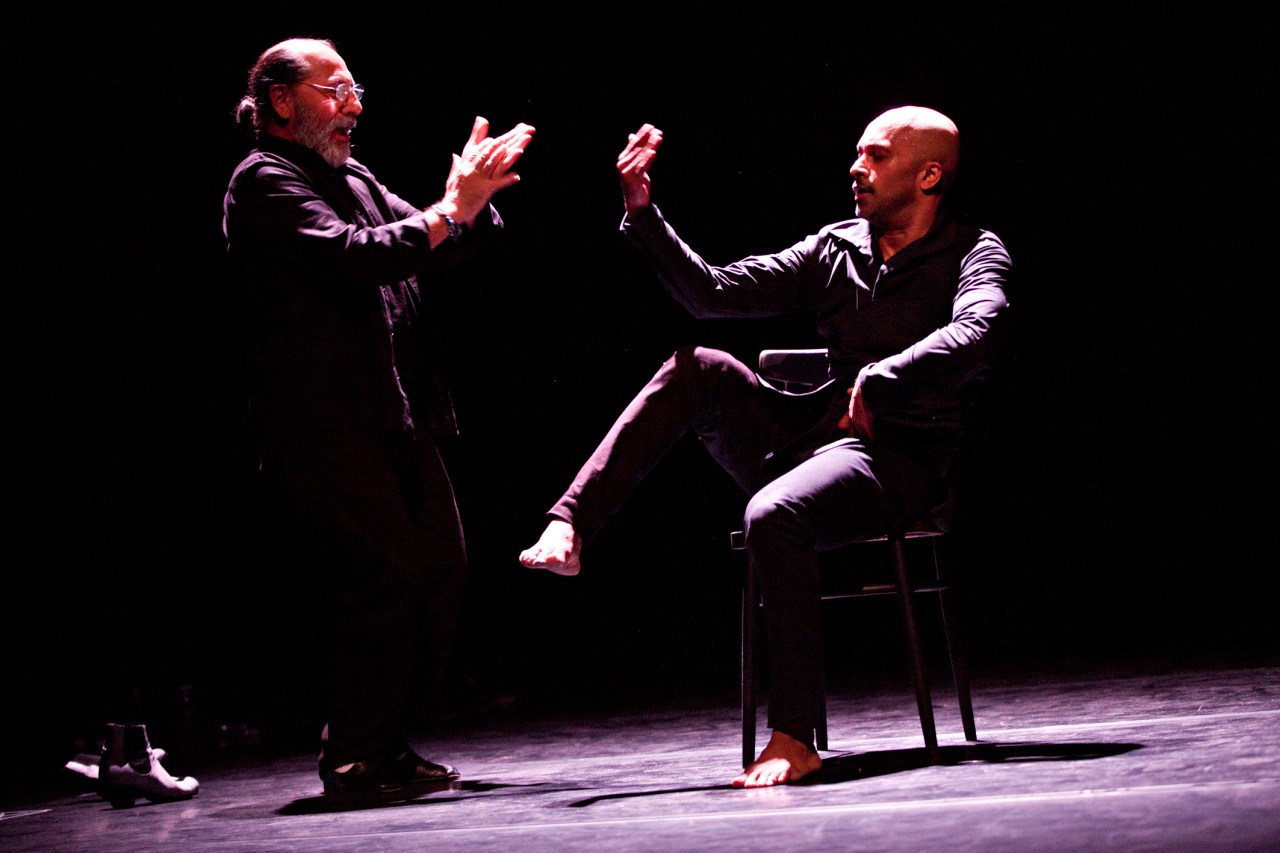
Reformatting the duet involves improvisation and has prompted some playfulness. Returning to the stage on bent knees, Kahn wears Galván’s white flamenco shoes on his hands tapping out the rhythms to build to a crescendo. The singers’ interactions at times invoke the chatter of the spectators at a bull fight and at others they seem like birds in call and response.

The most impressive aspect of Toro is Kahn’s embodiment of flamenco and kathak in the complex, high-energy choreography. It is hard to separate the dancer from the dance.

Most frustrating, for those to whom Sanskrit and Spanish are a mystery, is the impossibility of understanding the storytelling that is so basic to these dance forms. Toro makes a wonderful platform for Kahn, a dazzling and precisely expressive dancer, but doesn’t quite coalesce into a unified piece.

Photo of Bobote and Akram Khan by Jean-Louis Fernandez

The uplifting art of Alvin Ailey dance

Alvin Ailey American Dance Theater

Sony Centre, Toronto

March 4 and 5, 2016

The standing ovations began after the first number on Friday’s opening show of the Alvin Ailey American Dance Theater.  It was “Toccata,” an excerpt from Talley Beatty’s Come and Get the Beauty of It Hot, first performed in 1964 by Ailey’s then fledgling company.

The dance for 16 men and women affirmed at once the continuity of the Ailey tradition and the injection of new vigor and talent that came with the 2011 appointment of long-time Ailey choreographer Robert Battle as artistic director.

“Toccata” is an occasion to show off the classic lines and the high-energy amalgam of ballet, modern and jazz dance as the dancers, costumed in white sleeveless tops, swept the stage in rows or pairs or trios to the music of Dizzie Gillespie. That little insouciant kick that sets a pivot in motion or the wag of a hand in the midst of a long, fluid arm extension are elements of the sassiness that accompanies the Ailey form. These dancers, young and new as well veterans of the company, were like the melodic line to a drum solo in the midst of the piece.

Yannick Lebrun’s achingly expressive solo in Ailey’s Love Songs from 1972 similarly brought to the fore the highly versatile, athletic nature of the Ailey-trained dancer. Lebrun performed the songs, in descending order of sadness, from “A Song for You” to “He Ain’t Heavy He’s My Brother” to Nina Simone singing “Poppies,” as if they were written in his bones.

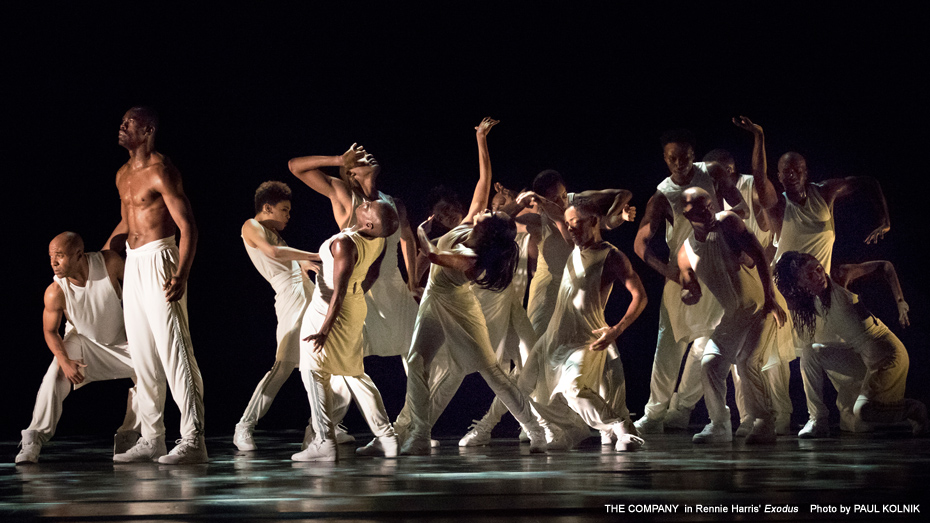
Without doubt the biggest impact of the evening came from Exodus, a 2015 hip-hop based piece for 16 dancers choreographed by Puremovement originator Rennie Harris. This extraordinary work set to sounds and music composed by Raphael Xavier, follows in a line of African American expression that began with Alvin Ailey’s 1960 dance Revelations (performed Saturday at 2 pm), which was set to spirituals and gospel music.

A giant of a Moses-like figure, Jeroboam Bozeman could be said to be the lead dancer, in a crowd of fleet-footed dancers that seemed to multiply before our eyes. Clearly aligned to the politics of Black Lives Matter, Exodus is a transformative celebration of spirit and solidarity. Dressed in street clothes and brightly coloured running shoes at the outset, the troupe somehow rearranged itself as a kind of chorus in white tunics and formed a united force near the end, when a gunshot rings out. But hope rather than defeat was the takeaway.

Even more than his distinguished predecessor Judith Jamison, Robert Battle has brought a range of dance creators under the Ailey umbrella. The closing dance, Open Door, was choreographed by Ronald K. Brown, artistic director of Evidence. This piece displays the breadth of abilities in the company and was performed by 10 dancers including veterans Linda Celeste Sims, Matthew Rushing and Glenn Allen Sims. The women wear long dresses, all the better to display their quick shifts from something African-based, leading with the elbows  and buttocks, to Graham-esque modern to partnering their men in salsa steps — in a seamless flow of the joy that is dance at its best.

Photo of Exodus by Paul Kolnik

A high-energy sporting success

Sporting Life

By Julia Sasso

DanceWorks DW214 Julia Sasso Dances

Harbourfront Centre Theatre, Toronto

March 3 to 5, 2016


It is an all too rare occasion when a piece of contemporary dance gets revived. Months of workshopping, fundraising, rehearsing and grant writing go into a production; it gets three or four performances and poof! – the show is truly over.

Taking her title from a British term for gambling, Julia Sasso made her first full-length dance for presentation by DanceWorks in 1997. Energetic, menacing, dramatic, Sporting Life makes a welcome return in the current Harbourfront season.

It is a show of many moods, original movement and striking imagery: a frame upon which several narratives could hang. From the bursting entry of five dancers in men’s suits, the clatter of their oxfords on hard floor providing percussion, we sense imminent violence.

This is a dance that calls for terrifically skilled performers and character actors. Timing must be impeccable, their faces working as hard as their feet, their body slams demanding the resilience of a wrestler. Sporting Life recalls the great years of Serge Bennathan’s Dancemakers, when Sasso was both performer and choreographer.

Rushing and leaping, throwing themselves to the floor to rise up again like puppets on strings, the dancers are gradually revealed as individuals. It’s a few minutes before we realize one of them is a woman: Jesse Dell.  Sporting Life is patterned into a fearful symmetry. Over the hour the dancers separate and combine in trios and duets, gaining identity with each shifting scene. Matthew Cuff wears a jacket with a plaid weave;  Mateo Galindo Torres, Irvin Chow and Daniel McArthur with his shaved head have a similar gangsta mien. All five shed sportsjackets to reveal vivid shirts and ties, bringing to mind the colour-coded thugs in Quentin Tarantino’s Reservoir Dogs.

Eric Cadesky’s soundscape and musical composition drive the production. From a heavy electronic dissonance, to train sounds to siren-like violins to a moody saxophone, or a Johnny Mathis ballad, the music shifts as violently as the hard-driving choreography. In an especially affecting moment, two fallen dancers make a tom-tom beat with one of their shoes tapping the floor like sticks in the hands of a drummer.

Gabriel Cropley’s lighting design creates the settings on a bare stage: a cone of light with criss-crossed bars suggests a prison setting, a splatter of blue hexagons on the floor a ballroom.

The quick scene changes evoke still relevant themes: crime and punishment, torture, bullying, gender-bending, playing at dangerous games that could end in death.

Dressing and undressing becomes the motif for a lot of shape-shifting. Having stripped down to their skivvies (Dell’s hands over her breasts), they re-dress, re-combine and then in a momentary lull in the action put on black evening dresses, preening and applying lipstick in a line before imaginary mirrors.

This dramatic shift ushers in tenderness and celebration. Light shines on a final, poignant grasp of an unseen hand before Torres exits, parting from his companions in a heap on the floor.

It’s a winning gamble for Danceworks and Sasso, who leaves nothing on the table in this brilliant revival.


Photos by Aria Evans

Dancing the diaspora

Footsteps across Canada

Presented by Dance Immersion

Harbourfront Centre Theatre, Toronto

February 26 and 27, 2016


Geographically and stylistically, the six dances in the Dance Immersion concert embraced a wide African diaspora. Taken together they made a strong connection to Mother Africa and in several cases referred to a struggle for equality that goes on in the new world.

Montrealer Rhodnie Désir, accompanied live by percussionist Ronald Nazaire, performed BOW’T, a work that uses the imagery of a perilous journey across the ocean to express the longing for the homeland and the yearning for freedom. Désir’s strong West African-influenced choreography made her message clear.

A video projection of a seashore with rolling waves established a similar theme in Liliona Quarmyne’s Tide. The Nova Scotia performer danced to the music of Amadou and Mariam and manipulated a long white cloth to reveal a narrative of celebration and imprisonment, joy and concealment. A dancer whose face is covered is dehumanized and that seemed to be the point of what Quarmyne was saying about the historic African experience.

Two to see, four to reason is a quartet created by Rodney Diverlus, a Haitian-born dancer now based in Calgary.  Dressed down in big t-shirts and tight pants, Natasha Korney, Carina Olivera, Edgar Reyes and Diverlus had at each other, talking, shouting, pushing and gesticulating to music that included the blues of Bessie Smith and the big band sound of Benny Goodman. The dancers are all exuberant movers and the piece nicely bridged the divide between social and concert dance.

A solo by Toronto dancer Mafa Makhubalo, Songs of the Soil, was performed against a backdrop screening clips of South African students protesting high tuition and excerpts of an interview with South African martyr Steve Biko. There was something about a healing ceremony and Makhubalo’s submersion in the water contained in a galvanized steel tub certainly referred to cleansing. But his vigorous dancing could have meant anything, really.

Percy Anane-Dwumfour and Lauren Lyn, Daniel Gomez were dressed in white with appliqués of brightly coloured Ghanaian fabric. Anane-Dwumfour spoke a lot about the struggles of a man who finds after moving to Canada that he no longer feels at home in Africa or his new country. This piece, choreographed by Esie Mensah, could have been more effective without the speechifying.

Mikhail Morris, a Jamaican-born Toronto dancer, made a scary figure in long braids and a black mask over his face. With his features mostly obscured, he performed his solo Dichotomy, again underscoring the dilemma of the immigrant of African origin. What face are you proud to present to the world?

Photo: Liliona Quarmyne in Tide